
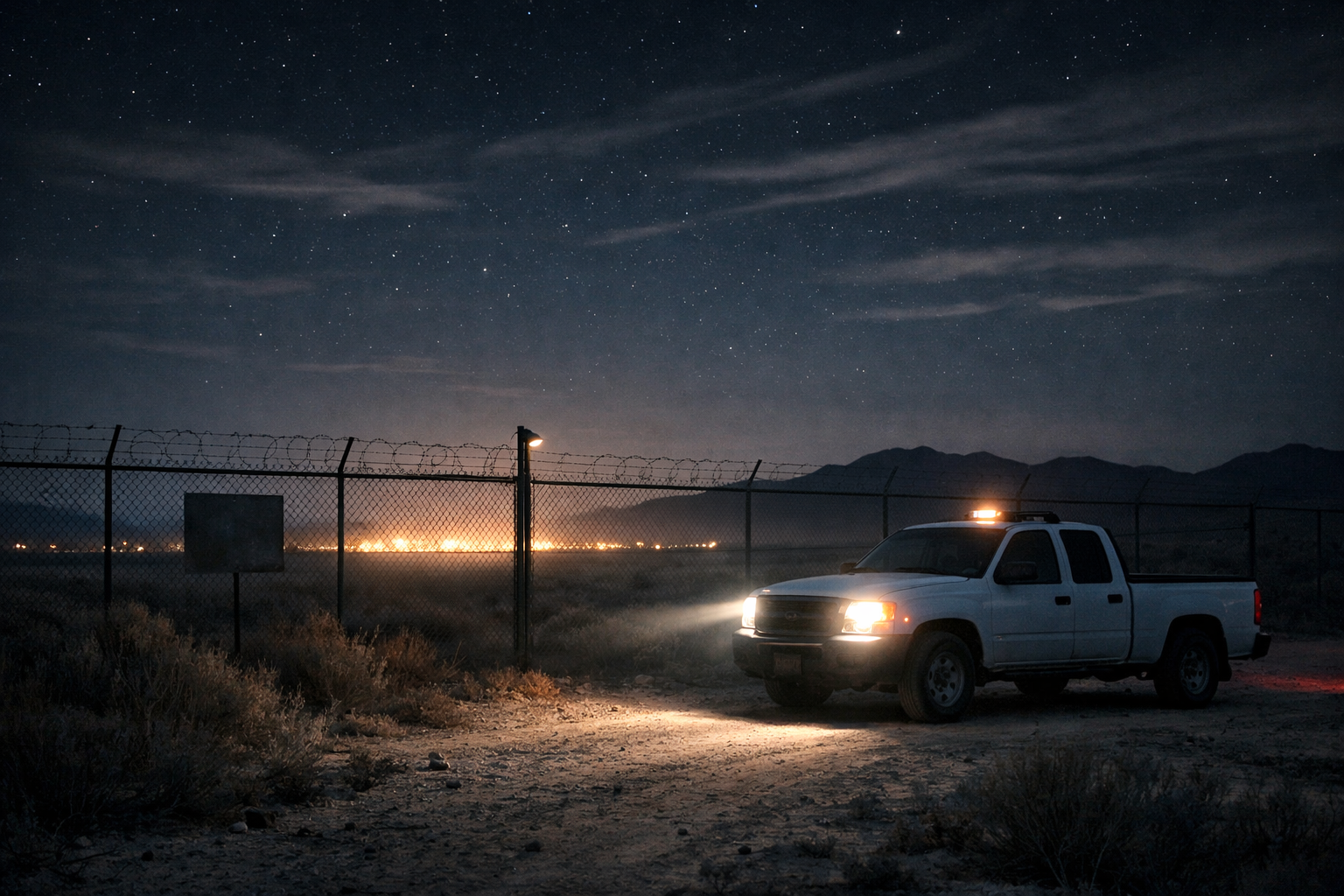
Area 51: Secret Base, UFO Mythology, and Government Silence
Midnight Lights Over Area 51
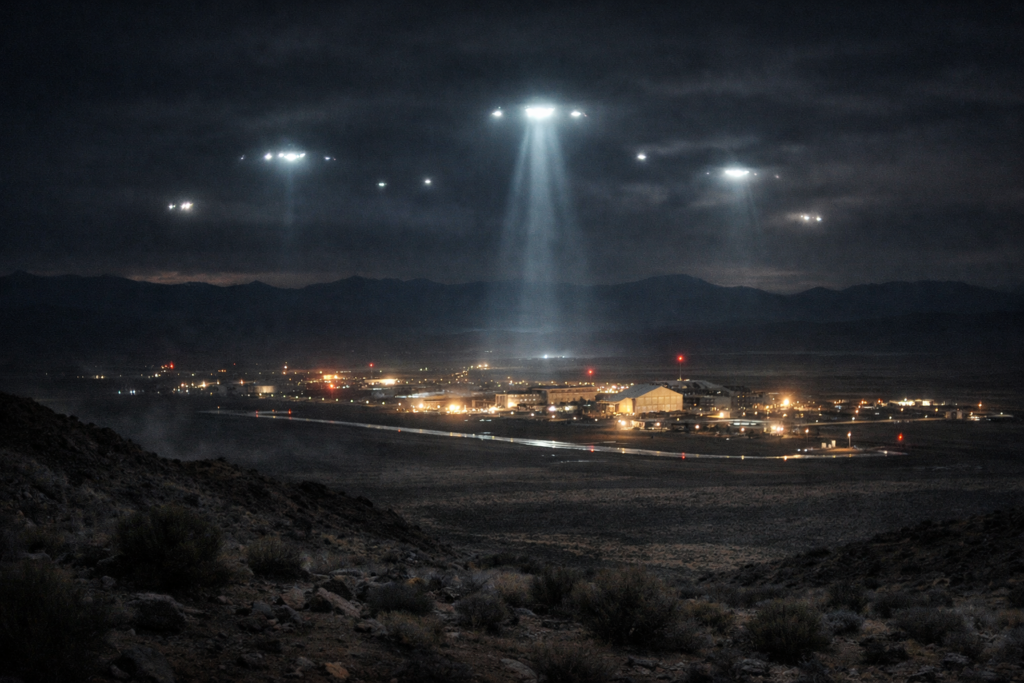
From the ridgelines north of Groom Lake, where wind scrapes the desert and the night sky is a hard enamel of stars, the silence is often broken by a distant roar and a sudden geometry of light. It is here, at Area 51, that curiosity hardens into conviction for some observers: a hidden runway glows, a craft maneuvers in ways that seem to deny familiar aerodynamics, and a generation of stories springs back to life. The setting itself—a dry lakebed ringed by mountains and guarded by the fiercest perimeter in the American West—feels purpose-built to feed the modern mythology of secret machines and stranger origins.
That mythology never really recedes. It returns in cycles—on late-night radio programs, in newly declassified documents, in the uneasy laughter of travelers who pull over on Highway 375 to take photographs of the warning signs. The central claim persists: within this restricted installation, the United States has hidden not only revolutionary aircraft but also, perhaps, technology not conceived on Earth. Alien hardware, reverse-engineered propulsion, recovered debris—these ideas refuse to vanish.
Understanding why requires peeling back the overlapping layers of reality and rumor. There is a real test center here, with a documented role in shaping American airpower. There is also a decades-long record of silence, euphemism, and strategic misdirection. Between those two truths, entire subcultures have built a canon of belief.
Origins of Area 51
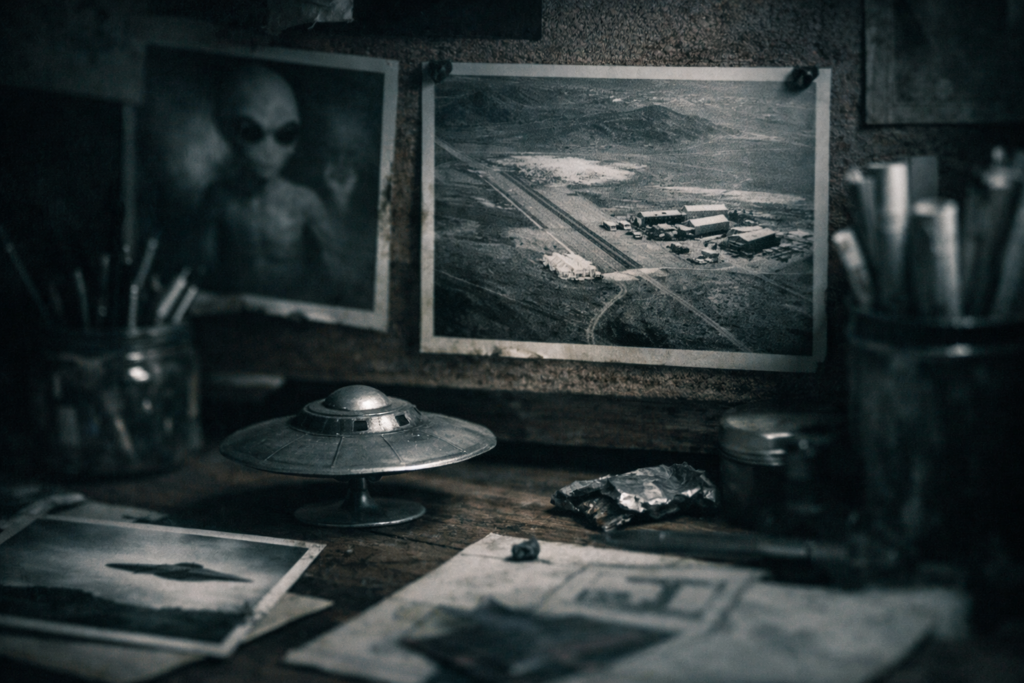
In the 1950s, as the Cold War demanded new eyes over hostile territory, the desert north of Las Vegas offered a near-perfect laboratory. A dry, immense lakebed. Vast airspace folded into larger restricted ranges. Distance from population centers, yet close to the aerospace and defense plants of Southern California. Into this geography came the U-2 reconnaissance aircraft and later, even faster and more secretive machines under the banners of programs we now know: OXCART and the lineage that produced the SR-71 and stealth platforms.
The facility developed under a cloak that was, at first, simply practical. Radar signatures, high-altitude envelopes, exotic materials—the physics of these programs required privacy. Over time, secrecy evolved from operational need into a culture. The base’s name was used sparingly and obliquely, replaced by coordinates, codewords, and innocuous phrases. The site became a place known everywhere and acknowledged almost nowhere—until declassification decades later conceded what the desert had always known.
What Area 51 Is Alleged to Hide
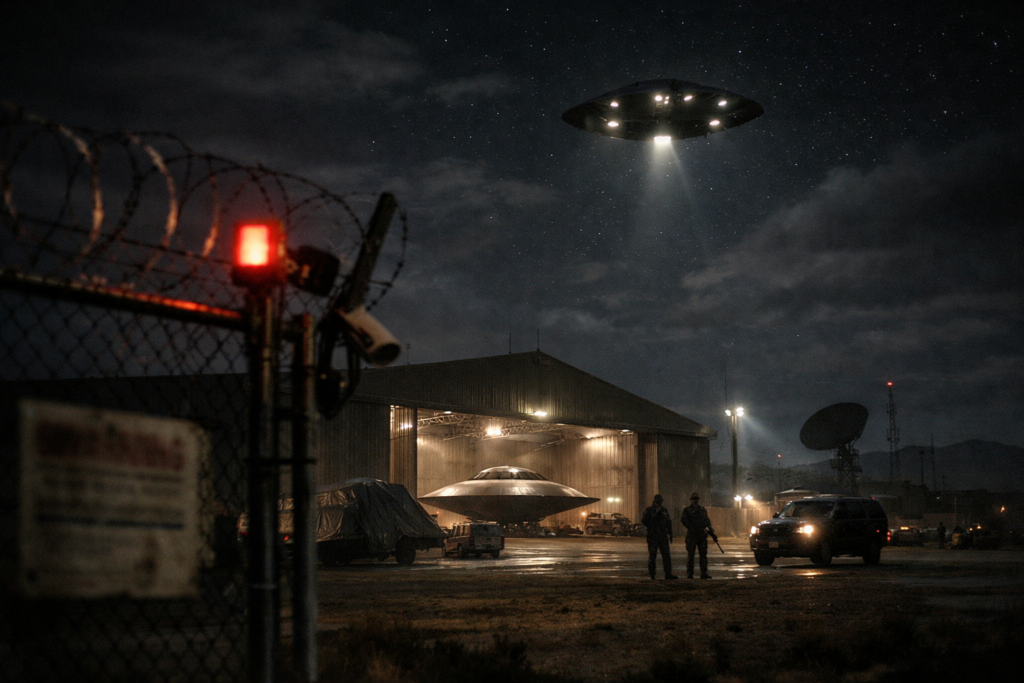
Within popular culture, the list of alleged activities in the high desert has grown dense. The most persistent thread ties the place to the crashes and controversies of New Mexico in 1947. In this telling, debris from an otherworldly mishap—secured and spirited away—arrived in Nevada for study and replication. Another prominent strand dates to the late 1980s, when a technician came forward claiming employment at a nearby sub-facility and described craft of nonhuman origin, fueled by an exotic element and capable of astonishing maneuvers.
From those seeds proliferated a host of satellite ideas: particle-beam weapons, gravity-nullifying engines, and flight tests conducted against the black canvas of the Nevada night. Enthusiasts point to alleged insider testimony, to sketches and hand-drawn layouts that circulate in books and on forums, and to the fact that official channels have historically answered such claims with minimal comment.
Figures, Files, and Area 51’s Paper Trail

Despite the lore, a concrete historical record exists—though it reflects aircraft, not extraterrestrials. Declassified documents released in the 2010s provided detailed timelines of reconnaissance and high-speed programs conducted from Groom Lake, and they confirmed what aviation historians suspected: that crucial chapters of American aerospace unfolded here. Memos, project overviews, and test logs describe long sorties, titanium metallurgy, and stealth shaping long before these technologies were widely acknowledged.
There are also glimpses of the legal and political efforts to maintain secrecy. Presidential determinations in the mid-1990s exempted the installation from certain environmental disclosures, citing national security. Freedom of Information requests yielded maps with careful redactions and references to logistic arrangements, including commuter flights operating under an innocuous airline code out of Las Vegas. Satellite images visible to anyone today, paired with historical aerials, show the airfield’s growth: longer runways, new hangars, and a web of roads cut into the playa.
In the wider narrative, a handful of personalities loom large—engineers and contractors who speak cautiously about tests they supervised, or, more controversially, claim to have handled technologies beyond standard aerospace. Some stories never waver, while others buckle under scrutiny of resumes and records. The result is a layered cast: verified veterans of black projects, skilled storytellers, and a surrounding chorus eager to connect disparate dots into one coherent picture.
Evidence and Alleged Evidence at Area 51

Hard evidence in the extraordinary sense—the kind that would irrefutably demonstrate nonhuman craft—remains conspicuously absent. What exists is a mix: distant photography of airfields and hangars; telescope footage of bright points executing ambiguous motions; contrails at odd angles; and secondhand accounts from those who say they were closer than any camera could be.
On the terrestrial side, the evidence is solid. Aerospace historians can point to timelines of bleeding-edge tests and to the operational record of aircraft once so secret they were ghost stories. Pilots and ground crews have, over time, spoken plainly about achieving speeds and altitudes that the public did not yet believe were possible. The base’s formidable security apparatus—motion sensors, remote cameras, patrol vehicles with night-vision gear, and a legal boundary that appears on federal registers—underlines the seriousness of what is protected.
Bridging these two categories is a gray zone of ambiguous artifacts: alleged photos of internal layouts, pieces of metal said to be compositionally anomalous, and remote viewers’ sketches preserved in old archives. Some are likely hoaxes or misinterpretations. Others remain unresolved not because they scream the extraordinary, but because their provenance is too thin for a definitive conclusion.
Skeptical Views of Area 51 Mythology

Skeptics offer a straightforward counter-narrative: the legends bloomed from secrecy surrounding very real, very advanced human technology. High-altitude spy planes caught sunlight with unfamiliar brilliance. New shapes on radar confounded trained observers. Strange sonic signatures and shock waves were the auditory calling cards of unannounced speed regimes. In this view, people saw something genuinely new; they simply misattributed its origin.
They also note that extraordinary claims must meet an extraordinary bar of evidence. Freedom of Information releases have richly documented classified aircraft programs and the bureaucratic machinery that kept them quiet, while providing nothing verifiable that points to materials or craft from elsewhere. The distance between “unknown” and “nonhuman” is vast, skeptics say, and the first term does not logically lead to the second.
Why the Area 51 Story Endures
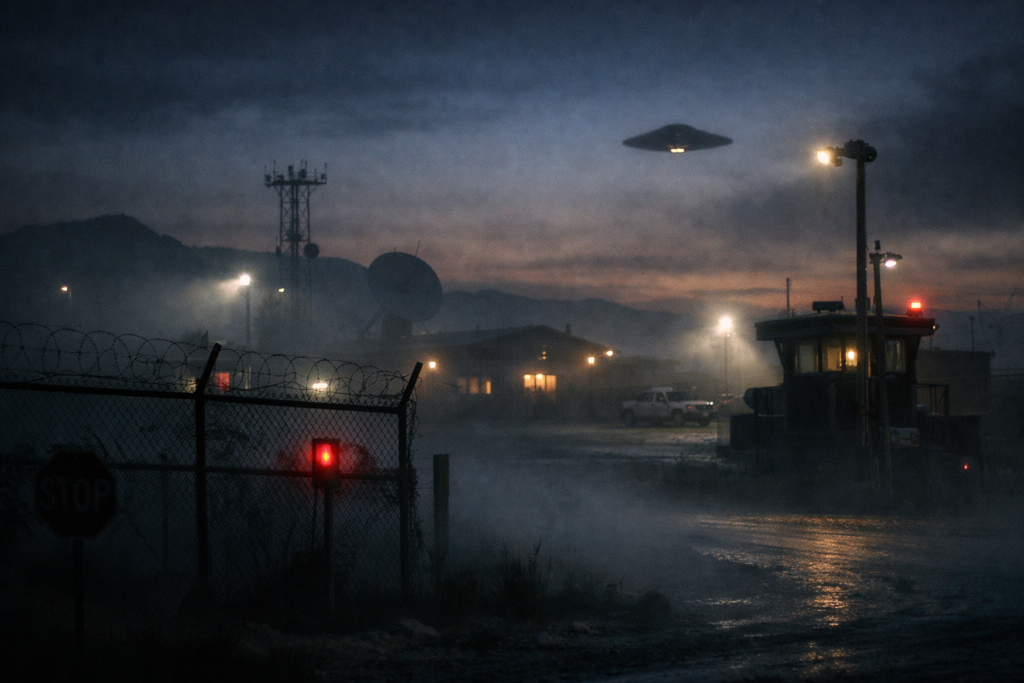
A perfect storm sustains the legend. First, the location itself: remote yet oddly accessible to public gaze from certain mountainsides, a mirage of knowable unknowability. Second, the drip of declassifications over time, each confirming pieces of a larger hidden history but rarely addressing the loudest rumors. Third, a culture complex—movies, television, podcasts, and roadside attractions—that has turned the Nevada desert into a stage set where America plays out its anxieties about secrecy and power.
Trust, too, is part of the equation. When agencies deny the existence of something for years and later concede it, even for prosaic reasons, a residue of doubt remains. Each revelation about reconnaissance and stealth programs confirms that the unimaginable can be real. The leap from “unknown aircraft” to “alien technology” may be unwarranted, but it is easy to understand how it happens.
Daily Paranormal Analysis
This story became popular because it sits at the crossroads of legitimate mystery and national mythmaking. The Cold War’s hunger for advantage produced quiet breakthroughs that had to stay silent. That operational silence created an information vacuum the public filled with the language of the fantastic. As with other secret installations and projects, the mix of visible infrastructure and invisible purpose proved endlessly generative: a runway here, a new hangar there, and yet no public briefings, no ribbon cuttings, no plaques on the wall.
Believers find the tale compelling for specific reasons. They see the pattern of partial truths: an installation denied, then acknowledged; aircraft that sound like science fiction, then surface decades later in history books; personalities who claim access to unusual machines and offer technical details that seem, at least superficially, coherent. Add to this the gravitational pull of earlier incidents in New Mexico and the lore of reverse engineering, and the constellation snaps into a recognizable shape.
Skeptics doubt it for reasons that are equally concrete. They point to the robust timelines of reconnaissance and stealth, to documented test regimens that explain many luminous oddities in the Nevada skies. They highlight the absence of vetted, chain-of-custody materials or reproducible data. Where technical assertions about propulsion meet known physics, the holes widen: power densities that defy available energy sources, control surfaces that can’t be reconciled with stable flight, or elements whose alleged properties diverge from peer-reviewed reality.
Connections to similar cases abound. Stories of underground labs and alien hardware echo in tales of other remote ranges and test sites. The pattern extends into claims about clandestine exchange programs and secret treaties—in short, a larger tapestry of government-withheld contact. Meanwhile, the official movement toward broader studies of unidentified aerial phenomena, and the periodic release of cockpit videos that show puzzling encounters, keep public attention primed, even if those cases point elsewhere and lack a paper trail back to the Nevada desert.
Does the mystery remain unresolved? Yes—in the sense that the facility’s present projects are classified and will remain so until their strategic value fades. That is an ordinary, not a cosmic, mystery. But for those who suspect the extraordinary, no declassification will likely suffice; the question they want answered is not simply what was built there, but what was brought there.
Conclusion
Strip away the romance and the myths, and a clear foundation remains: a restricted installation shaped the arc of aviation, conducting tests that demanded silence. Upon that bedrock, a parallel narrative rose and thrived, one that transmuted secrecy into speculation and then into folklore. The two stories are now inseparable. To talk about the airfield is to talk about the legends, and to examine the legends is to be reminded of how much we still don’t know about the machinery of secrecy itself.
Perhaps that is the enduring lesson of the Nevada desert. In wide places where official words are few, every light in the sky becomes a question. Some are answered, years later, when a black project turns gray and then public. Others flicker on the horizon and fade, refusing explanation. Between them stretches a runway of possibility that keeps researchers, skeptics, and night watchmen returning to the same ridges, listening for the next distant engine.


