The Man Who Would Only Speak Off Camera
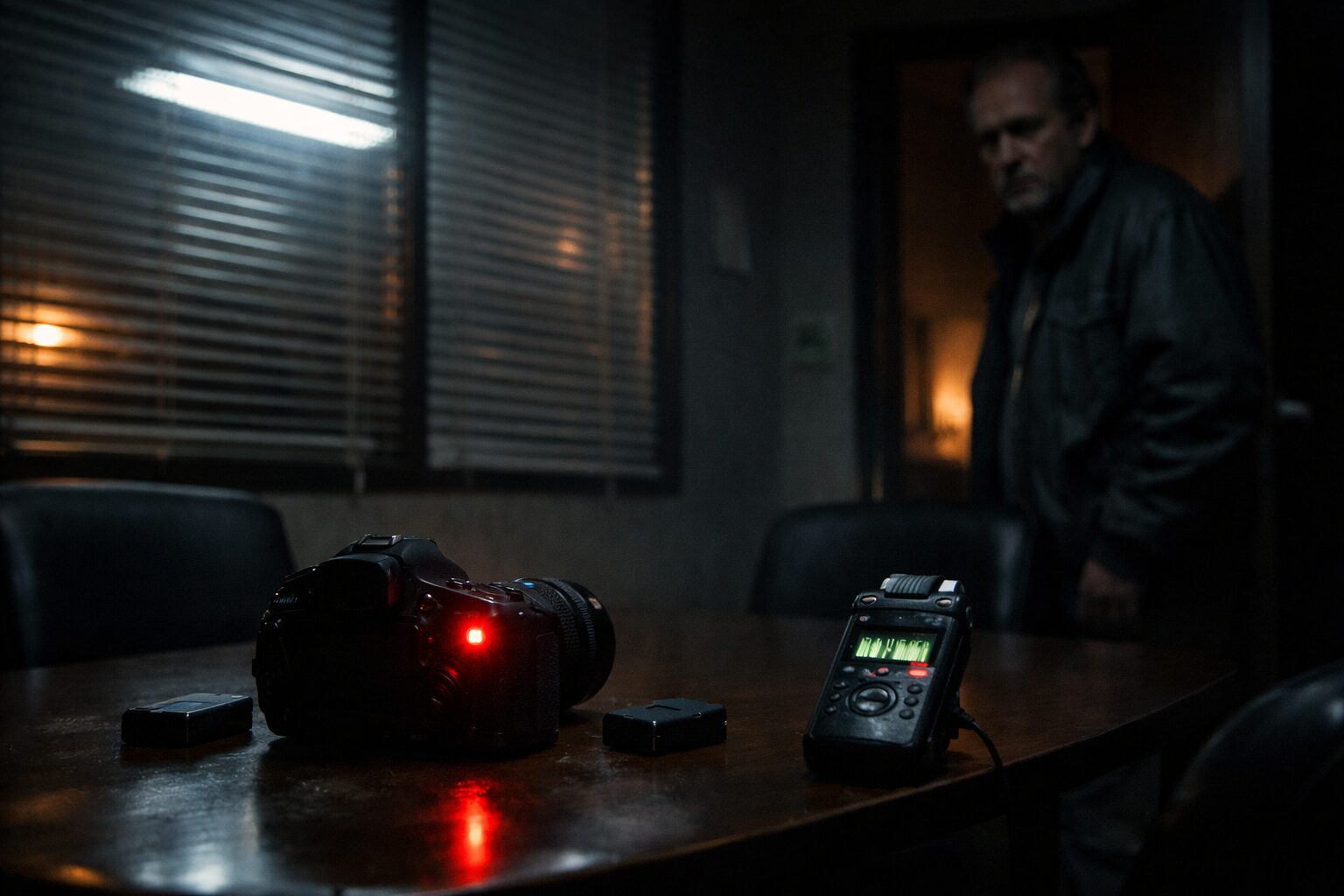
The building was the kind that sleeps with its eyes half open—fluorescents left on under mandate, automatic thermostats humming to an audience of exit signs. After hours, the carpeted corridors swallowed every step and gave back the faintest rustle of their own breath. The security guard had buzzed us in and, at my request, turned the deadbolt behind us with a metallic certainty I could feel in my teeth. We chose the smallest conference room, the one with a long laminate table and a view of the dark parking lot, blind slats tilted to show only a ribbon of those orange sodium lights.
He had already been waiting when I arrived, jacket zipped to the throat though the office ran warm at night. He was in his fifties, maybe, the kind of man who seems to take up as little space as possible. His hands never rested in one place for long: fingers on the paper cup I’d left with vending-machine coffee, then his watchband, then the seam of the chair. He was not jittering for show. The nervousness had a specific gravity to it—I recognized the type. I introduced myself and didn’t offer a hand. He let out a breath and nodded as if I’d passed a test.
“We’re alone?” he asked, not looking at the security camera bubble eye in the ceiling corner.
“We’re alone,” I said. “He’s in the lobby. I asked him to keep the line closed.” I pointed at the door. “Deadbolt’s on. No one else has a key.”
I set my kit out because ritual can calm everybody: camera on a small tripod, lens cap on, the handheld field recorder flat on the table, my notebook open, a pen that didn’t scratch. He watched me do all of it and then showed me his open palms, a tiny gesture that made my throat feel tight. “I’ll talk,” he said, “but not if that’s on.” He meant the camera. The request had been in his messages, but hearing it in that room, with the vent coughing and the building stretching, made it feel like the first wrong detail of the night.
“No problem,” I said, and took my time proving it. I turned the camera so the lens faced the whiteboard, flipped the power button. I even slid the battery out and put it on the table where he could see it, a black rectangle between us. He didn’t relax exactly, but some tight wire in him stopped vibrating. He pointed to my phone. I switched it off and placed it screen-down under a yellow Post-it, a childish bit of theater we both accepted. The recorder I left on. “Audio only,” I said, touching the red button without pressing it. “You can see the light if we’re rolling.”
He nodded once, a little disgusted with himself for needing the promise. “I don’t care about my voice,” he said. His own startled him when he heard it in the quiet room.
For a while, he was a man telling his employment history under fluorescent hum. He said the company name without saying it; I recognized the abbreviation anyway. He had been a subcontractor, electrical, working on a series of upgrades at a place out past the state road where the scrub opens up and then is suddenly all fence. He didn’t name the place either. He didn’t need to. Triple coils of wire meant to snag a man and hold him by his clothes. Signs every ten feet with that federal code on them. No cameras. No phones. No excuses. “It’s just a job till it isn’t,” he said. His jaw worked, and he looked past me at the blind slats and their scraped light. “We’re there at night because that’s when they let us in. Less traffic, they say.”
I hit record, and the little red LED came on obediently. The levels showed soft tremors from the air conditioner, then rose and fell with my quiet prompts. He watched the light once and then kept his eyes on the table. “There’s a floodlight on the northeast quadrant that makes a sound. Not the transformers, not the ballast. This other sound, like… a person whispering in a ventilator. You don’t hear the words until you go under it.” He stopped. The recorder screen went flat-line for a second, levels zeroing, though the light stayed red. I tapped the case without thinking. He kept talking, but I saw the counter on the recorder hang at 00:07, then 00:08 stutter, then jump to 00:10 like something had tried to erase the part where his voice made sense.
“Hold on,” I said, too casually, and stopped it. The file saved itself with a cheerful chirp that sounded out of place. I played back the last ten seconds. Where his “floodlight” had been, there was the thinnest electrical chew, like cloth dragged over a comb. The last word of his last sentence had a thumbnail of itself in place of the word. He looked at the device as if it had blinked at us.
“It’s fine,” I lied. I popped a fresh SD card in anyway, a reflex. He clenched his jaw and went on because there was something ugly in him that needed to be let out or it would rot him from the inside. “We were running fiber in conduit along the inner perimeter. There’s a run that passes under a service culvert. When you put your hand on the line, you can feel it hum when they’re doing their thing. This night, the line was humming when nobody was supposed to be doing anything. The guy with me—he puts his ear to the PVC and laughs, like he’s hearing music through the wall. Then he stops. He looks at me and he’s gone white. He says,” the man paused, chin dropping as he reached for the words as if they were at his feet. “He says it’s my name he’s hearing. He says it’s my voice calling from the other end.”
On the second fresh card, the recorder’s timecode did something I’ve only ever seen when files corrupt—froze to 00:00 for three counts, hiccupped, and then obediently pretended it had been rolling all along. The red LED didn’t flicker. The levels didn’t move. His mouth did. He was telling me something he’d never told anyone and to the machine it was as if a mouth were opening and closing under water, bubbles instead of syllables.
I switched power off and back on, the universal cure. The file icon blinked, made a little coffin for the previous clip that was somehow still only a minute three even though I could swear we’d been talking longer. “We can go without,” I told him, tapping the notebook. “I can take this all down.”
“You won’t get it right,” he said without apology. “No one does.” He nodded to the recorder. “Try once more. I’ll be quick.” He meant: I’ll spit it out before it realizes.
When he began again, he did not ease into it. “He puts his ear to the conduit and hears me call his name. But it’s not me. It knows he’ll tell me what he heard. We get out from under the light. The whisper keeps going if you stand in the dark. It says go back. It says don’t look. Then one of the radomes—it’s black for a beat like a blink. The lights don’t do that. They don’t blink. The guard comes over and says we’re done for the night. He’s not looking at us. He’s looking at the places we aren’t.”
As he spoke, the recorder’s meter bars waked and then lay down like grass under a slow wind. The headphone jack gave me nothing but a microsecond of hiss again and again, gaps on gaps. I felt the animal brain part of me decide the room had shrunk a foot. The after-hours quiet of the office was no longer half-sleeping; it was listening.
“It followed us to the truck,” he said. “It rode in the wires. When you look right at it, it steps aside and you see only your own looking. You understand?”
I didn’t. I wanted to ask about what “it” was, and how a thing can ride in conduit, and what he meant by the radome blink. I didn’t say any of that because the camera on the table, battery out, lens facing the whiteboard, made a low, almost contrite whir. The focus motor rolled itself through a range and stopped. The screen lit with its dark-blue pre-boot and then a square of grainy conference room, a wide, sallow shot of us from where we hadn’t put the lens. The red tally light came on by itself for a blink—on, off, on. I could see my own hands on the table in that first flat image it gave me, my fingers an unflattering color. I could see his hands too, stopping their moving for the first time all night.
He fell silent so hard it made the cheap chairs vibrate. Nothing in his face changed except his eyes, which went matte. It was like watching a deer decide it is already inside a beam of light and everything after that is instinct. The word he’d just started to form—“under”—sealed up in his mouth and never came back out. I reached for the camera as if it were a too-warm cup of coffee. The on/off switch did nothing; my finger found plastic, not a button. The battery I had set on the table was still on the table. The screen showed its pallid shot, and then, for a second, something like static rolled up from the bottom and made the blinds look like water. When it cleared, my chair had moved a half inch toward the table in the frame, though I hadn’t touched it. “It’s not—” I started, sweating in a way I didn’t want him to see.
He pushed his chair back with a long rip of sound on the carpet and stood. “Not on that,” he said, each word separate as teeth. The motion sensor in the corner clicked to tell us it had seen us again, as if it had not stopped seeing us. The fluorescent above our heads shivered and steadied. I pulled the battery door open with my thumbnail and found it empty, then shut the camera with more force than I needed. The screen went black, then two beats later came back to its own reflection with the shutter clack that signals a lens retract where there was no lens to retract. The only red left in the room was the exit sign down the hall.
“I thought it might not like being pinned,” he said, and that was the only time he came near a reason all night. He had already shouldered his coat, his eyes on the door. “I shouldn’t have come. We should go now.” He meant he should go. He couldn’t get his mouth around the idea of me going with him. I slid the deadbolt back. The pressure of the hallway rolled into the room like water finding a notch. He didn’t wait for me in the corridor. He took the stairs. I watched him until the echo of his shoes got lost in the building’s breath.
At the lobby, the guard wasn’t at the desk. A screen saver of a cartoon mountain jumped in place on his monitor, the little peaks forever almost touching the corner and then missing it by a pixel. Through the glass, the lot was a wet painting. The man paused at the doors and, without turning, said, “Erase whatever you can. Don’t take it home.” Then he stepped into the wrapped sound of the rain.
I went back to the small room because I am the sort of person who always goes back in. The chair where he had been sitting was askew. My notebook had a smear where my palm had dragged a word. The recorder lay flat on the table, red light dead, screen a patient gray. I pressed play on the last file and got a minute of room tone so honest it almost rebuilt the room around me. You could hear the lighter note of the thermostat cutting out next to the heavier one of the building’s roof plant. Then the brief jerk of my voice. Then his, a fraction of a syllable. Then the chewing noise that lived where it shouldn’t live. I scrubbed the timeline with my thumb back and forth and caught a glitch’s tail. I put the recorder close to my ear. I hit play again and didn’t move.
Between my question and his not-answer, there was a whisper at a distance of no inches, calmly recorded by a machine that had done its best all night not to receive it. The words were unmistakable, and they were not words he had said aloud in that room. “It knows when it’s being looked at,” the voice said, full of someone’s breath and not his. I went through the other files, the stunted ones, the minutes that felt like more in my bones. In each, somewhere different, the same whisper had threaded itself like a stitch through fabric. I turned down the blinds to see the dark parking lot differently. I shut the camera in the bag and pressed the zipper’s teeth until they hit their stops. I sat until the fluorescent lamp cooled itself a note.
In the office after hours, with nothing running that I could name, the recorder on the table played the last seconds again, as if jerked by a hand. It was a trick of my thumb, a battery burp, I told myself in a voice as persuasive as a child’s. The whisper did not change. It did not add a word or take one back. It reminded me that some things you can only hear if you don’t point a lens at them and others will not forgive you for trying. I stopped the machine and the room deepened with the lack of it. The exit sign, down the hall, hummed brighter.
When I closed the door of the conference room and my own reflection left the small window, the recorder in the bag bulged the zipper against my hand and ticked its screen alive for a moment that didn’t take any battery from the icon. I didn’t play it then. I waited until I was in my car, the rain slapping patient punctuation against the windshield. The lot was a flat mirror of orange light. I hit play because I would always hit play. The same ten seconds. The same hiss. The same gentle, intimate breath in my ear. “It knows when it’s being looked at,” it said, and then again, and then, when I thought maybe I had imagined the first two, again.
It knows when it’s being looked at.
It knows when it’s being looked at.