The Recorder Captured Breathing in the Empty Room
The sounds started the first winter after we moved into the old building — a freight elevator of a place: thick brick, high windows, carpet laid over scarred cement. It wasn’t my house, of course, but after years of late nights at the office, you begin to think of its temperature and moods like a living thing you share space with. The ductwork popped when the heat kicked on. The exit sign hummed like a wet string. When the floors cooled after midnight, they would ease and sigh in a way you felt through your desk more than you heard. That’s what I told myself. A hundred small, ordinary exhalations of an old structure settling into the dark.
But there was one room where it sounded wrong. The glass-walled conference room across from my desk would let out a soft sound after the last train howled, something like a person thinking about speaking and deciding not to. Every time the building went quiet enough for the hum to flatten, there it was: that little gather of air. It was just a room. Even with the lights off you could see everything in it from the hall — the long table, the six tan chairs, the lip of the whiteboard. No drapes, no corners you couldn’t account for. I kept telling myself that if I listened with proof in mind, I could put the idea away and stop thinking about it. The building settles. Glass bends with the night. Stop naming it.
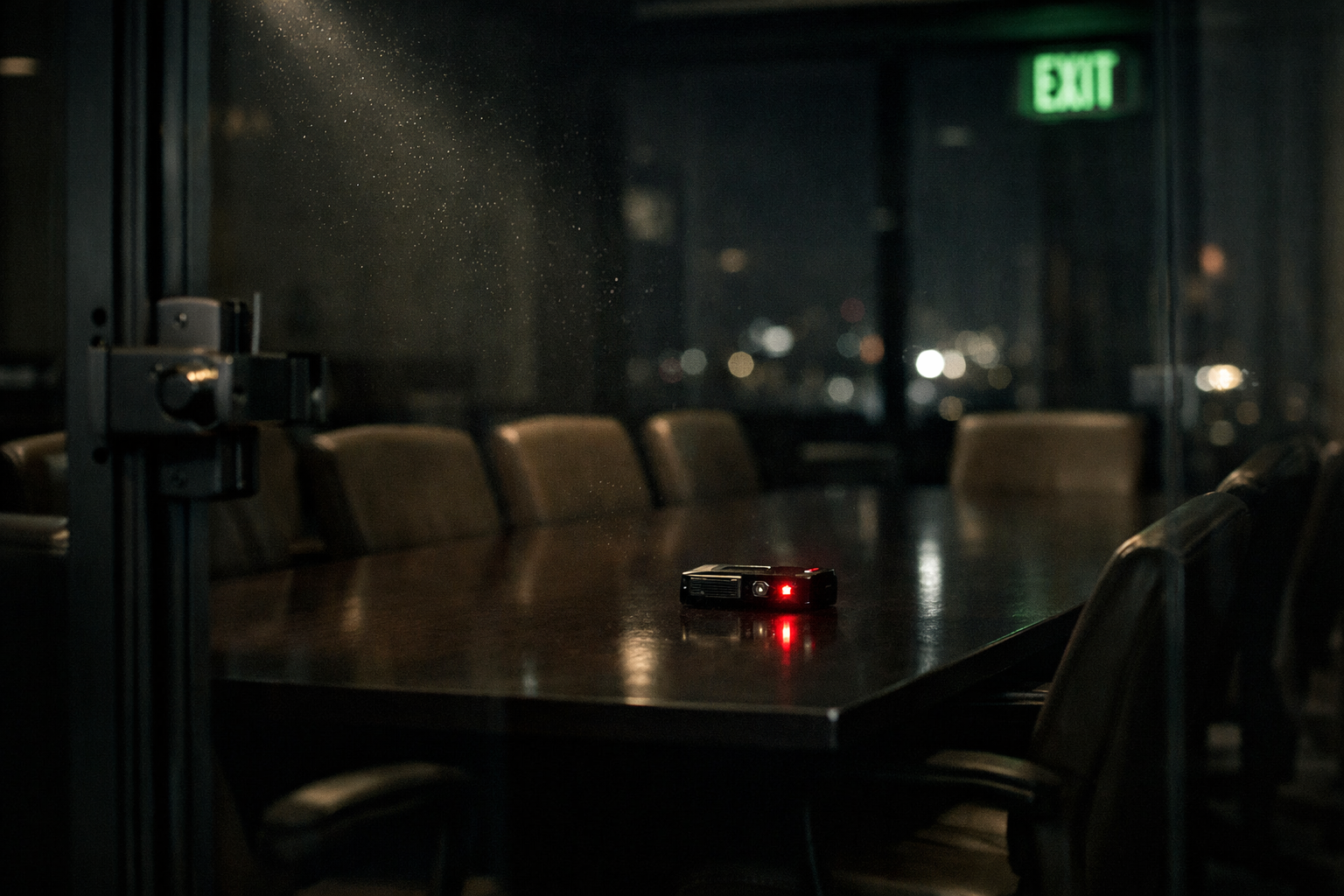
We had a small digital recorder in the IT drawer, the kind used for meeting notes before everyone decided their phones were good enough. Plastic, scuffed, but with a decent microphone and a little red LED. I checked a new battery into it, set it to record continuously, and placed it dead center on the conference table. Even in the dark the recorder was a neat little point of intent, the LED steady as an ember. I checked the windows; they were latched. I turned the dial on the door lock, pulled to test it, and heard the snick of the bolt answer in the frame. I stood outside for a second with my hand on the glass, seeing the blackness inside bubble my pale reflection. I could hear the elevator at the far end of the hall ease into stillness. I told myself, with that precise lie people make when they want to feel grown, that I was doing this to laugh at myself in the morning.
I came in early and made a small ritual of it: coffee into a chipped mug, notebook open, chair angled so I could watch the empty conference room while I listened. The recorder had run all night. I transferred the audio to my computer and scrubbed through hours of the building’s sleep. It was almost soothing at first — the low fan breath of HVAC, the distant metallic gulp when the boiler cycled, a single creak that sounded like a shoe but wasn’t. I was five hours in when I heard it: a soft human inhale, careful, as if not to be heard. Not a draft. A breath. Two, three, almost even as a metronome, airy at the top and weighted at the bottom. The microphone caught a small rhythm that had no business being in a locked room. My back prickled. I checked the timestamps. 2:13 a.m. I looked up at the conference room: empty, plain, a rectangle of gray. I checked the door’s thumb-turn and the sticker stripe the building uses for after-hours audit, still intact over the latch, like no one had gone in or out. It didn’t matter. The tape had what it had, and the worst part was that the breathing didn’t sound far. It sounded like it sat at the table with its elbows tucked in.
That morning, I told myself it had to be an artifact, something the recorder’s own electronics generated, some hiss the brain wants to shape into a person. So I tried to shape it back into nothing. I put the recorder under an inverted glass this time to muffle drafts, set it to run again, and locked up. The second night took longer. The breathing didn’t arrive until 3:05 a.m., after a series of tiny thermal ticks in the duct. But when it came, it came closer, swelling a touch more into the diaphragm of the mic, as if it had turned its head. If you closed your eyes, you could tell the direction — not from the hall side, not near the whiteboard, but from the long window side, a step down the table from the recorder as if someone leaned toward it, then away.
I started to mark down the times and how it sounded, little notes no one would understand in the edge of my planner. Night three, I taped the recorder under the table where the microphone pointed at the carpet. I don’t know why. It felt like cleverness, as if a trick-trick position would flush out a rational cause. It didn’t. The breathing arrived sooner — 1:41 a.m. — and across the course of nine minutes it drew closer, each inhale lifting a little more texture out of the room tone. You could hear the difference in distance when you watched the waveform, but I stopped watching. It was worse to see it become a hill. The conference room remained exactly itself the next morning: marker smell, dust outlined under the chairs, my own reflected face flat in the glass. I pressed my hand to the table where the recorder had rested, waiting to feel some stupid cold.
By then I was coming in even earlier, before the cleaning crew shuffled past with their cart. They were the only other people with access after hours. I asked, casually, if anyone had used the room that week. They shrugged and told me the door stayed locked. The log on the security panel agreed. I don’t know if I asked to hear the answer I was afraid of or the one that would let me go home and sleep. That fourth night I set the recorder again and took the chair by my desk with the lights off. I stayed a while, because I didn’t like the idea of the building being empty and me not even being within it. The office at night is its own geography — the green dot of the exit sign, the vertigo of seeing your reflection float in an interior window, the way the printer wakes and shivers as if remembering it has a body. I sat until the heat clunked back on and the little chill left my nails, then I went home knowing the machine on the table would keep its vigil.
When I listened the next morning, I knew it would be worse. It started the same — the air making that vast room sound, the clicks and contractings that add up to no one. At 2:19 a.m., there was a shift in the noise floor like a person had walked in although no door moved, a thinning of the distance. The breathing began low, patient. After a minute, it found a rhythm and then drifted off it, as if someone distracted pushed the air out without counting. There were tiny pauses that felt like thinking. I sat with one earcup lifted so I could prove the conference room across from me didn’t have a body in it. The wave on the screen went up in small shoulders. The breaths grew louder, tender, not labored. Two minutes passed that way and then three, and then, for a stretch long enough to make the skin of my arms ache, the breathing stopped entirely. The silence wasn’t silent. It had that close, padded sound, like a person was holding their breath beside a microphone.
I don’t know why that was the worst part. I don’t know why the absence carried more weight than the sound. I stared at the glass and listened to nothing pretend to be nothing. I couldn’t make myself touch the mouse. Then it came — one quiet inhale, so close it pushed the little recorder’s mic into a soft wheeze. You could hear the wetness of it, the little lift when the filter took the air. Plastic creaked somewhere in the body of the device like a thumb had pressed too close. I flinched so hard the left earcup slapped my cheek. There was a murmur of clothing in that moment, or perhaps it was the small brush of the recorder against the wood grain of the table, like someone had leaned one knuckle on the edge to look down at it.
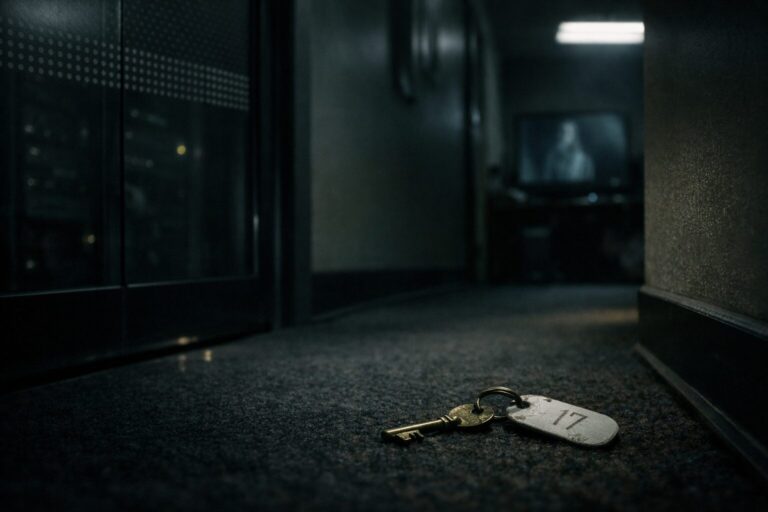
I stopped the file. My mouth tasted like I’d had a mouthful of coins. I didn’t want to hear what came after, in case there was a second inhale even closer in the world I didn’t know how to share with the furniture. I went into the conference room and the room was obediently itself: daylight dulled by high glass, dust motes rising like a private weather in the slat of sun. The recorder sat where I’d left it, a little thing that seemed harmless in daylight and had not been harmless in the dark. I unplugged it from its charger. I took the batteries out, because removing food from a thing feels like starving it. I coiled the USB cable and clicked its little sleeves so they didn’t unspool. Then I locked it in my desk’s bottom drawer under a pile of loose cables and the stapler I never use. It felt ceremonial in the way that makes ceremonies work: do this, put that away, make it stop. I went home and left both keys on the kitchen counter like I could see them sleeping and know the office was empty without me.
In the morning the drawer was still locked. My coffee tasted burned. There was no reason to be afraid in daylight; I told myself that as if I were trying to sell my own mind a service plan. I opened the drawer expecting a stupid relief. The recorder lay there on its back like a turtle, screen blank. The batteries were where I’d left them in a glass ashtray I use for paper clips, their flat ends catching a stripe of sun. I picked up the recorder and pressed the power button on the off chance I had imagined it all and this would be an empty shell. The screen blinked to life, blue-gray, and for a second I saw my own face flattened into its reflection. In the list of files, beneath the names I had made for each night, was one I did not make. Its timestamp was 3:17 a.m. The battery indicator showed empty-red like a tongue biting itself. I hadn’t pressed play yet. I didn’t have to. The file sat there, neat and rectangular, like a window you can look through or not and the view doesn’t care which you decide.