
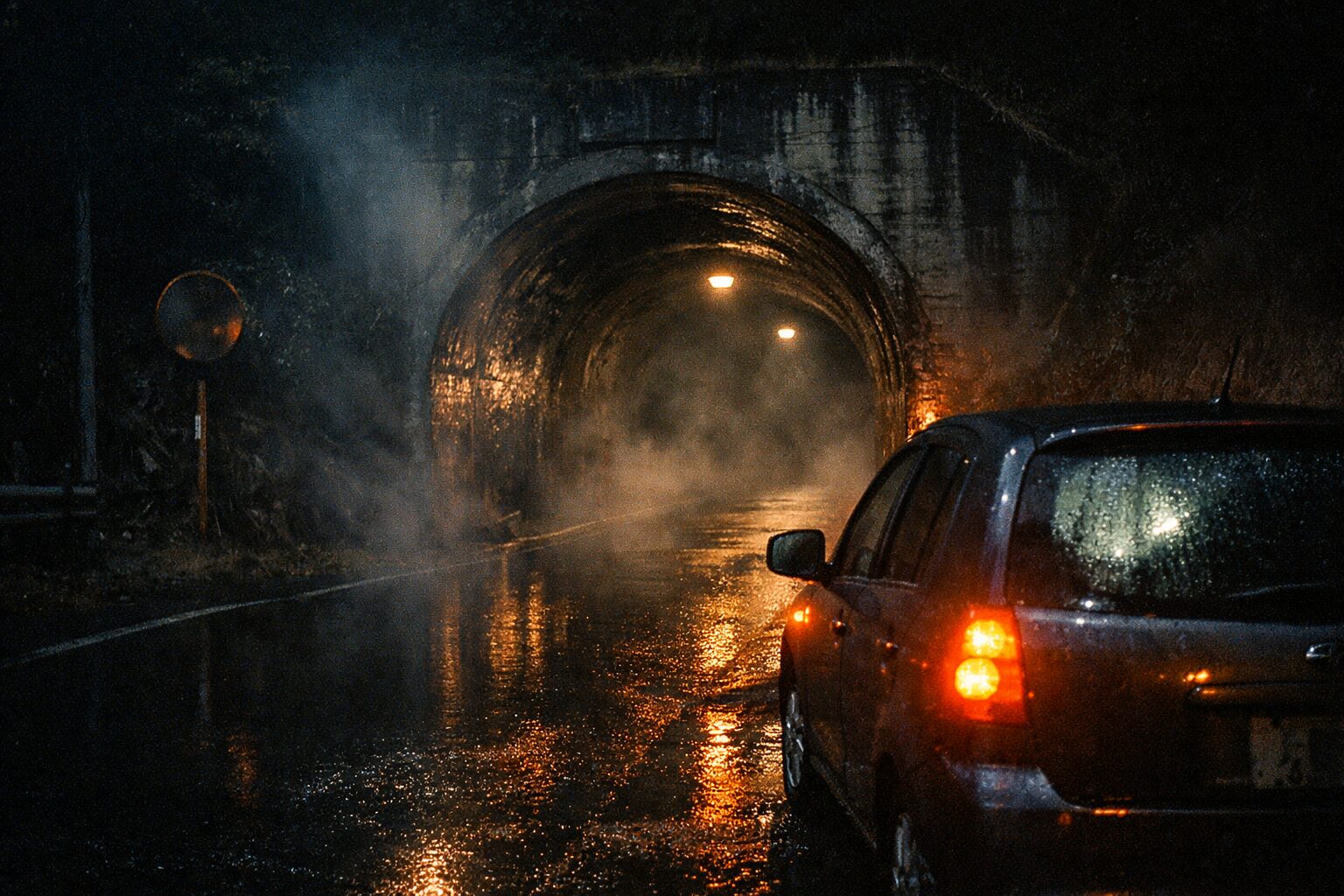
The Tunnel Where Drivers Hear a Child Cry
Where I grew up, the mountains begin almost at the edge of town. A narrow prefectural road cuts up through cedar stands and old stone terraces, crossing a pass where the air smells of iron and wet leaves. Theres an old concrete tunnel up therejust a single bore with a soft curvethe kind of place you can see daylight at the far end if you go at noon. At night, it looks like a drainpipe from the world. People say that after midnight, if you drive through with your windows up, youll hear a child crying. You can stop, you can switch on your hazards, you can call out, but the tunnel stays empty. The sound is not outside, they tell you. Its in the car with you.
Its the kind of thing truckers talk about at the family restaurant down by the river, hands wrapped around coffee mugs gone cold. Students say the same, in hushed voices, laughing at themselves after. There are small offerings at the mouth of the tunnel that make people shake their heads if you ask thema juice box with the straw still in the cellophane once, tiny sneakers tied together and left on the low wall, a tin of hard candy with the lid dented. Someone once took it upon themselves to tie a red bib around the neck of a stone Jiz4that was last winter, when the scarf around its base turned gray with slush. I drove up there plenty of times, daylight and dark, and I never heard anything but the drip of water and the rattle of pebbles under my tires.
That autumn, I took on a job that had me coming home long after the ramen shops had turned off their steam and dragged metal shutters down. It was construction work out by the new logging spur, little more than hauling and errands, but it paid enough to make me ignore what time the dashboard clock showed as I turned toward the pass instead of the toll road. It was a clear night when it happened, though cold. The first breath I blew out hung in the car like ripples on glass before the heater caught up. I watched the digital clock blink 12:41 as the tunnels concrete lip took the glow of my headlights and swallowed it.
At the mouth of the tunnel, I did the things I always did. I rolled the windows up fully, even though they already were. I turned off the radioit was just hiss anyway, this high in the hills. The heater fan kept up its whisper, and the highway rumble through the worn snow tires gave me a steady frame to sit inside. I was already in the shade of the entrance when I heard the first sound. It wasnt an echo and it wasnt the squeal of the suspension. It was something soft and small, one sharp intake and a hiccuping sob that belonged in a narrow bed behind a paper door, not inside a hatchback sliding into a tunnel.
Without thinking, I glanced to my right, then up into the rearview mirror. The rear seat was empty the way Id left it, the seatbelts molding themselves to their little brackets like quiet hands. A bag of screws Id picked up in town lay against the folded blanket, tapping occasionally when I took uneven patches. I tightened my grip on the wheel until the textured rubber pressed little half-moons into my palms. The cry came again, faint, damp at the edges. Inside the car. I know the sound of a voice that carries through glass. This did not carry. It sat down in the middle of the cabin and made itself small.
The tunnel walls flowed past in my periphery, weeping in the wash of the lights. Every join in the concrete, every seam and repair, became a notch I counted without wanting to. The white centerline glared and faded and came again. The crying didnt fill the space. It threaded it. Two notes, a breath, then one more, like the kind of crying that makes you stop and swallow so you wont make more noise than you can bear. I whispered, Are you hurt? and startled myself with the way my voice sounded, thin and foolish. The crying came from behind my right shoulder that time, low and to the side, as if whoever was making it had turned their face into the gap between the cushion and the door.
I edged down on the gas until the speedometer hovered just above the lowest mark. The tunnel curve meant I couldnt see the exit anymore, but I could see, in the rearview, the hollow mouth Id left behind, dwindling to a colder shade of black. The crying followed the car the way a smell will. It got no louder and no quieter. It did not echo. It did not pick up the clarion ring of concrete or the tinny flutter you hear when a radio station leans into static. I imagined I might reach back blind, fingers brushing nap of the seat for static-crackled hair that would not be there. The heater started to overdo it, and I reached to turn it down, the plastic slider smooth and slightly gritty with dust, as the next breath of the crying fluttered in place where a child would sit if I had ever had one.
Theres a spot almost exactly in the middle where the water collects in a tea-colored puddle against the left wall. I know it because theres always a little skid of gravel there that makes the steering wheel twitch. I pulled over next to it and let the car idle. The click-click of the hazard lights was a metronome in my head; their tiny orange squares threw a rhythm of light out into the damp. The crying didnt stop. It hung where I had been hearing it, the same distance from my ear, the same lamplike warmth of breath bent on letting me know it existed.
I shut off the engine. The tunnel breathed around me. Drops ticked onto the metal railing in irregular beats. In that pause the world makes when you take one simple sound away, I thought the crying might thin out and become a memory of itself. It didnt. If anything, without the engine, I could hear the smallness of it more clearly, the fragile catch in the throat, the way the inhale rattled and steadied. There was no wind. The air tasted like old coins. I unlatched my belt, let it snap back with its tired sigh, and opened the door.
Cold knifed in. The tunnel air was the kind that makes your teeth ache, that has lived without sunlight for so long it has forgotten skin. It pressed against my cheeks and the back of my hands, but the sound did not move or dull. I stood with one foot on the slick concrete, one still in the floorwell, and peered around with the curtains of my headlights cutting out a space in front. There was the puddle, and the scrim of muddy water it gathered into. There was the place where people leave things when they think no one is looking: a candy wrapper stuck in a crack near the wall, two coins darkened to the same color as grit, a glove missing its mate and stiff as a board. There were no footprints leading away or toward. Behind me, the tunnel fell away toward the entrance, pale with the memory of the night outside. The crying went on, thin and unwavering, from the place anyone would put a baby seat, if they were bringing a baby through a mountain tunnel after midnight.
I closed the door and the sound enclosed me, as if Id put a bell jar over a moth. I reached for the rear hatch release and stopped. The impulse to prove a negativeto show myself the lay of the blankets, the hollows, the plastic latch where condensation beadedflickered and went dim. I dont know why, but I spoke again, because silence had never felt more like something that could break. I cant help you, I said, and it sounded like someone else was talking through a scarf. The crying didnt change.
When I started the engine again, the heater fan stirred dust down on my wrists. I took the car out of park and let it roll enough that I didnt feel like I was pushing. The hazard lights clicked their way back into darkness. I did not look in the rearview mirror until the exit rim appeared, a dull gray coin far ahead, much smaller than it feels on a summer day. As the front of the car nosed out into the night air, the sound thinned, and for an instant I thought it was only the way the road opened out and the trees started to take the wind again. But then the back wheels bumped over the tunnels lip, and the crying stopped so suddenly that the space behind my ears rang.
I drove the rest of the way to town with the radio off and the windows up. Once, as I came past a turnout where someones cigarette burned like a star an inch off the ground, a fox crossed under my headlights without hurry. The river by the mill had that hard, slate color that says winter is thinking of lying down. I let myself in at my apartment and was halfway through undoing my boots when I remembered Id left my work gloves in the back. I went down the outside stairs again, my breath a private cloud in the stairwell light, and walked to the little car sitting quiet under the carports corrugated roof.
It was not cold enough for ice, but the rear window carried a film of moisture that my fingers could draw in. Not dew; it had the look of a bathroom mirror after a long shower, smooth and opaque with tender fog. I tried the wiper out of habit, and it smeared but did not clear. On the inside, I realized, even before my fingertips made little clean crescents against the glass. I held my hand there long enough to feel the damp cool, my breath turning my sleeve dark. There was no drip from the gasket, no spill from a bottle, no rag thrown against it to rot. Just a soft fog that had gathered in the place where a face might have leaned, the faintest arc of clearing when I pulled my hand away, and the nothing that answered me when I stood very still and listened.


