The House at the End of Briar Lane
People repeat it the same way you might repeat the town’s name or the speed limit past the school: no one takes Briar Lane after dark unless they have a reason. Not as a threat, more like weather. If you live here, you learn its changes and its moods, and you keep out of the ones that pull you under. I didn’t grow up in that town. I came for a month of contract work, borrowed the spare room at my cousin’s on Maple, and by the second week I had learned how the streetlights hummed a little and how the houses all had the same two porch columns and a willingness to share each other’s news. I had also learned to keep my mouth shut about the last house at the end of Briar Lane.
Curiosity is a small thing when the day is generous and the sidewalks are ordinary. It was a Tuesday, late October, the kind of cold that sits clean on your lungs and makes you feel honest for being out in it. I walked after dinner because the house was loud with her baby monitor and I felt like I was wearing someone else’s skin. Maple crosses Briar near a mail kiosk and a stack of blue recycling bins. I could have turned right and looped toward the playground. I turned left, because I didn’t have a reason, and sometimes that is reason enough.
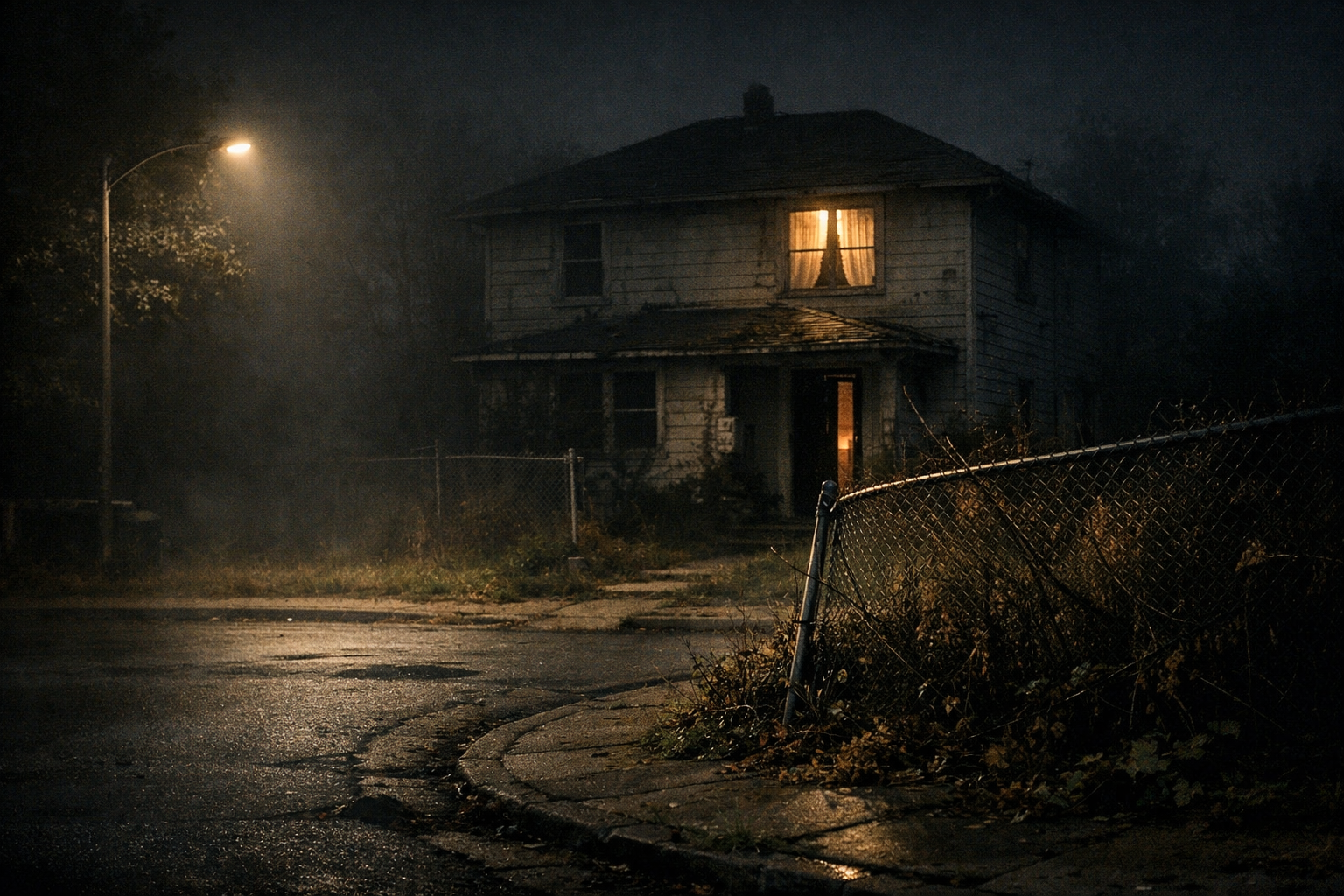
Briar Lane dead-ends into its name, like all the maps in the world forgot they needed to draw a way out. The sidewalks narrow. The houses get a little farther apart. A black SUV with fogged windows ticked as it cooled. A sprinkler somewhere hissed and then cut off with a cough. Above me, a tangle of lines and branches made a net of darker shapes in the streetlight, and I could hear my shoes scuff the sand someone had sprinkled along the curb where leaves piled up. The last house on the right kept its distance even from the cul-de-sac, set back behind a wincing line of hedge and an old chain-link fence with a lean to it.
From the sidewalk, if you don’t look too long, the place is just an old house breathing out its age, peeling paint and a porch whose steps list a little. The number by the door had lost its first digit; the others hung at angles, like they were shrugging. The lawn wasn’t really a lawn anymore. Vines had come over the fence, thorned and dark, tangled with grocery bags and a few dull beer cans as if the plants had collected them for company. I was about to keep walking, really, because from where I stood it looked as it must always look, a bad memory kept at arm’s length by a mesh of steel and thorn—then an upstairs window lit like a yellow eye opening.
I stopped where the sidewalk kisses the gate and I did the small, automatic human things: I checked my phone as if its time display could explain what I saw, and I blinked hard, and I waited for the sensible shift in the world that would make it a reflection or a trick of the streetlight. It held steady. It wasn’t the cold blue of an LED, and it wasn’t the watery pulse of a TV. It was warmer than that, a tired bulb through an old shade, something domestic and unremarkable, except there was nothing domestic left here and nothing that should be remarkable had any business being so right then. I remembered the way people at the diner had said it—no one takes Briar after dark unless they have a reason—and felt foolish, like I had let myself drift into a place where the sentence stopped making sense.
The power, I had been told by my cousin over coffee, had been shut off to that place years back, after pipes burst, after the bank took it, after something with a last name nobody said out loud picked fights they didn’t win. She told me it like a piece of gossip you tuck a blessing behind. The windows all looked blank in daylight, filmed in the kind of grime that settles when a house decides not to be a house for people anymore. But now, the upstairs right-hand window threw a slant of light onto the branch tip of a maple and made a small triangle of brightness on the porch roof. The rest of the house received it without waking up: black door, blank lower windows, a porch swing with only one chain left, swaying just enough to make you think of a missing weight.
Behind that light, a curtain—thin, old lace gone the color of tea—shifted. It didn’t flap. It didn’t whip. It lifted and then eased down again, like someone on the far side had smoothed it with their palm or drawn two fingers along its scalloped edge to create a view. I glanced down the lane for the friction of wind in the hedges and saw none. A spiderweb at the gate post was a sheet of crystal, undisturbed. The thawed silence between the night noises made a place for the drag of my breath and the odd, low squeak of my coat’s zipper when I moved my hands inside the pockets to keep them warm.
I told myself I would look and then I would leave. The gate’s chain was bound twice around the post and fastened with a lock orange with rust; if I wanted to cross, I would have to climb and I had no intention of doing that. I leaned just enough to put my weight against the metal and it answered back with a dull metallic complaint. The fence rattled, and the sound moved outward like a ripple, bush to bush, a small alarm. The window’s curtain lifted again, quicker this time, holding open for a breath longer, and the room behind it was a washed gold I could not make any sense of, given what I knew.
Standing out there, I had the sudden and specific feeling of being measured from that window. Not like a target, not even like prey. More like the way you count people at a church supper and decide how many folding chairs to unfold. The hair at the nape of my neck stirred under my collar, and the skin between my shoulder blades tightened, that cold little patch where your body keeps a memory of being looked at. The edges of things around me sharpened: the chipped corner of the mailbox concrete, the way a porch light three houses up made beads out of the water in a birdbath, the faint sound of a television laugh track through someone’s cracked window. Inside the upstairs room, something moved to one side of the curtain as if giving me a better look, or taking one.
Then the front door opened.
It wasn’t dramatic. There was no sudden bang, no gust. The black rectangle of the door shifted inward an inch with a low release—whatever held it, letting go or being let go—and then a long, damp wood groan as it moved wider. The sound belonged to old winter, to swollen frames that you shoulder open, to houses that remember fingerprints in their paint. It reached a small pause and stayed, open to a mouth of dark that smelled, somehow, even across the yard, of wet plaster and old varnish. I couldn’t see the stairs from where I stood; the entry swallowed up detail the way twilight does. But I could imagine the line the light would take, from that upstairs window down a staircase, and where it would cross the hall if it were on. The front room beyond the door had nothing of that tired gold; it was a mouth unlit, waiting.
I took a step back out of reflex and my heel clipped the lip between the sidewalk and the strip of grass, made my ankle wobble, and the small indignity of it almost made me laugh. The sound didn’t quite happen. Instead, something else did: a shape crossed behind the upstairs curtain again, and in response the light itself seemed to blur. Not flicker out—blur, as if between me and it some thin layer was passing. I don’t know why I thought then that if I turned away the house would stop petting at the edges of my sight and go back to its sleep. Often we make deals with the parts of the world that won’t shake our hand back.
“Hello,” I said, quiet, because it felt worse to say nothing at all, and because sometimes we carry the rules of normal houses into places that use them like bait. My voice went into the space and came back in a different shape, made smaller by the hedge, swallowed by the open door and returned without a decision. Far away, a dog barked twice and decided it wasn’t his problem. The chain on the gate ticked where it met itself, like a clock.
Behind the curtain, a line appeared briefly where there hadn’t been one—a vertical dark, the shape you get when a head turns and the hollow of a neck makes shadow. It wasn’t precise; maybe it wasn’t there. But the feeling of countedness tightened into something more particular. It felt like the difference between someone looking at you and someone looking for you. The upstairs light stayed on. The door on the porch did not move further; it did not need to. A longer moment passed than I had meant to give, and I realized my hands inside my coat pockets were fists.
I took one backward step, then another, careful not to turn my back completely. The sidewalk behind me had a scatter of sweet gum pods that rolled under my heel and made me adjust. I tried not to make sudden movements, as if the house would startle. At the corner where the cul-de-sac opens itself to the rest of the street, I allowed myself a look over my shoulder. The upstairs window held its square. The lace was shut again, or almost. The door looked a little less open, or perhaps that was because distance reduced certainty. There is a way light behaves when it is aware of being watched. I was not sure if I had learned that just then or had always known it.
I walked home without drama, my breath into my scarf, my steps the pattern of someone not late for anything. The porches on Briar Lane are potted with mums this time of year, orange and blood-red and vaguely cheerful even at night. A plastic skeleton leaned against a railing two doors down and nodded with the suggestion of a headwind that wasn’t there. Somewhere, someone’s dryer thumped a zipper against the drum. When Maple opened itself up in front of me, the sense of being looked at peeled off in layers: first past the neighbor’s oak, then by the trash cans, then only finally at the corner, like something had followed at a polite distance until the town decided enough was enough and closed itself behind me.
Inside, my cousin was rinsing bottles with one eye on the monitor. “You walked too far,” she said, not accusing, just diagnosing the way you remark that someone’s ears are red when they come inside. When I told her I had gone as far as the end of Briar, she put the bottle down and looked at my face the way a nurse checks a patient’s pupils. Then she reached past me and set the deadbolt more firmly. It slid into place with a friendly click. She didn’t ask me what I saw. I didn’t tell her. We let the television make a soft speak of other people’s problems, and we talked about paint colors for the guest room.
I hung my coat over the back of a chair, draped by habit rather than need, because I knew I would put it on in the morning when the air would be like nickel. When I later picked it up to fish for my chapstick, my fingers pressed into the left pocket and found something that wasn’t soft at all. The pinch was immediate and mean, the kind of prickle you get when you grab a rose out of its paper without paying attention. I thought for a second it was a stray safety pin, but what I brought into the kitchen light was a short piece of thorny vine, a section of briar no longer than my palm, the kind you only meet if you put your hands deeper into a hedge than you mean to.
It had two clean barbs and a small curl at one end where the plant must have wrapped itself around something once. A flake of white paint clung to one thorn like a chip of dry nail. There was a softness to the dust on it, talcy and faint, that left ghost on my thumb when I rubbed. I turned the coat to check the pocket flap and it was down. The stitching was sound. I had not climbed any fence. I had not put my hand into any hedge. I stood at the gate, and I did not reach beyond it. I know these things the way you know the shape of your own hands in the dark.
I set the little branch on the counter and it made the tiniest skitter where a thorn met the laminate before it settled. The house around me made friendly noises: the heater clicking as it came to life, the dull thud as the fridge cycle kicked over. I went to the back door and checked the lock, which was already set. In the living room, the monitor showed a crib of slowed breath and the shape of a baby’s arm lifted like a question mark. I came back to the kitchen and looked at the briar again. It lay there as if it had always been in our kitchen, as ordinary as a bread twist-tie, as impossible as light behind a lace curtain in a room that has no electricity.
I could have dropped it in the trash, and maybe I did. I don’t remember that part exactly, like the memory smudged under a thumb. What I remember is this: later, when I went to hang my coat in the hall closet, the weight of the fabric pulled me forward a little, and I had the careful, childish feeling that if I looked back down Briar Lane from our porch too long, I would see a square of gold where it did not belong, and the suggestion of a hand making a part in lace to better see if I had learned to mind my own business. I closed the closet smoothly. The coat, when I let it swing to stillness, brushed the other sleeves there, and something small inside the pocket ticked against the lining, as if to let me know it had found a better place to rest.