The Road Where La Llorona Still Walks
Where I grew up, the river owns our nights. It slides under the bridge and along the fields, it climbs the banks in the rains, and it has a sound people stop listening to once they’ve lived there long enough—the kind of hush that is not silence so much as a thing keeping you from hearing other things. And there’s a stretch of the old road that follows it closely—one lane in each direction, patched asphalt and catclaw acacia biting at your doors, with the water moving dark just beyond the levee. People told me since I was small not to take that road after midnight. If you must, they’d say, keep the windows up, don’t pull over for anyone, and if you hear her, don’t call back. They never said her name like a story. They said it like a warning: No cruces el río después de medianoche; ella camina. Don’t cross the river after midnight; she walks.
I was past the age where warnings feel like spells, but not so old I’d forgotten the specific tone my mother used. That summer night I left her house late, the last family to say goodbye, plastic containers of leftovers sweating on the passenger floor and the smell of fried plantains burned into the upholstery. It was a long detour to take the highway, and I’d done the drive along the water my whole life, so I turned down the lane where the asphalt narrows and the frogs hop like stones thrown under the rims. The clock on the dash ticked to 12:12 as I crossed the bridge. The river below was low from the heat, all black stones and a thin ribbon of running water. I remember how the headlights pooled over the guardrail bolts like fish scales. I remember the window controls clacking when I checked, force of habit, that they were up.
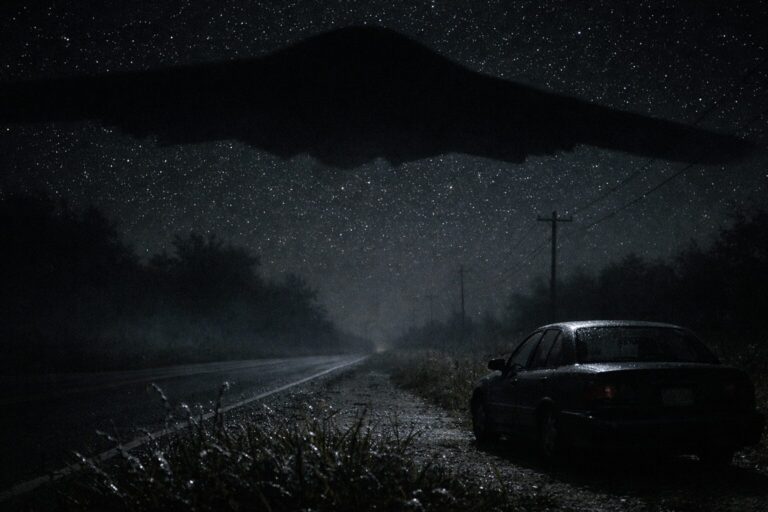
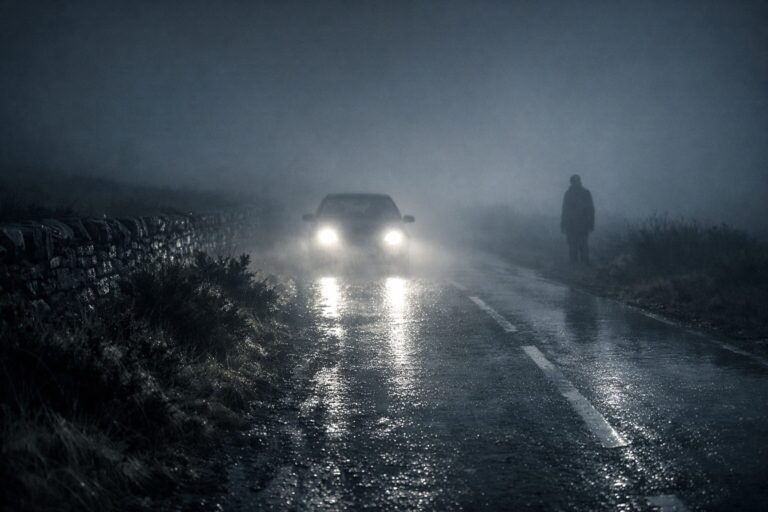
There’s a curve right after the first cane field where the road shifts its shoulder to make room for the river to breathe. I came into that curve and saw the pale shape ahead of me on the right side, where the gravel gave way to scrub and then to dark water. For a half second, I thought it was a stack of those irrigation tarps, sun-bleached and thrown over a fence. Then it moved. The idea that it was a person landed in my body the way a dropped wrench hits concrete—an ugly, single sound. A woman, I told myself, though what I saw first was the white of what she wore, something inexact between a dress and a sheet, moving against the brush as she walked. Her hair looked long, darker than the rest of her. She kept to the edge of the road, along the ditch line where the runoff collects in the rains. She was barefoot or wearing shoes I couldn’t see; her steps were careful without being slow, like she had somewhere to be and hated the way to get there.
I took my foot off the accelerator to give her space. The night tightened around us. I glanced in the rearview—a reflex to see if anyone was behind me—and saw only the line of my own brake lights dim out into the bends. I turned the radio knob down to zero like you do when you’re looking for an address, because sound felt like something that could knock something else loose. She moved into the edge of my headlights for a moment, light catching the hem of her garment so it flared brightness and then became gray again as if it had soaked up the road itself. It wasn’t raining. There had been no mist. But that hem looked weighed down, as if she’d come from the river.
Maybe she needed help. That thought should have been the first one. But her posture put a border around her. She didn’t seem lost. She didn’t look over her shoulder at the car coming up. She didn’t flag me down. There’s a way someone in trouble throws a hand, a stutter in their walk, a turn of the head that looks like question marks. This wasn’t that. She was simply there where no one should be, walking the shoulder, white against the thornbushes, and in that wrongness all my mother’s words rose slow and familiar like a box from the bottom of the water making its way up to air.
I considered passing her carefully, hugging the center line to give her as much space as I could. The road was narrow and there was no place to pull off without dropping a wheel into the ditch. So I rolled as slow as I could manage. The speedometer dipped to twenty-five, then twenty. She kept walking. And here was the first thing that didn’t fit inside any kind of night logic: no matter how my headlights reached for her, she didn’t get closer or farther. She was the same small pale shape just at the rim of what my lights could really touch, held at a fixed distance by something that wasn’t the road. It felt as if the asphalt itself had learned a new trick beneath my tires.
I tapped the brakes a little harder, expecting I’d edge down to fifteen and she’d resolve into a person, a face, a shoulder blade, a reason. The numbers on the dash slid down. The hum of the tires changed. The frogs were louder. She stayed a length ahead, precise as if measured—the way the shadow under your dining chair is always under your dining chair no matter how you shift your weight. I sped up again, telling myself it was just the way headlights feather out, that she was keeping the same pace I was, that country nights distort distance. The needle lifted to thirty-five, then forty. Still she was just there at the edge of the beams, no nearer, no farther, the white shape making the same small movements of cloth that were somehow independent of the wind. I remember my hand slipping on the steering wheel because the condensation on my plastic cup had run down and pooled inside the curve of my palm.
I spoke in the car to no one. “Do not be stupid,” I said, and heard my mother’s voice in the sentence as if I was a radio playing a station I hadn’t selected. It felt foolish to talk, but also like a tether. Sometimes the voice that keeps you is your own.
I thought of honking. The absurdity of startling someone who had refused to see me made me swallow back the impulse. I turned on the high beams instead. The night opened up. Things crowded back from the light—the cane to my left, the acacia to my right, a sliver of river throwing a line of silver down the far edge of the ditch. But the woman in white did not get closer. She did not flare brighter in the high beams. She existed at that arm’s length the light had decided, and nothing I did with the car altered the terms. The darker part of my mind noted that all the stories said she was heard more than seen, that people mixed up the closer and the farther, that a wail behind your ear could travel for miles across water, but still I watched her shoulders—or what I told myself were shoulders—rise and fall in the even rhythm of walking.
I kept my hands steady and my face toward the windshield, a child’s posture as if stillness could make me invisible. I realized then there was a smell leaking through the vents—not rot or sulfur or anything dramatic. Just the honest wet of the river in summer. Mud and algae and the edge of stone cooled faster than the air. I heard something tick inside the dashboard, the sound a car makes when plastic pieces contract under air conditioning. I told myself that, too. The road curved to the left, hugging the river closer, and for a second, she stepped into fuller light. Her garment clung around her calves, and there was a darker V where it crossed her throat, a shadow that could have been a scarf or hair. I couldn’t tell if what hung along her back was fabric or something else. She didn’t shiver. She didn’t look at me. The river made its hiss like distant traffic, although there was no traffic.
And then I heard the crying, not outside where my eyes were fixed, but behind me where no light was.
At first, I refused it. My brain made it into a trick of the tires, the whine they make when they hit a groove. But tires don’t breathe between sounds. Tires don’t run out of breath and start again. What I heard was a small spilling sob the size of a cupped hand, as if someone were trying to be quiet and failing. It came from the space just behind my right shoulder, low where the seat meets the floor. It made the hairs rise in a stripe along my forearm under the dashboard light.
I did not look in the mirror. I told myself to keep going. My mouth tasted like a copper coin you’ve held too long. The woman outside continued her steady walking at the brim of my lights, ironed into that distance. The sob climbed an inch in pitch and broke on itself in a kind of keening the way a grief that thinks it is private reveals itself without consent. And so I did what any person would do to make a bad sound end: I said, no louder than to myself, “Shh.”
On that syllable, the crying stopped, and the car felt emptier than before, the empty that wakes you up because something had weight and then the weight was gone. The road carried on, and I realized there were tears running from the corner of my own eye because I’d been holding my face so still. The shape outside didn’t falter. The smell of the river was inside the air conditioning vents as if I’d driven along with my windows open for hours. For a beat that lasted longer than any I’ve ever known, the world was edge, edge, edge—my headlights feathering out, the woman’s hem whispering its same little contradiction of breeze, my own breath so careful I could hear my shirt fabric shift against the seat.
“I’m taking you home,” I said before I knew I was going to say it. It came out in a voice I don’t use in daylight. I don’t know who I said it to, or if it was the same voice from the kitchen telling me not to stop. It filled the car and made it mine again. The next bend brought the first unbroken straightaway, a longer stretch that rose a bit and then dipped toward the scraggly palms near the old boat ramp. I took it, the white lines flicking beneath the hood like an old movie reel. The shape outside didn’t change speed or distance or anything like an intention. Somewhere past the palms, the road forked. The left went on following the river. The right, a beat longer, latched onto the farm road that would spit me toward town and more lights. I put on my signal out of habit no one could see.
The crying came back when I passed the sign for the boat ramp, as if I’d driven over a buried wire. It was closer, not in distance but in intimacy—a sound almost in my ear and somehow still from the floor. It had words tangled in it I couldn’t make into words, like water trying to be language and failing on every shore. I said “Está bien,” before I knew I had switched tongues, and then, because my throat burned, “We’re almost off the river.” It didn’t matter to whom I spoke. The sobbing softened to a breath. Outside, the woman remained exactly and precisely herself and not mine, always the length of my lights away, not even a degree more real for all the miles I put between us.
At the fork, I turned right, and the river’s sound pulled back, and the cane columns replaced it with leaves. The asphalt felt less narrow under the tires, as if the road were exhaling. I crossed the cattle grid where the farm road begins, and the metal bang of it under the car was a sound you can’t mistake, the kind of thing that reminds you there are surfaces and things that hit them. In the rearview, for the first time in a long stretch I dared a look, the curve behind me held only my own tail lights and then nothing. The shape in white was not there. The shoulder was shoulder. The night was simply night, full of its own private insects and the quiet of people asleep in houses I couldn’t see.
I didn’t stop at the first streetlight; I kept going until I reached the little tienda that leaves its front sign glowing even when the doors are locked. I pulled into the gravel and killed the engine. The river smell that had colonized the car faded a touch, like something remembering it had somewhere else to be. I waited in the idling quiet you earn after any fear by doing nothing but letting your body believe you again. When I finally reached back to the toggle and flipped on the dome light, the car’s inside became small and yellow and, in its way, embarrassingly ordinary—a tote bag with receipts spilling out, the dent in the backseat cushion where my niece had thrown herself earlier that day, the sweater I always forget to take inside.
The rear seat was empty. The crying was nowhere. The cool part of the seat, where no one had sat, was exactly the cool you expect after midnight.
Then I looked down at the floor.
The rubber mat behind the passenger seat had been pulled forward so it curled up awkwardly against the footwell, no longer tucked under the seat the way it always is. Its top surface was wet enough to shine under the dome light. Not the dampness of a spilled drink—you know that stickiness, the sweet kernel of cola. This was clean in the way rivers are clean and not, a damp that left a fine ribbon of sand along the edges, a darkening of the rubber shaped like the backs of knees or the weight of feet pressed there a while. When I touched the edge with my fingertips, a cool flagged up them I felt like winter in a place that doesn’t have any. I pressed the mat back down where it belonged, and the sound it made was of water leaving something it had borrowed.
I shut off the dome light. The tienda’s sign hummed blue against the night. Out on the farm road, a truck went by, someone going home or leaving it, and its tail lights stitched themselves into a new darkness that had nothing to do with me. I checked the back seat one more time. The window showed me my own face and then lost it. In the side mirror, the road I’d come from was empty, just gravel and the idea of the river miles away turning itself over in the dark. I drove the rest of the way with the radio low, humming a song my mother used to hum when the power went out. When I parked at my building, I hesitated before I locked the car, an instinct like you do when you leave someone sleeping in a room and don’t want to wake them. The next morning, when sunlight had burned off every trace of the night, there were thin lines of silt dried on the ridges of the back mat that weren’t there the day before, and the mat itself didn’t sit flush against the floor. It had shifted forward again in the night, as if it had learned some other position and preferred it.