The Same Nightmare Came Back With New Details
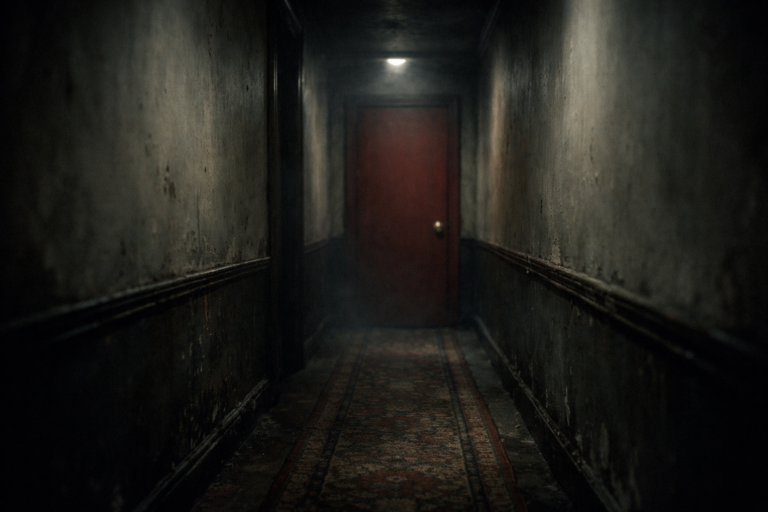
For as long as I can remember, I have dreamt the same hallway. The walls are the color of old teeth. A strip light buzzes overhead and throws a hard glare on varnished floors that look slick though they never quite reflect me. The corridor bends where it shouldn’t, swelling wider for three steps and tightening again, like the house is breathing. There are doors on both sides, painted shut by the look of them, and at the end, a darkness that never recedes. In the dream, I am always barefoot. My heels make no sound. Somewhere out of sight a slow knock begins—measured, patient—not on wood, exactly, but on something hollow. It keeps pace with me without moving closer, and when I put my ear to the seam of a door I hear breath that isn’t mine. I press a palm to a knob and wake before I turn it, heart banging, sheet damp at my collarbone. That was childhood, and then adolescence, and then the years after, like a book that kept reopening itself at the same page no matter where I tried to mark it.
It has been a constant, oddly comforting in its sameness. I could have drawn it with my eyes closed—the ripple in the plaster, the oily scuff three-quarters down the left wall where a shoulder brushed a hundred times, the hairline crack that climbs from the baseboard to the light switch like a drawn vein. When I moved between apartments, between cities, it came with me unchanged. It never admitted in windows or clocks or anything that tethered it to time. I woke always at the same point, with the certainty of someone who knows the exact bar in a song where the record will skip.
The first time anything altered, it was raining. Real rain, I mean—the kind that comes in sheets and throws itself flat against the windows like it’s trying to get in. I fell asleep to the ticking of it in the gutter and thunder that rolled like a thing heavy being dragged. When the hall found me again, I knew it before I knew I was dreaming. But on the right, where there had only ever been a wall, a door stood cracked open. There was dull light behind it. Even that felt like a betrayal. I had never seen that door. The seam of air that leaked through smelled like dust and camphor and something old that had been packed a long time ago.
I don’t decide to go in. In these dreams, I never decide anything. It’s more like a current brings me to the threshold and I am set down there humbled by it. The room beyond was narrow but longer than it looked, the way rooms are when they keep going past their walls. There was a single bed with a chenille spread that had been combed into a pattern and then forgotten halfway through. A green enamel mug sat on the floor under the window, chipped through at the rim to expose the black iron beneath; the window glass had a bloom on it like a cataract. On a shelf—rough wood, bracketed by iron Ls—were ordinary things: a blue-and-white soap dish shaped like a leaf with a crack spidering under its glaze, a brass key threaded on string thick as twine and stained darker where hands had worried it, a worn library checkout card stamped and restamped into an erasure of months and years, a paper luggage tag with a string handle and a faded number 15, a shoelace knotted around a seashell, a square wooden block with the letter M burned into it so the edges of the M had bled. There was a smell of old lavender and the faint sharpness of cold metal. Nothing matched. Everything was the kind of object that attaches itself to people and then refuses to be put down somewhere sensible.
I don’t remember picking anything up. I remember only the slow knock in the hall, coming through the wall as if the sound went threaded along the studs. Then the light went to a duller color, like a cloud coming over the sun behind the ceiling, and I woke with rain insistent against the glass in the real room and a line of electric blue on the ceiling where lightning was probing through.
I won’t pretend I thought about it all day. Work was work. By the time I turned out my pockets in the evening, I had half convinced myself I’d just had a longer dream is all. But when I went to brush my teeth, I set my toothbrush down in a dish that had not been there in the morning. Blue and white. Leaf-shaped. The hairline crack like a road on a map under the glaze. I stood in that wet tile light, listening to the rain tap harder and try the weak spots around the frame, and I felt a thing in me go cold in a steady way that had nothing to do with the weather.
You buy things and forget buying them. That was how I tried to talk about it to myself. The dish from some weekend market, wrapped in newspaper that I took out and put down and then couldn’t place later. Except I don’t go to those markets and I didn’t have any newspaper. The sink had the same ring in it from where a glass had been sitting too long. The dish sat cupping water as if it had always been there to catch it. I looked for the tape residue a new thing leaves behind on porcelain when you first set it down and there was nothing. I could have sworn on anything that mattered to me it looked sunk into place in the way everything else already was.
It didn’t stop there. A day later, I opened the top drawer of the little table by my bed to pull free a tangle of chargers and I found a brass key coiled on a loop of twine. It was exactly like the key from the shelf in the dream—the same blunt teeth, the same flattened circle at the head where a brand name had been worn to a soft island of metal you couldn’t read. The twine had a kink in it at the exact place my dream-hands had seen it hanging. I don’t own anything that key would fit. I don’t even own anything that looks old enough to want it.
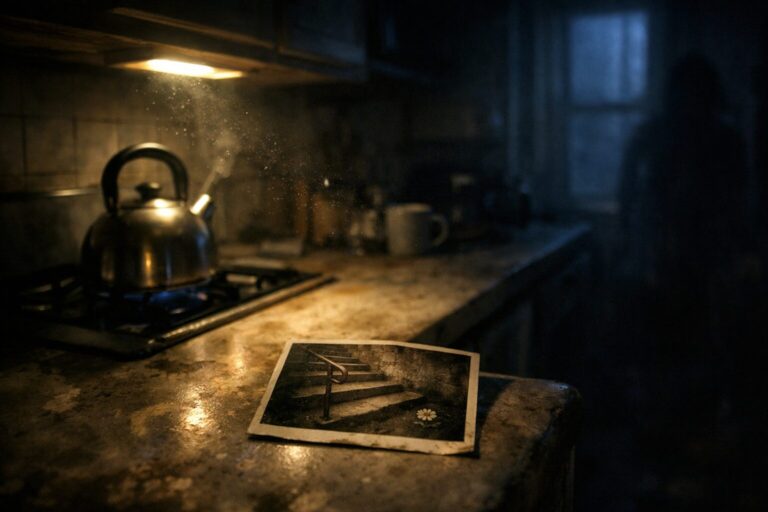
On that same night, I went to fold the book I had been falling asleep over and there was a stiff card in the middle that hadn’t been there at dinner. It was a checkout slip from a library I don’t use, maybe no one uses now. Under the grid of months were the ghosts of stamped dates layered over one another until you couldn’t read any of them, a palimpsest of attendance and return. My name wasn’t on it, though I turned it over twice expecting to see it. I slid it into the stack of envelopes on the dresser and stood back and stared at the drawer as if it might try to explain itself.
Every time I told myself rational things, something in the house would shift a fraction into the dream’s shape. The enamel mug turned up at the back of a kitchen shelf behind a cinnamon tin I had not reached for in months, chilled like it had been under a window all day. I know every cup I own—I drink out of the same two without thinking. This mug didn’t weigh like anything I had; it was heavier, with that small precise chip where your lip would meet it if you were careless. It smelled like wet metal. The paper tag with 15 burned into its face lay on the mat under the potted ivy by the window, string still looped and grimy where fingers had pulled it tight. When I lifted the pot to look underneath, imagining that some draft had pushed it there, the saucer left a half-moon imprint of damp on the windowsill as if it had been sweating quietly for hours.
I started arranging those things together on the shelf above my desk without meaning to—this is what I am doing: gathering the mess. But they didn’t look gathered. Even separated from the dream by distance and light and the measure of hours I am awake, grouped like that they had a gravity, a way of making the other things around them feel theatrical. When I turned off the lights in the rest of the flat and went to my bedroom, I could feel them behind me as if they were eyes.
On the nights when the storm hung around, the dream came back truer. The hall knew my bare feet. The new room never shut once it started existing. I visited and revisited it as if I were checking a private museum for theft. The objects were where I expected them; sometimes small details had evolved. The soap dish had a hair of someone else’s soap collected in the curl. The library slip had a smear on it like it had been pressed under a damp thumb. The block with M had a new bruise of wood chipped on its corner as though someone had thrown it once and missed. The knocking in the hall changed with me. It began to slide and halt, slide and halt, creeping along the studs like a chess piece pressed from square to square without lifting from the board.
And then the corridor presented a door I had not yet seen. This one was not painted shut. It was just very plain, a workman’s door in that washed-out schoolhouse color you see in basements. A cheap brass number was screwed crooked into it: 3. The screw head was burred where someone had jammed a too-small screwdriver into it years ago and slipped. The number had a new shine in the troughs where fingers had pressed over it to smooth down tape. Under it, a strip of masking tape ran straight and level. On the tape, in black marker, was my name. Not just my name but my handwriting—my exact downhill slant, the way the lower of my Gs gets a flat in the loop when a pen loses patience, the determined cross I put through a T like I mean to nail it down. Seeing it was like catching sight of my face in a window when I hadn’t expected the glass. For a second, it felt like the floor under the corridor went away and the hall went on without it.
I reached for the handle. I could see my knuckles blanch; I could feel the burr on the flattened head of the screw catch the heel of my hand. I could hear the knocking behind me steady itself, patient, sure. Rain battered somewhere beyond the house of the dream and the house I was sleeping in. Lightning pulled a line across the ceiling and took it away again. I did not turn the handle. The dream broke there like a cheap thing snapped in the middle, no resistance, and I surfaced into my room with the dark shape of the wardrobe on one side and the soft blink of the router telling me my world was continuing without my say-so.
The air had the heaviness of pressurized weather. My window knew the rain. The gutter apologized in small constant splashes. I lay there with my hand out of the blanket, fingers still bent to the shape of a knob that didn’t exist in the room I was in. I listened, as if the listening would tell me whether what I had come from could come here. The house creaked the way houses creak—wood learning to be wet again after days of dryness, pipes finding their small voice. I closed my eyes because that’s what you do when you need your hearing to do more than it can.
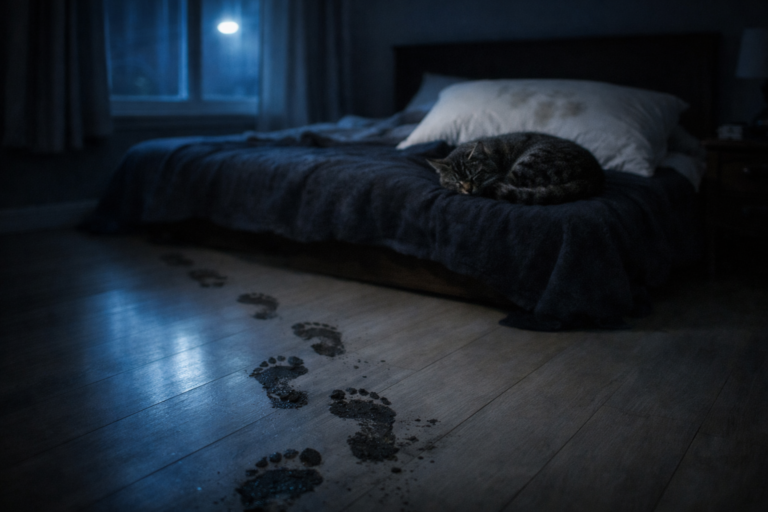
When the handle turned, I knew it for what it was the way you know your name across a crowded room. Not the latch—that lazy rattle when someone bumps a door you haven’t quite closed—but the dry click of metal finding and deciding. The handle on my bedroom door moved down and then up again, deliberately, as if wrist and weight had been involved. The carpet at the threshold made a tiny grit sound like a shoe testing ground. Nothing came in. The uncut dark on the other side of the door hung there like a held breath. I told myself I must have not shut it right earlier, though I remembered the pull, the suck of settled air you get when a door pulls home. I didn’t name what stood there. I didn’t name the way I could feel myself on both sides of it.
It was a polite sound, when it started—the first knock. Not the enormous sound from the dream hallway, not exactly. Just the neighbor’s-please kind, knuckle on wood, but placed wrong for the hour and the way houses are supposed to sleep. It came again, three seconds later, a measured interval that hit me the way a familiar word does when someone else mouths it. Then a pause. Then one more, like it was waiting for me to understand the sequence I had known in my feet for years. Somewhere outside, thunder walked around a bend in the sky and rummaged in a pocket for coins; the light tightened and relaxed like a muscle around the room. I stayed still because moving felt like a declaration, and any declaration felt like permission. The handle did not move again. The rain battered gentle as if it were sorry for what it had to do. The knocking started again.