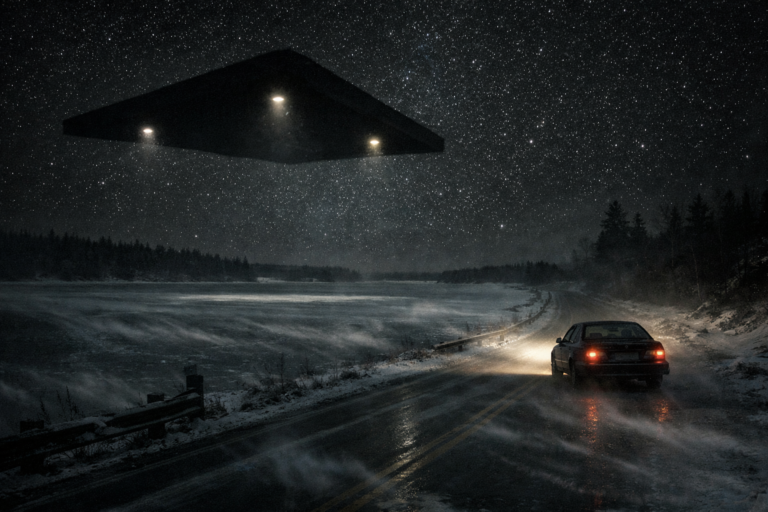
Air Traffic Control Never Saw the Second Aircraft
Clear night, smooth air, the kind every crew hopes for. The airplane settled at cruise and the sound turned to that familiar pressurized hush, the noise tucked behind the insulation like a steady thought. The captain had finished his takeoff notes and left the autopilot minding the line of magenta across the map. His first officer kept the panel dim—just enough light to make the numbers legible without washing the stars off the windows. The cabin behind them was a thicket of dozing passengers, blue overhead strips set to low, galley latches quiet, seatbelt sign off. Both of them were awake in that shift-worker way, not jangled, just present. From the windshield forward, sky opened in stages: hard black close in, a pale band of thin cloud a whole state away, then a crown of small, bright stars. No storms, no traffic. Perfect.
They had checked in with Center not long after climbing through three-one-zero. A comfortable voice gave them a handoff and a clear path: direct to the next fix and on to the arrival. The aircraft held three-six-zero and the Mach number steady; the only adjustments were small scrolls on the heading bug as the route bent around a restricted area that wasn’t hot tonight anyway. The captain’s coffee cooled in its square holder, and he nudged the cup absently with a knuckle when the autopilot took a tiny trim. There is a way the night settles into the cockpit, a shared understanding that hours pass at one pace and space passes at another. It was that kind of night.
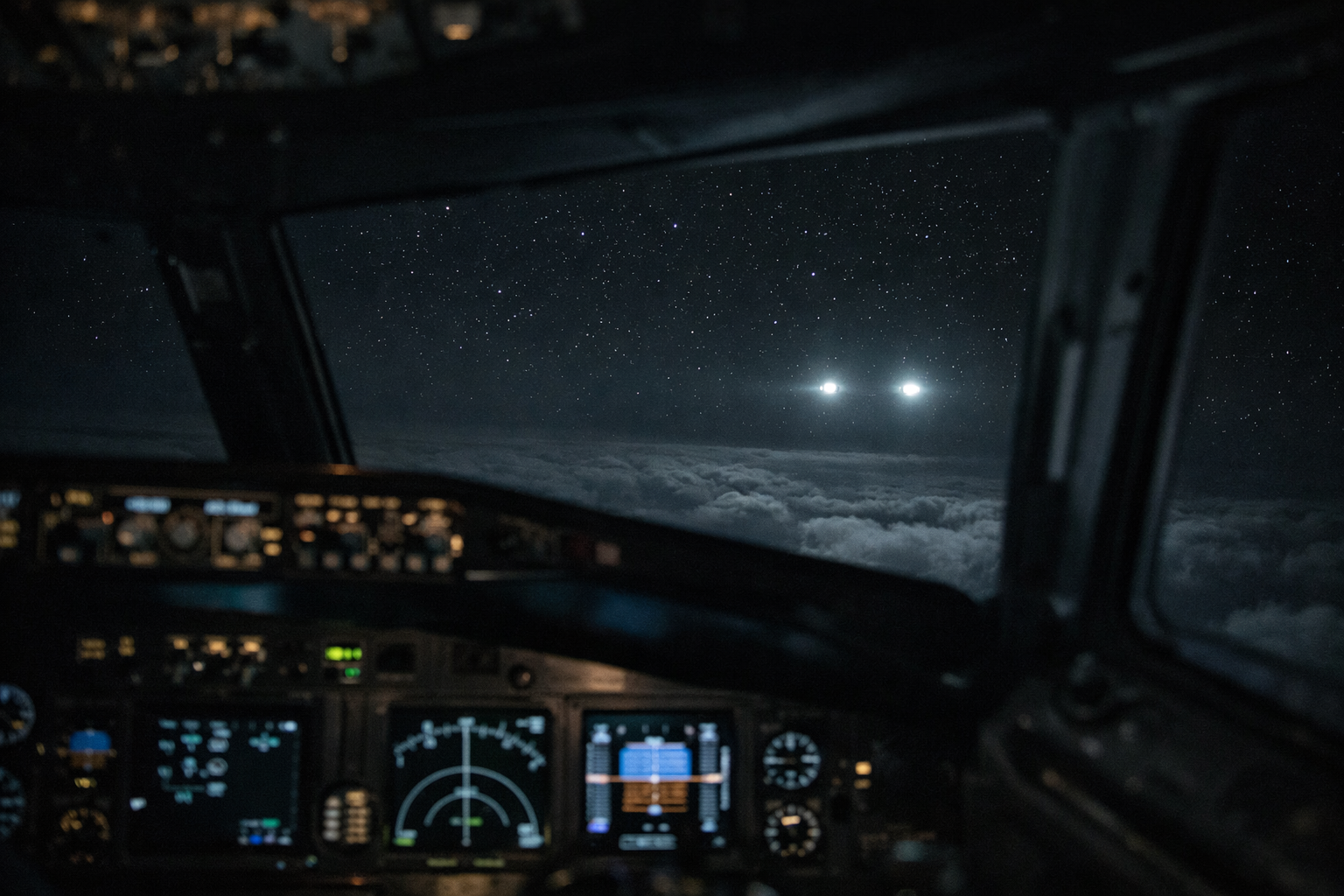
The first odd thing arrived almost politely. The first officer, glancing right because everyone glances out of habit even when nothing should be there, paused. Two lights hung out past the oval of his window—steady, white, and close enough that they drew his focus. Not the bright, urgent white of a landing light and not the crisp patterns of nav and strobes. Just two points, a little warmer than the stars, holding a place that should have been wind and night. He leaned forward until the seat belt tugged and cupped a hand to the glass to chase the ghost of his own reflection. The lights didn’t blink. They didn’t resolve into wingtip colors. They stayed.
“You got traffic?” he asked, quiet because it wasn’t yet a thing, and the captain looked over in the controlled way that meant he was already listening. The captain’s eyes went where he pointed. He didn’t need binoculars; you don’t on clear nights when something’s too close. Right side, two o’clock, level, fixed in relation to their fuselage in a way that felt like formation. The captain keyed the mic and asked Center if there was traffic off their right side, two to three miles. Center came back smooth. Negative traffic observed. None indicated nearby, no primary either. The TCAS screen in the middle, which would have thrown a caution if another transponder breathed within its parameters, sat clean—just their own symbol, a tiny white arrow proceeding into nothing.
They both went quieter for that. The first officer reached for the light rheostat and took the instrument panel another notch down, letting the darkness press against the glass and make the outside brighter in their pupils. He found the wing inspection switch on the overhead and flicked it. The starboard wing lit: a tired half-moon of rivets and metal and the glossy curve of the engine nacelle. Beyond that arc, there should have been depth. But the space where those two lights were felt oddly thick, like there was mass there, not reflecting, not swallowing, just a subtraction against the sky. No wing between the lights. No sense of a body. The first officer clicked the inspection light off and they both watched the lights hold as if the airplane had become a track they were sharing.
The aircraft rolled a hair left as the captain adjusted for a gentle curve in the route—just a few degrees of bank, enough to feel the shoulder strap tighten for a moment. In that movement there is a parallax you count on, the way far things shift faster and near things slide with you. The lights didn’t behave the way far lights do. They didn’t lag or scoot; they traced the bank exactly without banking themselves, steady orientation, steady separation. When the wings came level again, the two points were where they had been, just outside the invisible circle their right wing would have carved if you could see air turn.
“Center, confirm,” the captain said after a minute that felt like five. “We still have a pair of whites off the two o’clock, level with us. Anything at all painting?” There was a pause long enough to be real. They could imagine the controller looking at a sweep, at a secondary overlay, at the splashed green of returns that meant airplanes with their names and codes attached. “Negative,” the voice said again. “Your traffic picture is empty. We’ve got you alone for at least thirty miles. Nothing is primary.” The controller added it like a reassurance, as if adding ‘primary’ would have made it an old-fashioned unknown. It only made the cockpit feel smaller.
The cabin call light chimed once. The captain glanced down at the panel; the forward galley was showing an attendant trying not to bother them. He picked it up with his left hand so he could keep his right near the thrust levers. The voice on the interphone was kept professional, but it had that note. “We can see some lights on the right side,” she said. “They look like—like car lights, I don’t know. Is there someone out there?” He told her they were in contact with ATC and everything was under control. He said the phrase that calms a cabin and hung the phone back into its clip more carefully than was needed.
They asked for a small turn. They didn’t say why; you can always request a vector for ride or for weather, and the sky could hold invisible shear even on the smoothest nights. “Ten degrees left for a minute,” the captain asked, “then back on course.” The controller gave it without question. The airplane listened and leaned. The lights listened too. They stayed steady, as if the whole sky were a plate and the airplane and those two points were magnets sliding across it together. The first officer marked the time with a pen on a scrap of paper—Z time and an approximate position, half habit, half a way to press the event into ink so it couldn’t wriggle out of memory like dream detail. He kept glancing between the right window and their speed, their altitude, all the expected anchors of the job. Nothing else moved.
The fear arrived not like a spike but like a slow rise you notice because it meets you at your throat. Without warning or show, the two lights unhooked from their place beside them and went forward. There was no banking. There was no coronet of brighter burn as if someone had pushed throttles hard on a set of engines. The lights drew an arcless line to the twelve-o’clock high offset, same altitude, same unreal steadiness, and stopped there exactly. The first officer’s hand had come up without him telling it to, palm toward the glass as if he could slow what was happening by offering a gesture. The captain’s right hand had closed more firmly on the yoke; the autopilot was still in command and that fact felt like something to defend, as if the act of disconnecting would consent to a new set of rules.
The human brain does a strange thing with motion in darkness when reference is thin. Vectors flatten. Angles lie. But there was no angle. The lights slid ahead like a stage mark, like a planned cue. They held that new position and then, for a breath, dimmed in a way that was not a blink but something subtler, a retreat behind an edge the eye couldn’t name. The captain had already keyed the mic, and in his own ears his voice sounded very calm. “Center, we have that same traffic now dead ahead, slightly high. Distance is hard to tell. We’d like to climb one thousand.” The controller asked if the traffic was converging. The captain looked at the window and then at his instruments, because that is what you do when you don’t want to answer with feeling. “Unable to determine. Requesting climb.” There was a delay, a request to stand by while another frequency cleared. During that small bureaucratic span, the lights ahead did not wobble with the slight turbulence that tugged their wings. They did not dance. They simply existed in a location that an airplane would have had to fight to hold with that precision, and yet they held it like it cost nothing at all.
Climb approved, the big airplane lifted, pressurization valves murmuring, a new number in the window. The first officer watched the pitch change on the side of his world and did not see a corresponding shift from the lights. If they were moving, they were matching. He thought about the word unknowable, and how in training they put you into scenarios where you could choose between bad options and at least you owned the choice. Here, the only choice was to look or not look. He looked. He tried once to catch a photo with his phone, and the result was a smear of black and cockpit reflection, no depth for the lens to bite.
They were handed off to another sector. A different voice, same cadence. They repeated the advisory they had been giving, because form is a comfort. Negative traffic, said the second controller. Negative primary and secondary. The reply was so expected that it somehow made it worse. For a while there was nothing but engine and the fine metronome of checklists spoken under breath. Then the two lights dwindled. Not a sprint away. Not a dramatic breaking off. They became less. A slow dissolving, as if someone were turning a dimmer in the sky and the stars behind were gaining strength in their absence. When the first officer finally pulled his hand back from the glass, there were chill circles on his fingertips where they had rested too long against the pane.
They flew the rest of the line in a bubble of niceness that felt like superstition. The descent began on schedule. Approach control’s vectors slotted them down among the traffic into the pattern for a runway that showed its rabbit lights in solemn rows. The captain briefed the approach with an extra care that the first officer didn’t comment on. The landing was one of those that you feel all the way through the gear and into your spine—firm but rightful. On the taxi in, amid the new tone of ground, chirps of other airplanes, instructions mapped into pavement, they barely spoke except to do what the taxiway signs asked.
Company wanted a call. “Anything unusual?” Dispatchers phrase it so there is room to say no, to keep the night easy. The captain didn’t take the out. He described it in the simplest words he could: two lights off the right, same altitude, no nav colors, holding station; a forward slide without bank; subsequent hold dead ahead; gradual fade. On ACARS, he typed it short. After shutdown, with the systems shushing into the kind of quiet that makes a person hear their own breath, he filled the boxes of a report that lives in a file no one reads unless they must. The first officer added his note about time and position and even wrote the words no visible wings, though he felt silly as he wrote them, the way you do when you commit a personal certainty to a thing that asks for only facts.
The chief on duty passed them to an ATC supervisor on a landline patched to the ops room. The supervisor was courteous in the way of people accustomed to dealing with strangeness politely. “We’ve scrubbed the tapes in your sector and the adjacent,” he said. “There were no secondaries, and we don’t have a primary. We had you, and that was it.” He offered the times they had called in, which matched the notes on the first officer’s scrap as if collated. He offered to file whatever needed filing from their end. The captain thanked him out of reflex and closed his eyes for that thanks because something in him had wanted there to be even a blip, a misunderstanding, a dust mote of physics on a green screen that meant there had been a shape out there to see.
In the hotel later, it was the line that stuck. We had you, and that was it. The captain stood at the window, squinting past his faint reflection because the lamps at the highway exit glittered and he didn’t want to see himself, he wanted the sky. The stars over the black strip of roofs were bright and small and behaved themselves as stars should. He tried to decide whether he would tell the story as it had happened or soften it with the words pilots use when they don’t want to sound like they’re telling a story. He thought of the way the two lights had moved forward, not with a push but with a decision. He put his phone facedown on the nightstand and, before sleep folded the room into its one unlit color, he watched a pair of car headlights climb an on-ramp far below and, for a breath too long, they held the exact spacing he knew by heart now—level, unblinking—until they turned where the pavement turned, and in that small bow of physics he felt his shoulders drop, and then he remembered in his body that up there, there had been no turn at all.