Every Clock Read 4:44 When I Woke Up
I moved into the apartment in late September, when days still had some warmth to them but the evenings started to taste like metal. It was the kind of place you swear you’ll only keep for a year: third floor over a late-night bakery, the smell of sugar and burned crust soaking into the hallway carpet, a narrow fire escape that faced a brick wall so close you could learn its cracks by heart. The radiator clanked like an old man clearing his throat, and the windows painted the room a perpetual city gray, a color that never quite became dark and never quite became light. It was the first week of my graduate program, and I wasn’t sleeping much, but I thought that was the reading, or the caffeine, or the new address my brain refused to memorize.
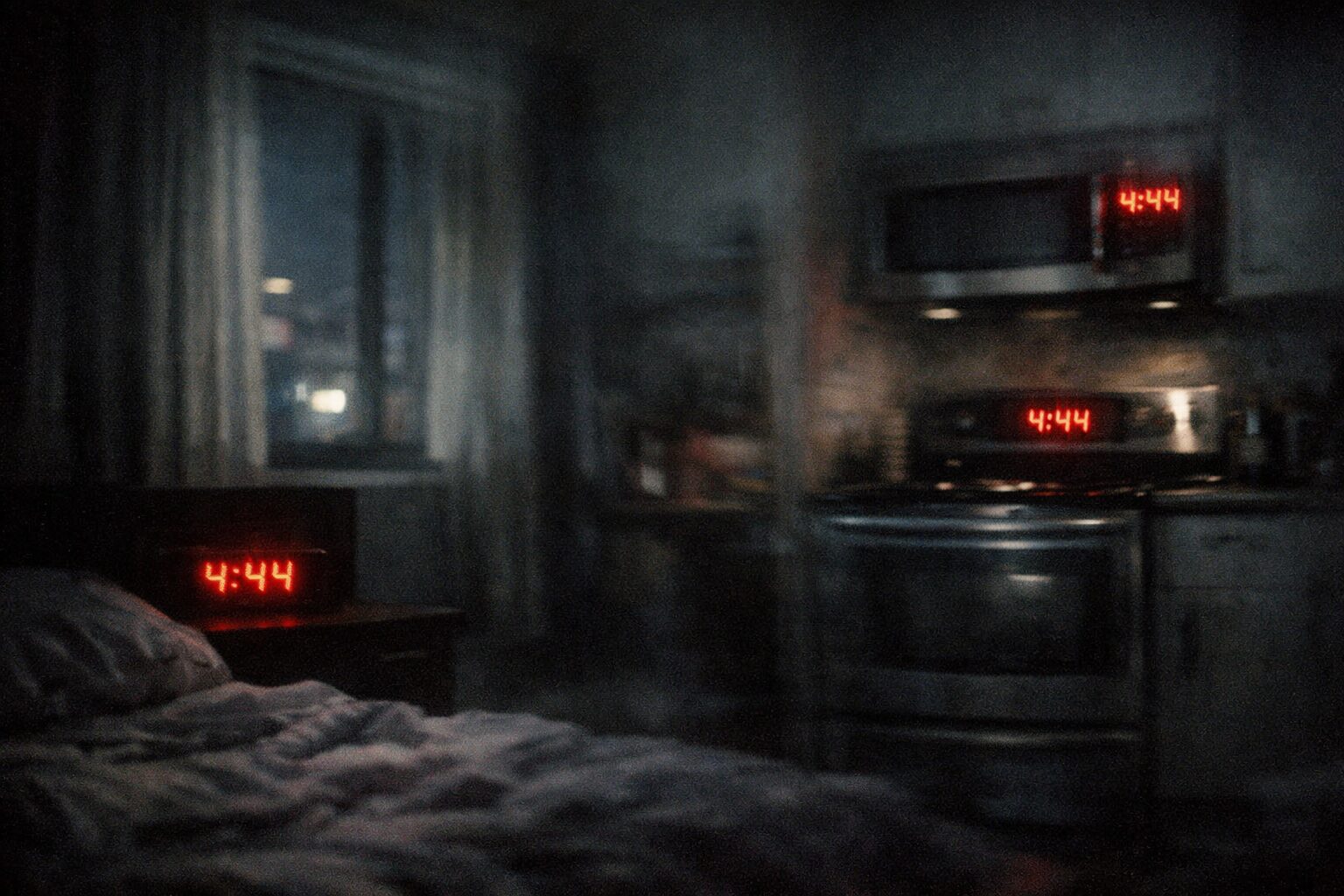
The first night I noticed it, I had been asleep, and then I was sure I was awake. The room was the same shape but seemed to lean, as if the building had exhaled and not bothered inhaling again. I could see the red digits of my cheap bedside alarm clock: 4:44. My phone, when I tapped it, lit up with the same time. In the kitchen, the oven’s display showed 4:44, and the microwave, too, a twin set of red mouths open in the dark. The analog clock I’d hung with a crooked nail in the living room—white face, thin black hands—had its minute hand pinned at forty-four, the hour hand between four and five, a precise angle that felt like an accusation.
I stood in the doorway and let the cold from the kitchen tile climb my feet. It was too quiet for a city; no trucks, no laughter from the alley smokers, no bottle clink. The silence felt like someone had told the block to stay still. I drank some water. I checked the deadbolt. I went back to bed with the taste of tap water sitting inside the back of my throat, and I fell asleep without meaning to.
When I woke again, I was on my side, hand under pillow, the alarm clock buying my attention by adding and then subtracting the same numbers: 4:44. I didn’t move for a long time. The red glow made the room seem warmer than it was. I tapped my phone. 4:44, again. I pulled the covers over my head the way you do instinctively, the way you did as a child as if cotton could become wall, and I listened to the thin, high note of the refrigerator humming and to my building’s elevator thudding somewhere down the hall. It all felt the way a word feels on your tongue when you’ve said it too many times: hollowed out, unfamiliar, like it was trying to tell me I’d been here already.
By the third time, the apartment had picked up a different angle. My feet found a rug at the side of the bed that hadn’t been there before, a thin runner I’d meant to unroll earlier that week and hadn’t. The plant I’d put on the sill—a gift from a friend, unkillable pothos, an optimism I didn’t deserve—had a leaf missing that I would have noticed. The mug on the counter had its chip on the wrong side. The detail felt so small I thought I could ignore it, and then the thought of ignoring it felt like walking past a person you know without saying hello because you’re not sure if they recognize you. I didn’t turn the lights on. I let the place be dim and careful.
I did the simplest thing I could do to be in the main story of the night: I took one of the batteries out of the living room clock and laid it on the bookshelf. I made myself do it slowly so I could remember it later and tell myself it had happened. When I turned around, the microwave and oven were still spelling out 4:44 as if I hadn’t moved, as if time was a sticker someone had pressed onto every surface. I waited until the need to sleep came back and took me.
What came next felt less like waking and more like being presented with the word “awake” on a flashcard. My neighbor’s music was low and then wasn’t there. A siren grew and then failed before it could arrive. I opened my eyes to my alarm clock’s red mouth frozen at 4:44, and my phone lit up without me touching it, offering me the same. The battery I’d laid on the shelf was gone. The living room clock sat on the wall in the same crooked way, ticking, minute hand exactly on forty-four. I put my ear to it and heard nothing, not even the cheap grinding sound of a failing mechanism. The hum of the refrigerator stuttered and then started over with a breath like it had lost its place in a sentence. I felt the edges of the room soften and slide, like the building had shifted when I was looking at something else.
There is a kind of tenderness in these things, when they happen. You start asking the room to treat you gently. You touch the corner of the table you’ve always bumped your hip against and feel the groove your body has already made. You test the door chain to see if you set it at all, and it is hooked in a way you never hook it, high and backwards, an arrangement you couldn’t recreate even if you were fully awake with bright lights on. A hairline crack in the kitchen tile runs left to right when it used to go the other way. My books—my defense against every feeling I don’t want—had slid a half inch down the shelf as if gravity had changed its mind about thin wood.
I don’t know how many times I lay down and opened my eyes again, but I know the moment I found the note. It was on my little table by the window, the one I’d put there to make me think I might watch the city happen while I drank coffee and instead left to become a place for coins and keys and scraps. A torn piece of lined paper from the back of the cheap spiral notebook I kept for grocery lists, blue-ink handwriting that looked exactly like mine if I’d written it with my left hand in a moving bus. It said: “Don’t get up.” The D was a little too sharp. The apostrophe leaned the wrong way. I touched it and it felt cold the way stainless steel does.
I didn’t remember writing it. I checked the notebook and there was a missing page, the tear ragged and a little toothy. My blue pen lay there with its cap off like someone else’s bad habit. I was caught on the question of who counts as someone in a moment like that. The urge to follow simple instructions is a kind of gravity, too. So I didn’t get up. I lay there in the dull red light of my room’s clocks and let the words sit on their small torn island until my lids grew heavy and closed.
When I came back, the note had another line, smaller, fitted beneath the first like an apology: “Not yet.” The handwriting the same not-quite version of my own, each letter crowded, as if whoever wrote it had been trying to be brief and couldn’t. The plant had regained its missing leaf in a way that felt like a reverse of snapping a puzzle piece into place. My mug’s chip had hopped back to the right edge. The rug under my bed was gone again, and my feet met cold wood when I swung them out. The battery I’d once set on the shelf now sat on the table beneath the note, centered, as if it were the period at the end of a sentence.
I have heard people say that the worst thing in those loops is the sudden obviousness of the dream, but for me it was the equal obviousness that it couldn’t be one. My phone should have betrayed the trick. It didn’t. I held it. The glass was cool. The little scratches I’d made with my keys by mistake were still there. I could see the top bar, the time, still 4:44, the numbers clean, the battery icon stubbornly, impossibly, frozen. My thumb dragged and didn’t leave a smear. The oven light flicked when I tapped it and showed me the inside like a stage with no props. I could hear the building’s elevator open and close on the empty night, the doors sighing like a person who had let themselves cry alone in a kitchen at 4 a.m. for so long that it had become a habit.
I tried, once, to force it. I set the living room clock to 3:00. I unplugged the microwave and plugged it back in. I put my phone on airplane mode the way you do for a flight even when you know it probably doesn’t matter. It didn’t matter. The minute my eyes closed and then opened again, the digits had returned to 4:44, the hands had crawled back to their angle. The card table I’d pulled from the wall and popped open sat folded again with its legs blunt against the paint in a way that left new crescent marks. The bathroom mirror had a tiny ripple at the bottom like heat on summer pavement, a wobble that made my face look the way your own voice sounds when you hear it recorded and cannot accept it is yours.
Outside, down in the alley, there should have been the bakery trucks, the slurry of voices, a cooing chorus of pigeons arguing over stale bread. There was one heartbeat of sound that pretended to be a distant bus and then fell through a trapdoor. A cab passed with its headlights off and no motor noise, a drift of light like something underwater. Upstairs, someone walked across their floor with careful feet, and each step arrived a half second before it should have.
I found the note again when I turned back to the table. It was shorter now, not longer, as if something had been erased, ghost letters pressed into the paper where the ink had been. I could make out only the tail of a y and what might have been the hint of a t. The battery rolled a little all by itself, then stopped, as though it had decided to show me the flat head of a screw and then changed its mind. The rest of the apartment had the expectant hush of a theater waiting for the lights to dim and never quite dimming.
At some point, if there was a point, I stopped appealing to logic and lay back down because the instruction wasn’t hard. I thought about my advisor’s voice on the phone when I asked for an extension once; the softness before the no. I thought about my mother, who told me once in a grocery store: Don’t make a scene. The room became sleep again without me telling it to. The last thing I remember in that passage of night is the quietest click: the sound of the oven clock resolving an argument with itself and then choosing a number it already knew.
Light woke me. Not the red clock light, not the quiet hospital glow the city makes on rainy nights that slides on the walls like a hand feeling for a switch. It was gray morning, an authentic color, grainy and somehow generous. Traffic made a river noise under the windows. A bird scolded someone from the fire escape. My radiator knocked and breathed like an old creature that had decided, finally, to go back to work. I listened until I was sure the air wasn’t faking being air anymore. Then I rolled over to check the nearest clock.
The alarm was blank—no digits, just a black window reflecting a thin version of my face. My phone refused to wake for a long second and then offered up a lock screen with no time on it, as if it had forgotten that part of its job. The oven display was dark, the microwave a wide unlit grin. I went to the living room and stared at the wall clock; the second hand was still in mid-tick, frozen a hair’s width away from another notch. I took it down. It was light in my hands, the way you don’t expect clocks to be. I shook it once and listened. It made a sound like a pebble in a jar and then quieted, as if embarrassed to be caught.
I made coffee. The kettle shrieked like it had been waiting to speak. The bakery downstairs clattered new pans. The hallway filled with voices and steps and someone letting a door shut too hard. Everything took itself up again and made its noises and seemed to remember the script. I tried to be grateful for the story of daylight. I told myself that any minute the power to the clocks would sort itself out, that I’d replace the battery I’d surely taken out at some point, refill and reset, let the red digits count forward. I told myself I would plug in my phone and it would return to its stubborn little clock as if nothing had happened.
When I finally did plug it in, the screen shivered and bloomed, and a time appeared that could have been anything; it didn’t match the coffee maker, which had blinked 12:00 into the room like the start of a bad joke. I decided I didn’t need to know what time it was exactly. I ate a piece of bread standing at the counter. I put the living room clock back on its nail and let it sit like a silent witness. The apartment had resumed the run of ordinary things, an orchestra tuning itself in a way that passes for music when you are grateful enough.
Before I left for campus, I put the note on the refrigerator with a weak magnet shaped like a city skyline. By daylight, the blue ink looked harmless, like a message you’d stick to remember laundry quarters: “Don’t get up.” The impression of the second line was almost gone in the glare. If I held the paper at an angle, I could still catch it, the indentations rising like veins. I put my thumb on them, lightly, the way you test paint to see if it’s dry.
It left a faint gray on my skin, like graphite.