The Dream Warned Her Not to Open the Door
She woke with the words still in her mouth, as if she had been the one who spoke them to herself in the dark: Don’t open the door after midnight. The bedroom was washed in the pale hum of the city. A soft hiss from the old radiator in the wall; the faint seawater sound of traffic far off, an elevator cable breathing somewhere in the building. She lay on her back and stared at the ceiling. The rectangle of light from the street made its slow, watery pattern, and the digital clock beside the bed said 12:52 in patient red numbers.
In the dream, she had been in this very bed and the light under the front door had been the only light in the apartment. Three soft knocks had come at exactly 12:17, each one the same weight, as if measured. The bulb in the hallway had flickered in slow, resigned pulses, and she had thought, with the blunt clarity that only happens in dreams, that if she opened her door, something would be pushed into her apartment that could not be taken back out. She had not seen a face. She had only heard a voice she knew ask her to open it, gentle and ordinary, the way someone you trust might ask you for the time. And over all of it, a second voice, without a mouth: Don’t open.
Now awake, she exhaled into her hands and sat up. The apartment was not large: one of those quiet places that feel held together by coats of paint, narrow and honest. She went to the kitchen for water and stood barefoot on the linoleum. The refrigerator ticked. She could see the shadowed strip at the base of the front door from where she was, the little bar of borrowed light from the building hallway. It looked just like it had looked in the dream, except the light held steady. She waited a minute, then two. Nothing knocked. Finally she set her glass down and went back to bed, leaving the lamp on.
All the next day she thought about it, as if the dream had been a thing misplaced that she would someday find again by chance. On the train she watched the soft faces of commuters in their early morning quiet. She told herself there was nothing to it: her brain had stitched together scraps—the neighbor’s boots coming home late, the elevator’s settling clank, the way the hallway light sometimes took a second to come on when you stepped outside your door. But on the way back up the stairs that evening her key trembled once at the lock, and she remembered the sound of the knocks with a strange certainty, the exact distance between them.
She tried to anchor herself in the ordinary. She folded laundry and sorted the socks and put a row of oranges in the wire bowl on the counter. She wiped the counter twice. When the building settled and the evening smoothed down, she turned on the lamp by the couch and read, then didn’t read. At 11:40 she brushed her teeth and paused with the toothbrush in her mouth because she thought she heard the neighbor’s door down the hall open and close twice without footsteps. She laughed, a sound too light in the small bathroom, and moved her book from the couch to the bedside table with the clock. She did not lock the deadbolt only once; she locked it twice, keeping her hand there a second longer than necessary to feel the metal sure under her palm. It was a habit she did not think of as a habit.
She was almost asleep when the clock read 12:16. She had not planned on watching for it, but she couldn’t help shifting toward awareness. A whisper of emergency threaded up along her spine, a gentleness of panic the way you might feel waking to remember you left the stove on. She listened to the nothing, and the apartment offered her nothing; it had nothing to declare.
When the first knock came at 12:17, she knew, instantly, it was the same. There was nothing remarkable about it: it was not loud, not aggressive, not the knock of someone furious or drunk. It was the knock of someone certain you were home. Three equal taps, each one a breath apart. She pulled herself to sitting so quickly her knees bumped the nightstand; the lamp trembled, and the red numbers blurred and then sharpened again.
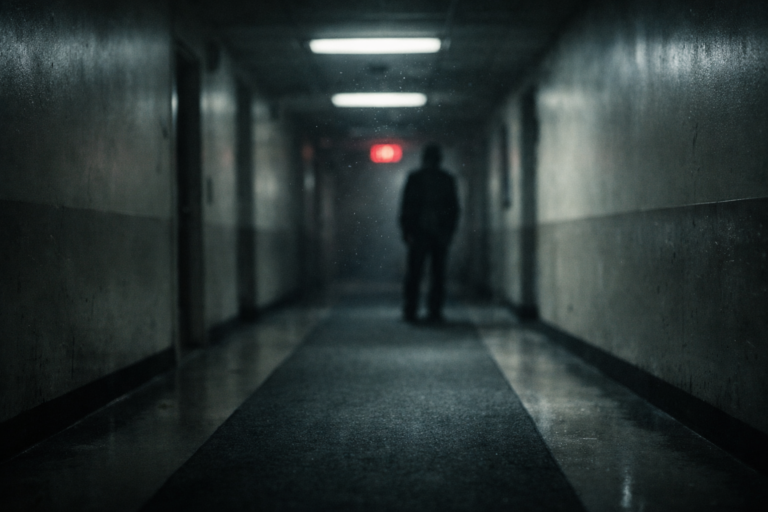
She waited for a second series to prove she had imagined it, that it was something settling, a trick. Instead, the light from the hallway went dim. Not out, exactly—just dim. It thinned, like milk in tea. Another small breath of time, and then there was a gentle click somewhere above the door, and the light came back a little too bright. Then dim. Then back again. She could hear the bulb humming, the way old bulbs hum: a wire singing where the air can’t see.
In her dream, the hallway light had done exactly that. She threw the covers aside and stood up bare-legged in the bedroom doorway, looking down the narrow hall at her front door. The chain was slid across; the deadbolt showed its brass tongue. The mat she kept on the inside was in its place, dark and coir-stiff, angled as always so the corner didn’t catch on the jamb. Her shoes were exactly where she had kicked them off. Everything was as it should be, except it also wasn’t, because the light outside continued its slow, tireless pulse and a thin, careful shadow moved under the door as if the hall itself breathed.
The second knock came, then the third—not in a set, but singular, each one placed as if someone were tapping a fingernail and listening to the wood for an answer. She went to the peephole and put her eye there, and saw the same small distortion she always saw: the gold fish-eye of the hall with its painted cinderblock and the corridor that slid away to the right. The bulb above cast a cone onto the scuffed tile. There was no one in it. Not the glossy black of a shoulder, not a shoe toe. Just the grainy sameness of late night, bared to her like a planned photograph of nothing.
She thought, with a steadiness she could not quite believe in, that she would simply wait them out. She leaned her forehead gently to the cool of the door and felt the fine tremor of the building—maybe the elevator descending somewhere out of sight, maybe the deep, low train under the city hauling the night along with it. She placed a hand on the inside knob, because in the dream she had placed a hand there and it had been so cold it felt damp. The knob was cold now, too. There was a faint film to it, as if a wet hand on the other side had drawn heat through the metal.
Her phone glowed when she tilted it, a face pale in the dark. She texted the neighbor whose name she knew but whom she had barely ever spoken to: You awake? There’s someone knocking. She watched the little sending bar cross. She waited. No dots. She imagined the phone in that stranger-neighbor’s silence, dark on a dresser, inhaling her message and giving it nowhere to go.
“Hey,” a voice said from the hall, right at the door, the word quiet as a question. And the familiar shape of it slid under her skin like a key finding the cut it was meant to fit. It was a voice she knew in the way you know the voice you grew up with answering the phone: its particular warmth, the way the vowels angled toward comfort. It said her name. It said, “I left my key. Can you open? I won’t come in. I just need to talk to you for a second.”
In the dream, the voice had said precisely that, every comma in place. She told herself the thing that people tell themselves when they know they are being arranged by something else: Maybe he’s been drinking, maybe he forgot, maybe he’s joking, maybe he’s here to apologize. But the person whose voice it was did not live in this building and had not, in months, known or wanted her door. She tasted metal at the back of her tongue. The light above the hall made its gentle pendulum again: bright, thin, bright.
“It’s cold out here,” the voice said. “Open up a little. I won’t come in, promise.” It said the word promise the way he had always said it, with the smallest smile at the end of the word. She could have opened the chain and let the door swing the width of two fingers and recognized, or refused. The space between what she could do and what she should do made a pressure in her chest, like standing at the top of a very clean flight of stairs and knowing a fall is possible simply because your body remembers what falling is.
She kept her hand on the knob and did not move. She imagined the thin metal of the chain, the neat loop that would slip free if she angled her wrist just so. The voice tried her name again, softer, patient as a nurse. From far down the corridor, or from another floor entirely, metal scraped metal with the little cry of the elevator doors catching. Her neighbor’s dog padded once and then lay down again, its nails clicking out a small half sentence on tile. The sound of the building lifted and lowered like a winter pond risings to crack and then settle. She did not open her door.
Minutes began to make themselves into a shape. 12:20. 12:28. The red numbers took to marching. Sometimes there was no sound at all beyond her breath and the bulb’s tiny hymn. Sometimes there was the shoulder-brush of something at the other side of the door, the hint of cloth passing as if someone leaned close. Once she heard a faint, wet adjustment, as if a damp sleeve were being tugged. Twice, exactly twice, the voice returned with her name, unthreaded from any other sentence. It did not knock while it spoke, and it did not speak while it knocked. It obeyed its own weird pace.
At some point, her legs grew too tired for her to stand in the frame of the hall. She slid with her back to the wall, knees in, and watched the dark rectangle of the door, the underline of light. Her phone slept. The apartment was very clean, suddenly, in her eyes, as if it had already been abandoned. She thought of the oranges in their wire bowl next to the sink, rows like small suns, and knew irrelevant things with a focused clarity: the top orange had a bruise she had rolled to the back, the dish towel hung too long off the oven handle, her mat inside the door always formed a little arc of grit in the same corner. She closed her eyes and opened them again because the voice said her name not as an invitation this time, but as if it had just discovered there was a name to say.
“You’re going to be sorry,” the voice said then, without malice, like a fact that had simply been reached. She slid further into herself until her chin tucked the top of her knees. The hallway light, beyond the door, hummed and held a steady glow—only not steady, because now that she looked it was never steady, it was a ripple of steady, breath on breath. The clock hushed past one, then two. The last set of knocks came with the patience of a teacher. Then there was nothing.
Nothing wore the long hours down into themselves. She must have slept there, eventually, slumped and folded against the baseboard, because she woke hungry and confused to a gray that belonged to the morning trying to figure out if the day would be bright. The apartment was the apartment. The radiator sang its low J like always. The silence had the sound birds make when there are windows between them and the branches. The hallway light above the door—she could tell its color by the tone under the threshold; it was warmer in the day—stayed the same, sky-steady. Her phone read 6:41. There were no new messages. The building had resumed its patient, domestic ticking.
She unlocked the deadbolt and then stopped with her hand on the chain, because the dream did not say what to do in the morning. She unhooked it anyway, because it felt childish now to hesitate when there was sunlight, when the city was out there already making decisions without her. The door opened to the width of her palm against the jamb, then all the way. The hall lay in its own draftless clearness. Down by the elevator, the carpet was flattened in the center where everyone’s feet had taught it to be. Nothing waited nearby. It was a building on a morning.
She almost didn’t see the mark at first. The paint on her door was a few years old, clean but with that faintly glossed skin common in halls everywhere. At the height of a shoulder, left of the peephole, a handprint bloomed, so clear it carried the splay of fingers. The moisture had not dried, even though the rest of the hall air felt normal, and small beads had collected in the arcs between the print’s lines, like dew pooled on a leaf. It was not her hand. It was a touch that had paused there long enough to choose a shape. And below it, her mat lay where it always lay except it didn’t, because someone had turned it around so that the wear-marked corner that always faced in now faced the corridor, as if whoever had been there had made room for themselves on her side and then thought better of it.
She stood with the door still half-open behind her, the chain swaying and whispering against the wood where it had been unlatched. The hallway light didn’t flicker. The building hummed in its morning. The voice had no reason to speak in the daytime, and it didn’t. The handprint kept its brief, wet life on her door, and the mat, quiet and unassuming, presented the wrong side to the hall as if that had always been the way it was meant to be.