He Drew the Basement Before the Search Team Entered
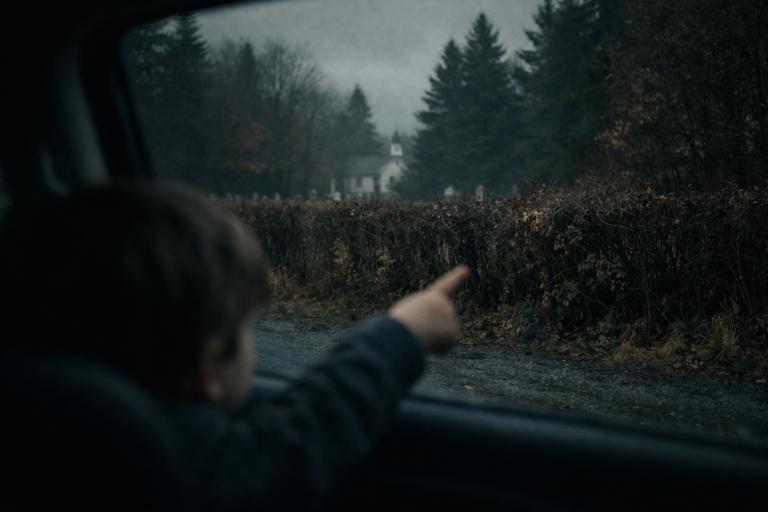
The house waited with its windows boarded and its porch rail buckled in the cold, the way some animals pretend sleep to see who will come close. They parked two trucks in the rutted lane and stepped down into a light wind that stirred paper from the ditch and set it against the chain link. Their breath showed. Someone had hung a yellow notice long ago and the ink had washed out to gray. On the clipboard there was the county parcel number, a warning about black mold, and a stamped signature nobody recognized. They had masks and nitrile gloves, a tape measure rolled tight like a metal insect, a CO detector held like a talisman. One of them tapped the siding with a flashlight and listened to it answer through the studs.
They worked in practiced silence. The shortest of them, the one with the old green jacket that still smelled faintly of roofing tar from another life, unspooled thin nylon line and clipped it to the porch beam so it wouldn’t swing into them. Another lifted the front mat and found nothing under it but fine dirt. They had their own habits; they didn’t announce them, they just did them, and when one bent to secure the boot cover over a laced toe, another was there with a hand to steady a shoulder.
The key for the padlock came from a county liaison who met them where the asphalt had broken into gravel. He spoke with the quiet of someone trying not to raise the dust. He had blueprints in his satchel, folded until their edges felt like wire. He pointed at thin lines that showed a rectangle beneath the footprint of the house. The plan said basement, open, two posts, stairs center-north. He tapped it twice with the eraser end of a pencil, as if a rhythm could make it truer. They nodded. The woman in the green jacket placed the copy of the plan under the elastic cross of her clipboard and it became part of her chest for the day.
Six miles away, in the basement hall of a church that they sometimes used as a staging spot, a man they didn’t put on paper drew a basement none of them had seen. He sat at a plastic folding table with the courtesy coffee untouched and the fluorescent lights buzzing, their sound scraping along the skin. He was not on the roster and he wasn’t paid. He had no uniform. He had a school notebook, the kind with a black marbled cover, and a handful of pencils worn to stubs. The woman in the green jacket had twice stood far away from him the way people stand from something hot—even if it doesn’t look like much—because there was no place to put her hands when he bent and began to draw.
He laid a rectangle on the page as if it had already been there and he was bringing it out. He drew stairs at the far right edge, narrow, eleven treads, with the third missing. He pressed his thumb to a corner and smudged a crescent like a water stain. He wrote “low ceiling” along the south line, and “shelves maybe not attached” along the west. He drew a circle with a scribble—“heater tilted”—and a little square “post red.” He attached a dotted line behind the shelf and labeled it in a small neat hand, “through here, a back room.” When she looked up from the clipboard and realized what he had marked, she felt the light in the church basement tilt, as if the floor were angling her toward him.
The first wrong thing was so simple she almost missed its wrongness. The county plan showed the stairs center-north, square against the flat wall below the front windows. They had walked the exterior earlier in the week and seen the ghost of those windows beneath the plywood. Everything said the staircase would be where they always were in houses like this. He, who had never seen the outside and who was drinking nothing but his own patience, put the steps against the opposite wall and added a scratch of graphite at their base that looked enough like a pile of debris to make her feel the soft crunch of it underfoot in advance.
He did not speak like a seer. He didn’t speak very much at all. When she stopped by the church basement to collect the CO detector and the spare mask box, she paused by his table and he lifted the page enough so she could see without touching it. “Is that for ours?” she asked, and he nodded without lifting his eyes from the place where his pencil was making a small open circle in the margin, the way a person does who is pretending not to notice their own hand.
They drove back to the house with the notebook page copied on a phone. The woman slid it out of her notifications and held the image with two fingers to zoom. The picture stuttered on bad reception and the pencil lines grew grainy, but the marks remained: stairs right, shelf broken at the third upright, a door behind a door. The county liaison waited in his car and pretended to make a call. The sun sat on the roofline like a level bubble. Someone tugged at the padlock and it moved like something that had been cold for a month.
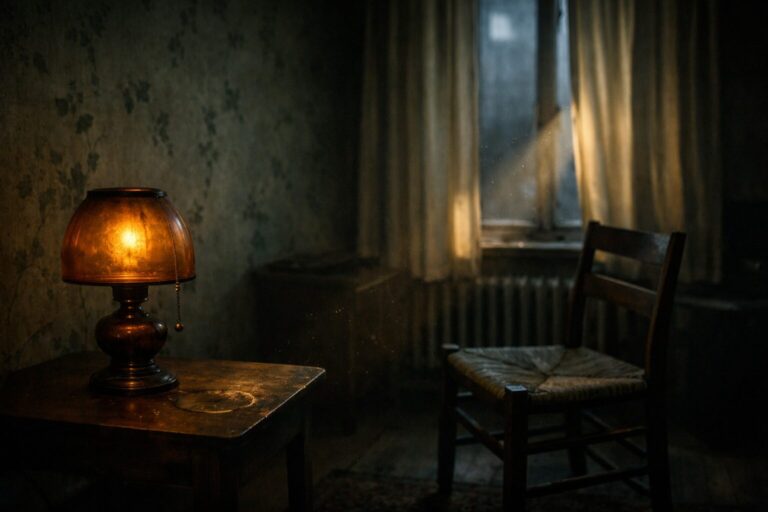
They swung the door open and the room exhaled. You never knew what smell would come with old air. This one was coins in wet cloth. The wallpaper in the front room had a pattern of violets now the color of ash. A calendar hung from a nail above an oil heater that wasn’t there anymore; it had the wrong month of a wrong year and a recipe for dumplings along the bottom in a font with its own good manners. Their lights made the dust wake and move. In the hall there were dark ovals rubbed into the paint where hands had been. They spoke in low voices to one another not to complete thoughts so much as to release them back into the room.
They didn’t go down first. They never went down first. They cleared the main floor, photographed the turned-over chair without remark, counted windows and found one cracked diagonal, measured the distance from the kitchen sink to the back door. Small acts pinned their minds to the present. The woman with the green jacket noted three matching sets of prints in the fine dust on the tile by the refrigerator space and drew a small square on her own copy of the plan that had nothing to do with the house below her. She wrote, “three sets,” and drew a question mark, not knowing why the question lived there, only that it did.
When they finally stood at the basement door, the air at the crack greeting their ankles, she felt the first thread of that earlier wrongness pull across her throat. The door was not in the kitchen where she knew it should be. She knew because she had known since earlier in the week, when they had walked the perimeter and tried to match their bodies to the interior like people trying to read a word through a closed book. She knew because the county plan had told her. But the door, set in the hall against the right-hand wall, sat where his pencil had put it, and the quiet of the house remarked on that all by itself.
Everything else narrowed. The light found the saw cuts in the stair treads, rough and bright under the dust. Third tread missing; she stopped on the second and reached over the gap with the toe of her boot, then stepped down. Their lamps threw their own shadows forward and the shadows shook when their hands shook. The first clump of spider web brushed her cheek and she didn’t flinch because she had already decided not to flinch. The concrete was there, cold and made grayer by the winter light. On the far wall, a post painted sometime long ago with a red she had seen a thousand times in barns and playground rails and the inside of workshops, dulled by the years into something like a memory of red more than the thing itself. He had written it. There it was.
She standing at the base turned and took in the room slowly, pressing photographs into the back of her eyelids, comparing each to the page on her phone and to the plan under her clipboard strap and to the small catalog of basements she had kept ever since she was a child and her father had finished theirs and left the wood smell in the air for a month. Those stairs were wrong against the catalog. That post did not belong where it stood, not in her memory of this house or any other. The simple fact of it — that something she had been sure of for so long didn’t map — made a column of cold run down her arms.
There were shelves along the west wall. One set at the end had slumped when the third upright cracked. On their boards lay the world in miniature. Rusted screws clustered like a spill of cheap pearls. A mason jar of roofing nails had broken its rim and held onto its ruin as if a hand would soon put its mouth back together. An orange extension cord, looped and tangled upon itself, was hooked by its last loop to a nail, the way his pencil had suggested with a thin arc and the word “hook.” The heater sat with a listing tilt as if bowing toward them. The post wore its red like a story no one told at the table but everyone carried.
There was a place where the cinder block changed sound under the knuckles, and one of them found it by leaning to pick up a bottle cap and laying a hand there for balance. “Here,” he said, and they all heard it. The shelf in front was not attached to the wall; the boards had been braced against a second line of blocks, leaving a shallow throat of space that had never been meant to be a passage. A splinter brought a thin red comma into the top of someone’s thumb and they pinched it clean. They set the lowest board aside. When the woman in the green jacket pressed with the flat of her palm, something shifted. They pulled, and the board gave, and a rectangle of pitch was their reward.
It was a small door, twelve inches narrower and a head shorter than any door had a right to be. It had been painted the same dull color as the wall, to learn the trick of hiding in plain sight. She put her headlamp close and saw the outline. Her mouth found air as she breathed and she didn’t know she had been holding it. She lifted the latch and something moved behind the threshold like a breath that did not belong to the house. She put her shoulder in — a bad habit, she knew it — and the door came forward and the cold in the little room beyond did not belong to the weather.
They stood around the low room and let the beam run over the floor. It was tamped earth that remembered the shape of shovels. Someone had once put down sheets of newspaper that became part of the soil. On the left there was a child’s school desk with a lift-up top. It was turned on its side as if braced against a draft. Dust had settled along the inside of its legs like a skirt. There was a thermos with plaid paint and a cup for a lid, and when she brushed it with her glove, the top came away and inside was a curl of paper that had remembered words and lost them. She did not take it. The shelf that had hidden the door cut a line across the light like a horizon. She turned and looked back at the main room and the post and the orange cord and then at the drawing on her screen. Every part of it sat where his pencil had set it down hours ago.
She felt then the slow alarm of a memory pushed aside by a second memory. She had walked the outside of this house two days before and had put her finger through the ragged curtain in a basement window to feel the empty for herself. She could see her hand do it now. She had seen, through that gap, the square wall without interruption; she could swear it on the clipped grass and the nerve of her own name. But the wall in front of her, bent back now around a door that had been here longer than two days, made her picture of those minutes go watery at the edges. Something in her began to accommodate this new fact, and something else in her refused, and the refusal stood up straight inside her like a second spine.
The radio at her shoulder spat once and found the man’s voice as if it had been waiting on the other end of the line the whole time. He did not ask what they saw. He said, as if continuing a sentence they had left him with in the church basement, “In the little room, look to your right. There’s paint cans stacked.”
She turned her light. No paint cans. The tamped floor was dry in a way that remembered wet. There was a shallow round mark on the earth near the right-hand wall, a ring where a circle had once kept the dust from settling, like the pale where a cup lives on a table. She put her boot there and the earth gave as if it had learned the weight of a can a long time ago and still expected it. She said on the radio, “No cans,” and heard her voice travel the cable and cross the miles and return to her as someone else’s answer in the man’s chest.
There was a pause that touched a thing she did not want to touch, and then the radio clicked again and the paper-on-paper sound came through as he turned a page. “Past where the cans were,” he said, and then corrected himself without knowing he had done so, “past the cans, there’s another door. It’s low like the first but longer. It runs into the dirt. You’ll feel it before you see it.”
She pressed her palm to the wall where his words wanted to make an opening. It was cool and flecked with sand. She found a smoothness in one place, a plaster patch maybe, a place that took the oils from her glove and made an echo of her touch. It was not a seam, only a stretch where a trowel had known the surface and then forgotten it. She looked at the floor again. The circle where a can had not been for a long time—or had been an hour before—sat in the lamp glow with its shallow lip of shade.
Some call these things coincidence because coincidence sits down quietly and does not ask for a chair. She had no name for a door that a man could add to a paper and have the wall in front of her feel as if it were holding its breath. She marked the spot on her own page without saying it out loud. The others moved their lights in slow motions like divers in water. They tapped and listened and heard nothing at all that would tell them yes or no. The air held the iron smell close to the concrete and did not pass it around.
They took more photographs than they needed. They measured from the red post to the hollow sound, from the shelf run to the little door’s edge, from the floor to the beam. They made numbers to anchor themselves. Her pencil broke and she felt a childish frustration at it, the thin lead giving up when she needed it to draw a plain line around the part of the wall where the man’s voice said something should be. The county liaison texted to ask for an update and she typed out that they had found an unrecorded room and then deleted it and wrote that they would have notes by afternoon.
In the church basement the man had added something to his drawing. When her phone decided to become a phone again after a moment of having no bars at all, his message came through with the photograph of that paper. He had drawn a second rectangle beyond the first and this one had a narrow blacking-out at its interior edge the shape of a mouth without teeth. He had shaded it as if it were not empty but not full. He wrote next to it with a hand he was maybe holding too carefully so the letters stood up very straight: “Not yet.”
They stood there until the light at the storm window died down to what they brought with them. The woman in the green jacket traced the smoother spot on the wall again and pulled her finger away as if it had become too warm. When they backed out of the little room, ducking their heads, their lamps threw their shadows on the shelves and their shadows wavered in the weave of the boards. She set the small door on its hinges again and it rested with the soft final sound of a lid on a box. She looked once more at the missing third tread as if it were a person she had forgotten to introduce to someone else and then let the darkness take that spot.
Outside, the same wind that had woken the paper at the fence now pinched her jaw under the earbones. She spoke into her collar to the man and told him they had not found the second door. He said, very gently and in a voice that had no triumph in it to use against anyone there, “I know,” and that knowledge was the wrongest thing yet, the small calm of it in his mouth like a spoon. She closed the truck door and the thud of it put a period on what had no grammar to offer her.
The day went on with its errands and its compromises. They sent an email. They agreed to return the next morning with a stud sensor and a second hammer. In the office where they kept the kits, she set the plan with the county’s stamp on top of the copier and it refused to catch, as if some thickness of truth kept its mouth from taking the paper. On her way out, her phone lit again with one more attachment. The photograph showed the man’s hand at the bottom edge of the notebook page, the skin whorled with pencil dust, the second door now drawn open the width of a fingernail, the black inside unshaded this time like a decision. The upper right corner of the page was dark where a dampness had lifted the fibers. It might have been a water ring from another cup, from another room entirely, or the memory of one, marked on paper that did not belong to any house at all.