The Child Pointed to a Grave Before Seeing the Cemetery
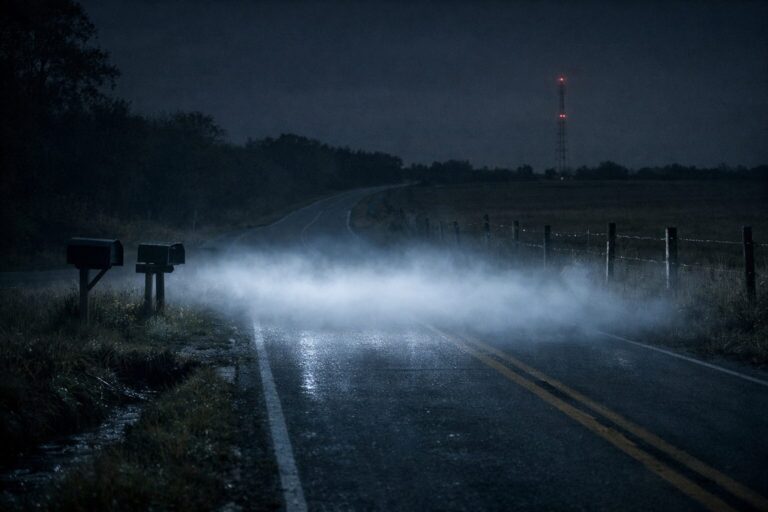
The road to my aunt’s place is the kind that changes shape with the seasons—spring ruts that snap your jaw shut, summer dust that lies like sifted flour over the ditches. That morning the fields were done browning and hadn’t yet gone stiff with frost. A sky of pale pewter, corn stubble standing like bristles, the smell of last-cut hay coming through a crack in my window. My niece was in the backseat, velvet hair matted on one side where she’d slept in the car, a juice box sweating onto her knees. She was at the age where everything is a matter of naming: the kind of cows, the color of roofs, the number of mailboxes in a row, and whether the clouds looked more like sheep or mashed potatoes.
She had one foot out of her shoe, toes worrying the toe seam of her sock, and a running commentary on all of it. “That barn has a broken smile,” she said when we passed one whose doors never quite closed. She had a teacher’s seriousness when she counted fence posts out loud, starting over when she lost track. I nodded, asked her to check again for horses at the long pasture, said we’d see if the big white one with the forelock still lived near the bend. She leaned in her booster to press her forehead to the glass and watch the ditch go by, the sawgrass, the occasional bright scrap of litter snagged in a thistle.
I told her we were going to see Aunt May and Uncle Ken, that there would be pie, that she could help pick the last of the cherry tomatoes if they hadn’t split from the nights getting colder. We might stop by the old chapel later with flowers, I added without thinking, because my aunt sometimes asks me to replace the jar at my grandparents’ plot. The child made a pleased humming noise, not because of the cemetery but because I’d said pie.
We’d just come through the low bit near the creek where the road heaves and then smooths, when she went quiet. Her finger lifted, that small, solemn gesture children make when they’ve remembered something important, and she pointed out the passenger side, beyond the bean field that had been cut down to its pale ribs. “Stop,” she said. The word was small and absolute. “Stop. They’re crying.”
I looked for a dog in the ditch, for an injured deer, for anything that would be crying in an observable way. There was the head-high hedgerow, the tangle of buckthorn and wild grape that shields the sightline along that stretch, and nothing else. No cars behind me. I slowed because that day had room for it. The gravel shoulder slid under us, a spatter ticking in the wheel wells. “Who’s crying?” I asked, trying to keep it light. In the mirror I could see her, hand still in the air, finger steady like a compass needle.
“The ones by the hill,” she said. Her eyes didn’t leave the spot she was pointing to. “By the box with the flowers. It’s so loud.” She pressed the heel of her other hand to her chest as if she had a side stitch. “They want somebody. That lady. The one named…” She squeezed her eyes, searching, a child concentrating in a way that always looks like pain.
There is no hill there, not that you’d call a hill. Just a long swell and then the country church half a mile further up, hidden by the cedars until you’re almost on it. The cemetery itself sits back from the road behind a sagging chain-link, a place that exists and then, as soon as you pass it, seems to fold back into the trees. You cannot see it at that exact spot because the hedgerow rises and there’s no gate on this shoulder, only the old farm track, sunken and rutted, where someone years ago dumped a rusting tractor hood. She didn’t know the chapel. She didn’t know the cemetery was there at all. She tugged insistently at her belt. “We have to help,” she said. “They’re so wet.”
My hand had already gone toward the hazard light. I stopped it. “We’re almost to Aunt May’s,” I said. The excuse hung there, thin and apologetic even to my ears. “We’ll check later, okay? We’ll see the flowers.” I used the last word like a bridge. She lowered her finger, but only slowly, as if not by her own idea. When we rolled forward again, her eyes tracked that place in the hedgerow and then, once we’d left it behind, moved to the window latch, her thumb working it even though the child-lock made it do nothing.
The porch was warm from the oven and the kitchen smelled like cinnamon and the clean, humid scent of dishwater. There were voices and a radio; the television muttered to itself in the other room. My niece slipped back into her other life as easily as a seal into water, chattering to my aunt about the red barn with the crooked mouth, lifting her arms to be swung up for a hug. The adults did the adult things—compliments about weight lost or gained, the inevitable talk about tires and whether this winter would be as bad as the last. At lunch my aunt mentioned, as she always does to anyone passing through, that if we were going by the chapel on our way back would we mind freshening the jar, the plastic one with the poppy print, because the last wind had blown it over and she hated to think of the picture of my grandmother lying face-down in the rain.
We didn’t go straight back. Hours happened in that slant, unhurried way they do in kitchen houses: dishes done, a short nap taken on the sofa by Uncle Ken, my niece making a fort from couch cushions and commanding us to crawl through the door if we wanted to be in her castle. Clouds skated over; light came and went. There was nothing, in any of it, that could have handed her what she would say next.
We left close to three. The country has its own sense of time; you think you’ve been somewhere for an hour and it’s the whole afternoon. I said we’d stop by the chapel now, while we still had daylight, and my niece sat up straight as a signal. “Flowers,” she said, as if reminding me of a promise. My aunt put a mason jar of mums in a bag with paper towels because the stems would drip. We loaded into the car with the lazy reluctance of the sated and drove the short bit down to the lane that turns off for the church, the road bending away from the hedgerow that had made me lie to a child.
The chapel is a small white thing that looks like it belongs in a snow globe. The cemetery behind it is older than it looks, stones rounded to loaves, lichened inscriptions that ask you to lean in close and let your breath fall on the names of the dead. In the foreground newer markers stand up straight and polished, plastic flower stakes confident in their color. There was a patch of ground not far from the path where the grass hadn’t taken yet and where the earth, even a couple days after rain, still looked moist as cake. The funeral home’s folding tent had left square shadows of crushed stems. On a holder by the head stood a white temporary sign, the kind with slots for letters. But from the gate all I could see was the white of it and the shine of bouquet cellophane slicking in the light breeze.
Before I could tell her to hold my hand, my niece unlatched her belt and slipped from the car. She walked ahead in that tilting, un-straight way children do when they’re mastering a new place, past the familiar family stones without so much as a glance. She didn’t pause at the bench where my aunt sits sometimes. She went right to the spot where the earth was freshly dark and put her small palm on the scraped dirt as if to steady it. “June,” she said. The word was soft, rounded, and came out more as a knowing than as a sound, and my first thought was that she was cataloging months again, that this was simply the one she could remember after May.
I joined her. The stems were tight, supermarket stiff. Dew still beaded at the throat of white mums. The temporary sign had been slotted with black letters, the first name and then a shorter last name, and though I made myself take in the whole thing it was the first part my eyes clung to: JUNE. There is a feeling you get when something in the room is too loud. It isn’t a sound. It’s the sense of your blood trying to find a quieter path through you. I stood there with my hands on the bag of paper towels and realized I was cold.
“She’s the one,” my niece said, and she stooped to tuck a strand of grass that had fallen over the mound. She had the carefulness children sometimes reserve for nothing except ants crossing a crack. “It’s wet,” she said, repeating herself, not sounding bothered by it now but explanatory, the way she would tell me the difference between lambs and sheep if it had just occurred to her. She put her fingers to her own sternum and pressed there once, gently. “She was looking. She was looking and nobody came.”
I don’t know what I said. I remember looking around for the person who had already been standing with us, only to find there was no one. The chapel door was shut. The road was far enough away that the tires hummed without profiles. I could hear our car clicking from heat and the ribbon on one bouquet making a small whisper each time the breeze lifted it and let it fall.
“Who told you her name?” I asked her. It came out too soft and too light, a voice used on airplanes when the person beside you is asleep. She didn’t answer right away because she wasn’t finished with what she was doing. She straightened one stake and pinched out a wilted petal and then patted the earth in three places, like she was following instructions she couldn’t skip. When she looked up, her face had the same faraway focus it had by the hedgerow. “She did,” she said. Not solemn or dramatic. Simply making a report. She blinked at me, a little patient, as if she didn’t understand why I’d asked what to her was obvious.
My aunt came up behind us, carrying the mason jar with two hands, and then my uncle, dusting his palms on his jeans the way he always did in places like this. “Not our side,” my aunt said quietly, reading, the way people do, the dates first and then the name as if time makes the name less heavy. “Who is she?” No one had known a June through marriage, through school, through church. Someone would have. In that county, you usually do.
I don’t have children. I don’t know what measure to take when a child seems so sure. You take their temperature with your palm. You put water near them. You ask it differently. I tried. “Did you hear someone say that name at lunch?” I asked, because there had been a woman on the radio with a song in a chorus that said June, over and over. Or maybe I had simply thought there could have been. My niece was already walking to the next stone, as if whatever had needed her attention at the fresh earth had finished. “No,” she said. She’d moved on to reading the little picture faces on a double stone, commenting on the man’s hair, the woman’s blouse.
We put the mums at my grandparents’ marker. We righted the jar. We had the conversation about whether to tuck the card under the rock so the wind didn’t take it. Ordinary, thoughtful, useless acts. I kept looking past to where she’d stood, to the bright, raw rectangle—because even with flowers and letters, a fresh grave seems like a word unspoken in a quiet room. None of us could explain to one another why our voices sounded thinner after that. On the way back to the car my niece slipped her hand into mine without looking up, a long-ago habit from crossing parking lots. Her palm was warm and dry as paper. She didn’t seem shaken; in fact, she was humming, tuneless. Back in the car she poked at the window switch as if testing it for power again, and then, when we turned out onto the lane, stared steadily at the trees without telling me what she saw among them.
That night my aunt called to say she’d asked around. June had been a widow from the next road over, a name that, to half the people in that town, would be a first day of summer, and to the other half, nothing but a month. There was no branch that connected to us. No girl in my niece’s preschool. No mention at church that would have filtered in, no obituary left open on a table that she could have seen and put together with a real place. My aunt talked herself into and out of a dozen answers in the span of a minute and then stopped. “I don’t know what to do with it,” she said, and neither of us did, and we didn’t try to make a shape out of it by talking any more.
Days later, driving that way again alone, I slowed at the same place without deciding to. The hedgerow humped up, the ditch ran along with its silver of water. Crows worked over something below the fence, then all at once hopped back like boys told to behave. Somewhere a harvest bin rattled. I glanced at the mirror out of the old habit of checking for cars and, for a breath-long instant, had the clean, bright certainty that if I looked over my shoulder she would be there in the booster, finger raised, chin tipped, ready to tell me where to turn. There was only the empty seat and the strap lying like a line someone had drawn where it would fall each time I braked. A small, silly thing to disappoint me.
I didn’t stop. The lane to the chapel went by. The sky came down a little, as if in time with the trees thicken. Somewhere beyond what I could see, a woman whose name I hadn’t known until my niece said it had been lowered into the ground with a handful of strangers standing above her, then had her name printed on plastic, then on stone. I keep thinking of my niece’s hand, small and certain, traveling through the air to point at a place concealed by thicket, and how she didn’t sound scared when she said they were crying. The unhelpful, un-fixable feeling of someone asking and being heard by the person in the wrong seat to help.