She Heard Her Sister Scream From Three States Away
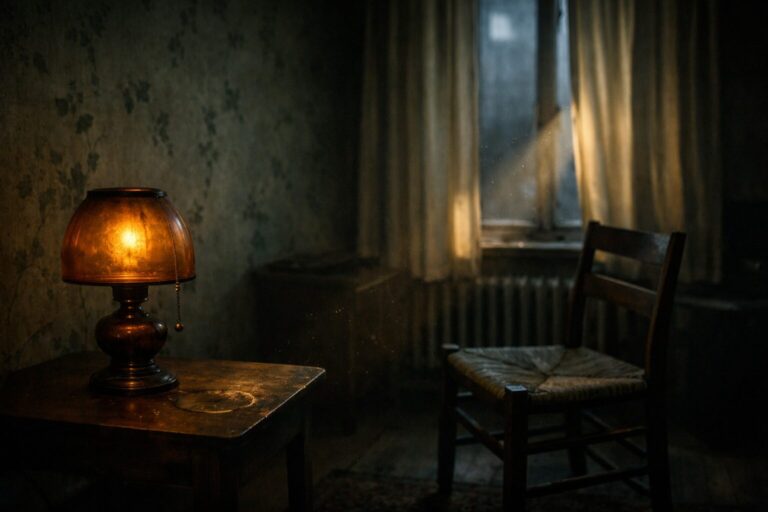
She had fallen asleep with the ceiling fan clicking a tired rhythm and the streetlight outside combing the room with pale bars of orange. The windows were shut against a mild wind; the curtains were heavy and a little dusty where they brushed the sill. Before turning in, she had checked the lock twice out of habit, thumbed a last text to her sister—something small about the plant they were both trying, an agreement to call on the weekend—and set the phone facedown on the nightstand. In the dark, traffic thinned. Somewhere in the building a pipe knocked once. She slept on her left side, face to the cool part of the pillow, her glasses folded on a paperback, the little digital clock’s soft red numbers keeping watch without meaning.
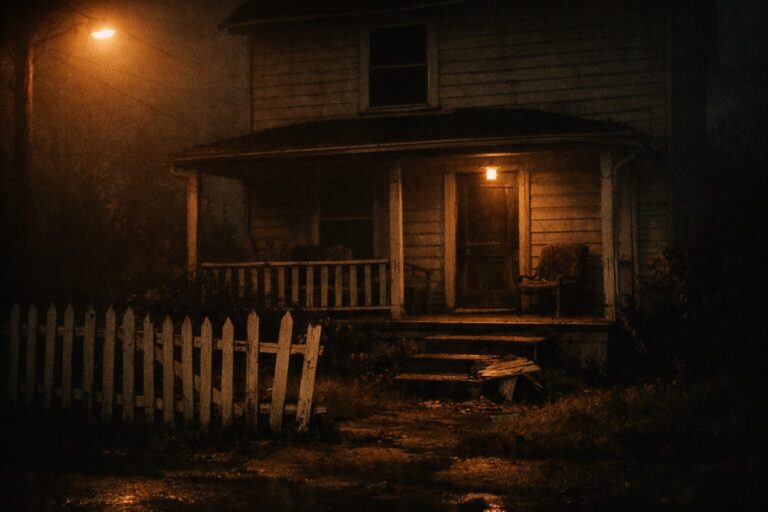
Three states over, her sister was asleep too, in a low house at the edge of a quiet street, the kind of place where porch lights made little islands on the grass. That other bedroom had a leaning mirror propped by a dresser because the wall wouldn’t take a proper anchor, and a braided rug with a fraying edge under the bed. She knew these details as surely as if she’d walked them that night. She could picture the cheap smoke alarm with the battery her sister said needed changing and never quite got to, and the narrow kitchen with the humming fridge, and the windows that rattled when the freight passed two blocks over. She turned in her own bed thinking of none of this, slipping under the late hour without any story forming around it.
At 2:41 by the cheap red numbers, the room spoke her name in her sister’s voice.
It didn’t come from the phone or from outside. It didn’t come down through the ceiling from the neighbor’s living room. It came from the corner where the closet door was left a hand’s width open because it never settled right on the track. It came as if her sister had been standing there, shoulder turned into the little wedge of darkness, and screamed her name at a volume that reached for her and hooked under her ribs. She knew the shape of it—the way her sister always stretched the first syllable by half a beat, the rasp that crept in when she was upset. She sat up so fast the paperback fell open and splayed like a failed bird.
For an instant after the sound, everything held. The fan continued to rock its slow circle. The air had that close, used warmth of a room where someone sleeps. A car rolled far away and didn’t belong to the moment. She wasn’t fully awake and wasn’t asleep, but she knew without question what she’d heard. She said her sister’s name back into the corner, a whisper, as if the room needed her to be careful with it. The closet door stayed ajar, an indifferent black seam. The hair along her arms lifted as if responding to a draft that didn’t exist.
She scrambled for the phone, knocking it against the nightstand so that it skated into her palm. Her hands were shaking enough to make the contact list slip under her thumb. She pressed the call icon and listened to the rings lift and fall, lift and fall, the bright little sounds that felt too small for the feeling in her chest. Straight to voicemail. She hung up at the start of her sister’s recorded greeting and called again. She could see the silver nick in her own screen protector catching a strand of streetlight, and her thumbnail, bitten a little too short, and the clock: 2:42 now. She tried again. Straight to voicemail.
She texted. You okay? Call me. Are you awake. Hello?? She watched the typing indicator not appear. She toggled between apps like there might be an answer in another one. She called one more time, pressing the phone so hard to her ear that the cartilage bent, willing her sister to be where she always was in the day—the voice reachable at a thumb’s movement, the laugh that always broke too soon. Out in the hallway something settled with a mild, belated clunk. She listened to the house try to pretend it was as it had been ten minutes ago.
She stood and crossed to the doorway. The apartment extended away very plainly: the gloomy rectangle of the living room with its low couch and the afghan folded back at a neat angle, the kitchen beyond stashed in its own dark with the microwave clock a faint blue square. No one stood in those spaces. Her keys were in the ceramic dish by the door. The chain was latched. She found herself thinking of the other house three states over, the dresser with the mirror leaning at that slight angle that always made you look different, the kitchen where a single night light under the cabinet put a weak puddle of yellow on the counter. She could picture her sister asleep, one arm over her head the way she always did. She tried to count that image into a kind of certainty.
She went back to the bed and sat without letting her knees touch the mattress, the way people do in hospital rooms. She called again. On the fourth ring, the call severed with a dry click. Call failed. She stared at those two words like a kind of small verdict. She set the phone down, picked it back up, put it facedown, turned it back over. She went to the window and moved the edge of the curtain and looked at the street, at a raccoon shouldering itself from one yard to another, at a porch light that had been left on and made a halo on its own steps. She thought about calling her sister’s neighbor, that woman with the husky who had once texted photos from a barbecue. She didn’t have the number. She thought about calling the police in a city three states over at two in the morning to ask for something she didn’t even know how to describe. She typed in the non-emergency line she found with a search and hovered her thumb above the call button until it started to ache.
Her phone vibrated in her hand so hard it made a damp slap, the name lighting the screen in her sister’s letters. She answered without seeing, and they both spoke at the same time.
“Are you okay?” she said.
“Are you okay?” her sister said. The question came on a breath that frayed out at the edges, too loud for the hour. Behind it, another sound, thin and insistent. “Have you been calling me?”
“Yes,” she said. “I woke up. I heard—” She stopped. The word hung, a shape she hadn’t given away yet. “I heard you.”
“I heard you,” her sister said, and quieted, like she’d been running and had to stand still all at once. “Right next to me. Like you were right here. I sat up so fast I didn’t even—” Her voice faltered and came right again. “I screamed your name. I thought— I don’t know what I thought. And then the mirror fell. It just went. It wasn’t even touching me. It fell forward like someone pushed it and it exploded everywhere. I can’t walk, there’s glass— It’s everywhere.” Her breathing came close and wet to the speaker, that small, private sound of somebody trying not to cry.
She closed her eyes and pictured the mirror propped by the dresser, the one with the thin frame like a strip of painted wood. She could see the glitter of glass in a dark room, all the little pieces turning over the night like fish scales. She could make herself smell the specific cold of a room that has just met the outside, the faint metal tang from where the frame bent. She pictured her sister on the far side of that yawning field of shards, phone out of reach on the cord where she always left it on the dresser across the room. “Did you cut yourself?” she asked. Her voice surprised her, calm in the middle of the strange pass of the hour.
“No,” her sister said. “I stood there and couldn’t move for a second. Then I found my sandals with my toes and put them on like someone teaching me steps over the phone. I kept stepping on nothing. The oven clock says… it said 2:41. I don’t know why I looked. It was just there. I could hear the other houses. I could hear… I don’t know. I turned on every light between the bed and the dresser. By the time I saw you calling, it was already 2:45.” She drew a breath—not quite a sob. “What did you hear?”
She leaned back against her bedroom door and felt the cool of the paint through her T-shirt, the intangible push of distance between that house and this one pressing down to the one trembling line that was their call. “My name,” she said. “In your voice. From the closet, like you were already in the room.” She realized her hand was at her throat without meaning to be there, thumb under the jaw the way one might test a pulse. “I thought someone was in here. I don’t know why I thought that. It was just so… familiar.”
They each went quiet with it then, the line filled with the little artifacts of two places at once: the whirring coil of her sister’s old fridge, the lazy one-two of cars idling by her apartment, the fan tapping its tiny habitual complaint. The hour had thinned the world to nothing but personal noise, nothing meant to impress or frighten anyone. She sat down on the end of the bed and felt the muscle in her thigh jump once, like a sparrow at a window, and then nothing. She looked at the closet’s narrow dark and saw nothing that hadn’t always been there.
“Did you hear anything else?” her sister asked finally. The question was gentler than their fear. It brought to mind a field between their two houses that each could tip their voice across.
She didn’t answer right away. She thought of how the scream had felt inside her bones, and how close the voice had been, and then, under it or beside it—not louder, just nearer—a second thing, as if someone who had always lived in the room had leaned too far against the words and let one slip. When she spoke, she made the sentence careful and slow, as if saying it wrong would spill something. “I heard someone say, ‘I’m right here.’” She tasted the words after and wished she didn’t know them.
Her sister let out the smallest breath. “Me too,” she said, so faintly that it felt like an admission left on a doorstep. They did not say the words again. They would not say them after that night, not to one another and not in telling anyone else what had happened. They sat for a while longer on their separate beds with the lights on, the phone call a narrow hallway they held between them like the only part of the night with walls. They agreed to stay on the line until the glass was swept and the sandals were on, until the closet door in one state was pushed with two fingers and clicked into a place it didn’t want to go. They said goodnight in a way that acknowledged nothing of the thing that occupied the room when they went quiet.
After, in the weeks when they told parts of it to different people, they measured their language. She would say she’d woken to a voice that didn’t belong to the hour, that she’d called and called and could not reach the person it sounded like, and then the phone had rung and her sister had been out of breath because of glass on the floor and a time on the oven clock that she hadn’t meant to see. They each would say the timing was odd. They each would say it wasn’t a joke anyone would play. They left out the second set of words, the ones that felt like a presence leaning in, not because they agreed to but because their throats closed a little on them without warning, like a body knowing something a mind would only dress in theory. Some nights since, she will wake and hear nothing but the fan and the street, and all that will rise in her is the knowledge of how complete a room can sound when it chooses to put a voice in it and then remove it again. The other house keeps its own hours three states away. The mirror was replaced with another that rests flush against a different wall. The rugs are shaken, the glass long gone. But both of them, waking or falling asleep, avoid one small phrase as if the words had heat. It sits in their memory with the ordinary bones of that night and makes a minor light of its own, much like the red numerals that, at that one minute, had looked back at them without surprise.