She Dreamed of the Missing Keys Under the Porch
The day the keys went missing, everything else had already started late. The dog wouldn’t come in. A delivery truck blocked the driveway. Someone had put the school permission slip on the refrigerator with a magnet, then watched it disappear under kid drawings. She kept patting her coat, her jeans, the inside pocket of a bag that never had enough room. The ring had the car fob, the office key, the mailbox key that took forever to replace last time. Everyone knew they were important. No one could remember the last true moment they’d been in a hand.
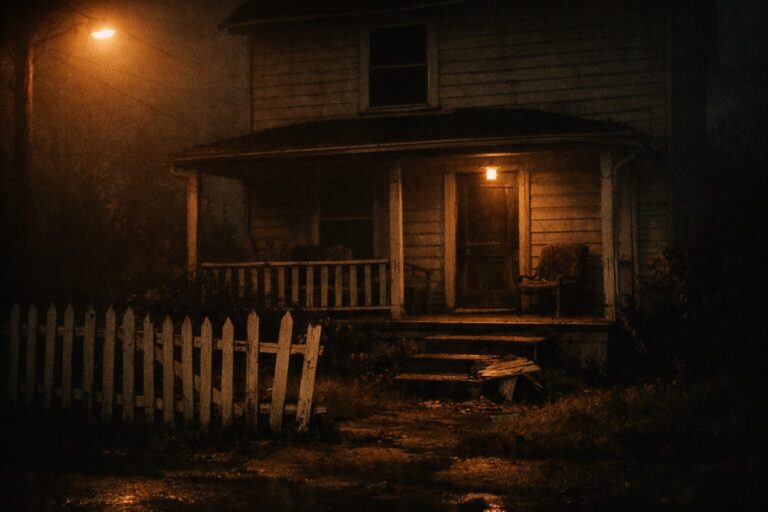
They turned the house in rings, first the obvious places—hook by the door, catchall bowl, kitchen table—then the soft traps for small things: under the mail, between sofa cushions, the folded throw blanket. Her husband checked the car twice, combing the floor mats with a flashlight, then went outside to scan the porch in the slanting winter light. The old porch had been her grandparents’ once. White lattice wrapped around its belly. The boards sighed when anyone crossed it. She stood on the doorstep and closed her eyes. She could almost see the motion of last evening’s groceries: a plastic bag splitting on the top step, oranges edging into dusk. She had heard something then—a small hard sound, the rhythm of metal bouncing and vanishing. She had told herself it was a bottle cap.
By the time the children’s voices faded into dinner and dishes, the house felt too bright from all the lights they’d switched on without moving closer to any one room. In the living room, she emptied her purse onto the rug: receipts, a hair tie, a bent coupon, a pen with someone else’s company on it. No keys. Her husband rubbed a circle on the porch rail with his thumb like he could polish a memory clean. They told each other it would turn up because that’s what you say when your hands are already tired. They made do with the spare car fob and pushed the day past its limit.
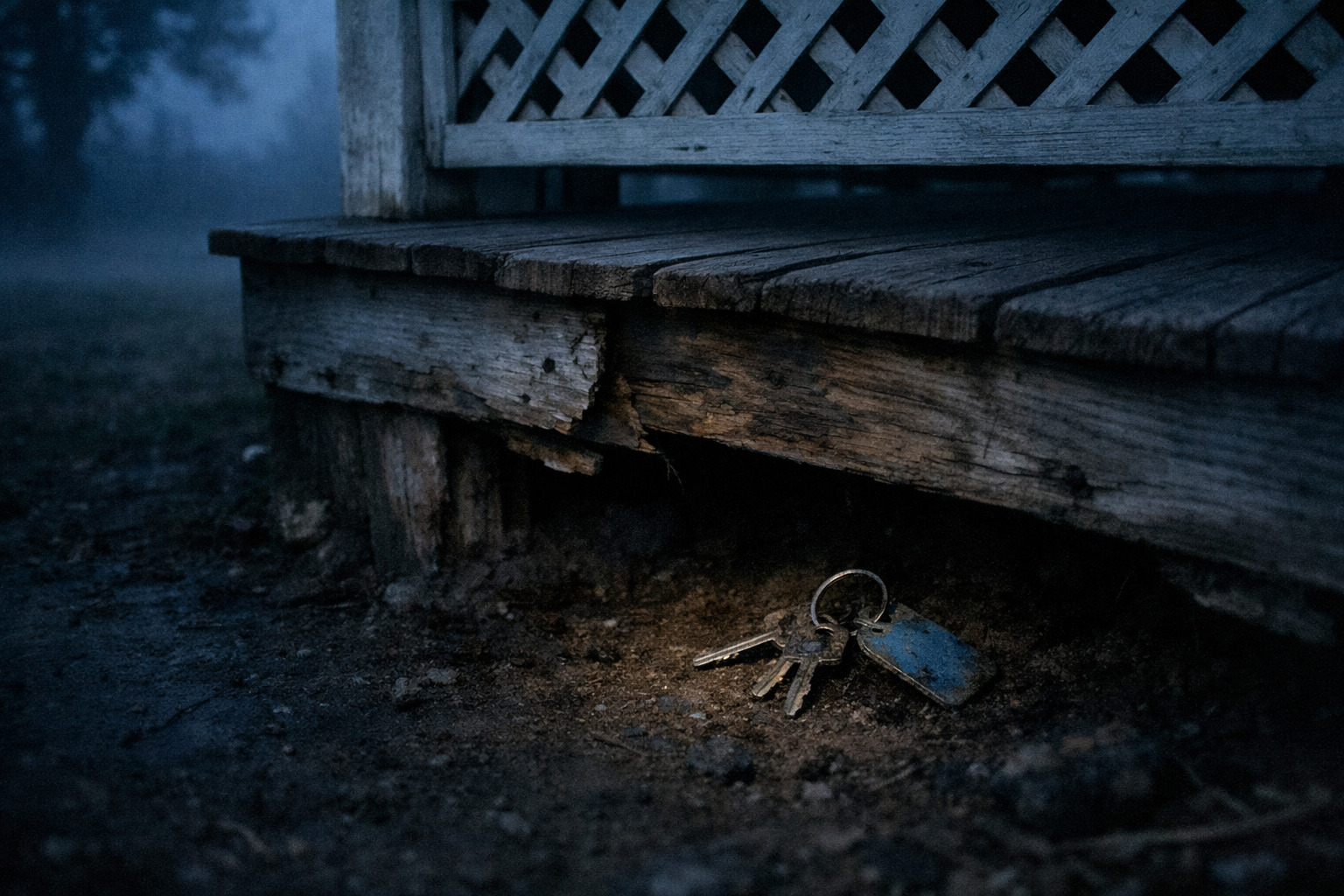
That night, sleep slid in pieces. In one piece she was small again, counting floorboards on that same porch. In another, she stood at the edge of it with her palms on the rail, cool paint against skin, and looked down through the lattice to where breath made a fog in the cold air. The dream was not like movies. No chorus, no enlarging glow. It was the ordinary light of a morning that hadn’t happened yet, gray and patient. She peered under the porch through a neat, rhombus pattern in the wood slats, as if one had broken a little. A cracked beam ran diagonal like a fault line along one of the supports. She could see the split, could see how it bit through the grain into a pale vein. Beyond it, earth. Damp, matted leaves and something snagged there that caught the dim: a ring of keys lying against the dirt like a trapped fish. She saw the blue tag on the ring—it swung once, a slow tremble—one of those loyalty cards from a grocery they didn’t even use anymore.
It was wrong in the way dreams are wrong about small things you’re sure of later. Last summer she had helped repaint the porch. There had been no crack on the beam. The lattice was intact then, every slat nailed straight. And that blue tag—she had cut the little plastic rectangle off with kitchen scissors when it kept digging into her hand. She had watched it arc over the recycling bin. These were the places her waking mind tried to lay like planks over water. But in the dream she crawled forward, feeling cool powdery soil under the pads of her fingers, and knew, with that heavy dream certainty, exactly where to reach. There was no noise except a soft ping somewhere—wind chimes, though they’d taken them down in spring. A glass jar half-buried at the beam’s shadow caught a smear of light. White chalk, or mold, streaked the underside of the joist like a careless number left by somebody bent and tired.
She woke to the sound of something ticking in the heat vent. Her room held that light the dream had borrowed—a thin morning working its way around clouds. She lay very still and watched the seam where wall met ceiling. The family moved around the edges of the house: the flush of a toilet, a kettle’s slow growl, a chair leg scraping a board. She told herself not to be foolish, not to go crawling in pajamas with a flashlight, but she was already holding her breath like a diver by the time she pulled on boots.
Outside, the porch sat with its familiar lean, paint cupped into ridges along the handrail. Frost in the grass broke under her steps with a sound like salt. She knelt at the corner where the lattice met the brick pier and ran her fingers over the slats. One was loose in exactly the spot the dream had offered, a triangle of absence that made no sense to her memory of repairs and summer afternoons with a hammer and iced tea. She pressed and the slat gave to her hand, a gap opening toward the dark beneath.
The smell rose up—damp dirt and old wood, and something sour like leaves that had never dried out. She laid her cheek against the rim of the hole. It was colder under there than the air above. Her eyes needed a heartbeat to learn the new light. Then shapes resolved: the low stretch of beams, the seam of the house’s underside, a jar with cloudy glass at an angle as if it had lost a lid years ago. White chalk lines zigged on the joist, exactly where her dream had scribed them, a mark or counting from whoever had inspected for termites long before.
There was the crack. In waking the split was finer than in the dream, a hair more than a wound, but once you saw it you couldn’t unsee it. It angled along the grain, shallow at first then widening to a thin dark that swallowed shadow. She wouldn’t have missed it last summer, she told herself, if it had been there. She ran her thumb lightly over the place where the wood gave the slightest softness beneath its crust. The beam did not groan or argue. It simply admitted that it was not as she remembered.
Her breath made a small cloud and drifted under. She had brought a bent coat hanger because the dream had set that in her hand, too. She didn’t remember picking it up, just that it felt right to carry. She fed it through the gap, the metal whispering against wood, the end bending to a hook. “If I see them,” she heard her voice say in the quiet morning, “I’m not going to like it.” Then she did. There, just beyond the socked-in shadow of the jar, a metal glint. A ring. She angled the hook around the main loop and pulled, gentle because the ground held them as if it had opinions. Dirt smeared the shiny parts to dullness. The keys slid an inch, two. The hook slipped. She bit the inside of her cheek and tried again, catching a small key by the jag, drawing the ring toward the light.
They came out of the dark like something alive rescinding itself, mud dragging one last string. Cold and heavy, they fell into her palm, and she was surprised at the weight as if her hand had never learned it. The car fob. The mailbox key with its shallow bite. The office key with a nick at the edge. And the blue plastic tag, faded to a gentler color but absolutely there, clacking lightly against the ring. She stared. She could see, inside the space her mind made for moments, the movement of the scissors blade through blue, the twist of her wrist. She knew she had done it. Yet here it was, stamped with a store name that had changed logos two years earlier. She pressed her thumb over it like it could be blotted out. When she looked again, the tag hadn’t moved.
Something clinked beneath the porch, a late slide of the jar settling deeper into its hollow. The wind, too light to be felt, combed past the gap and made a noise she wanted to call a chime, though there were none. She slid the lattice slat back into place slowly, like she might spook whatever law held this together. From inside the house, a child called her name and the sound flattened against the door, ordinary and comforting in a way that made the porch more foreign than it had been an hour ago.
All day she could feel where she had laid her cheek on the porch’s edge, a coolness that returned whenever she was still. The keys, cleaned, thunked into the bowl by the door in a sound familiarly satisfying. Each time she passed, the blue tag tugged the corner of her eye. She did not tell anyone about it. When her husband asked where she had found them, she said only, “Under the porch,” and turned aside to lift the kettle off the boil. Her chest felt full of the kind of silence one keeps on purpose.
Nights returned to their regular shape for a while. A week went by, and some of the tightness in her shoulders let go. Then a second dream came, not like the first, which had laid itself out simple as a map. This one arrived like someone had knocked on the underside of the house and she had stooped to listen. She was beneath the porch again, but deeper this time, into the crawl where the air felt older, packed and untroubled, and the boards above her head were closer to her face. The crack in the beam was there because it had always been there in this place, and the chalk was older, scuffed by nobody’s hand. In the far dim, where the space met the cooler earth and the smells changed to clay and iron, something small lay in a fold of dirt: a brass key threaded through a button on a frayed string. She recognized the button. Her father had used one like it, a coat button too big for any shirt, to weight the end. He’d kept that string in a glass on his workbench across town. She could see the scratches on the brass where his thumb had worried it. It didn’t belong here. She had not lost it here. She had not lost it at all.
In the dream the beam’s crack widened with each shallow breath, not to threaten but to make room. She reached, and the dirt cooled the inside of her elbow. A spider’s single thread caught her knuckle and held a tiny drop of water that closed over the pattern of her skin. The button lay an arm’s length beyond reach. The key’s teeth were packed with soil. She knew, with dream knowing, that if she slid forward on her stomach she would fit. When she woke there was a mark on her wrist where the thread had touched and no web to make it.
She stayed in bed until the house began to move around her again, waiting for the ticking in the vent that hadn’t been there before but had somehow been there forever. Later, washing dishes, she heard the faintest metal chime from under the floorboards, the sound of a small ring letting go and settling into a softer place. She turned off the water and stood without moving, the sun striping the sink through the window, listening for whatever she had learned to hear.