The Cabin Was Empty but Dinner Was Still Warm
They had been moving fine until the wind came up hard off the ridge and turned a steady snowfall into a thousand small needles. The man checked his watch, then the map that had been softening in his pocket with every hour. The woman didn’t speak. She had her chin tucked into her scarf and only glanced up to follow the cut of the old logging road where it bent through spruce and fir. They had taken the road because it seemed like a safer line than the ridge proper, a belt of trees instead of exposure, a compromise made at the speed of weather. By the time the first clapboard corner appeared through the curtains of white, the decision had already been argued in breath and quiet looks and the way each of them stepped just a little faster when the wind shoved behind them.
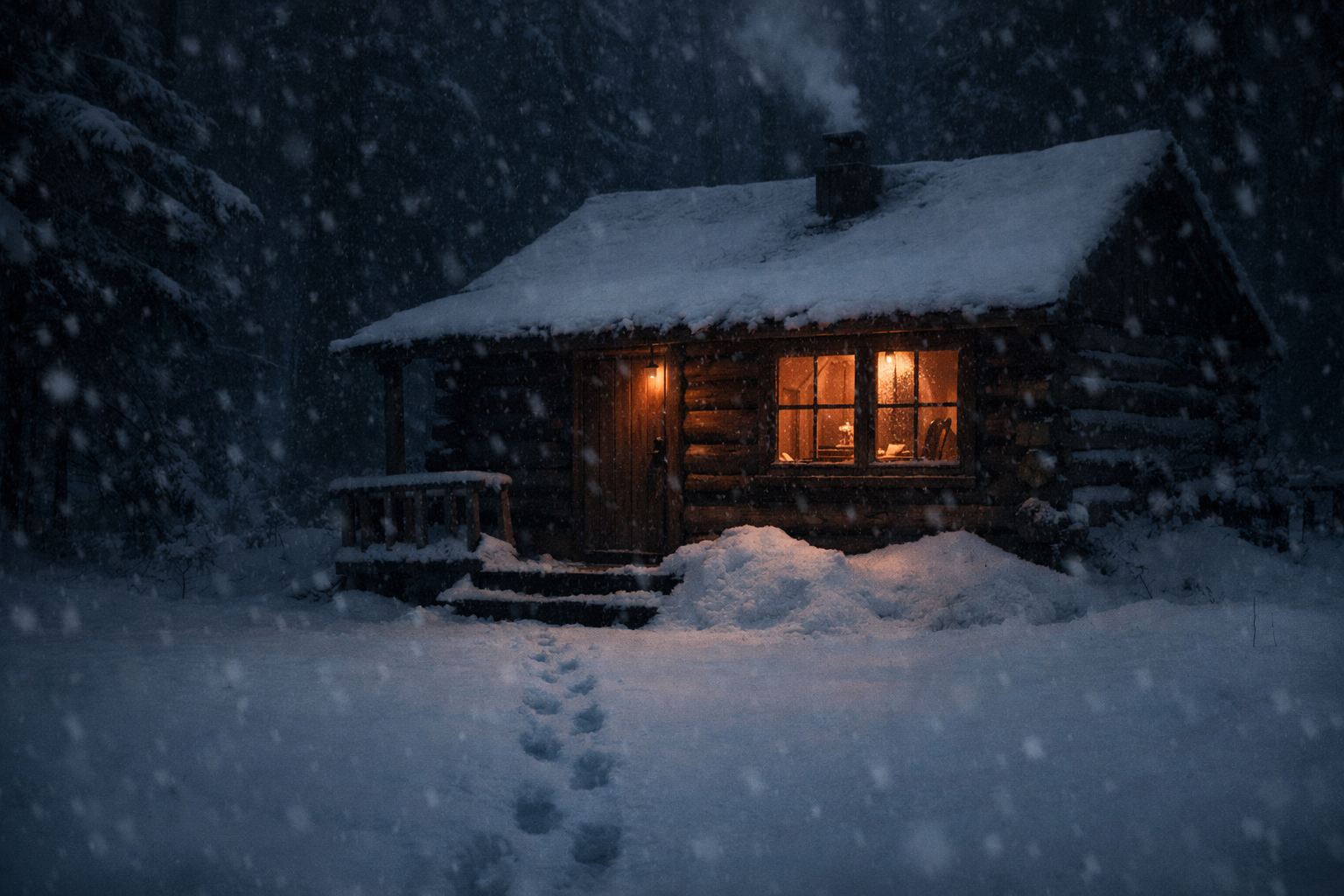
The cabin had that look of having been there before they were ever thought of. A low roof shouldered a wide pull of snow. The porch sagged a little, two logs propping a beam the way a hand props a tired head. Smoke clung to the roofline like a rumor. The man knocked at the door because knocking felt like the way to stay human in a place far from people. The woman cupped her hands to the window, waiting for motion. No answer. They traded a silence that was more question than sound. He knocked again, louder, letting the knuckles carry something of their situation, that it was not a social call, that they were cold and the light was leaking out of the day.
It wasn’t the sight of the little table that made her thumb find the latch and push; it was the smell. Savory and modest, like stew, like something that had been simmering low so it wouldn’t burn while someone put logs on the fire. They came in on a cloud of their own breath and a wash of warmth that felt like forgiveness. The first thing the woman did was take her hat off and close the door behind them, and then she stopped because she saw it all at once—the bowls set, the plates rimmed with something pale where steam condensed, the loaf of bread on its side with the knife stuck in like a flag, the two chairs pushed back hard from the table, not evenly, like someone had stood up too fast and too far. The man moved around the chair as if not to disturb it, and put his palms over the nearer bowl. Even through the calluses he felt what he expected to feel: not hot enough to burn, not cold, warmth that still belonged to the moment. He lifted his hand without touching anything. It felt like interrupting a conversation.
“Hello?” he tried again, and his voice sounded wrong under the low rafters, made small by the things that were not answering. A kettle rattled lid to ring on a back burner. The fire made a sound that was more breathing than flame. On the table, a smear of butter was catching the room’s light in slow collapses. In the thin window, snow was blowing flatter now, angling across the clearing, filling the shallow trough their tracks made on the way to the porch. The woman took a step toward the hallway beyond the table and stopped when she saw the coats still on their pegs by the door—two canvas barn coats with darkened cuffs, a smaller wool one cut short, a hat with a missing button, a pair of gloves clipped together. A boot tray sat under the bench, empty, but next to it two pairs of boots were tucked heel-to-heel, damp down the sides where crusted snow had chosen its line. She reached for one glove to feel it. It was warm the way a stone holds a day’s heat long after the sun’s gone.
They did not speak of eating. It felt like there was no permission in the room for that. The man stepped around to the range and turned the stove dial down a notch because heat was heat and because setting your hand to a dial made you belong to the room, but above the dial there was a calendar with two months open and both of them had the days crossed all the same way—dashes neat as fenceposts. He tried not to look like he was reading anything. On the counter near the sink lay a paperback splayed face-down like a bird, and a pencil across its spine, and half a crossword filled in. Three mugs were on a drying towel, leaving dark round prints. One had a ring of tea the color of old varnish. There was a deck of cards stacked tight and squared at the edge of the table, the top card antlers and a winter scene like the one outside, snow caught in blue.
He was the one who thought to look outside again. It was the kind of thought that came from the neck hairs going their own way and the way the room made a circle around its center, and he needed to prove that something had gone out to make it make sense. He put his gloves back on and leaned into the wind on the porch. The clearing ran down into scrub and a creek line and the black-on-white of thick spruce beyond. There were their tracks like a measured staircase across the open—sharp, then dulling as the wind’s fingers found them. He leaned out over the porch rail and followed the line of wall to the door, then down along the logs where the drift tallied the afternoon. It was clean. Whatever prints had come in this morning, or yesterday, the wind had loved them flat. But the snow piled against the sill, the way it should if no one had opened the door since some time before the last squall. He tipped his head, listening for something past the wind—the quick laughter of someone coming back around the outhouse, a chore belated. Snow slid off the eaves and answered everything with a soft hand clap. He went to the corner and walked the porch length, feeling his weight in the old boards. Every direction, only the tapering finger of their path, and then no print at all on the far side of the cabin where the drifts made shoulders to the window sills. He could not make a new story out of it.
She had gone down the short hall and come back just far enough to see him at the window. The first door on the right was a bedroom, small, with quilts stacked on the trunk and a basin with a chipped lip. The second door was a second bedroom, this one with a child’s bed under the window and a sheet of drawing paper weighted with a smooth stone on the desk—trees sketched in pencil with child-honest trees and a shape at the end of a path, a square with a triangle roof. The third door at the back was a door and not a door; it led onto a stoop so small it was a single step into the snow. She pushed it. It resisted, crisp, the seal of it unbroken by any habit of opening. From that back entrance, there were no steps at all—only the snow come up against the door like a body leaning. She pressed her fingers hard there, feeling for draft, found none. When she came back to the table, she placed a hand on the back of the chair the way a person might if they were about to sit. The chair had a nick at the top where years ago a different hand had placed the same hand there and had a ring on. She did not sit. He met her eyes and lifted his chin toward the window like asking without words whether she had seen anything that explained their being inside a stranger’s warm life.
She shook her head. They stood together in the territory between being grateful and feeling like they were standing too close to something private. The man touched the lip of the bowl again, the broth wobbling lightly, the skin not yet forming. The woman looked at the clock on a nail; a round face with a painted bird in the middle. Its second hand was working. It made a noise. It was the only thing in the room living on a beat. Through another window the light went down another little step, the cold pushing in like a thought you didn’t want. She thought: someone will come through the door and be as alarmed as we are. She thought: we should leave a note, say thank you, we sheltered, we didn’t take more than heat.
They were just agreeing to do that—he had taken the pencil from the paperback, she had lifted the top card on the deck to find a blank scrap beneath—when the chair nearest the door moved. It was so simple in the way it moved, so ordinary, that for a second the sound of it belonged. Wood toes crossing the seam in the floor, the voiced drag of an old leg. The chair slid back in under the table by the tidy inch. The pencil in his fingers squeaked on the scrap in a meaningless line because his hand had drawn without him. She did not step back because there was nowhere to go that wasn’t inside the room’s thought, but everything in her body leaned. They might have blamed wind if it had been a gust and then quiet, but the wind had taken its breath and held it, and the room was its own weather. They watched the chair settle into the small square where its legs had polished the boards over time, a learned place finding itself.
The kind of fear they felt then was not the kind that shouts. It was the kind that puts its hand on the back of your head and turns your face, gentle as a mother, to make you look at the thing you decided not to put into words. They did not speak. The man didn’t put the pencil down because that would have sounded like putting something down on purpose. The woman set the top card back over the blank scrap and made it square with the deck. The kettle’s lid ticked once, as if on cue. She could see, in the shallow silver of the kettle, a kind of red smear where the stove’s eye made an oval of reflection. In it, the chair’s legs were four black marks now where there had been space. He looked at the door and then back at her and then at the note he had not yet written. He put the pencil back on the paperback, just the way it had lain when they came in, with perhaps more care than the person who had left it last had shown. He reached his hand to the stove and turned the dial one slow step lower.
They left without slamming. The woman made sure the latch found its home. The man took a last breath inside and stepped out. On the porch he stood a second longer in case anyone wanted to step into sight, to laugh and say good joke, to come relieve him of the debt of having warmed hands in a stranger’s room. The wind took the open space they made and pressed against the door until the latch clicked quiet like a mouth closing. They found their tracks and made them deeper back to the trees. Neither of them looked back. At the creek crossing her boot slipped and he put out his hand and she took it and that was the first touch between them since they had stepped into the cabin. When they found the old truck road again, they took it like a lifeline, eyes on the ruts frozen into hymn lines by an old thaw. Dusk made the sky the color of a bruise you didn’t remember getting. They walked until their headlamps made low circles on the snow and then down the last mile to the trailhead where their car was one dark shape among the darker shapes.
The next morning the ranger at the station looked like a man whose job was paper and boots and the way the radio turned the forest into tin. He listened. He didn’t ask them to repeat the part about the chair. He asked for draw coordinates, and the man traced the logging road on the wall map with a finger and the road kept not being there, replaced by a checkerboard of green and grey squares and numbered compartments. “Above the creek?” the ranger said. “There used to be a line cabin up that drainage years ago. Before my time. They pulled it out with a skidder—this was, what, ’92? The roof was falling in. No one should be up there. Where exactly did you say?” The woman tried to say it more plainly—the bend where the spruce leaned over heavy, the cut bank, the rise before the flats. The ranger’s eyes went off toward a memory in someone else’s story. He set his palms on the counter. “There’s nothing there now,” he said, not unkind, just the way you’d say it if you had walked those squares until the map bled into your boots. “If you see someone built something up there, folks call us. We go look. You must have cut lower and then angled back without knowing. It happens when the wind’s like that.”
They left their number on a scrap that looked like one of a thousand the ranger would slide under a paperweight and all at once forget. They didn’t bring up the smell of stew again, or the butter laying down into itself—small details that felt too personal to put across a counter. They got coffee in the town that had one street and a feed store, and they warmed their hands and said almost nothing. In the car, they drove past miles of fence and then miles of no fence and then the long run of pines that hid the shoulder of the mountain where the road kicked up. The woman kept her eyes on the way the snow gave everything the same blank law. When they crossed the bridge out of the valley, she looked back a last time and the line of trees lifted like a throat swallowing.
They did not go back. There was no plan to, then there was a plan for a different range, then there were years where work stacked like cordwood and no one needed the empty kind of cold that eats every word you would use to explain something to yourself. The man kept the map with the soft corners. Sometimes he would unfold it and try to lay his memory over the trapezoids of land, imagining the exact mathematical place where a house could be and not be. The woman put her red hat in the back of the hall closet and found another one in a different winter. When someone asked them, later, if they’d ever had trouble on the trail, they gave the kind of answer that discourages follow-up: “Weather turned on us. We got out. Lucky.” The closest they came to telling it again was to leave an extra can of soup in the truck’s emergency box and to carry a scrap of paper always, even on day hikes, to write the little notes you might need if your mouth went wrong.
Spring opened the roads and the ranger called and left a message. “Just so you know,” he said, and said the woman’s name like a courtesy given to an acquaintance you might meet at the post office. “Drove up to the north fork with the seasonal kids last week. Looked where you said. Not even the padlocks on the old gates are there now—someone cut them. There’s no structure, not for miles. If you see folks squatting up there, let us know.” His voice crackled inside the small speaker and then was done. They never called back. The man erased the message without looking at her. She nodded without looking at him. It was a small, careful relay, the way you pass a cup of something too full from one set of hands to another without spilling.
At some point after that, he woke one night and could not think of the face of the clock over the stove, only hear the soft lick of the second hand. He listened and waited for it to tick again and make a shape of time where he could lay himself down and sleep. The house had its own noises—refrigerator, settling joists, some animal in the soffit—and none of them were the sound. He lay there with the sound inside the space of his head like a room he had left but not really left. In the morning he did not go into the storage room where the map had migrated. She passed the closet and did not look for the red hat with the snow halo still on it in her memory, did not retrieve it to shake it out and make herself laugh at the superstition.
When people ask where the trail goes at the end of that road now—on the way to summer’s lake or the fall aspen the color of coins—their hands lift to point and then don’t. They tell the left fork and the right fork and the draw that looks wrong until it’s right, but no one in that car says anything about a cabin the weather folds up and puts away for later. Someone will tell a story about a couple missing off a different trail, a different year, and the way the searchers found their snowshoe tracks to the edge of a meadow and then not out the other side. They will shake their heads like a settled matter that was never settled. In the rearview, the trees close around the bend. The map stays folded in the dark, soft at the seams. The dinner that was warm enough to steam a little hangs suspended forever over a table, a chair sitting under it the way a good chair does when it has been put back by a careful hand.