The Hiker’s Boots Were Found Facing Home
He had walked that trail since before the county paved the feeder road and put in the little gravel pull-off by the cattle gate. It was a habit so regular neighbors could read the week by it: twice around the loop on Mondays, once up to the ridge after rain, and, if there was still light after supper, he would go as far as the switchback that looked down toward his mailbox and the thin stripe of the creek. He knew where the stone outcrops stayed slick, where the old hemlock’s roots made a snag, where deer crossed the path leaving splayed prints like handprints pressed into mud. He kept to the same pace, the same rhythm—wind nipping his ears, breath talking back to him in a little fog on chill evenings—never racing, never lingering longer than the stretch at the ridge where the wind always found him and brought the smell of wood smoke from the valley. On Friday he told his sister over the phone he’d be home by dark. He left a mug in the sink and locked the kitchen door like he always did.
There was nothing dramatic about that afternoon. The county road lay quiet, a single pickup drifting by with feed sacks in the bed. He parked where he always did, tires making the easy grind on gravel by the rusted gate and the posted sign weathered to a gray squint. He pulled the bill of his cap down, stepped over the shallow rut where runoff had eaten at the path, and went up into the green. No one remembers the color of his shirt for certain, only that he was alone, and the little trail camera halfway up the first rise caught him moving steady as a metronome, head turned toward the creek as if listening for the water.
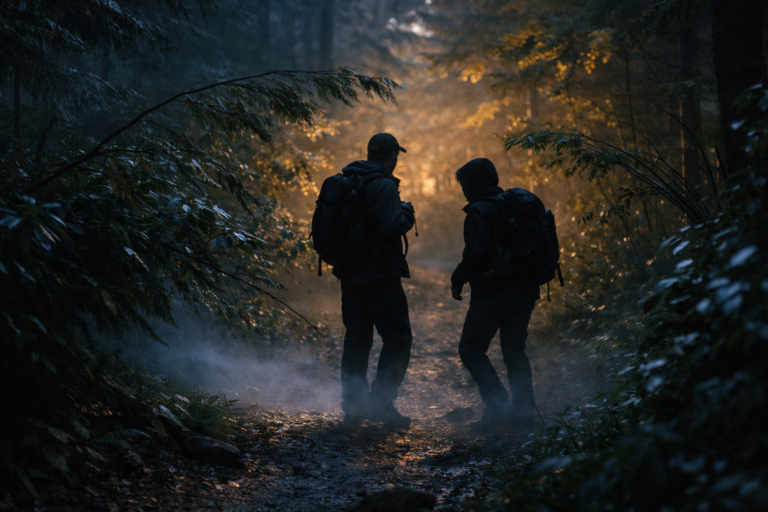
He didn’t have the dog that day. Folks would bring that up later—how she sometimes padded at his heel, a blonde mix with a limp. She was home, it turned out, sleeping under the table with her nose tucked tight to her back leg when the sun went down and he did not come through the door. When the kitchen clock hit eight, his sister tried calling. By nine, the porch light was on. By ten, the deputy was on the gravel pull-off, kicking at cigarette butts and waiting for other lights in the night to break the tree line. Everyone moved like they’d been trained for it their whole lives: a search coordinator in a canvas vest, a retired teacher with a box of headlamps and an old topo map, three cousins with gaiters and a coil of flagging tape, and a man who owned a hardware store who had the big light that could throw a beam down trail like a white road.
They started with what they could. The phone never pinged a tower out here, but his truck sat quiet with the seat slid back just so. The hood was cold. His thermos, empty and rinsed, was stowed behind the seat. Someone checked the latch on the cattle gate like the metal could remember who had come through it last. The first hours bled into the second. Their boots marked the places their voices went, and their voices went far. The creek muttered under the frost-killed weeds. The wind traded stories between the poplars. Coyotes made a far-away shape of noise but never came close.
They found sign where they expected: the deep, reliable stamp of his boots in a patch of fine silt at the first curve, the heel-toe of a careful descent on the rooty pitch just past the deadfall he always climbed over rather than around. A volunteer pointed: here, and here. The prints were crisp where the duff had been dampened by a squall the night before. He had gone farther than usual for a January evening. The trail climbed in slow confidence through laurel and hemlock and then leveled out, the dirt path wide as a pickup tire. It ran along a ridge toward the old logging spur that, if you followed it long enough, folded down toward the pasture that backed his property. The moon, thin but present, put a shine on the frost that gathered in the hollows.
It made sense until it didn’t. The wrongness was quiet and absolute, and when they saw it they did not say so at first. A pair of boots sat in the middle of the path, equidistant from the huckleberries on either side, not toppled or tossed but set square and neat as if someone had slipped their feet out without bending. The leather was his—a lot of people knew them, scuffed on the toe where the concrete of his front step had eaten the finish away winter after winter. The laces were tucked inside. The tongues were pulled up smooth. They had not been caked in mud; he was careful with them. There they were as if waiting, the way a man might leave them by a door before bed.
One of the deputies lifted a palm without touching anything, a signal for everyone to hold back. Their headlamps made a little white theatre around the boots, thrown shadows moving like reeds. Nobody said his name. People looked at each other the way people do when they want to ask a question and don’t want to be the first. The hardware store owner broke before the rest: “He might’ve sat down,” he said, looking for someplace a man could have sat to pull off boots without getting his backside soaked through. There wasn’t one. The path there was damp and fine, a kind of ground that tells on you. No crushed ferns. No disturbed crust on the frost. No print of a body. Nothing leaned in the leaves where someone had propped a socked foot.
They widened their headlamps. The light found sticks, pine needles, the brittle blue of a jay feather under a root, a snapped twig that had been snapped three days ago by weather, not weight. And then the first realization that chilled each person in the circle the same way, one after another: they could see where the tracks had approached from the south, the heel-and-toe bite of his soles easing up to this spot in a pattern anyone who knows a person’s walk can read. The prints came right up to a short scatter of looser duff, and then nothing. Not a single indentation led past the place the boots now sat. There were no bare feet outlined in the damp. There was no diagonal slide mark of a sock. There were no toe-digs like a man would do if he tried to hop, no crawl-scrape where knees or palms would tell on a prank. Chipmunks, maybe, had pricked their little dashes by the trail’s shoulder, but even those seemed old, their edges softened. Around the boots, the earth could have been a photograph pressed under glass.
They took their time asking the same questions several ways: Could someone have replaced the soil, brushed it, raked it? No. There was no brooming of the duff, no swish marks. Could he have stepped into a waiting truck? Impossible; the trail there was narrow and hemmed in by laurel that bent low and held dew like it wanted to keep it. Could he have left the path entirely and gone into the brush? They poked poles into the evergreen thickets and found only thorns and old beer cans. The dog handlers came up in the chilly dark and the dog turned circles at the boots, confused, whining once in a voice that made the hair rise on the back of a man’s neck who would later swear he didn’t spook easy. The wind snuck through all their zippers.
“Look how they’re pointed,” the retired teacher said softly. It was nothing at first, a small observation, the kind you almost apologize for, but heads tilted and even the deputy squatted and shined a stronger light. The toes of the boots were aligned not with the way the trail meandered but in a truer way toward the valley. A man could plant them square and have them face any number of vague lines—back down the path, uphill, into the laurel—but these didn’t make vague gestures. They pointed as if toward something invisible and fixed. Someone took a compass. North was there, and the boots ignored it. They pointed along a sightline that slid between two black humps of hillside and, if you kept that line in your head and peeled back the trees and the curve of the world, ran not to town, not to the store, but toward his house: the back door that stuck in wet weather, the porch light still burning like a little vigilant eye out there in the dark.
It was such a small thing, the angle of two empty shoes. But it grew legs inside everyone who saw. A cousin crouched until his breath made a ghost in the beam and used his finger as a rifle sight. “That way,” he said, and you could see them measure it, placing the map in the air. You could watch the way they all suddenly stood a touch farther apart. Wind took a leaf past and they flinched like it had said a word. The trail itself seemed to hold its breath, a straightened back between two curves. Miles away, in a quiet kitchen, the dog got up and went to the door and lay down with her nose against the crack, as if something were standing on the other side listening.
Dawn took its slow time coming, gray growing into a kind of bruise color before it ever thought about blue. The boots stayed as they were. The small decisions people make around an absurdity—do you touch it, do you cover it, do you bag it like evidence—were made carefully. The deputy flagged the area and called in a supervisor. The rest of the day went through its necessary motions: grids, clips of ribbon on branches, whistles blown every ten minutes and listened for. They worked the creases of the land under a sky the color of tin. No one found a sock. No one found a sign of bother. No one found a man walking in his bare feet out of winter woods as if it wasn’t winter at all.
There are strange things that happen in the country, but most of them are the long tail of reasonable causes. A person will say so, in the store, in the church doorway—raccoons undoing latches, forgetful minds, and bad light. But the boots were not a mistake. Everyone who saw them in place in that quiet, on that particular kind of ground, where even the flutter of a bird makes a statement, will tell you that. The prints came, then stopped. The leather sat with a steadiness that suggested an owner would be back in a moment to step back in. That is a thing that makes the skin move on your arms whether you invite it to or not: the tidiness of abandonment.
When the county took the boots, they did it with the kind of practiced gentleness reserved for photographs in a family album. They took them not because anyone thought a crime had happened—they were obliged to, they said, for the record. Days sifted through the place where people’s cars had scraped two bare arcs into the frosty ditch. The porch light had been turned off and then absentmindedly turned on again, and then left. Nobody chose the moment to stop looking; it simply went from shouting a name into taking care not to say it at all when you passed certain places.
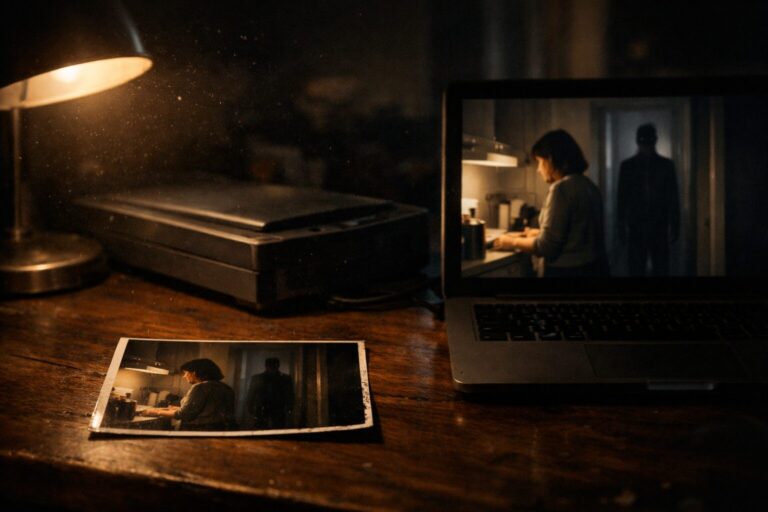
Weeks later, a man who leases hunting rights on the far side of the ridge came into the hardware store holding a memory card between thumb and forefinger like a splinter. He had a trail camera strapped to a twenty-year-old beech not a hundred yards from where the path flexes and then runs straight. He hadn’t checked it since before Christmas. He said he wasn’t trying to stir anything but figured someone ought to see. The hardware store owner called the deputy before he slid the card into his laptop. They sat under the hum of the fluorescent light and clicked through night after night of deer shoulders like gray ships, raccoons rifling leaves with little hands, wind making the world look haunted by breath. Then came a frame where the path was empty, the same stubborn weeds leaning in, frost silvering the dirt like a skin. The time stamp near the bottom corner—2:06 a.m. The next image jumped ahead by two minutes. The trail was again empty. And then the next—the time said 4:12 a.m., and there, centered in the path like they had been staged for a photograph, stood the boots. No figure was with them. No shadow crossing. No blur that could be a man. Just the boots, upright, toes set along that same unwavering line toward the places beyond the trees where a kitchen light had burned all night and then all morning and then some part of the day, like a small ship’s lamp stuck in fog, the kind that calls in what can find it and lets the rest of it circle in the dark.