
The Iron Box Had No Way to Open
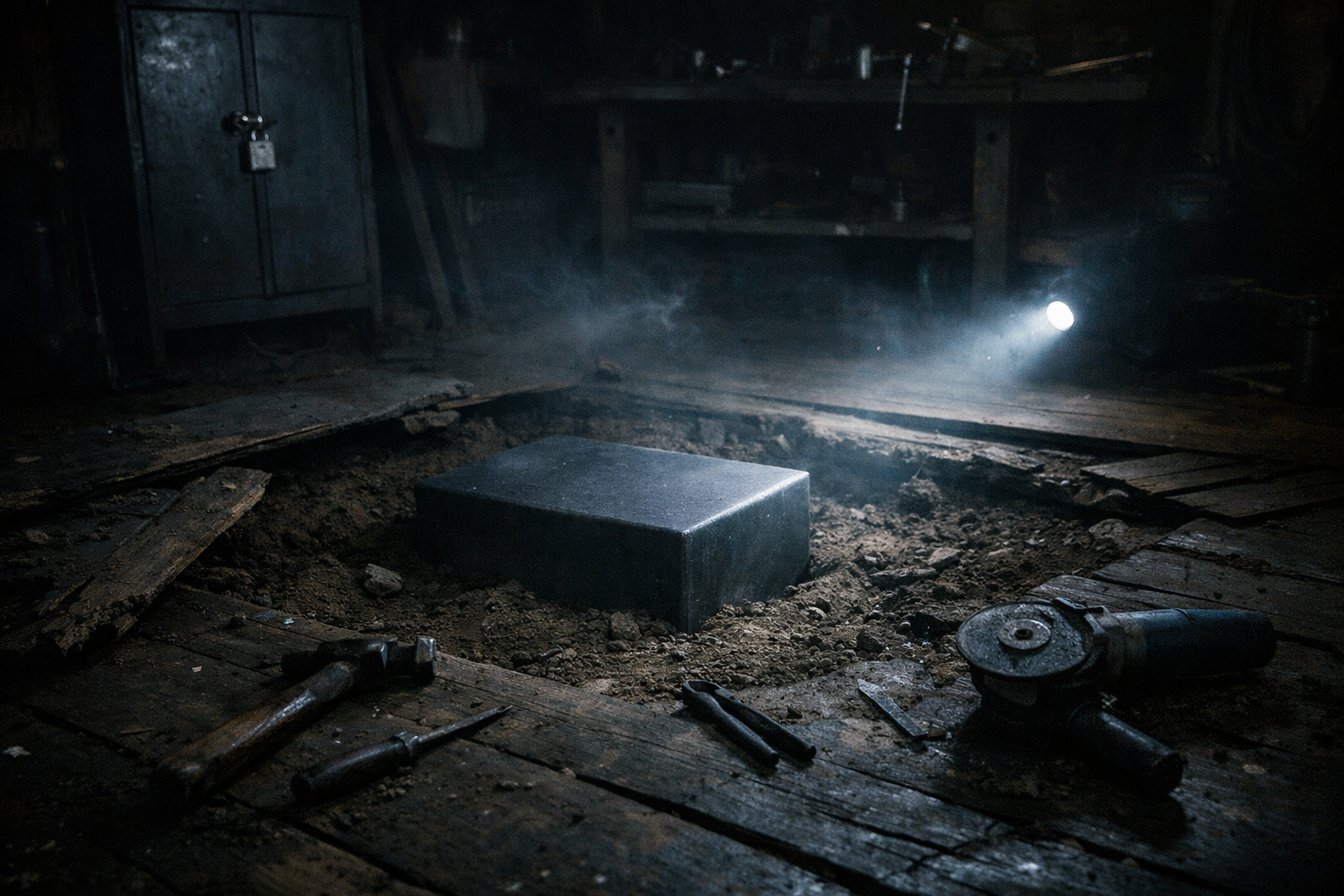
They were fixing the dip in the floor where the old ash pit had sunk their corner of the workshop by a half inch each winter. It was a long room with rafters bristling with clamps and lengths of angle iron, the smell of oil baked into the studs so deep it sweetened when the stove warmed the morning. He’d worked in there twelve years, and the building had worked longer than that for whoever couldn’t afford new space, or liked the kind of quiet that came with dust and leaded panes. The boards by the back vise had gone soft; he could feel the give under his boots when he walked a circle around the post. When he pried them up, he found not ash but packed clay, tamped hard like it remembered the shape of too many boots.
It was under the third plank. His bar skated off something that wasn’t nail or knot. He knelt, breathed chalk, and brushed the clay with a whisk broom until a flat gray face came up, not stone but metal. It made that tuned thud when his knuckles tried it, the kind you can feel in the meat of your hand. He thought at first it might be a cast plate he’d forgotten, or an old press jaw the last tenant had buried to hide the theft—people did odd things in their leased rooms. He scraped out around its sides with a margin trowel until the corners lifted with the shovel and the clay sweated to the floor as he levered.
It was a box, the size of a bread pan stretched long, heavier than it looked. He rocked it onto old burlap, thinking of rust. At a glance, it was just iron gone dark with age, filigreed in shallow oxidized smears. But even in the fine euphoria of salvage—the part of the mind that starts to count what can be sold by weight—he felt the first wrong thing and placed his fingers to confirm it.
There were no seams. No lid line, no hinge stubs or holes for cotter pins, no hammered rivets. The faces were too exact for handwork and too senseless for a casting if nobody meant them to open. He turned it, sidled it, wiped it twice with a vinegar rag until his skin prickled from the cold through the cloth, and still there was only iron, a plain oblong with rounded edges, blank on every side. Even the scratches were few and parallel, as if something had once brushed it with brushes nobody used anymore. It was iron made into the shape of a box and deprived of every normal way a box declares itself a box.
He took a straightedge and a flashlight and laid the beam sideways to catch the shallowest indent. Light slid without breaking. He pressed the magnet on a telescoping wand and it skittered merrily across, catching nowhere. On his lunch break he pulled his old jeweler’s loupe from the drawer and peered along each corner until his eye ached from the nearness. It was all the same surface, like the idea of a hinge had never occurred to it.
Tools made a show at the beginning. He clamped it to the bench just enough to catch the edges and brought the abrasive wheel down from its hook. The first cut bloomed sparks and a smell of hot metal, savory and old, but the disc skated, the iron shrugged, and when he set the grinder aside, there was less than a suggestion of scuff to show for the effort and a notch missing from the wheel he hadn’t seen chipped before. The carbide bit in the drill press, the tapping oil shining in its tiny pool, shaved something fine and bright that curlicued like steel wool, and then caught, bit, and sang in a pitch that turned his back teeth cold. When the bit snapped, the snap felt like a personal failure. He changed tactics, brought up heat. The oxy-acetylene rig hissed, then roared, rose from cherry to orange to almost-white, the iron sweating, darkening, and then—humiliatingly—not sagging, not giving him even that softening he could coax out of tool steel. It took a mark like ice takes a mark from a fingernail, a faint clouded kiss and nothing more.
By day he told himself he would sell it by the pound. He rolled it onto the scale between the anvil and the vise, braced his back and took the number. Sixty-two pounds to the ounce. He wrote it on the crumpled ticket he kept tucked behind the ledge above the coffee tin. He took it off, wrestled with it, felt the pleasant ache in his forearms, and told no one except the man who came to fix the floor with him in the afternoons.
By evening the number was wrong. Not a lot wrong, and perhaps he had not seated it flush. He took the clamps off, rolled it back, watched the needle. Seventy-one. He tapped the dial. Sixty-eight. He lifted and set it harder. Sixty-five. He swore gently at himself and at the scale, at how steel coils relax with old age and dust, and he wrote none of those numbers on the ticket beside the 62. When he slid the box along the bench to its home near the drill press, it dragged more stubbornly than his memory told him it should have dragged noon of the same day.
There was nothing in its shape to hold your eye, but the air around it admitted a chill even on nights when he put the small electric heater on for his hands. He would stop the radio to make a clean cut and realize the radio had been off all along, that the workshop had developed a voice of its own: the moan of the back door’s ungreased spring, the clock with the gritty second hand, the creak of wood under metal feet. The box sat in its corner and drew the sightline like a sign with no letters.
On the fourth night of the new floor, the power along the row went out. He was there because he’d taken the late call from the roofer about a delayed delivery, and because he liked the building empty of other sounds. The carpentry tenant next door banged into a wall and laughed. Somewhere down the corridor, a phone lit a face and drew moths to its rectangle. They stood for a moment in the sudden absence of hums. The emergency light over the stairwell cough-lowered to its little green patient glow.
He turned and saw the rectangle of the iron where the streetlight snuck under the gap in the bay door. The box was only a darker dark on the bench, blank as ever. He started toward the breaker panel with his hand out for the familiar ladder-back chair he kept for reaching the higher row. He didn’t bump it. Behind him, in the direction of the bench, something very small shifted where there was no loose thing to shift.
It wasn’t the sound of the box itself moving. That would have been a scrape, a clonk, a bench foot singing damply on old concrete. This was content, not container: a short, dry slide, like a nail losing its place in a jar, or fine shells settling in a held breath. The far tenant with the phones said in a voice louder than anyone needed, “You heard that?” and the carpenter next door, who had always laughed at the building’s grumbles, didn’t laugh.
They stood without talking. The night outdoors had thickened; a sleet ticked at the windows and ratcheted higher on the tin above. The iron box did not care about weather. It was as it had been—except it hadn’t been heard from, not like that. He set his hand on the bench and felt the cold move up into him like his own blood running wrong. He put his ear near the metal and told himself, aloud, “It’s thermal. It’s cool contracting.” He didn’t believe the sound such a thing.
The lights breathed back once and then left again, like lungs discovering a problem. In that brief blaze the workshop looked briefly kind to him: all the things he knew and named, their colors returned. Then the green glow took over again and made all edges a little uncertain. From within the iron, in this second darkness, something leaned or settled or bumped. Only enough to be distinct. Each of them in their different rooms made the face people make when a noise reorders a corridor of the brain.
He put his hands under the box and lifted to set it into the lower cabinet of the welding locker because that was what you would do with a thing if you didn’t know what to do with it. The weight surprised him less than the temperature. It had the cold of a stone that’s never seen noon, the kind of deep refrigeration that lives in churches and caves. The locker itself was steel, with a tongue that took a padlock through a hole you could only just reach with one hand. He slid the box inside with a care he wouldn’t have given a delicate thing.
The electrician from two units down arrived with a toolbox and a grin he wore like armor. They held their phones to the locker’s shadow mouth while he wound the chain through the handles for good measure, then turned the lock so it clicked. The carpenter said, almost lightly, “Well. That’ll do,” and backed away with a long neck and eyes he didn’t know were betraying him. The rain took on a new insistence. Somewhere a truck trawled past with its bed slapping.
They went about separating the ganged circuits in the breaker panel with their torches cupped like candles. The numbers pencil-scratched on the panel door didn’t always match their work, and the building had been wired three different ways across fifty years. Two breakers tripped smooth; a third tripped and snapped immediately. The electrician sighed and said he would need to get into the main room, the one where the old magazines were stored and the sawdust hung in a fog around the television nobody watched. They stood just long enough in the glow to feel the cold press in from the locker, and in that slow breath of time, three firm, hollow knocks came from inside the cabinet door.
No words were exchanged. They waited as if the knocks would explain themselves, counting the seconds by the throat thud of their own nerves. The electrician let out a show whistle and failed at making it amused. Someone muttered something about air and heat and expansion, but it wasn’t even a good mutter. The metal was good steel and good iron and it had no kindness in it that night.
He set a spacer under the locker door so the rattle wouldn’t travel into the floor. He checked the padlock again—checked it twice, the way a person checks a door they know they have locked, the way you can only half keep yourself from doing once doubt has been born. He slid the bolts on the bay door, because ritual was a kind of insulation, and made sure his magnifying goggles and the small square of sandstone he used like a talisman sat where they always sat, everything in its place.
When the power finally climbed back into the lights, it did it in an exhausted way, first the office fluorescents in a blink and flicker, then the softer tungsten lamps over the benches. They all stood in the new brightness wanting to laugh it off but too careful of each other’s faces to force it. He wrote 62 on the ticket again and tucked it away.
That night he took his coat from its hook and left the heat off and pulled the door to, locking it the way he always did. The hall smelled like wet cardboard. At the foot of the stairs the electrician said the feed had burned a spot in the tract above the door and that he would return with new wire in the morning. The carpenter shook his head twice as if to chase water from his ears and went home with his collar up. He alone walked back once more to touch the padlock and feel the cool kiss of it on his fingertips, noticing as he did how the cabinet had fogged the air an inch in front of its seam.
He walked to his truck with that feeling you have when you’ve put out the last light in a church—sure of something behind you because that’s how people work. Sleet had turned to a sleet-rain and then to a noise like chewing along the gutters. He sat behind the wheel a while before turning the key, listening to the building’s small nighttime. In the deep of it, through the sheet metal and the wood and the two layers of air, he heard it once, and then again, the tempered clarity no other workshop noise had: from the locker in his room, from the blank iron pressed inside the locker, three short touches spaced exactly like patience.
He turned the key and the fan blew cold air into his hands. He watched the bay door for longer than he could defend to himself, until the sleet had etched a new varnish down it and turned the world past the glass into smeared lanes. Then he left. The building fell into its normal noises, and then its quieter ones.
In the morning he would arrive early, before the others, and he would stand with the key in his fist and wonder if you can be too early to a place you already own. He would unlock the door and each lock would sound like a word you don’t know the meaning of but have heard more than once. The cabinet would cool the skin. The room would look exactly as he had left it, and not. He would put his ear close without admitting he was doing it. The light would be on, the radio low. And from within the iron, he knew, pressed into its tight darkness without seam or hinge or sign, the knocking starts again.


