The Ghost That Followed the Old Family Bible
The box came on a Thursday, dropped gently on the front step as if the delivery driver could tell from the way it sounded that something inside was old. The return address was my aunt’s, though it was really my grandmother’s house by then, where my cousins were still working through furniture and photo albums and the hundred little drawers my grandfather built into every surface. There had been talk about the Bible for years—how it went to the eldest, how you were supposed to keep it safe, how nobody could agree on who counted as the right kind of eldest. My aunt must have decided for us. The box had her tidy block letters and two strips of brown packing tape, as careful as her handwriting. I carried it into the living room and set it on the low table by the hallway where the keys and mail usually land when I come home.
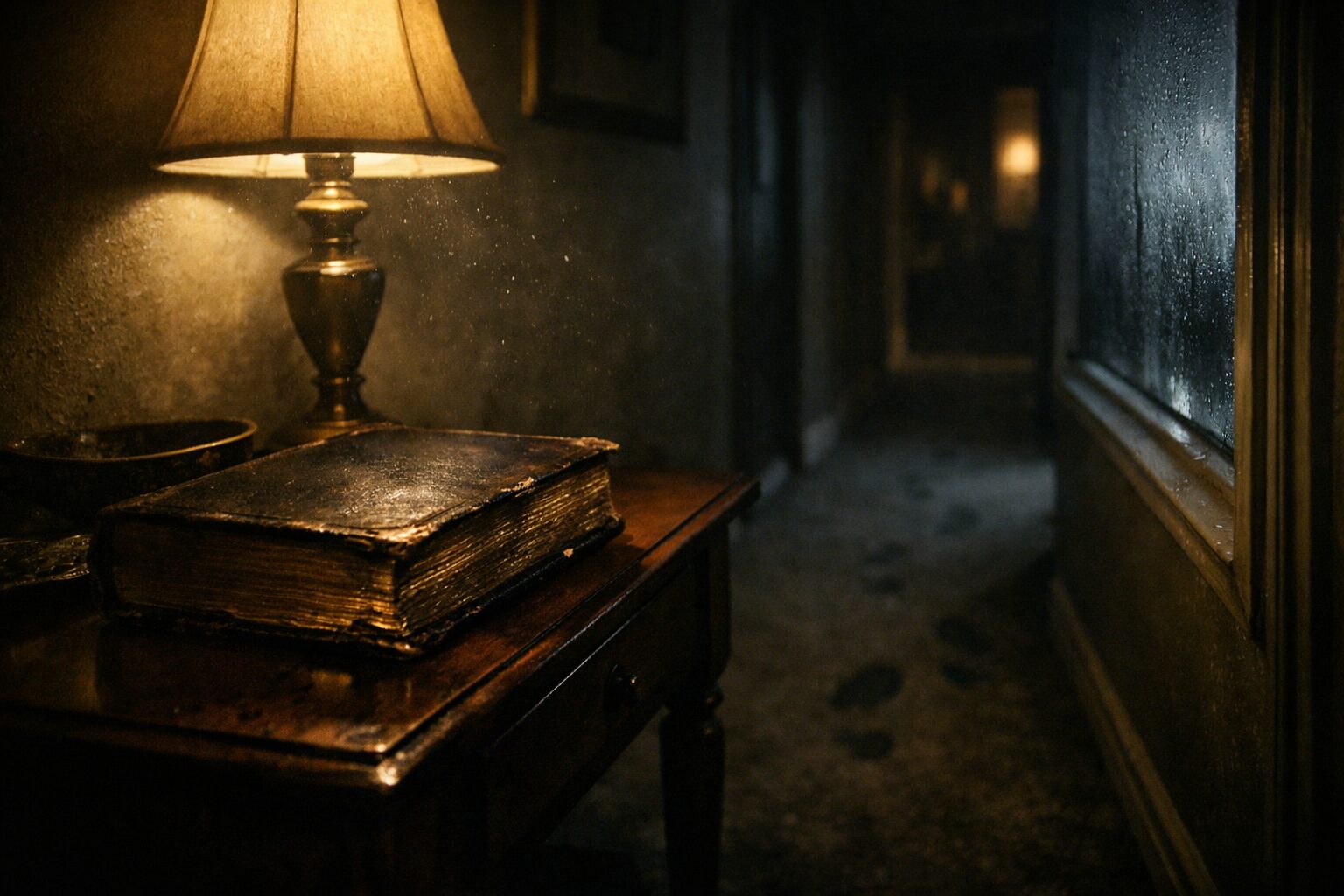
I wasn’t thinking of it as anything other than an heirloom, a book like a piece of furniture. The binding gave off the sweet, dry smell of paper left to cure in a hot attic. The cover was heavy leather with a cross pressed into it so long ago the ridges had worn smooth. When I opened the first page, a tiny flake of gilt leaf came loose and stuck to my thumb. Inside were our names in different inks: births and deaths, loops growing tighter as the years passed, a little tremor in the last hand to write there. There were places where someone had pressed things flat between the pages—a faint arch of grass, a pale rectangle that had probably been a ribbon. On one page I saw the dark ghost of a flower I couldn’t name, purple once and now a grayish violet that you had to catch from the side to see at all. I didn’t prod at it. I closed the book carefully and set it right where I’d opened it, between a bowl of loose change and the dish of dog biscuits for a dog I don’t have yet, the way you put down something you plan to appreciate but don’t have a plan for.
That night the neighborhood settled into itself: the single car curling around the cul-de-sac and out again, the motion light across the street coming to life and dying, the refrigerator’s buzzing note stepping up and then dropping back into the hum of the house. It was early fall, the kind of evening where the heat really doesn’t need to kick on if you put on a sweater. I noticed the living room felt fine. The little hallway felt fine. But when I walked past the table where the Bible sat—keys on one side, mail stacked neatly under it like a makeshift stand—the air had a different edge. It was cooler. It wasn’t dramatic, not enough to see my breath or anything like that, just enough that the skin on my hands tightened and the hair on my arms made a small prickling under the cuffs of my sweater. I checked the window near the table to see if I’d left it unlatched. It was shut. I put my hand over the heating vent in the baseboard and felt a faint wash of warm air, like the HVAC was doing its job. I stood there, half bent over, feeling the mix of the room’s normal warmth and that little drop in temperature right at the table.
When I moved away, the air felt like it always did. When I stepped back, it didn’t. If you could roll weather like a rug and unroll it again exactly over the same spot, that was the sensation. I told myself it was the windows, or the fact that the table sits in a shallow notch between the hallway and the living room, and maybe air eddies there. I felt a little foolish for thinking about it at all. But the drop was real, a border I could step in and out of like a pool.
By Saturday morning the mail had collected on the table in a bigger drift: the grocery flyer with a smiling family on the front, a reminder about the water bill. The Bible sat like a brick at the center, the kind of thing you move around without meaning to touch. I straightened the stack, set the change bowl back a few inches, and felt that cool air touch the backs of my fingers again. I went to the thermostat and tapped the button up one degree. The heater came to life in the closet with its usual shudder, moved air in all the rooms, warmed up the smell of the place a little. The cool place near the Bible didn’t respond to that at all. If anything, the contrast made it stand out more clearly: ordinary warm air in the living room; a small, insistent pocket of night on the table.
I wasn’t thinking of the stories. When I was a kid, there were jokes at holidays about how not to put the Bible under your pillow because you’d wake up to someone sitting on the edge of the bed, or how my great-grandmother wouldn’t let it rest on a bare surface because “that man will bring in his winter”—a thing adults said to make cousins jump and then laugh it off. They were always told with enough of a grin that you didn’t have to take them seriously. I had never taken them seriously.
Monday night I fell asleep on the couch with the TV throwing soft blue across the room. Around eleven, the volume of the house shifted in that way that most suburban houses do when the street quiets and the crickets take over the speakers. I didn’t hear anything unusual at first. Then a floorboard in the hallway popped like a knuckle. Another one, a half second later, nearer the entrance. Houses remember the weight of footsteps and they complain in the same places. I lay there on the couch and listened to the creaks count down from the bedroom toward the little table where the mail lay. One, barely there. Two, closer, the sound of wood catching and letting go. Then a softer sound I couldn’t place, like a fabric edge rubbing across wood. I told myself it was the return vent drawing settling air through the rooms. I told myself a lot of things. I lay still and watched the blue TV light breathe up and down on the ceiling while something shifted the weight of empty air a few steps down the hall.
The next morning the keys were a few inches to the left of where I’d left them. I don’t catalog the position of my keys; I only noticed because the bowl had a half-moon of dust under it and the keys were lying where they had revealed clean wood. Beside the Bible there was a faint wet ring on the table like a glass had sweat there, though I hadn’t had anything to drink in that room. The little satin bookmark that had been tucked along the right edge of the pages now missed and hung over the left. None of this felt like proof of anything. It amounted to a handful of small, polite adjustments, as if someone had been tidying my untidiness at the careful edge of the table and had always returned to rest their hand by the book when they were done.
On Wednesday a dining chair was angled differently, turned a few degrees toward the hallway. I’ve lived alone long enough to know when I’ve knocked into a chair with a hip while walking past it. This was not that kind of angle. It was set as if to include the table in a conversation. I put it back. I stood where it had been pointing and looked at the table and felt that unseasonable cool on my collarbones as if a window had been opened somewhere very small. I reached out and pushed the Bible an inch toward the wall to make room to sort the mail. The pocket of cold moved with it, a step to the left, like a person adjusting to keep the same distance between us.
That night I left a light on in the hallway. It seemed like a concession to something without admitting it. I went to bed, double-checked the lock on the front door because I’d walked to it and back twice already without remembering, and lay down under the thin quilt I keep at the end of summer. I woke to the sound of steps again, softer now, just the suggestion of weight testing wood. It was not the busy wandering of a raccoon on the roof or anything stomping. It had a person’s rhythm to it. I knew where they were by where the house talks: the third plank from the bedroom squealed; the one before the table made a little hollow noise. They came to the table and stopped there in the square of yellow cast by the nightlight, and then there was a faint pressure in the quiet like when the refrigerator motor is about to start but doesn’t. I let the feeling wash over me, and I think I fell asleep because the next thing I knew it was light and the coffee maker was sputtering the way it does when it decides the schedule for me.
I told myself I should put the book somewhere more appropriate. If it didn’t have an aura around it—if there wasn’t anything at all on the other end of it—it at least deserved not to be next to a pile of coupons. I carried it into the guest room in the afternoon, set it on the dresser that used to be my parents’ when they had an apartment with a window on the parking lot, and then stood there with my palms flat on the cool wood to see what I’d feel. The room smelled faintly like the cedar chips I’d tossed in the closet and the dryer sheet folded between extra pillowcases. It felt ordinary. I went to bed that night thinking I had done something practical.
At just about one in the morning, I woke because I had the sense that the house had turned its head to listen. The HVAC had cycled off and the silence had that specific thrum you only get between sounds. I thought of the book on the dresser and, before I knew what I’d decided, I got up and went to get it. The hallway light made the house look two shades paler than it was in the day. I stepped into the guest room, lifted the Bible—it has a compact weight that surprises you on the first try, like picking up a relative’s ashes you expect to be lighter—and turned to carry it back down the hall to the living room, where I had decided suddenly that it should be, where it had been.
I heard the floor in the guest room shift behind me the way it does when a person steps from carpet to wood. The next part is where my memory rolls itself out and I can step inside it as many times as I like and it doesn’t change. I walked three slow steps into the hall. The floor spoke under me. Another step spoke after me. The spacing wasn’t mine. It followed, matching but out of sync, a half beat after, like an echo with feet. I stopped dead in the doorway. Everything stopped with me. I took another step and something took another, faint, measured. The little hairs at the back of my neck rose so hard it made my scalp feel tight. I looked back down the hallway into the guest room, which was nothing but shadows and the pale ovals of the dresser knobs. There was no one there. The feet still found the squeaky board when I did.
I didn’t call anyone. I didn’t say anything out loud. The idea felt suddenly embarrassing, like speaking in a library. I carried the book very carefully back to the little table by the hall, set it where the water ring had been days before, and stood there exactly where the yellow nightlight fell onto my feet so that I could see my own ankles, and listened. The house breathed and ticked. Somewhere outside, a car door shut. Inside, at my back and to my right where the guest room hall emptied into the living room, there was the absence of a step that should have come and did not. The pocket of cold returned like a hand put gently against my chest not to push me but to keep me still. After a minute that I couldn’t have measured, the feeling lifted, the way sinks are loudest right when the water goes quiet.
In the morning I put the Bible in a shallow sweater box—the kind you buy for seasonal clothes—and lined it with an old tea towel. I did this with more care than the thing required and more care than I knew how to justify. I laid the Bible down, slipped the towel over it, pressed the lid of the box into place, and wrapped a length of twine around it because that made the box seem complete, as if it now had a purpose other than being a container. I slid it onto the top shelf of the hall closet behind a stack of blankets and shut the door. The place on the table looked suddenly naked and very bright in the morning sun, and when I stood there I did not feel cold at all. I went about the day like a person who has done the right kind of tidying.
That evening I read in bed with the bedside lamp on low, the shade casting its own imperfect circle on the wall. The night outside was clear enough that the neighbor’s porch light tapped my curtains with a blue square. I turned the light off around midnight and listened to the small sounds as we all settled into the shape of the dark. Sometime after that—according to the glowing red numbers on my alarm clock, 2:13—I woke with the uncomplicated feeling that there was something to observe. Not dread, not even curiosity, just the sense that a slight adjustment had been made to the room I had left. There was the faintest smell, a cross between old paper and something that might once have been floral if you were generous and remembering the flower from very far away. I reached for the lamp switch and, after a moment of gritty hesitation, the bulb pooled its little sun on the nightstand.
On the wood, next to the coaster and the glass of water I always forget to drink, lay a pressed flower. It was not fresh. It was the translucent, papery kind that has to be moved with a fingertip or else it will shatter into a series of quiet nothings. Its petals had been a deeper color once—I could tell by the way the edges still held to a violety shade while the center had gone to the color of old receipts. You could see the pattern of the veins, the way a leaf remembers the water it used to carry. A few grains of pale pollen, or dust that only pretends to be pollen, made a half-moon by the lamp. I did not own any pressed flowers. I had not opened the Bible to the pages with the dark marks in them. I thought about the box in the hall closet, under two blankets and a spare pillow, the lid I had snugged down and the twine looped like a child’s idea of how to tie a package.
I didn’t touch it. I pulled the sheet up and lay there with my hand under my cheek and the light on, listening to the house be a house. The pressed petals made no sound at all. They simply were, as if they had always been there and I’d been the one set down in the wrong place. When I reached out finally and put the glass on the coaster and very gently set the coaster over the flower to keep the small movement of the room from stirring it, I noticed the faintest stain on the nightstand where the stem rested, a pale line as if someone had drawn the outline first and then filled in the rest later. I kept my palm on the smooth wood until any cool that had been there had nowhere to go but into me. The hall closet door remained closed. The box remained tied. The house kept its own counsel and, in the circle of lamplight, the violet did not dissolve.