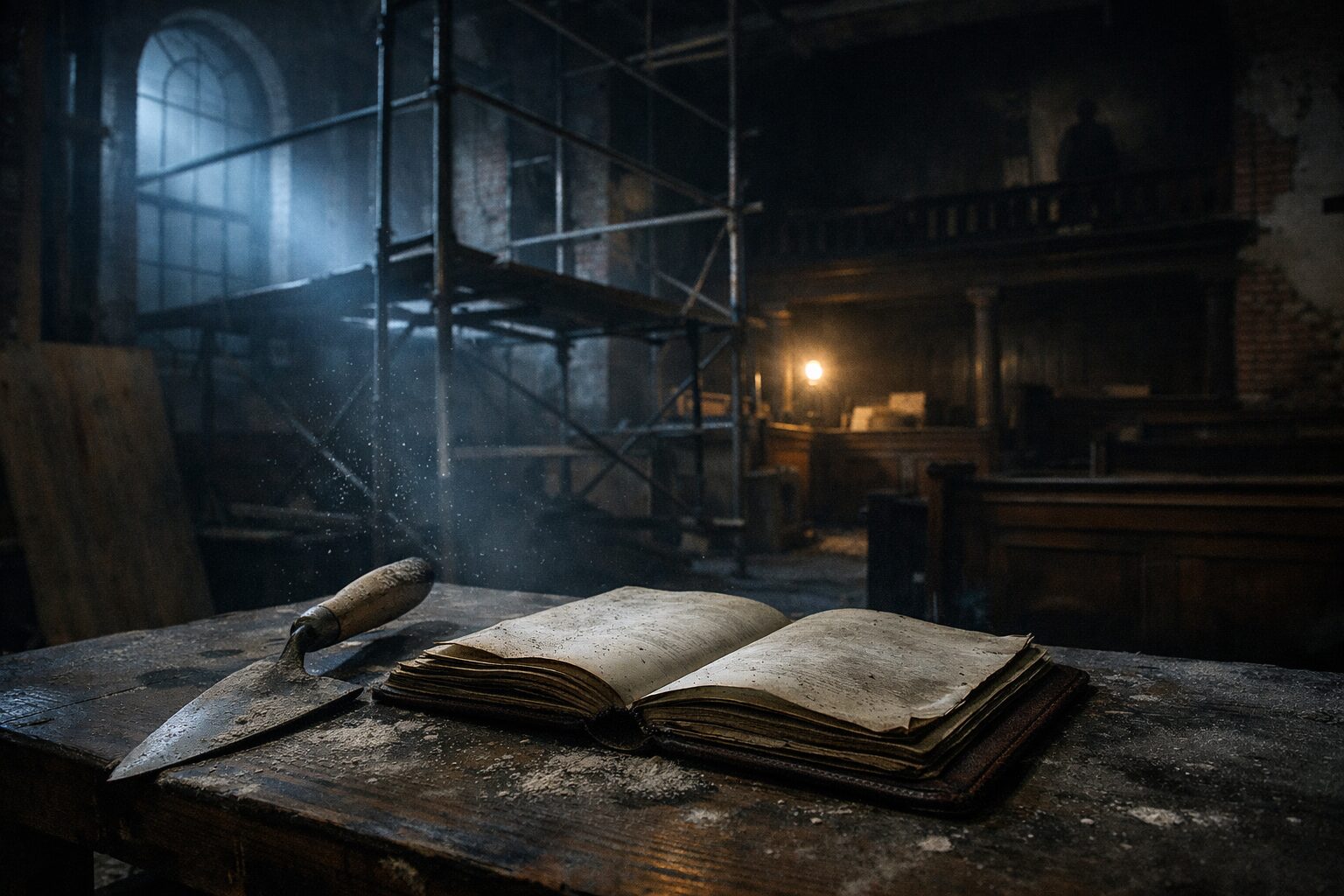
The Journal Found Behind the Courthouse Wall
They had stripped the plaster from the northeast corridor first, where the oldest bricks showed crow-foot indents and the lime-sand mortar had gone to powder along the joints. It was honest work: scraping with a putty knife, brushing off the dust, tapping to listen for voids. One of the men—broad-shouldered, quiet, always careful with edgework—tapped at the base course beneath the judge’s robing room and heard a roomier echo than brick ought to give. He pried gently at a seam line, finding a row of slightly darker mortar no broader than a thumb. The others turned off a radio and watched. The blade of his trowel slid into friable grit, lifted a slim facing brick, then another, and there was a chill that pushed out as if the wall had been holding its breath for years.
Behind that slit, in a narrow pocket formed by three courses and a brick turned sideways, lay a parcel black with dust. It was wrapped in canvas that had been heavily waxed and tied with a brittle leather thong, sunk into the cool dryness of the cavity, the leather shivers leaving a sweet, tired smell on the worker’s hands. They called in the site supervisor, who called the county archivist. She arrived without removing her scarf, still wearing her desk cardigan under a winter coat, and took the parcel to a makeshift table beneath the scaffold.
It was a book, the kind of ledger old offices used, bound in dark calfskin rubbed to a seam-sheen at the spine. The first page had an owner’s name written small, with a law-clerk’s patience: A.S. Bligh, Deputy Clerk. Below, in the same hand, the date 1906. The ink had browned and feathery edges in places where the nib had stalled. The archivist turned past two empty leaves to find the first entry: a neat account of closing the courthouse one night in March, securing keys, extinguishing gaslights on the second floor, winding the clock in the tower to the correct hour, and then a sentence about something that was not correct. She read in a low voice to the gathered workers, the sound of her reading a faint burr under the hum of a halogen work light.
The entries marched with the dates. There was no grand flourish to them. There were times listed, terse phrases, sometimes a full sentence to catch a detail the writer feared he might forget. At 11:17 p.m., when the building settled and the cross-draft died, the hallway outside Courtroom B took on a pressure like someone leaning against the air. At 11:23 p.m., the third tread up from the main landing creaked under weight, though he could see it move and see nothing on it. At 11:30 p.m., a sound like a gavel, once only, came from the empty courtroom where he had laid the judge’s mallet fat-side down in the well. The steadiness of the writing was what made it persuasive; there were no adjectives of fear or melodrama, only marks on paper like pins on a map. He chalked the threshold to the jury room and returned in the morning to find the chalk smudged to the right, as if something had squeezed through with its shoulder turned. He set a paperweight against the lower sash of the clerk’s office window and woke at two to wonder whether he had locked the outer doors. When he checked, the paperweight was still where he had placed it; instead a clean handprint had bloomed in the faint coal-smut on the glass, heel towards the top.
The book went on with an accountant’s sobriety. On rainy nights, the stair complained more at 11:23 p.m. than on clear ones. There was persistent tobacco scent in the rotunda even after the anti-smoking edict, as if the building itself were exhaling through its past. He found court dockets lifted from their stacks and opened to an identical page—People v. Traynor, June Term—though he had re-shelved them in random order to test himself. It is the repetition that gained his attention, he wrote. A schedule kept without my leave. The entries were brief at first and then a little longer as spring grew to summer, as if the act of noting made the events more solid. He described standing in the darkened courtroom with only the streetlight on the glass globes and hearing the gallery benches creak one after another, as if a row of men had taken their seats when none had. He learned to anticipate the single knock at 11:30 and would sometimes sit in the judge’s chair holding one end of the gavel in his hand like a bridle, to see whether the sound came when he kept it from moving. One of the men on the scaffold, listening, glanced towards the open court and rubbed his forearm.
The county archivist kept turning pages. The handwriting held, small and circumspect. There were notes on a watchman who lasted two weeks and then quit, complaining of “goings-on.” There was a test with a sprig of lilac laid upon the docket to see whether, in the morning, it would be withered. He wrote that it was, and that he could not be certain he had not simply chosen a poor sprig to start. He wrote a line that could have been innocent if not for where it sat: It is comforting, in a perverse way, to know that the building keeps a kind of time when I am at my desk here, for I can hear it approach like an old bell with an old burr in it. Underneath, an entry dated early November noted a hard frost and the bell’s deliberateness even with the wind in the ventilators. He placed a coin on the clerk’s rail and described finding it on its edge the next morning, a neat trick he could not help but be proud of even as he would rather it did not happen in his care.
Then the entries stopped. There was no farewell, no tired musing at the end of a long run. One dated three nights before Thanksgiving recounted the usual: the stair at 11:23, the knock at 11:30, a book left open to the same case, and a note that he had gone down to the boiler room to check the banked coals because cold had come early. The handwriting broke off at the end of the line, as if he had been called away and would be back shortly. The page after that was blank, then another blank, then the back board. No explanation.
The men went back to their tools. The archivist took the book with both hands and moved it to a molded plastic bin with a lid, but she did not put the lid on. It sat open, spine-up, in the temporary site office where invoices were signed. The building made its old sounds as dusk came down earlier. They shut off the heavy work lights one by one, and when the last two men walked the stairs that first evening after the finding, the third tread did give, just as it had read on that page: a shallower, bend-wood moan rather than the high squeak of the newer replacements, like a knee. One of the men stopped and put his weight down again, listening for whether it was the kind of groan that would bear him safely or the kind that announced itself before letting go. Another man, not given to stories, paused, then angled his head as if hearing a distant hammer. In Courtroom B, there was a sound as small and decisive as the striking of a mallet on wood. They looked at each other and went on with their coats buttoned to the top. The site office heater clicked twice and began to exhale.
Night watch fell to a contracted guard that winter, a retired deputy with a pocket notebook he kept without flourish. In the log he wrote: 11:20 p.m. hallway quiet; 11:22 draft in N corridor like someone opened a door; 11:23 third stair; 11:30 something like a tap in Courtroom B. He was not in the habit of sharing his notes any more than he had to, but the county asked for a few unusual explanations. They had placed a small motion sensor near the jury room on a stand. It pulsed at the same time, on the same nights, even when there was no one scheduled in the building. The guard wrote once, three months in: Smelled cigars for a moment, reminded me of O’Dowd’s—no one here. He struck this line through and initials next to it, out of embarrassment or duty.
There were other things, petty and smaller than stories like to tell, and because they were small they stayed sharper. A folded petition moved itself across the clerk’s counter and lay crooked against the blotter, and the junior inspector laughed and said the building had drafts. The longcase clock in the main hall, long stilled except when it was wound for ceremonial days, clicked as if a heavy thing had settled back on its weight. A row of wooden chairs along the rail bore shiny places that were not there the day before, as if suit coat shoulders had burnished the timber all at once. A paperclip was found on edge by a worker who did not notice he had knocked it upright. Every repetition called to mind the ledger’s pestering, regular nights, so consistent it was easy to grow fond of a schedule one did not set.
The archivist did not intend to become the kind of person who haunted her own stacks, but she found she could not let it sit as a curiosity. On her lunch hour she went down to the Historical Room in the library, where the microfilm kept its own winter in the drawers, and she pulled the town paper for the week of that last entry. The wheels of the reader growled as she wound past advertisements for patent medicines and horse-hair mattresses. The news in those days had been thin: a school board vote, a brief about the river taking a scow loose on a Thursday, a court report with the names of men who were now only names. She squinted and let the film rest. There: a column run low on the page, a kind of squib, set between a notice for lost mittens and a local grocer’s special.
Deputy Clerk Missing: Mr. A. S. Bligh, of the Courthouse, failed to return to his lodging Wednesday last. He was last seen by the night watch about the hour of 10, the weather being cold. Friends report that he was in good spirits. Search was made at the river and along the railroad. It is believed he may have gone to visit his sister at Hastings and was delayed. Any information kindly to be brought to the Sheriff’s attention. The next day’s paper brought smaller types and colder tone: No news as to Mr. Bligh’s whereabouts. Watchman notes unusual disturbances (the rest fuzzy with a poor exposure). The following week the paper printed that relatives had been written to and there had been no response. No firm conclusion followed in the weeks that came behind, only a thinning of mention until his name was not in the column any longer.
She read further back and further ahead. There was a line in summer about a watchman’s resignation for reasons “peculiar to night service.” There was a note of a hearing continued due to a key gone missing overnight. Nothing overt, never anything so bold that it would turn a digest into a legend, but each piece fit into the notch of the ledger’s cool account. She returned to the courthouse with her notes written as plainly as she could, feeling that she had not done any more than name a absence that had already been there in the wall.
The book waited on the table. In the weeks since its finding, the cold came with that old courage the building must remember from winters when the slate roof borne snow as a matter of course. At closing time more often than they admitted, one of the workers would lay a pencil down so that it pointed straight down the table, then look for it in the morning and find it a shade turned. No one said that the shade was always the same few degrees to the right. On some nights the archivist stayed to finish accession forms, her tea cooling on the loaner filing cabinet. The watch said 11:15. She could tell because the HVAC blower sighed and then there was the little slack the walls took when heat withdrew. She had learned to hear the building’s intentions. 11:17, some quality in the air sorted itself out; 11:23, footsteps on a stair that was not under anyone’s feet; 11:30, the tap, no more than the agreed-upon punctuation of a judge with a tidy docket. She liked to tell herself it was ritual, the orderly breath of an old institution. She thought the same only until the nights when the open book grew particular in its presence, as if in each silence it had its own words to supply.
On a Thursday, she closed the bin lid for the first time. It felt officious and a little foolish, like moving a chessman one has never learned to play. She told herself that the damp in the air was bad for paper this old; that was true. She took her coat from the back of the chair and slipped her arm in one sleeve, then paused for an ordinary reason: she had forgotten her keys on the table. When she turned back, the lid was no longer evenly placed on the bin. It was skewed, lifted less than an inch on the far side, as if someone had nudged it and not finished the job. She had not nudged it. There was no one else in the room. There was a sound from the courtroom, a small, judicial half-announcement at the half-minute. She lifted the lid and felt, or told herself she felt, a draft from inside.
She had cataloged the item by then—Title: Journal of Deputy Clerk A. S. Bligh; Material: leather-bound ledger; Pages: 146 leaves, 70 used; Marks: marginal ticks, cross-outs, chemical oxidation on iron gall. She had written that the final pages were blank, in a precise hand. She had written it twice. She opened to the end and found the last used page, the November scrawl, the line that broke off near the sentence about the boiler, a horizontal of ink before the pen lifted. She turned the next page and saw what any good records officer expects to see: nothing. She turned the next, and there was the surprise and it was not like when you are a child and find a birthday five-dollar tucked into a book. It was a hand. It was a handful of hand; the first stroke of a date laid down alone, meaning to be followed by words, the date being this day’s date.
The ink had not browned. It still possessed a blue-black that photographs as almost green. There were three words after the date and they were in the same careful clerk’s hand that had been under her eye for a week, a little more aged perhaps, a little more deliberate. The words were not dramatic. They were like all the other words he had written before: a mark on a time that did not belong to him. 11:23—third stair.
She sat there with the bin open and the office fluorescent buzzing. She touched no part of the page. She looked at the window and thought of the paperweight that had not stayed a paperweight and the print at the top of the pane that had faced the wrong way. She listened to the building announce its agreements and could not help but count them now. The guard in his round felt the draft and wrote about it later, though he would cross it out twice. The two men in their truck outside let the heater run and did not speak. A folded petition somewhere in the clerk’s office worked itself a fraction out from the stack and did not fall, not yet, as if an unseen fingertip were straightening it along a line no one present could see.
She did not tell the men in the morning. She did not make a remark to the judge when he walked through and touched the walnut rail with the same motion as men in photographs had done a century before. She did what the ledger had taught her was the only honest thing to do when confronted with a record that keeps its own time: she looked again the following night. The page that had been blank had four new lines when she arrived. They named small, sensible things as if they were being performed in another room: 11:30—tap in B; 11:45—papers disturbed; 1:10 a.m.—wind in tower though the window is pinned. On the fifth line there was a name, not his or hers, the kind of common two-syllable surname that belonged on a contractor’s invoice. It was the foreman’s, written as if it were a docketed defendant, followed by a colon and a short description: moves brick from cavity, replaces with same. There was no accusation in it. It was only an account, the way all the prior entries had been, a building’s ledger kept in a human hand and carried forward.