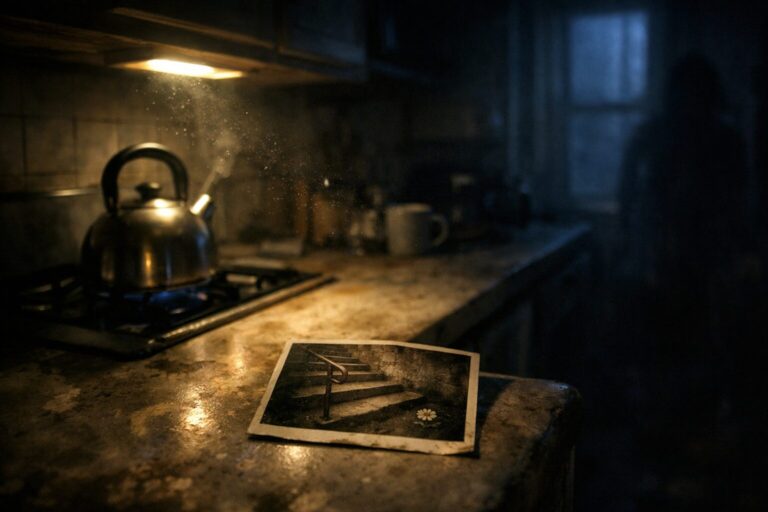
The Last Photo Showed Someone Behind Her
The box had lived in my closet for years, a shoebox wrapped in rubber bands and musty with old paper and whatever the photo lab used to seal color into cheap prints. I set it on my coffee table with a towel underneath so the cardboard wouldn’t leave a stain. The apartment was very quiet. It was a Sunday, late afternoon, the light lying thin and gold on the floorboards. The radiator clicked at intervals. Somewhere upstairs a chair scuffed. I had put on water for tea, and when it hissed I let it overboil, because I was already holding the first stack of pictures in my hands and feeling that ache in the chest I get when something familiar hits me straight on.
We never called it an anniversary. We didn’t mark the date online. But the box only ever came out in late winter, when the air had that hollow sound to it and it felt right to sit and listen to old paper. The mystery is old enough now that even the people who had something to do with it look softened in my mind, like they’re standing behind fogged glass. My aunt—it’s easier to call her that, though everyone called her by her first name—went out one evening and didn’t come home. Not a fight. Not a storm. She just didn’t come home. The file is still open somewhere; a chilly drawer in a building I can’t picture. On the better years we tell each other it’s good to look back, to keep the edges from blurring. On the worse ones we avoid the box altogether. This year I told myself I would at least sort the photos and scan the good ones for my mother.
I brought the old flatbed scanner out and cleared space on the table. Paper gum stuck to the bottom like dried sap. I thumbed through prints in their one-hour envelopes, wide margins and rounded corners, dates stamped in a red that had turned brown. Here was a picnic on a hillside in a windbreaker era. Here was the kitchen in my grandparents’ old place, the laminate like a chessboard. A Christmas with paper crowns. She moved through them like a lamp, never looking directly at the person behind the camera, always with something in hand—a spoon, a coat on her arm, a towel draped over a shoulder. I set aside the duplicates and the finger-blurred rejects. I kept the pile from the spring before she was gone to scan first.
The last picture from that day was of her standing in her apartment kitchen, the narrow one with the window that looked into the courtyard. You could see the dead fern in the corner, the clock with the wedge of a missing number. She had a knife in her hand and the frosting on the blade was the exact color of the cheap lemon cakes we used to get from the bakery on the corner. Her mouth was mid-saying something. It was a friendly kitchen, I remembered it smelling like lemon and onions. It took me a second to realize what was wrong, because it wasn’t her. She looked like herself. It was something behind her, a column of not-quite-shadow, to the right of the doorway that led to the hall.
I stared. It wasn’t obvious enough to call a person, not the way the original looked. More like when a long exposure catches a person moving and they become a pale blur against the wall. The hall lamp must have been on, because there was light down there. A trick of contrast, I told myself, or a coat draped over something. She never had a coatrack, though. I remembered the row of hooks by the door. The air in my apartment went still, as if the building itself was listening to me think. I held the picture by its edges and angled it toward the window, then toward the lamp by the couch. The figure didn’t go away. It felt like the shape of someone standing with their shoulders almost to the frame, as if trying to fit where they shouldn’t.
I took a quick photo of the print with my phone and sent it to the family text. It felt foolish and a little cruel, to drop a thing like that into a place we used mostly for grocery lists and photos of nieces. But the picture had already found its way into the small place behind my ribs where worry makes a nest. I put the kettle back on, let my phone vibrate face-down on the table until I could not bear it and flipped it over.
My mother’s reply came first. Her words came like they always do when she’s trying to be careful: Are you sure that’s not the doorframe? She sent a second message before I could respond: I don’t remember anyone else there. Then my uncle, the one who took a lot of the photos in those days, chimed in. That’s the last one I took before the batteries died. It was just us. The sink dripped. The dog. He’d spelled it “sink” and then corrected to “sink?” and then left it, which somehow made me smile and then made me want to cry.
Who else was there? I asked. I listed them, as if naming could make it firm. My mother told me the cake was bought on her way back from work, that she was tired and left early, that she would have remembered a visitor. My aunt M said she never let people drop by unannounced. She liked control, she wrote. She locked the door behind even the mailman. It was a running family joke, once. In the background of my apartment the radiator sighed through its teeth. Outside, a car alarm chirped and went silent. I felt, stupidly, like someone was going to knock.
I decided to scan the picture properly, to make it large on my laptop so it would stop being only what my brain was deciding it was. The scanner hummed and the light bar ran under the print. I watched it move as if it could disturb the surface. Dust flecks appeared. The computer fans made their small, even rush. I saved the file and opened it, and with the cheap crispness that somehow makes images feel truer, the kitchen sprang forward.
Zoomed in, the shape hardened into things that had edges. The shoulder looked like a shoulder, the line of dark down near the waist like a long coat. There was a suggestion of hair, a smear of light where a face might be turned away toward the hall. You could say it was an effect. I sat so still that the hum of the refrigerator down the hall seemed to become part of my skull. I sent the file to the group. After a minute, the three dots pulsed. My uncle wrote, That hallway was empty. I was facing it. If someone had been there I would have seen. The word empty landed with a weight in my head that didn’t fit their little moral letters. My mother’s bubble came next, slower. It made her fingers shake, I knew, to write. That door was always closed when we took pictures. She hated the way the hall looked in photos. The laminate gave a glare.
Something in the apartment changed then, not in any mystical way. The light shifted and the room suddenly seemed a shade darker, the winter afternoon stepping back one minute at a time. I rescan it, I typed. I’ll do a higher resolution. It felt mechanical, like an answer to any problem. Make a copy. Make it clearer. The second pass of the scanner was louder in my head than the first. I cleaned the glass with the tail of my T-shirt. I placed the photo with more care, aligning it to the corner. The buzz and crawl of light. I watched it through the plastic as if that would keep it honest.
When the new image opened, the room tipped a little. The figure was, undeniably, a figure, and what had been the blur of a head turned toward the hall now faced the camera. There was no detail you could name; it wasn’t like the movies, no sharp irises. But the planes of it had changed. The shape of a cheek caught the flash. There was a square of glare in a place that only eyes hold. The mouth was a darker seam. I realized I’d been holding my breath when my chest began to ring. The building gave one of those long settling creaks that runs under your feet like a small wave. I turned in my chair involuntarily, an animal move, and looked at the dim hallway to my own door, the rectangle of it, the coat I’ve been meaning to toss and the shoes kicked together.
My phone dinged again. My mother had left the chat for a minute—easier than thinking. My uncle sent a picture of the same kitchen from a month earlier, a daylight shot. The hallway door is shut in that one, a solid brown with the old brass latch. He’d drawn a little arrow on his phone to the place where the latch always stuck. I wasn’t sure if it was to comfort me or himself. The new scan sat open like a window to air that hadn’t moved in years. I added both images to the email I was building to save them from the thready scroll of the chat. I labeled them sensibly—last_kitchen_1, last_kitchen_2—and felt absurd, like I was writing captions for a museum.
I got up and went to my apartment door and put my eye to the peephole. The corridor outside was its own little aquarium of straw-colored light, the carpet cleaner than it ever really is because a fisheye makes everything look simple. No one was there. I stood with my ear to the wood a second longer than necessary. Footsteps from the stairwell came up, then went down again. The feeling of being observed—the one that slides over your scalp and makes you tilt your head without knowing why—came and went in a soft wave.
Back at the table, the photograph lay where I’d placed it for the scan. It’s funny how easily an object that you thought you knew can feel like a live thing. I took an envelope from the stack, the kind with the string that wraps around a paper button. I slid the picture in and wound it shut. It felt like putting away a piece of something that breathed, and I thought, superstitiously, that it would be better inside paper than looking openly from the wood of the table. The scanner lid was still up. The room was very quiet, the kind of quiet that has shape to it.
To break it, I reached for another envelope from the box, one marked with a summer in blue ink. The photos inside were from the lake that year. You could smell sunscreen just looking at them. There were sun-faded towels and a cooler and my cousin standing on the dock with her hands on her hips because she’d been dared and had already decided to jump. These were entirely unrelated to that cold kitchen, to that late spring. I picked one that had always made me smile: my grandfather asleep in a lawn chair with his hat tipped over his eyes and an empty plastic cup balanced on his knee. It was bright, nearly blown out by noon. It had nothing to do with a hallway that swallowed light.
I laid it on the scanner and set the resolution as before. The software bar filled blue. The machine sounded mundane again, freighted with nothing but light and timing. When the file opened, I zoomed by habit—I’d gotten used to looking too closely at things. The grass pixels sharpened. The weave of the lawn chair became a grid. And then, beyond his shoulder in the pale strip of shade cast by the side of the house, there was a narrow piece of dark that wasn’t in the print at all. I took the photo off the glass and held it to the lamp; the shade ran clean to the fence. But on the screen there was a small vertical where no vertical belonged, as if a person had been standing just inside the shadow, observing the funny little tableau of a man asleep under a hat. It wasn’t as bold as in the kitchen. It was less sure of itself. But it was there.
I stared until my eyes watered, trying to make it refuse to be what it wanted to be. My apartment held itself in. Somewhere a neighbor dropped something that rolled and rolled and finally stopped. I put the lake photo into the envelope with the kitchen one, as if keeping them together would calm whatever it was that had started to cross from flat paper into the room. The others I didn’t scan that night. I wrapped the rubber bands around the box and slid it back into the closet. I stood in the doorway a minute longer than needed, as if a draft were moving past me that I could not feel on my skin. The screen stayed open on the table behind me, the magnified rectangle of a shadow in bright summer. On the second scan, even at that size, you could almost see the way the dark seam bent around where a head would be, angled a fraction toward the camera as if it had only just then learned where to look.