The Lights Beyond the Restricted Fence
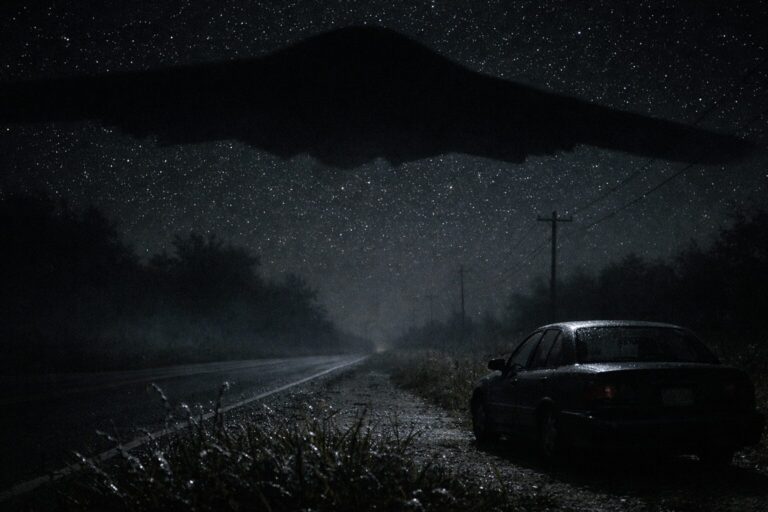
I was late because of the detour. A wreck on the main highway had pushed me onto the county road that threads the north edge of the range, past cattle gates and a long sweep of scrub where the Air Force owns the ground beyond the fence. I’ve always kept a steady pace on that stretch, not for fear of the fines so much as the feeling you get when there’s only wire and signs between you and miles of empty. I knew the posted boundaries the way you know the back of your hand. You learn to ignore the big white letters about restricted access. You keep your eyes on the yellow reflectors, on the way the fence line runs true and then jogs at the wash beside mile marker 42. That’s how it’s always been.
The night had gone bone-dry and clear. My headlights peeled the highway into a ribbon of chalk. Out in the scrub, creosote smelled like dust and penny copper. On the dash, the radio flickered through static and found a preacher out of Lordsburg talking about humility. There were the usual fixed points: two red obstruction lights pulsing steady on the ridge, a skeletal tower backlit by the stars, and the warning signs that cropped up every quarter mile in the beam of my driving lights—plain white with black lettering, hinged to the chain-link by twisted wire.
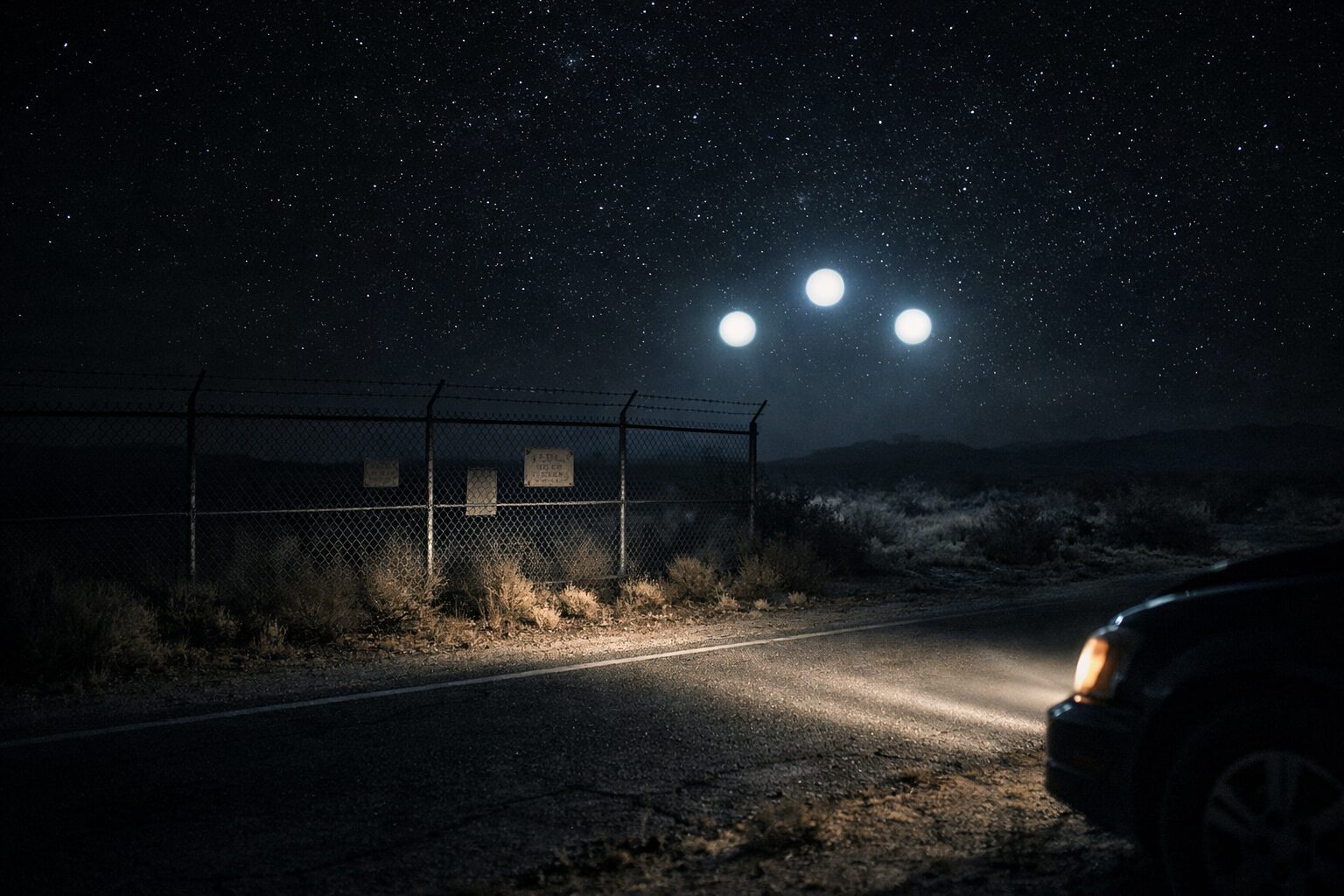
I had just passed the little turnout where the old cottonwood used to put one dark hand over the fence—before the flood took it—when I saw the first light. It was out beyond the wire, low and white as a halogen, drifting where no ranch road ran. For a second I thought utility truck or a side-by-side ignoring the postings, but there was no sound to it. No engine carrying to me over the stillness. Then a second glow slid into sight beside the first, as if it had been hiding behind the shape of the scrub and decided to step out.
They moved together and then apart, no bounce, no shake, drawing little arcs that looked like the first strokes of a sentence I couldn’t read. The radio sermon wandered off into another station and back again without me touching the dial. When I let off the gas, the lights didn’t pull away like a car would have. They eased down, nearer to the hardpan, low enough to be at the height of the mesquite. I realized I was holding my breath, as if exhaling would make them freeze.
I rolled onto the shoulder opposite a sign I knew by heart—Restricted Area, No Trespassing—and let the engine idle. Gravel snapped under my tires like old bones. I cut the fan so I could hear. Nothing out there but wind combing the brush and the dry tick of the engine block cooling. The two glows flanked a third I hadn’t seen arrive, and the three of them paced in a loose V, then rotated like points around an invisible circle. They were the color of a headlamp seen through fog, only there was no fog, and the light didn’t seem to come from anything, just hanging above the ground like a held breath.
The fence looked wrong. I didn’t notice it right away. It’s the sort of thing that doesn’t shout. You catch it when your eyes have been moving the right of way for the thousandth time and then snag on a splinter. The run of posts should have stepped down to the wash a few hundred yards west and then come back up with a little kink that made the reflectors sit out of plumb for three or four spans. I scanned for that familiar break and I couldn’t find it. The line went on and on ahead of me, straight as a taught string drawn past where the land should have forced it to bend.
I killed the headlights and the night folded around me. The three lights beyond the fence didn’t flare in response like a person’s would when you dim their eyes. They held steady. With no beam on the signs, the letters bled into their white boards. I opened the door and stepped into that high desert quiet that isn’t really quiet at all—crickets clicking in your head like a wristwatch, wind sketching over the wire. The gravel pressed through the soles of my boots and told me exactly where the shoulder ended, where the dirt started, where the ditch fell away. I went no farther than the painted line.
In the faint wash from my dome light, the nearest warning sign looked slightly off. The black lettering seemed thick where I remembered it thin, a different spacing, like someone had replaced it with a cousin in a hurry. The mesh of the chain-link had a narrower bite. The posts bore yellow reflectors notched with two screws instead of the one. All small things. I told myself they’d replaced sections after a storm and done it right this time, all the same gauge. That kind of common sense is what gets you home at night in these parts.
The lights dipped. They dropped lower until they skimmed the top edge of the brush, and as they did, the wire in front of me hummed a tight, mosquito high note. I felt it more than heard it, in my teeth and the hinge of my jaw. I turned my head to track the run of the fence again, to find that jog, and saw instead that the reflectors kept flashing and dimming in a long, even rhythm out toward the dark basin where the sign for 42 should have been. It was as if the road and the boundary were running side by side into a deeper stretch of night than we’ve got out there, a piece of country I don’t remember ever driving.
One light peeled away from the others and came toward me. It didn’t hurry. It didn’t sway. It stretched out a slow line over flat ground and stopped opposite my bumper. There was nothing between us but air and the six feet of chain-link and the barbed string above it. Maybe fifteen yards total. It hovered there—not quite head-high, a handspan higher—so that if I’d been out in that field and someone had told me to hold a lantern at my shoulder, I would have put it right where that one had stationed itself.
My radio cut into silence so clean it took the filing-cabinet buzz out of the car’s interior lights. The dash clock, which had been a stubborn green block, winked off. The little breath of wind that had been moving the sage seemed to hesitate, as if it had turned to watch, too. I had that feeling you get in a dark house when you realize you’re in someone else’s line of sight and you don’t know it until your skin tightens. I didn’t feel threatened as much as I felt accounted for. Noticed, in a way that was all pressure and no touch.
I swallowed and my throat clicked loud in my own ears. I said hello without meaning to say it, the syllables thin and ridiculous under the stars. The light didn’t waver. The other two hung back like dogs that know when to set their weight and wait. I raised my phone with the soft, apologetic reflex of a thief and lined up the glow in the screen. The camera tried to make a decision it couldn’t make. The exposure went high and then cut to black, as if the little computer inside had thrown its hands up. I tapped the shutter and felt the haptic buzz under my thumb, and the sound it made in that dead air—the tiny fake whirr—felt wrong.
On the far side of the fence, the light did something I could only understand by the way the brush responded. The mesquite directly beyond the sixth post to my left moved against the grain of the wind, a shiver like someone had run a knuckle along its spine. The chain-link made that insect pitch again, like it had picked up a current and was carrying it post to post. I became aware of the fence, the exactness of it, the way the top bar—which I would have sworn had never been there—drew a perfect level across the whole run. I had the ridiculous sense that if I reached out I would feel heat through the galvanized steel. I didn’t try.
I backed until my calf touched the car. Then I was in the seat, my hands on the wheel, the worn place at the top smooth under my palms, and I had the engine revved before I remembered it had never died. The dome light faded on its own. The thing across from me did not come any closer. It didn’t need to. The idea that it might be content to hold that line, to watch me from the exact boundary and never cross, was worse than the idea that it would rush and be done.
As my tires bit the asphalt, the preacher came back on mid-sentence—something about a narrow gate—and then he vanished again, replaced by a smear of voices none of which made words. I kept the car straight and didn’t floor it, because that stretch is rough and if you launch yourself wrong you’ll be in the cattle grid before you can correct. In the mirror, the three lights hung there and diminished not in the way of distance but like a match when somebody cups it—pressed down, briefly hotter, then gone into the world they’d been part of before I happened past.
The fence didn’t let me go. It ran alongside longer than it should have, reflectors winking off my taillights in mechanical, heartbeat time. I passed a new-looking sign I didn’t recognize—white letters on red I couldn’t parse as they flipped past—and then the old landmarks returned in a rush, familiar enough to relax my jaw: the dead billboard with a peeled beer ad, the shuttered gas station with the bird nest under the pump canopy. The right-of-way narrowed and the wire fell back into its proper place, pinched to the old wash. I put my hand on the empty radio and left it there like I was keeping a pet calm.
I pulled over once more where the road met the county line and checked the pictures in the glow of the phone, the screen making a ghost out of my hands. I scrolled and scrolled. The frames were there in order: my bumper lit too bright because I’d turned the headlights off and then on again, the edge of the sign with the black letters thick as paint, the fence like a metronome arm across the whole horizon. Where the lights should have been—where they had been, fixed to a point directly across from me—there was a depth of black I don’t get out here. Not the speckled dark of the desert where you can still pick out a yucca if you stare. These were wedges, shapes of absence that ate the pixels around them. In one, the warning sign blurred and the letters trailed as if somebody had dragged their finger through wet ink. In another, the yellow reflector on the post opposite my driver’s door was simply not there, though I remember it catching my breath with its shine. In one, the timestamp was broken: 00:00, as if the phone had given up on agreeing with the night about what time it was.
At home, later, on a screen that makes flaws plain, the fence in the photos ran and ran, longer than that span of road could hold, and in the deepest black where the first light had hung, a pair of fainter flecks were set hand-width apart at my eye level. Maybe dead pixels. Maybe nothing at all. In the moment, it felt like what it had felt like at the shoulder—like I had leaned too close to a thing that had already measured me and found it could wait.