
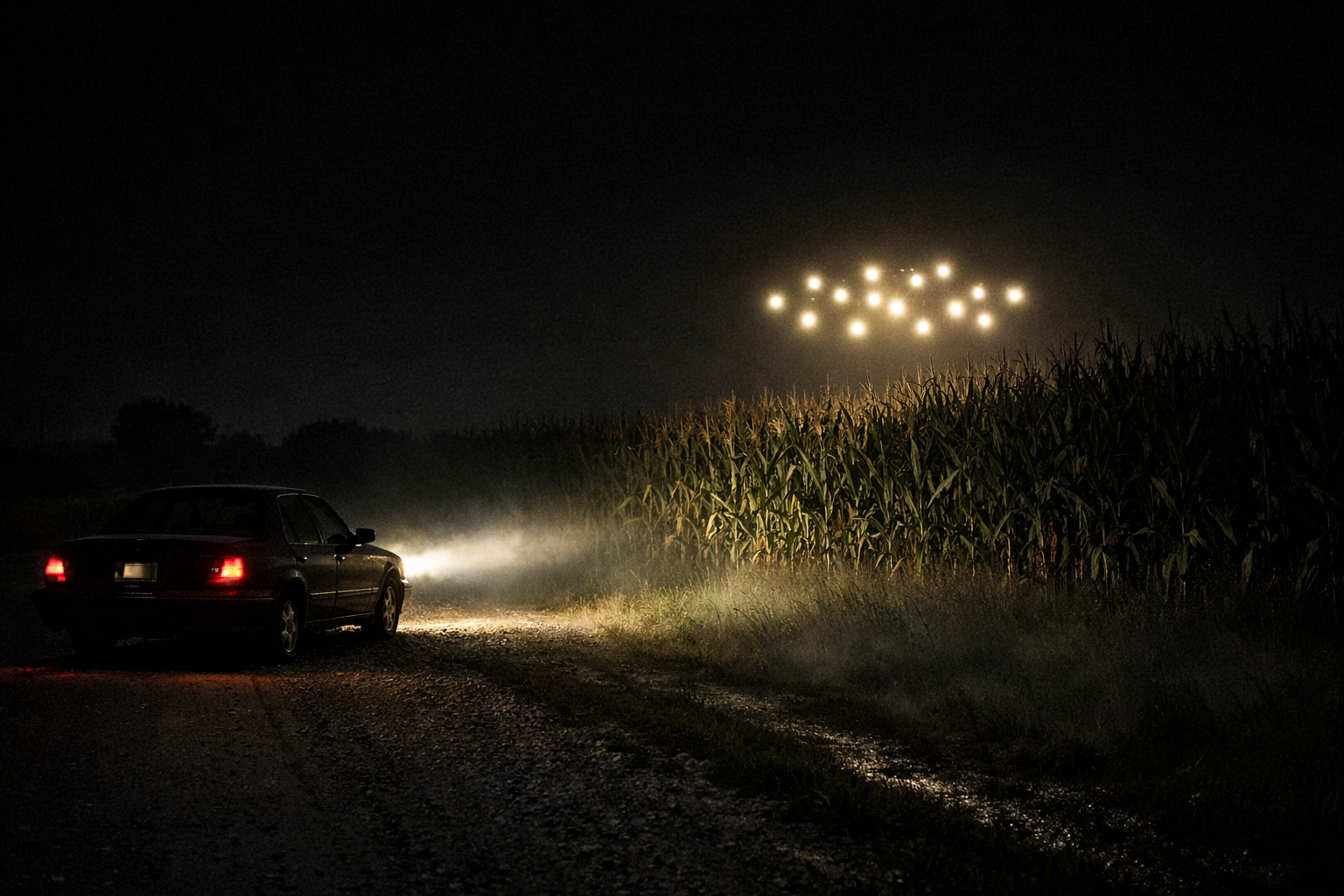
The Lights Over the Cornfield Moved Like They Were Watching
Most nights, if I leave the shop late, I cut down County 7 and then take the old frontage road that runs a mile along Martin’s corn. It’s quicker than the highway and quieter, too, a dark piece of road that makes you pay attention to your own little pool of headlights and not much else. By that hour the radio gives way to static between stations, and everything smells like dust and cut stalks. The dashboard clock glowed 12:38 as I eased past the first stand of maple, and the black hung heavy beyond the beams.
The gravel shoulder sheds into a ditch, and then the corn rises, a high rustle even with the windows up. I know every mailbox and turnoff on that stretch. If you look left at the right place you can sometimes see the tower lights from the county line blinking red through the breaks, and to the right it’s just fields and an occasional farmhouse light stubbornly burning at a distance. Familiar is the word for it. Even the way the bugs tap the windshield under the dome of the sky is familiar.
So when I saw a scatter of lights hanging low over the far rows, my first thought was only that I was seeing some angle trick from those red tower beacons. Except these were white, a kind of soft white like someone had set bulbs inside a paper shade, and there were too many of them. Four at first, then I noticed a fifth tucked a little higher, all of them sitting where no house or barn or machine should be, maybe a foot or two above where the tassels would be if the stalks hadn’t come down earlier that week. I let off the gas without meaning to.
Harvest was already over. Nobody runs equipment out there at that hour anyway—if they do, it sounds like it, a diesel grumble that arrives before you see anything. The night had been full of the usual: crickets, the distant hum of something on the highway, my loose muffler rattling over bumps. Now, as I rolled, all of that kept on exactly the same, like the world hadn’t arranged itself around these little lights at all. They didn’t bob like a quadcopter, didn’t blaze like a truck, didn’t blink. They just held, and I tried to fit them into something I knew: a crane with work lamps, a late combine, a new irrigation rig, some kids with drones from the DeWitt place.
I pushed the stick with two fingers to keep steady, maybe twenty-five, and the car hummed along the narrow road. The cluster, calm as a bunch of fireflies pinned in air, made a slow sideways slide through the field. It matched me. That was the thing that made the skin on my neck pull tight before my thinking caught up. The rows were running away from me, the fence posts clicking by right shoulder-left shoulder, and those lights shifted in the same measure, keeping a line with the nose of my car like we were tied on a string I couldn’t see.
I tested it because that’s what you do when something seems not right: you test it. I tapped the brake. The hood dipped, the coffee cup in the holder chimed against the change, and the lights eased a touch and then held again. I nudged the accelerator and coaxed up to thirty, listening hard for a motor out there that would explain it. The white points kept pace, not sliding ahead or dropping back, as if they weren’t going anywhere at all but the whole field was moving under them and I was the only thing worth keeping track of.
When I cracked the window the air came in cold, and the smell of damp dirt and husk was stronger than it should have been with the harvest in. Sound stretched around me the way it does out there, a low blanket of insect noise and the faint far-off whoosh of semis angling down 35. The lights made no sound I could pick out, no electrical whine, nothing. If you told me later I had imagined them, I could tell you that I felt them in my chest like a pressure, like the moment before a storm when everything holds its breath, but in that second I mostly watched them and didn’t blink enough.
Sometimes, with the towers, you can watch the pattern of blink-and-dark, and it helps you predict. These didn’t blink. They breathed, if that’s the word—brightening in my periphery when I glanced down at the speedometer, softening when I stared and tried to see the outlines of anything between them. They weren’t arranged in a shape I could name. Four made a crooked sort of bar and the higher one hung back like a knuckle held above a fist. I got the sense, not all at once but in little nicks of thought, that there were more out there, out past the glow of my own lights, set back like stars that had come down close and were deciding on a place to sit.
The frontage road bends a little past the old silo base, not much more than a concrete ring with grass growing through. Right there is a pull-off—two ruts where farmers used to park their pickups when they worked that field. I let the car drift there, signaled for no one, tires making that soft hiss in gravel, and I came to a stop with my two front wheels turned a little toward the field, as if that turn would mean something if I had to make it quick. My fingers left damp prints on the wheel.
For a second, nothing acknowledged the change. The engine idled its old predictable idle. The crickets continued, not a beat off. I reached down and clicked the radio off and the car seemed to shift its weight. Then the lights did something so simple I felt almost foolish for the fright that leaped up in me. They turned toward me. Not individually, not like some of them tracked me and others didn’t. All together, in one smooth adjustment, the whole spread of them angled and aligned with the road until the soft white faced me straight on.
It wasn’t a beam. It wasn’t brighter. It was just accurate. I could tell, the way you can tell when a person across a room has stopped gazing into the middle-distance and has seen you instead. There is a subtle weight to being the subject and not just another object in a scene. The hair on my forearms stood, and the little moan of the fan in my vents made its own tiny weather. I switched off my headlights out of some wordless instinct and sat in my car in the dark, and the corn became a black wall with small frosted dots floating above it where my reflection had been moments before.
Five breaths, ten. My eyes watered in the strain of trying to make sense of shapes from degrees of black. If there was a body to those lights, I couldn’t find it. Once, a wisp of ground fog moved across the ruts and curled around my bumper and went away, and in the white points I thought I saw a line like the shine off a curve, but then my vision flickered and the line was gone. Somewhere way behind me a dog barked, and after a second another dog answered, but closer, and then silence laid itself back over everything again. The sense of being watched didn’t lessen or increase. It stayed like a hand on my shoulder that weighed exactly the same whether I moved or not.
I put my hand on the shifter, let it stay there, moved it a fraction. The lights held. I pulled the parking brake and released it and then pulled it again, a small stalling tactic, the kind you run when you know you have to do a thing but hope something will interrupt you before you do it. There was nothing to interrupt. I clicked my hazard lights on and off and the red pulsed on my dash, meaningless. The white points didn’t change, but I thought, in that pulse, that their positions were not fixed—that within their group they had shifted by hair-widths, as if faces had tilted a quarter-inch to keep me centered.
When I finally eased the car to drive, the gear change felt too loud. I rolled forward slow, tires popping a single gravel here and there, and the lights slid with the same pace, as if the same string still tied the nose of my car to their attention. I came up on the blacktop and gave it gas. Thirty. Thirty-five. The ruts spit me back onto the road, and the car found its hum again. The lights didn’t rush me. They were patient. They let me leave at my speed and kept themselves where they were supposed to be in relation, like they understood that running is faster but watching is surer.
By the time I hit the little bridge over the drainage creek, the corn gave way to the soy field stubbed low and then to the patch of woods that always smells like wet bark. I checked the mirror once, twice, three times, and each time I saw my own two rear bulbs and the dark and, faintly, maybe, the smear of something pale where field met sky. Past the creek the road tips up, and I took that hill harder than I should have, and when I leveled out, the cluster wasn’t in the corner of my eye anymore. I told myself it was over. I told myself it had been over the second I moved. The world accepted the lie well enough to let me breathe deeper.
Miles later—the Martins’ mailbox a memory, the last of the corn gone behind me—I stopped glancing in the mirror as often. The dashboard settled at a steady forty-eight. A raccoon flashed from ditch to brush and was gone, and then even the raccoon was part of a story about a different night. That was when I noticed the little lights again, not in the glass of the mirror but in the glass behind my head. They were there in the rear window, not reflections exactly and not glare, a pale ring of points no bigger than pencil eraser tips, arranged in a way my eyes recognized without permission.
I leaned a little forward and then a little back. The points didn’t smear or distort with my movement. I reached up at a stop sign—no traffic anywhere, not a set of headlights for three roads east or west—and put my palm flat against the rear glass. My skin threw a darker shadow over the bottom of the window, and the points carried on shining above the line of my knuckles. It felt ridiculous to speak in my car to no one, but I heard my own voice say, Okay, all right. The sound of it was smaller than I expected.
There aren’t many places to pull over between that sign and the county blacktop. I didn’t. I kept driving. Every so often a reflector post picked up my headlights and flickered by, and in that millisecond of brighter cabin light the pale dots in the window tugged more distinct, like they enjoyed the extra definition and were waiting for it. I tried turning my dome light on and off and pressed the mirror to catch at angles and nothing changed the quiet insistence of the pattern hovering just behind the glass of my own car, unbothered by the fact that there was no field back there anymore, only road unraveling and hedges and the idea of town far ahead.
By the time I made the last right turn where the county tar turns smooth and the night widens for a few seconds, I had told myself all the things I could tell myself. A reflection from the instrument cluster, a pair of trucks cresting some hill behind a hill, some trick of glass I had never noticed though I’d driven this old thing every day for years. The last mailbox for a long time stood up with its little red flag raised, and I saw, caught in that rectangle of my rear view and in the thinner rectangle of the back window, the same small white points slide fractionally, together, to stay exactly where they needed to be if the car was a face and they were keeping its eye.


