The Pilot Saw Something Climb Straight Into the Clouds
He was flying the same route he had flown twice a week for months, the kind that began to feel like a thread someone tugged between towns. Evening had leveled out into a long strip of orange along the western horizon, and the air over eastern New Mexico was quiet enough that the screws in the panel seemed to hum to themselves. He kept one hand idling on the yoke even though the autopilot had been trimmed and locked for twenty minutes; habit, superstition, and the soft reassurance of feeling something that answered the smallest nudge. Below, the interstate took a narrow, stubborn path through the darkened mesas. Every few miles, a sodium flare marked a lonely gas station or the hard glare of a rest stop. Between those, just semis, white needles of headlamps sliding through a country that didn’t need them.
He had been watching that road, let his eyes walk along it the way you follow a vein under pale skin, when the first cloud layers knit themselves across his path—thin and even, a brushed edge to the sky. The Caravan sat a few thousand feet above it, at 9,500 feet indicated, an easy altitude that kept him clear of the low hills and the evening thermals that had dropped away once the sun went down. The radio was a steady backdrop: a voice from Albuquerque Center, then a pair of fast exchanges in clipped syllables he barely registered. His call sign had not come up for a while. Routine flew by seconds that all folded into the same smooth shape.
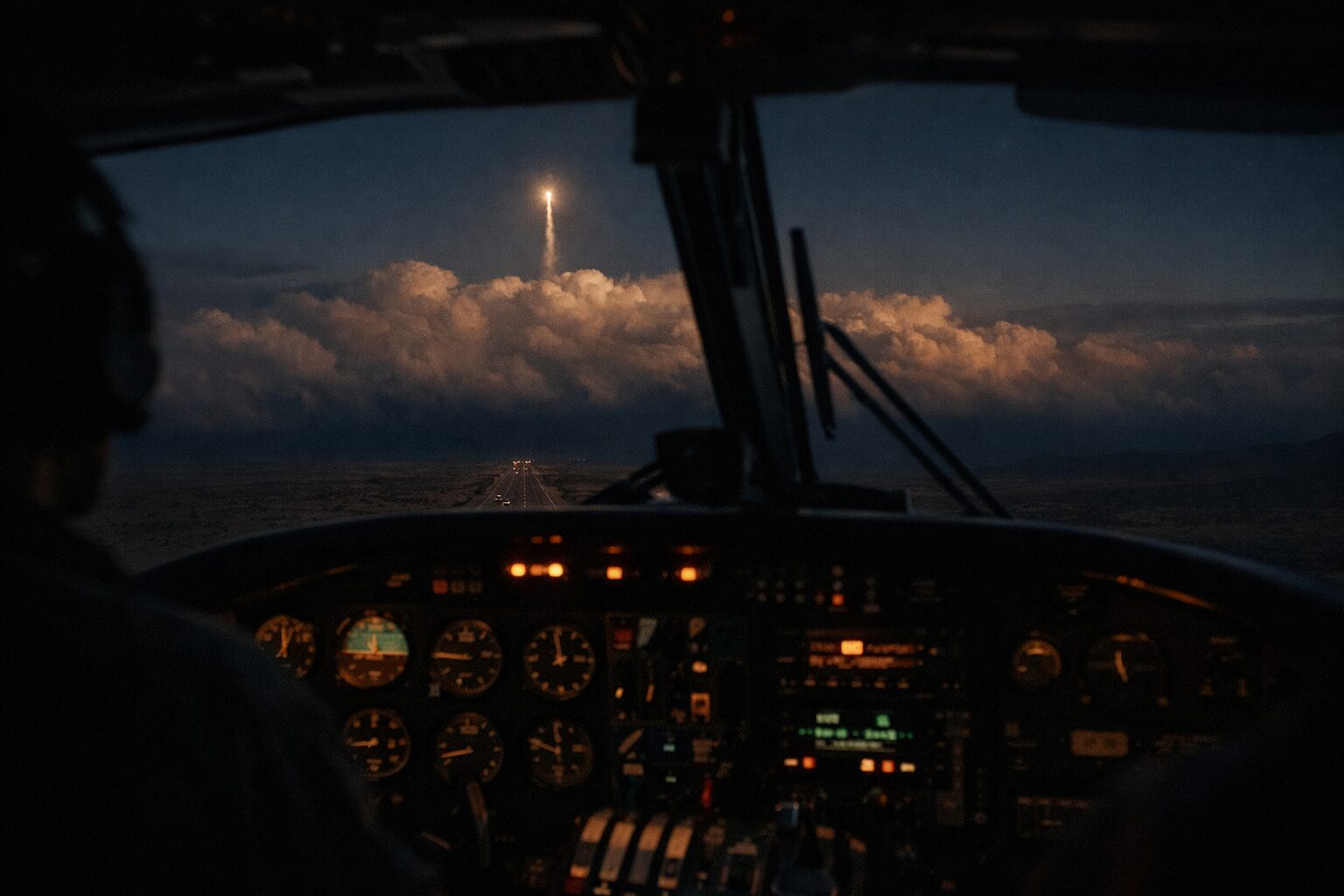
He almost didn’t see it. He thought, at first, that one of the semis had kicked its high beams up and struck something reflective in the sky, because there was a flash down and to the right that rolled like a pearl under light. But then it didn’t strobe again, the way aircraft beacons did, and it wasn’t on the road. It was hanging just above the top of the cloud layer, a white, unwavering brightness that no stars could claim because it was not in the forever behind things; it was inside the scene in front of him. Too bright for a planet, too steady for a beacon, and it sat in a slice of air that would have made no sense to anyone who has ever looked at a sectional.
He reached up slowly and turned the instrument rheostats down so his panel dimmed and his own face fell away from the glass. The brightness held its place. He put two fingers to the side of the glare shield, shading that quarter of the windshield, and the thing clarified: a single, solid point near the cloud deck’s ragged ceiling, motionless from this distance and this angle, then gliding, so slightly he almost doubted his own tracking, to keep the same bearing on his nose. The Caravan’s nose bobbed once in the light evening chop and the object answered with a tiny correction of its own, as if something down there had made a decision to keep a parallel.
He had flown the corridor enough to know there was no scheduled traffic there tonight, nothing that low on that part of the airway. And this felt lower still, near the woolly fringe of the stratocumulus where you would expect to find only birds in day and nothing in night. He reached for the radio and clicked the transmit key because that was what his training and his hands required.
“Center, Caravan Four Six Alpha. Any traffic off my two o’clock, low, maybe three miles?” He heard his own voice sound nonchalant and not convincing about it.
There was a pause, a paper-shuffling pause. “Caravan Four Six Alpha, negative contact. Radar shows you in the clear. Say again distance and altitude of traffic?”
He didn’t want to say he didn’t know. “Two to three miles, near the tops, maybe seventy-five hundred.”
“Four Six Alpha, roger. No known traffic in that vicinity.”
He thumbed the mic and let it go without answering. He put his eyes back on the road—a stripe of darkness now, a stitched line of headlamps crawling west—and then to the brightness near the sky’s seam, surprised by how quickly it made its own place in his mind. It slid along the edge of the clouds as if anchored to it, never venturing above or into the open air between layers, and it kept pace with a confidence that made his tongue go dry. He had seen satellites and meteors and the green flare of things taking their last heat against the atmosphere. This was not one of those. This was something in weather.
The Caravan shivered in another small breath of air and resumed its hum. He trimmed a hair left, watched the VSI needle rest on zero, listened to the insistent little whine of the gyros, and he decided not to say anything else on the radio. Down on the interstate a string of three semis ran in a long space between exits, their cab lights bouncing off each other’s trailers, the nearest pair changing lanes around a slow hill-climber. He could have imagined himself part of their line if not for the height and the way the rest of the land fell away from them in waves. He looked again to his two o’clock. The brightness held station, slightly ahead now, and if he had wanted to he could have reached forward and drawn a pencil line on the inside of the glass to mark where it seemed to live.
He did something like that instead. He pressed the side of his thumb against the windshield pillar where the edge of the world cut past the frame, making a flesh bookmark, and then leaned and watched the thing slip relative to his mark, then correct. It was not locked to the plane’s position perfectly, but it was not ignoring him either, not the way distant lights did. It was paying attention. The thought sat with him inadmissibly, like a superstition or a small shame, and yet his knuckles tightened on the yoke as if to answer it.
When it changed, it did so without ceremony. There was no roll the way airplanes would bank into a turn. One moment it matched, the next it drew a precise diagonal away from him, an angled slide that cut the sky between them. He felt a spark of relief—fine, a change that meant he could label it in some shared, human way—and then it refused him the label. The angled slide slowed mid-gesture, the point swelling brighter, and then it pointed itself up. That was how he would describe it later even though there were no surfaces to point. It oriented toward the vertical the way a startled animal rears, and then it went straight up.
He had seen fighter jets punch aloft with enough thrust to drill a hole in the air. They climbed with music to them, with tracers of condensation and heat, with a sense of throwing something hard against gravity. This did not gather speed; it did not show the small sag or the loop a bank would give you before committing to a rise. It did not widen or trail or swell into a bloom. It simply lifted along a line so pure his brain needed a second to accept it as motion and not a trick on his retina. It went up, like a nail being driven through the thin skin of the clouds.
The cloud ceiling took it. The brightness struck the underside and did not flare or diffuse as light would if reflected through fog. It passed into the cotton, a clean plunge, and disappeared. The hole it left was not visible; the place it had been had never been there if you were anyone else tonight. The silence in the cabin grew larger around him, turning the fan’s breath and the flip of air past seams into a kind of whispering that sat in his ears and told him nothing. He realized he had been holding his breath and let it out slowly so he would not fog the glass. Down on the road a pull-off loomed, a truck idling in its rectangle of light, and as he passed overhead the driver opened his door, swung down, and vanished into his own small world.
He touched the VSI again. Level. He scanned the panel, a ritual now, even though there was nothing wrong. Oil pressure, fuel on the left tank more than the right just as he meant, EGT in range, suction good. He clicked a soft notch of trim and brought the panel lights back up half a turn because the dark felt like something you could spill into. The radio stayed quiet long enough that he thought of calling again, then decided against it, then did anyway as if the choice had been made outside him.
“Center, Four Six Alpha, just for my—uh—confirming there’s still no traffic near me to the east.” He winced when he heard the extra words float out.
“Four Six Alpha, negative. No traffic observed. Say again nature of your concern?” The voice carried a compassion that was procedural and not meant to reach him more than rules allowed.
“Disregard. Four Six Alpha.” He let the key go and listened to the click swing the line dead. He put his hand back to the yoke and held it there so lightly he could feel the tiny twitch of it against his skin as the plane flew through light ripples he could not see. The hole in the cloud should have been there if physics were more dramatic tonight; he looked for it anyway and saw only the even graying of the layer, a fresher seam to the west where the last light bled through, an old contrail high and taking its time to lose itself to wind.
When he landed at the quiet field at the route’s end, the asphalt cooled enough to exhale a faint smell of dust. The ramp guy was a kid whose breath smoked in the light from the office, and he waved back at the plane like he always did, like they were staging a ritual they both respected. He taxied to the mark and set the brake and pulled the mixture and let the prop wind down into a settling that his bones had come to crave. The cabin dropped into the kind of silence that reveals every minor creak. In it, he could hear his own pulse in his ears and the faint tick of the cooling engine. It had only been minutes. It felt longer, and also too short.
He did not write it in the log at first. He put the times in, the fuel figures, the remarks blank as if that were a kindness he was doing himself. He put his bag in the back of his car and sat a minute with the door still open to the ramp wind. Inside the dim office a weather display flickered and made a map that no one was looking at. A printed NOTAM list lay on the desk, ink slightly smudged where someone had set a cup down. The only other pilot was signing off a freight bill with a pen he kept tapping on the counter, a noise that measured out time without intending to.
He went back to the plane because leaving without asking would mean not sleeping. He reached in through the pilot-side door and pulled the handheld he kept velcroed to the map pocket, scrolled back through the ON/OFF toggles and the memory channels as if he would find a recording feature he knew it didn’t have. He turned the master on and brought the panel to life to check the transponder’s last squawk, a useless act, then checked the weather receiver’s page, then the TCAS screen. No stored targets nearby. No one had been there to be replayed in numbers. The center frequency gave him only routine traffic when he folded down in one of the office chairs and called to ask if anyone had noted a primary with no return. The controller thought about it and said, “Nothing in your vicinity at that time, sir,” using the word sir stiffly as if trying to cushion emptiness with courtesy.
He sat in the chair a minute longer and looked at the map where the route was just a line across a pale-green state. He put a single note in the log after all, small enough that it might be read as a mark by anyone else: “light at 2 o’clock, vertical.” It was enough to remind himself and not enough to stand too tall on the page. On the drive out, the highway lay beside him in the darkness, the same semis taking the same spaces between widely separated towns. A low deck of cloud still covered the plains, featureless and honest. No glows traveled along it. If he glanced up through the windshield, a fixed spot of dust he had ignored for months lined up, just briefly, with the place where a point of light had been. By the time he reached the on-ramp and checked the traffic report on his phone at a red light—nothing, nothing filed by anyone, no PIREPs worth the mention—it had already begun to feel like something misplaced in the mind. But when he closed the phone and looked ahead, he could see where the cloud’s thickness thinned over the median, just enough that you might imagine a straight line too clean to belong there had once been drawn through it and then forgotten.