
The Rendlesham Forest Incident: Britain’s Most Famous UFO Encounter
The cold moves differently under pine boughs. It seems to hush the world and carry sound farther than it should. On a late December night in 1980, airmen from twin U.S.-operated bases in Suffolk stepped off the perimeter road and into that hush to find the source of strange lights drifting through the trees. What followed became known as the Rendlesham Forest Incident, a story that has lingered for more than four decades because no one can quite make it behave like a simple misidentification.
People still argue about what the men saw and recorded. Some insist the night delivered a structured craft, beams of light, and radiation traces on the forest floor. Others say everything points to lighthouses, bright stars, and the mind’s creative force under stress. Between these poles stands an audio recording—quiet, matter-of-fact, and indelibly human—captured by a deputy base commander as he followed lights that seemed to move with purpose.
The claim at the center of Britain’s most famous UFO narrative is deceptively spare: trained military personnel encountered, at close range, something that was outside their normal experience, and left behind an official paper trail. That trail is what keeps the case alive.
Background: Bases, Tensions, and the Rendlesham Forest Incident

In late 1980, RAF Woodbridge and RAF Bentwaters operated as a transatlantic hinge: Royal Air Force stations in name, but run by the U.S. Air Force at the ragged edge of the Cold War. The forest between and around them formed a dark corridor of patrol tracks and firebreaks patrolled nightly by security police. Sensitive operations and the tempo of global tension made vigilance both routine and exhausting.
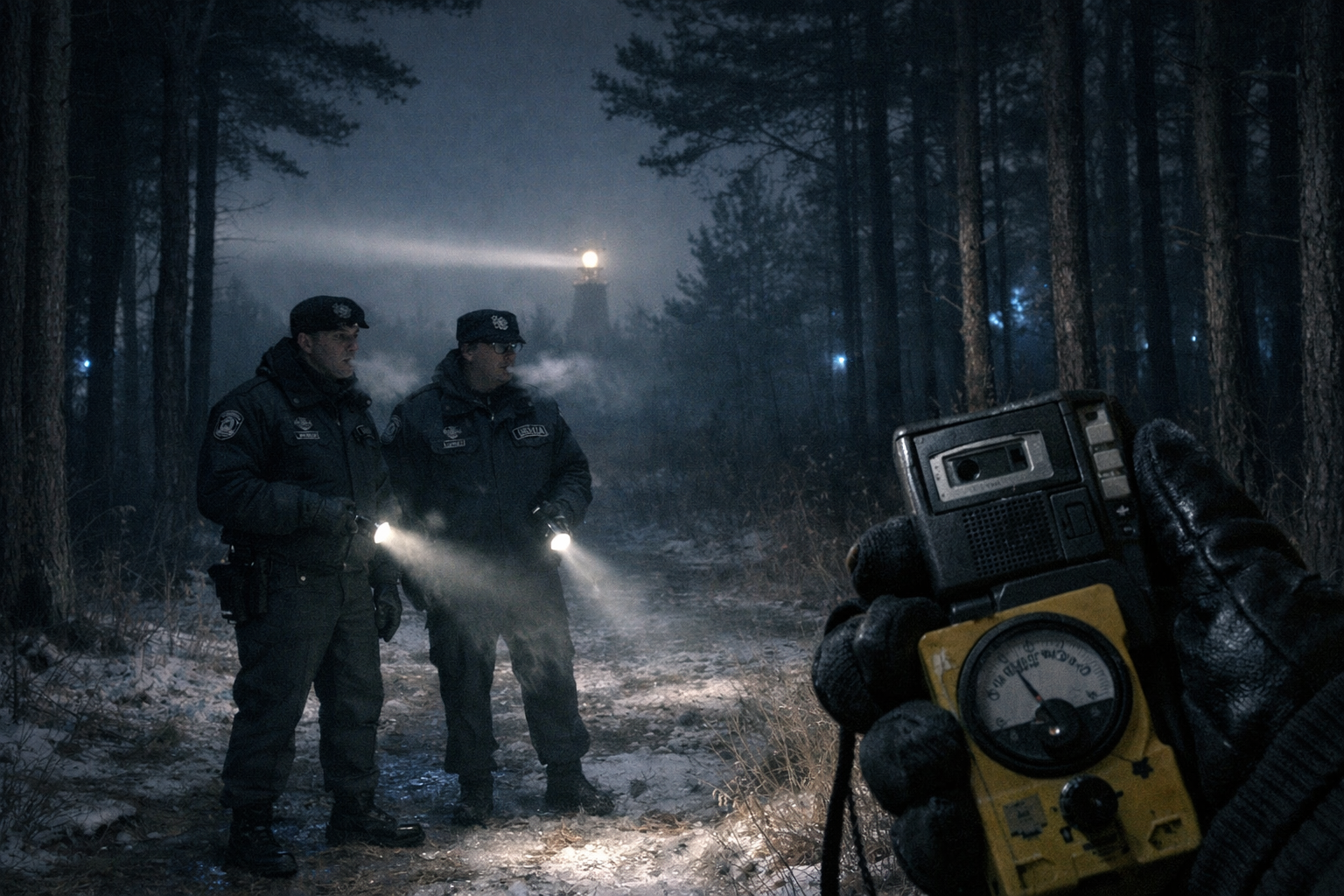
It was shortly after Christmas when the first reports surfaced. Security personnel on the graveyard shift watched unusual lights descend toward the trees beyond the fence. Over the next two nights, according to later accounts, a small cadre went looking for answers. Their footsteps became part of the mythology: boots in frozen ruts, breath clouding the air, radios hissing, and somewhere seaward the distant sweep of the Orford Ness lighthouse—steady, metronomic, and always just out of view.
The Central Claims of the Rendlesham Forest Incident

The heart of the narrative unfolds over two or three nights around December 26–28, 1980. On the first night, witnesses reported a bright object descending into the trees and a glow that seemed to pulse and shift. On a subsequent night, Lieutenant Colonel Charles Halt, the deputy base commander at the time, led a small group into the forest. During this patrol, he made a continuous, on-the-spot audio recording while they tracked moving lights and took instrument readings at a site where indentations in the ground and tree markings were noted.
Claims attached to the episode include a triangular formation of impressions in the soil; elevated, though not hazardous, radiation readings; a brilliant object breaking into fragments and vanishing; and, crucially, narrow beams of light that some participants described as reaching down to the base perimeter. None of this, if it happened precisely as remembered, fits comfortably within routine base activity or known navigation aids.
Key Figures and Documents in the Rendlesham Forest Incident

Two documents anchor the legend. First is the “Halt tape,” a real-time microcassette recording in which Halt narrates locations, directions, and apparent motions of lights, occasionally punctuated by startled exclamations from those with him. The calm, clipped delivery gives the impression of a man cataloging oddities he cannot quite resolve.
Second is the memorandum Halt later sent to the Ministry of Defence, often called the “Halt memo,” dated in January 1981 and titled “Unexplained Lights.” It outlines times, observations, and a summary of physical traces. This memo ensured the event entered official files, becoming discoverable when the UK released portions of its UFO-related records decades later.
Also part of the public tapestry are statements from U.S. Air Force security personnel involved in the initial approach into the trees—accounts that have evolved as memories and interpretations shifted. Researchers and journalists have added context: local police logs noting little of concern, lighthouse timings and bearings, and the testimony of British and American military figures who either downplay the strangeness or insist the night signaled something extraordinary.
Evidence and Alleged Evidence from the Rendlesham Forest Incident
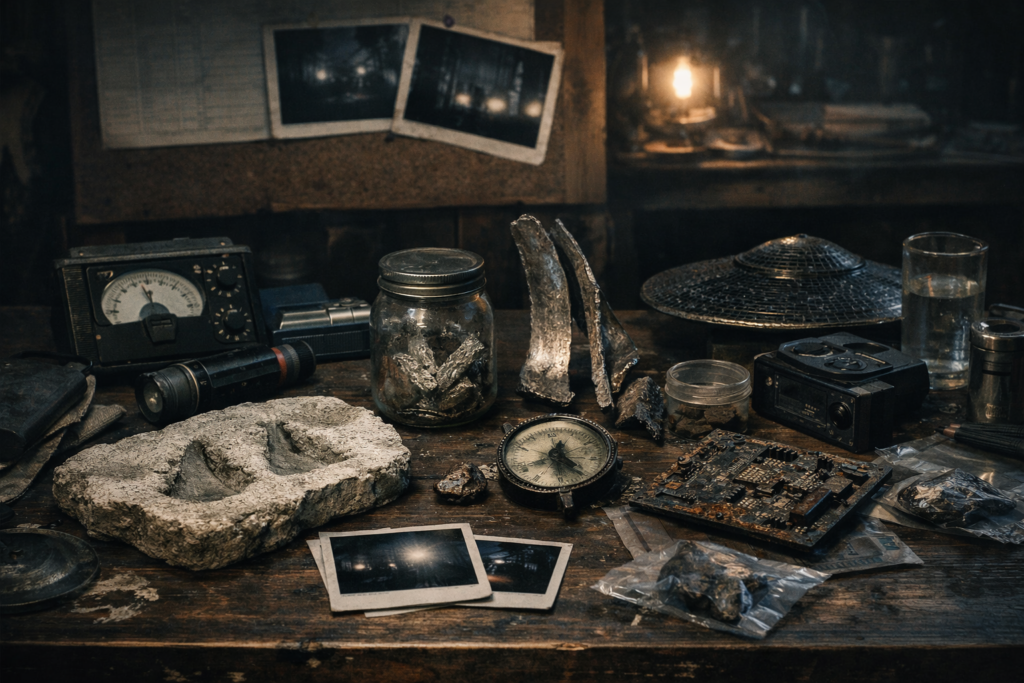
What remains most tangible is the audio: an officer describing something happening in front of him. The tape references a bright object moving through the trees, intermittent star-like points that seem to maneuver, and a moment when a beam touches down. Those who favor a prosaic reading point out that the experience of movement can be a trick of parallax when viewing lights through branches, and that an observer’s sense of direction can be unreliable in dense forest at night.
Physical traces cited in the record include three small ground indentations at equal distances—suggesting to some the landing feet of a craft—and scorched or abraded bark on nearby trees. Soil compression and bark marks, however, can result from mundane causes: animal activity, forestry operations, or weathering. Radiation readings have been part of the argument too. Instruments reportedly registered values higher than background but well below any threshold of danger. Critics suggest measurement units were misunderstood and that modest fluctuations are not unusual in forested areas with naturally varying soil composition.
Photographs allegedly taken at the time have never emerged in a manner that adds decisive clarity. Plaster casts of the indentations reportedly existed but do not settle the argument: impressions alone cannot distinguish between tripod feet, deer tracks, or a forester’s kit. Meanwhile, the clockwork sweep of the Orford Ness lighthouse—flashing on the same interval all night—sits in the background of many reconstructions like a magician’s misdirection or a demonstrator’s control variable.
Skeptical Explanations for the Rendlesham Forest Incident

The skeptical case is built on a triad of light sources and human factors. First, the lighthouse. Analyses have shown that from certain points in the forest, its periodic flash appears intermittently through gaps in the trees, giving a staccato impression of a moving, brilliant point that seems to evade approach. Second, the sky. Astronomers note that Sirius, the brightest star visible from Earth after the Sun, was high and scintillating in winter skies, often twinkling with dramatic color shifts near the horizon, particularly when viewed through thin cloud or branches.
Third, a bolide meteor widely reported over the UK during that holiday period may account for dramatic “object breaking apart” descriptions on one of the nights. Add to this the peculiarities of depth perception in forest at night, the psychological pressure of patrolling a sensitive installation during a tense era, and the tendency to connect dots under stress, and the case becomes, to skeptics, a masterclass in layered misperception.
Official lines over the years have nodded toward these prosaic causes: misidentified lights, celestial objects, and ordinary activity around the bases. For some investigators, that mix accounts neatly for every element—down to the radiation readings, which they argue were misread or within normal variance.
Why the Story Persists: Britain’s Roswell
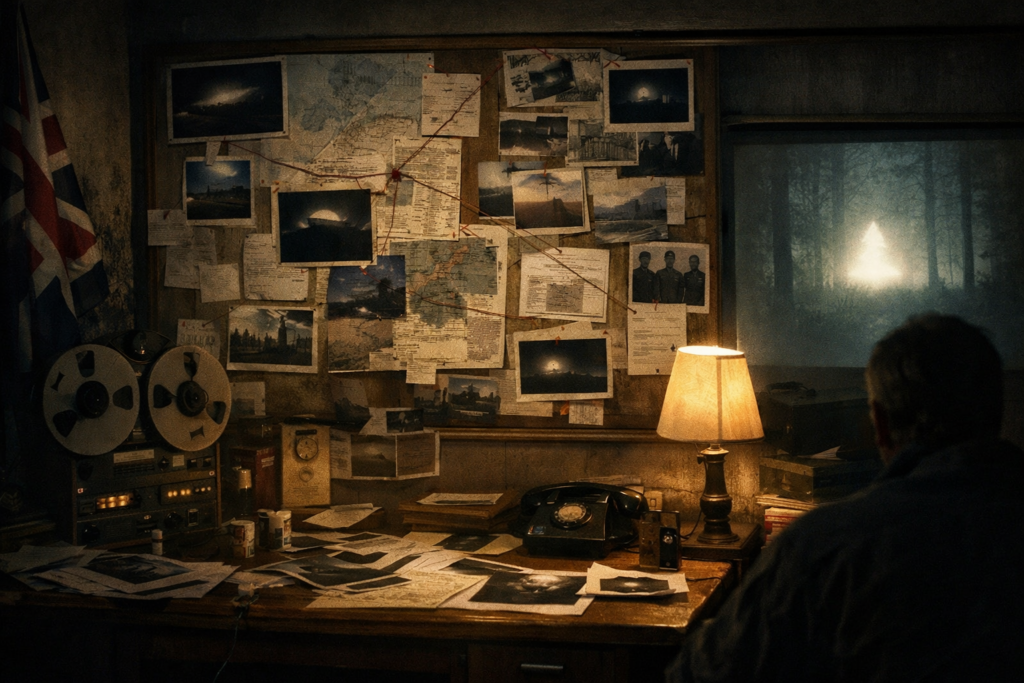
And yet, documents and arguments do not erase the human voice on the tape. They do not dissolve the convergence of trained observers who were willing to report something unusual on military property. Those two facts—official witnesses and an immediate audio record—separate this from many lights-in-the-sky tales and help explain why the press eventually anointed it “Britain’s Roswell.”
The case also benefits from setting. Rendlesham’s pines and lanes are cinematic. The Cold War staging is ready-made for intrigue. The UK’s release of Ministry of Defence files in the 2000s reinvigorated public interest by showing that officials took the reports seriously enough to file and forward them, even if they concluded there was no security threat. Cultural memory then links the story to other well-known military UFO threads—from older American cataloging efforts like Project Blue Book to modern mass sightings such as the Phoenix Lights—giving the Suffolk nights a broader narrative home.
Daily Paranormal Analysis
Why it became popular: timing, credibility, and texture. The late-1980 period was soaked in Cold War tension, and any anomaly near U.S. bases demanded attention. The inclusion of a deputy commander’s memo and the microcassette recording gave journalists and researchers something concrete to quote and analyze, elevating the story beyond rumor.
Why believers find it compelling: multiple trained, security-vetted witnesses reported maneuvering lights and physical traces. The Halt tape’s calm cadence feels incompatible with hysteria, and the claims of beams touching down suggest intentionality rather than passive celestial behavior. The presence of ground marks and instrument readings—however ambiguous—adds an empirical thread that many sightings lack.
Why skeptics doubt it: every extraordinary element has a plausible counterpart. Lighthouse flashes masquerade as motion. Sirius performs its winter light show. A meteor explains fragmentation. The forest distorts bearings and distance. Radiation meters used outside formal survey parameters can produce numbers that sound alarming but rest within natural background variation. And decades of retellings may have polished raw memories into a more dramatic narrative arc.
Connections to similar cases: the incident stands in a lineage of military-adjacent UFO reports in which the setting amplifies stakes—mirroring the archival ethos of Project Blue Book and the public fascination surrounding the Phoenix Lights. Each benefits from official involvement, whether through reports, recordings, or radar traces. Each also fractures along the same seam: witness sincerity on one side, prosaic mechanics on the other.
Does the mystery remain unresolved? Technically, yes. A thorough skeptical model can explain the components, but it cannot eliminate the tensile strength of those original, in-the-moment accounts and the audio narration that suggests something more than a lighthouse was at play. Conversely, the believers’ synthesis of lights, traces, and beams remains suggestive rather than decisive, lacking the definitive artifact or image that would anchor the conclusion.
Conclusion: The Enduring Questions in Rendlesham Forest

Walk the lanes of the Suffolk woods today and it is easy to reconstruct the patrol in your mind: the crunch of frost, the pause to listen, the glance toward the unbroken rhythm of a distant beacon. Between those sensory certainties lives a thinner, more elusive reality—the one that moved trained observers to step into the trees and record what they felt was not routine.
That is where the Rendlesham Forest Incident still lives: in a precise place and time, backed by sober voices and constrained by ordinary possibilities. For some, the balance of evidence tips toward a layered misinterpretation. For others, it pushes stubbornly against that boundary. As with so many military UFO cases, the file ends not with a revelation but a careful comma—a pause that invites us to listen to the tape again, and to notice how the cold carries sound farther than it should.


