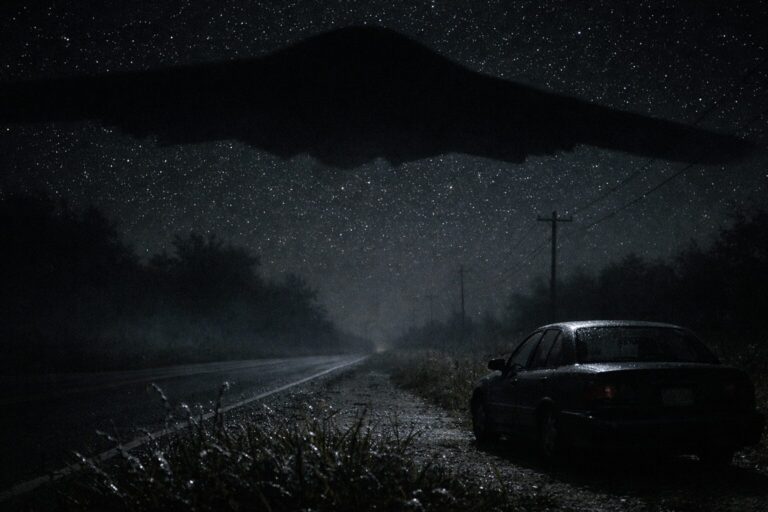
The Shape Behind the Barn Was Not an Animal
The wind had gone down with the heat, and the night pressed in over the fields like a lid. I was half-asleep when the cows started up, a ragged lowing that had none of the unbothered rhythm they keep through summer nights. The mares in the south stall hammered once, twice, as if to test the boards. It was the kind of noise that brings you out of bed before you understand you’re moving. I snapped on the kitchen light and stood a second with my hand on the counter, listening. The sound seemed to carry through the siding of the house, not just through open window. A shift in weight, something large brushing against something larger. Then a scrape along tin.
I pulled on boots and my old chore coat, left the house light off behind me so as not to throw my eyes off too much, and stepped into the yard. The screen door stuck and sighed on its spring. The dog rose from under the porch but didn’t bark. He kept to my heels with his head low, his collar tag not even choosing to clink. There was no moon to speak of, and the air had that dense, damp feel it gets before a front. It smelled of old rain and manure and brittle hay, and the grass sloped wet under my soles. I took the flashlight down from the nail on the post by the gate but didn’t click it on yet. I know these paths well enough without it.
The barn sat big and black against the sky, the cupola a darker cutout where a star should have been. Something about the quiet made me slower. Usually the night carries sound—the creek, tree frogs, the distant tires of a truck on the highway you can’t see—layered thin and familiar. Tonight the quiet was one piece. Each step I took seemed too much of an announcement. I slid the latch and pushed at the big door. It rolled along its rail with the rough chatter it always makes, loud in the still, and air spilled out around me, sweet and sour, animal warm.
Inside, the cows had their heads up, ears turned to the back wall as if listening with their whole bodies. One heifer had her tail tucked and was half trying to stand in the same place as the one next to her. The mares had backed tight against their stall rails, necks long. Their eyes flashed pale when the flashlight beam finally came on, quiet as my thumb could make it. I kept my voice low, the way I talk to the horses when a storm is still too far off to hear. “Easy now,” I said, and I laid a hand flat on the hot shoulder of the oldest mare until she found my smell. Her skin went trembly under my palm like a sheet on a line and then calmed some, but she would not turn back toward the rear door no matter how I eased the lead on her halter. All her weight pressed into the stall corner. It was like there was a draft out of that back seam that had a taste to it.
There came then a noise I know too well for it to be imaginary: not the patter of small feet or the clumsy shoulder of a stray cow. It was a drag, a slow draw of something across the barn’s tin siding, up high where the paint chalks to your hand. It didn’t come with matching footsteps. It sounded like a long sleeve pulled along a piano wire, drawn almost careful. I let the lead fall and stood there with my hand in the horse’s mane, listening beyond listening. The dog had crowded into the doorway and would not cross the threshold.
The back door’s slide never shuts all the way—the foundation heaved a hair two winters ago and I never planed it right—so there’s a knuckle where a board bows, a finger’s-worth of seeing if you get your face close. I clicked the flashlight off and walked back that way slow until the rails under my boots changed note and I had one palm on the door’s cold plank. The wood smelled wet old, like a dock. I leaned to the gap and set my eye to it. At first all I caught were shapes of things I knew: the fence posts running away at a slant, the rise of the feed lot, the smudged line of trees where the creek cuts through. And then nearer, pressed to the barn’s shadow on my side, something stood.
If it had been a deer, it wasn’t any deer I ever saw. It was where a body shouldn’t stand—half-shouldered against the wall just beyond the corner, tall enough that whatever it was took the barn’s shadow with it and added to it. Stood is the word, but it didn’t hold itself like an animal holds itself. There was no cock to the head, no ear pivoting to count me, no bunch to the withers. It was upright against the boards with stillness that wasn’t fear. It was a decision not to move. It had the slimmest break of a shoulder, a cut where a neck might meet, but the edges wouldn’t quite agree with the light. My brain kept trying to fit it to something I’d seen dragged off the road or hung in the trees by kids, and there was nothing that matched. I didn’t think “person,” though it had the height. There was no weight shift, no breath steam. The air at that side of the barn felt colder, as if someone had opened a door to a cellar.
I stood there far longer than made sense, my eye watering from being pressed to the splinter. Once or twice I made myself look away and then back, to see if it was one of the tricks the gap plays sometimes with a night that won’t give you much to work with. Every time I came back, it was where it had been, as if saving its place. The mares would not turn their heads. One of the cows made a sound I never heard from her—not a call, but a crushed grunt, as if the breath had a burr in it. I should have gone outside and circled round. I should have clapped and talked loud, the way you move a strange animal along. I had no wish to be between it and the door.
I caught light then out past the tree line, far enough it made the creek a seam of varnish. It wasn’t how headlights look. We get stray vehicles down at the low water crossing sometimes, teenagers spooking each other, neighbors late. You see light in a smudge and then the swing of it bounces between trunks as it crawls. This was more a spill. It had no tone to it—no sodium, no tungsten. It put a rind of pale along the tops of the thistles in the lot and along the cracked edge of the old tire I use to cover the well cap. It did not throw a sharp shadow of the trees, just sort of thinned them. The tops of the cottonwoods do that little whisper when a breeze works its way high and never reaches you down low. They did it then, but I couldn’t feel the wind on my bare wrist.
Every animal in the barn shifted as if a pocket of air had moved through them. I felt it in myself the same time: a tingle that ran up the hairs on my arms and neck and stayed there, not a shiver and not heat. The smell in the barn changed a hair—metallic, like the inside of a battery slid open. I set the flashlight on the feed bin boards and, without thinking much at all, slipped the iron drop bar into the hasps on the back door. The noise of the metal on metal seemed to jump in that still air, too clean. Whatever stood outside didn’t react that I could tell. The light down past the creek pulsed once, not brighter, just a slow change like a fish turning in deep water. The dog was nowhere I could see.
I don’t know if what happened next started out there or in me. There was a pressure—like you get when you drive up fast into the hills, when your ears don’t clear right away—only it wasn’t in my ears. It was more a sense of being looked at hard. And then, without any shift of footfall or weight against the siding, the shape turned. It was like a hinge you couldn’t see had been set in the boards of the barn and somebody had swung that height of shadow toward the crack where my eye was. There wasn’t the sound of a step. There wasn’t even the soft give of grass. One moment I had its shoulder to the barn, the suggestion of length along, the next that same length had faced me, not coming forward and not retreating, and in that face of dark that had no face I felt everything in me step back all at once. The mares hit their stall fronts. A halter ring twanged.
I took my eye from the crack and leaned my whole back against the door with the stupid thought to keep it from bowing in. There was nothing pushing. There was only the sense that a space right on the other side of those few planks had filled with something that could tell exactly where my breathing came from. The iron bar shivered against the hasp once, very light. Not a rattle. Not a knock. Something testing how noise might work here. I put my hand to the bar and could feel the vibration in metal that had no echo.
The cold light beyond the trees lifted and fell as if a cloud had learned a new motion, in place, over and over, slow enough to make minutes feel wrong. The chickens made no sound. Once, far up over the back pasture, a bird I did not know called out in one note as if it had been woken out of a different night and set here by mistake. All the while, that tall not-an-animal held itself against the siding with me a board’s breadth away, and turned toward wherever I shifted. I tried to think of something sensible—call someone, wake a neighbor—but there’s no asking a man to come out of his bed to stand with you and your fear in the dark against your own door. I stood there and felt time go thin.
I don’t know when the light went. I know that at some point the cows stopped trying to pour themselves backward through their rumps and the mares’ ears came forward a fraction. The smell moved back to manure and straw and the sharp of sweet feed. My breath turned into something I could keep track of again. I waited longer than any of that required, and then I eased away from the door slow. I put my eye back to the split and saw nothing but my fence’s line and the trees black against a sky beginning to think about dawn. The dog came and slipped his head into my hand like it had always been there.
I slept in the tack room then, if you can call it that, on top of the blankets I use for the horses and under my coat, my ear tuned hard to silence. The radio out there is broken; it only catches two stations and one of them plays old hymns. I didn’t turn it on. Sometime after the dark slid from black to tar to gray I must have let down enough to let go of myself. The next thing was the swallows under the eaves starting up and the feel of straw under my cheek.
Morning made everything smaller the way it has a right to. The cows crowded to the gate and pushed their damp noses into my pockets for grain. The mares were quick-eyed but normal-faced, if you know horses that way. I lifted the iron bar from the hasps and worked the back door aside a hand’s width. The wood had left a fog-shaped arc in the dew on the sill where it had wept since last rain, and my palm print felt warm there. I slid the door open all the way and stepped into the yard.
It took me a breath to understand what I was seeing. The big front door—the one I had rolled shut when I came out, the one that needs a shoulder to persuade it—stood open to the day enough to let a goat in. There were places in the mud under the eaves where something had stood and then lifted—the kind of soft, shallow ovals you get when a person in thick socks takes a step on damp ground, only each was wrong at the edges, not toes, not hoof. They ran out from the corner where I’d watched, angled across the yard, and then stopped six paces from the pump in the thin grass, not trailing off, not vanishing into gravel, just ending in open ground as if the rest of the yard were a picture someone forgot to finish painting.