Every Family Photo Included the Same Stranger
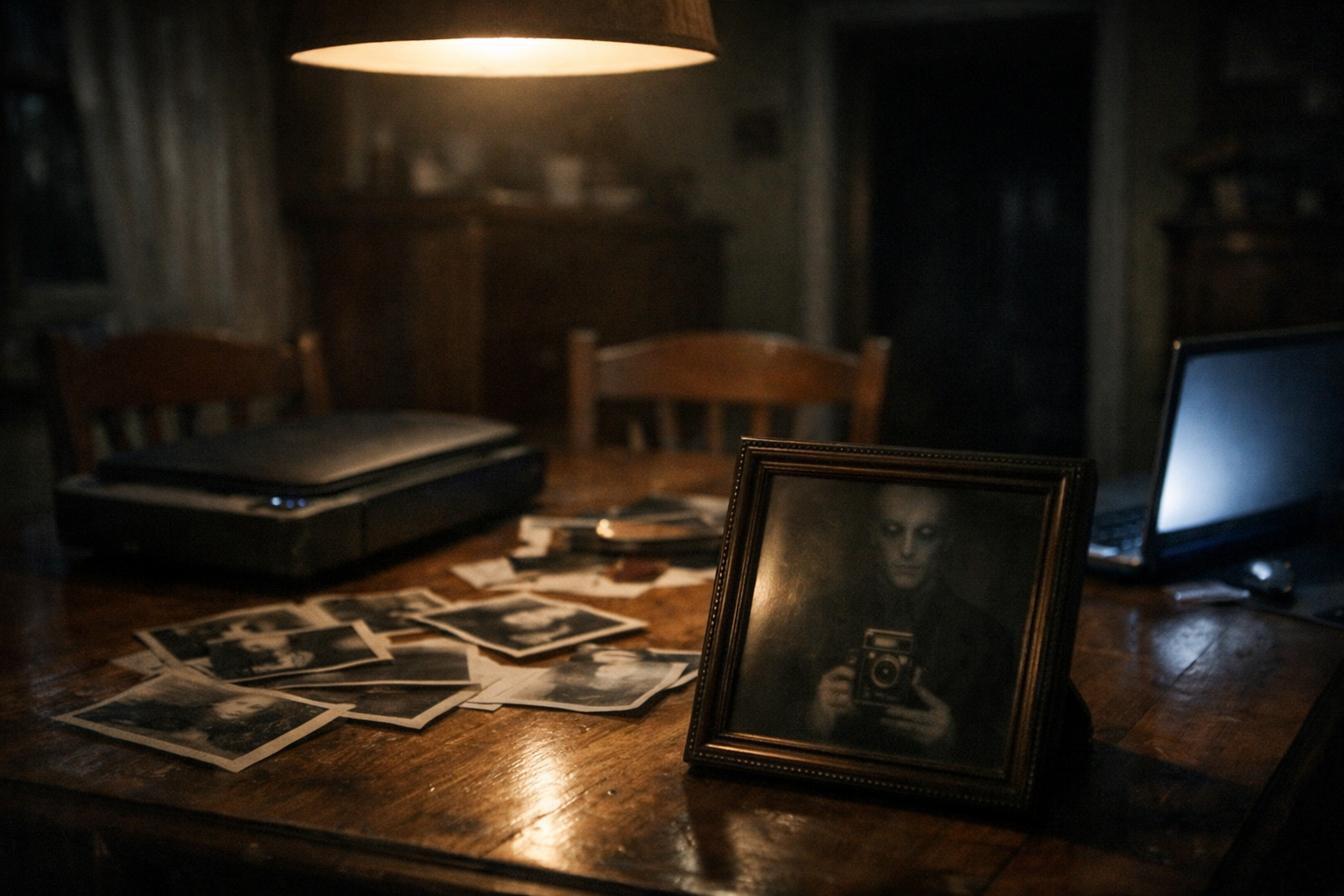
I started scanning our family albums on a damp Sunday afternoon because the dining room table was the only surface big enough to hold the mess. The light over the table is yellow and too warm, the kind that makes paper look older and skin look tired. I cleared a lane between stacked albums, the flatbed scanner, and a laptop whose fan kept waking up and then falling asleep again. Outside, the street was wet and all the sounds were domestic—the soft knocking of the radiator, the dishwasher grumbling two rooms away, the refrigerator’s throat clearing at uncertain intervals.
It felt like work I’d been meaning to do for years and finally had no excuse not to: build a digital archive for my mother, whose handwriting on the backs of photos has begun to crane downward like a tired plant. She’d box them all “so they won’t get ruined,” then forget the box somewhere damp. I wanted to sort the faces before they shuffled farther away. I wore the little cotton gloves for a while before I forgot them and felt the familiar rasp of old matte paper on my fingers, the dusty sweetness that sticks to the inside of your nose.
By the time I’d made a folder for each decade, the table looked like a map laid over actual wood. I moved slow: brush off crumbs, blow away grit, square the photo into the scanner bed. When the lid came down it was like putting a blanket over someone’s face. The bar of light slid across the inside and translated birthdays and haircuts and old arguments into pixels. I named the files; I tried to be efficient; I kept stopping to look longer at things that didn’t need looking at.
The first time I noticed him, I didn’t know what I was noticing. It was a backyard shot from the late eighties—there’s my father with a spatula, the red grill billowing too much smoke. My cousin is mid-sprint, his mouth open like he’s trying to swallow the day. In the lower left corner, almost a blur at the edge of the frame where the grass fades into shade, stands a man under the maple. I didn’t clock him as a stranger. He’s a little out of focus, like the camera didn’t decide in time. He’s not doing anything but being there.
Then, later, a photo from my aunt’s wedding in the early nineties: people arranged like cutlery, everyone fresh and tired at the same time. In the doorway of the rented hall there’s a thin man in a gray suit with lapels that could tell you the exact year better than any caption. He’s turned three-quarters toward the room, hands folded, looking across all of it and not at anyone. That should have been it—incidental person, someone’s date stepping out of a smoke break. Except he had the same face as the man under the maple. I only saw it because I leaned closer out of habit. The mouth was narrow and set, lips that didn’t seem to interpret smiles the same way as other mouths. Pale eyes—washed out, maybe blue, maybe gray—set deep so that the skin above them made a soft shadow. There was a small crescent mark near the right eyebrow, a healed cut or a birthmark you’d forget to mention if you were describing him to someone.
I went back and forth between the two. Different clothes, different years, but the same man. I told myself that resemblance is a trick and we are made to see faces in wood grain and salt stains. Then I pulled a funeral photo from the mid-aughts, everyone compressed under black umbrellas like punctuation marks. Far off, half-hidden by the limping branches of a cedar, a man in a dark overcoat watched the open ground. He wasn’t with our family—he stood too cleanly apart, as if the rain was a courtesy that ended a few inches from him. The umbrella he held was the cheap kind you buy from a street vendor, and even so, I knew his face before I could quite make it out. It was the nose and the set of the jaw and that mark at the eyebrow. It was not something you could un-know once you had decided to know it.
I spread photos across the table in an impatient fan—the dining room grew smaller with paper everywhere, and the lamp caught on the glossy ones and threw back ovals of light. A vacation shot from the early 2000s: the beach looks too bright to be real, everyone squinting and pretending not to be cold. Over my mother’s shoulder, out near the lifeguard stand, a man in a sleeveless shirt the color of sidewalk sand watches the water with his hands in the pockets of cut-off jeans. The hair is shorter, combed forward the way everyone did then. The expression is the same hollowed patience. He is just far enough away to be explained as anyone, and yet not anyone enough.
Another — a child’s birthday, the rented room at the community center with a partial mural on one wall. My niece is two here, her cheeks caught in icing. Parents and grandparents ring the table in that way we do, like something needs guarding. At the back of the room, in the corridor where the vending machine hums, a man stands in a blue windbreaker that bunches weirdly at the shoulders because windbreakers always do. His hands are tucked under the sleeves, he’s turned almost—but not quite—toward the camera, as if he had expected the lens to pivot and include him. The focus is tighter here. You can see the faint edge of the mark by his brow. You can feel him watching, not just the room, but the moment the room is becoming as it’s being taken.
I told myself again that faces echo, that you could pluck cousins from certain angles and watch them become their parents. I turned a few over, read the scribbles on their backs: “BBQ at Sue’s,” “first Xmas in the new house,” “Jimmy’s graduation—hotter than h—l!” Names paraded. His never did. In all the decades and captions and notes, nobody labeled the man who was present enough to be in frame and absent enough for no one to remember. The dining room clock, which I don’t usually hear, found a softer beat and nested it under my ribs. Every time the scanner light passed under the lid, it made a pale whistle that registered as breath.
He was at the wedding, the funeral, the beach, the birthday. He was even in a photo from a vacation I don’t remember because I was too young: a parking lot outside a museum, my father kneeling to tie my shoe. Behind us, reflected in the galley of glass windows, stood a man in a tan coat, his head tipped as if listening. The coat was wrong for the temperature you could infer from the clothes around him. He gazed not at the exhibits through the window but at the root of the camera, through the pane, across the years toward me, which is to say not to me, but to wherever the camera was always pointing. The more I saw him, the more his shape began to feel like a small certainty you carry when you walk alone at night—a piece of air that stays with you two steps too long.
At some point it was full dark outside and the window over the sink had turned into a black square that reported back a smeared version of the room. I pulled at my collar and noticed how the dining room light made a gleam on every bit of glass: the frames, the scanner bed, the lacquered finish of the table. I wanted, badly, the practical answer—some uncle I’d been too young to remember, a neighbor who always lingered, someone’s quiet boyfriend. I stood up and stretched, the chair groaning, and my shadow went over the clutter in a way that made it feel like an extra person crossing the room.
When I reached for my phone to text my mother—“Who is the man in blue at Kara’s 2nd birthday?”—I saw the thumbnails of my own camera roll lined up like the smaller cousins of the photos on the table. I scrolled without really intending to. There was the pan of bread I’d burned last week. There was my sister’s cat, accusing. And there was a picture my sister had taken of me at this very table a month ago, when I’d half-started this project and half-abandoned it. I could see myself hunched over the same tight confusion of paper, the same lamp, the same clock keeping time for itself.
Behind me, in the picture. In the doorway that goes from the dining room to the hallway, where the paint is a slightly different shade because I never finished the second coat. He was there. Not blur, not suggestion. A man, the narrow mouth, the pale eyes that seem to read an instruction between you and them, the slight lift of the right eyebrow where the half-moon mark sits like punctuation. He wasn’t doing anything except inhabiting the negative space. No one in the frame saw him. I had been in that chair. It made a thin, specific heat unfurl across the skin between my shoulder blades, as if the photograph had proofed a draft and returned it with a single correction: not was, is.
I held the phone up and then away like it was some animal with a sting. The doorway was visible from where I stood. In the live room it was empty, a strip of hallway, the wall thermostat blinking its indifferent green numbers. The radiator tapped. The refrigerator made a noise like a person clearing their throat and decided against saying anything after all. I waited to feel foolish and didn’t. The sensation of being watched has a particular weight, like a hand that isn’t quite heavy and isn’t quite there. It perched a moment and then didn’t go.
I sat again because moving didn’t seem like the correct choice. My hands found work to do. I slid another album close, one of the oldest—the leather is cracked the way some things are ruined and improved simultaneously. The corners are clipped black triangles, the pages stiff and smelling faintly of a glove compartment. People stare from gray life where the sky turned out the same white as a face if the exposure was wrong. Hats you don’t see anymore. Jawlines that look borrowed from a textbook. I scanned two pages without stopping. For the third, I lifted a portrait out of its corners to catch the date imprinted on the ragged edge: 1936.
It’s taken at a table. Not this table, but I recognized the sideboard behind them—ours, the one I oil in spring because the wood blooms open and asks for it. My great-grandparents are there, younger than anyone over there has any right to be in my mind, his tie too fat, her hands small and intelligent on the tablecloth. A mirror hangs above the sideboard, oval and foxed with that steely patina glass gets when it remembers silver instead of reflecting it. They are looking straight ahead the way people do when told by someone behind the camera that this, right here, is the face that will hold still for the rest of its life.
I scanned the photo and set it aside to name it, and only later, when I enlarged it on the laptop, did the silver in the mirror resolve into more than old age. The dark center was the room behind the photographer, a narrow tunnel of hallway with the pinpricks of other rooms stitched along it. At the rim of the mirror, where the light rolled off like oil, the camera he held appeared as a black box, a mouth held at chest height. There was, tucked between those dark geometries, an oval of face and the hint-white flash of an exposed eye. He was there. Not in the room, not among the seated family, but at the throat of the image itself, captured in the act of capturing. The same straight mouth, the same soft lift of the brow, the same inhuman patience that reads less as kindness than as duration.
It took a moment to understand what I was looking at, how the shape of him mapped to every other incidental man I had been teaching myself to notice. The old emulsion held him without complaint, the way it had held the faces at the table and the light over their shoulders and the print of the tablecloth. I tried to pick out, behind the black box, what kind of camera he had held, to ground him with a brand or a date, a model number. The silvering swallowed detail at the edges, but his face didn’t blur with it. It stayed clean. The mirror had remembered him better than it remembered the room.
On the screen, his gaze sat level to mine, even if that was only an effect of angles and accidents. Beneath my fingers, the live table hummed slightly with the refrigerator’s distant vibration. Somewhere in the stack of scanned images, he was always off to one side, not asking to be included and being included anyway. The oldest photo explained nothing about the newest, except that the act of looking hadn’t begun with me.
I shut the scanner lid gently, the way you put a sleeping child down when you’re not sure if they’re faking. In the laptop’s black bezel, I could see a flattened, funhouse version of the dining room and a faint ellipse where the doorway waited. The picture on the screen showed him, perfectly framed by his own mirror, holding still in the center of what we chose to see. I set the 1936 portrait down so that the glass of the lamp threw its circle of light over the oval of the mirror in the print, and, caught there, his eye looked back with the same unimpressed attention. The room felt as though someone else might be ready to come in, not from the hallway, but from wherever the camera always points when nobody is in front of it.