The Town Looked Like 1956 for Ten Minutes
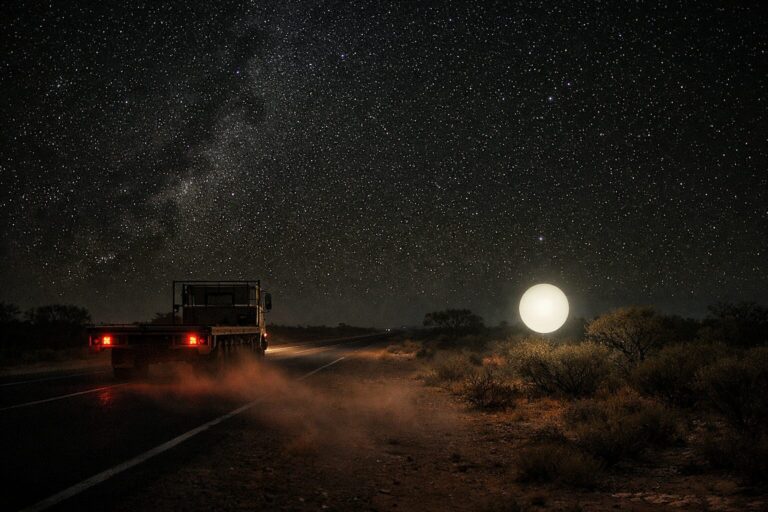
I was eastbound on State 23, trying to beat the kind of tired that comes on like fog—slow until it’s everywhere. That strip through the scrub and wheat between Ash Fork and the river is just two lanes and a shoulder that disappears whenever the land does something dramatic. I’ve run it so many times I could list the milemarkers with my eyes shut. There’s a town that hugs the highway about halfway, Welden, where the speed limit drops and somebody’s always got a porch light on. If I leave the bypass and go through Main, I can shave two minutes off and sometimes pick up a coffee from the truck stop before the grade. It’s an old habit that makes the miles feel less like a punishment.
It was a windless evening, the kind where the sky makes a low dome over everything and the stubble fields look like they’ve been brushed flat. My dashboard clock said 9:37. The radio murmured a late talk show out of Santa Fe, small-town callers talking about coyotes getting into trash. The inside of my car smelled like the bare footprint of coffee from earlier, and hot plastic. I rolled my shoulder and saw the faint scar of an insect smear on the glass from June. Two tail lights vanished over the rise ahead, then there was nobody but me and the light on the horizon that meant Welden.
Main Street starts just past the feed silos, a right turn between a water tower and a sagging billboard for a lawyer who moved to Phoenix two years ago. I eased onto it out of habit. The road surface here has a rhythm—modern patch, older chip-seal, then a section of blacktop that hums under your tires. I know the cracks, the place where the left wheel catches the gutter if you don’t swing out a little. I know the bakery on the corner that closes at four and still puts a paper sign out every morning. The truck stop on the far end has LEDs so bright they throw your shadow on the gravel like a movie still; you can see them from the water tower if you look.
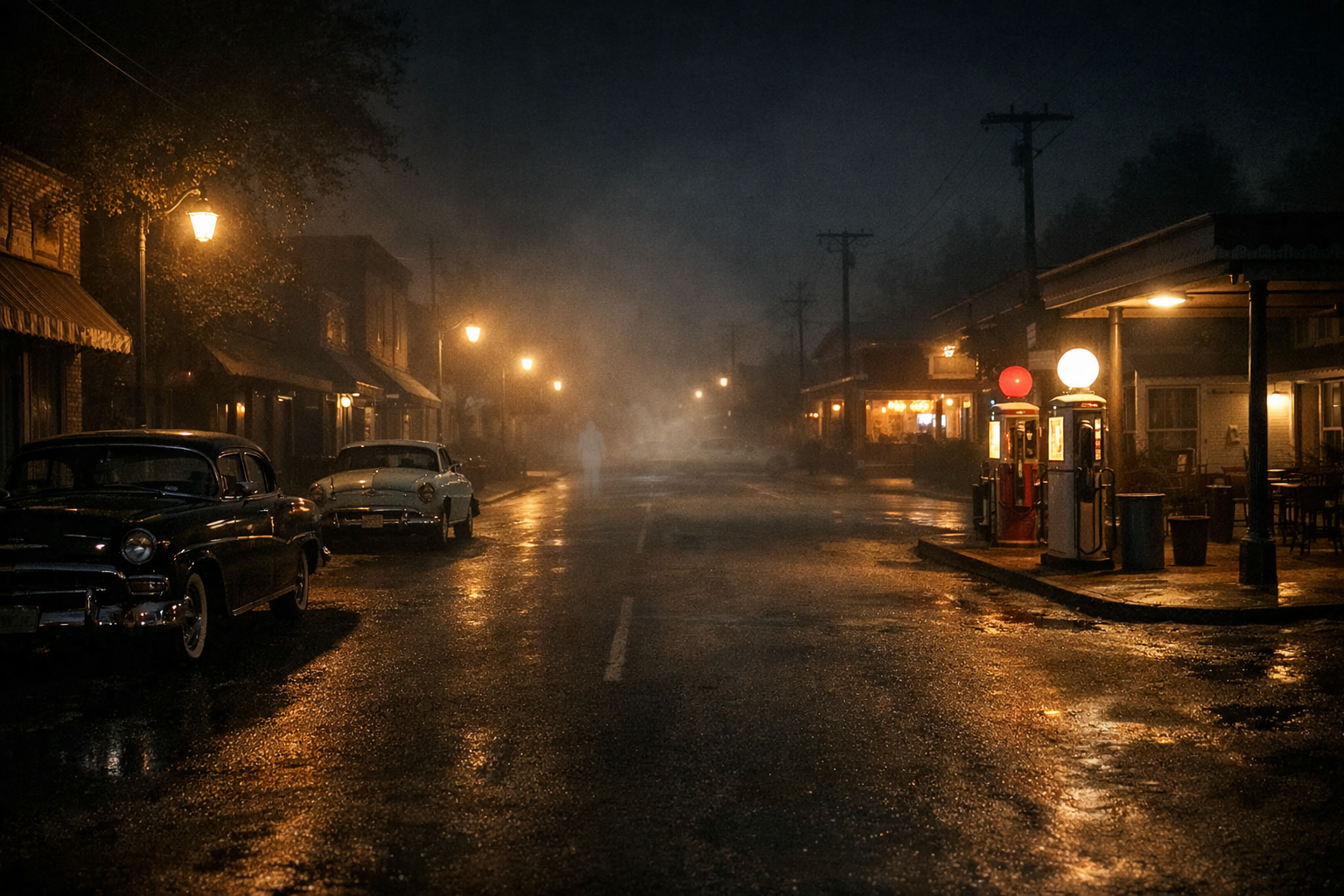
I noticed it when I looked up for the neon open sign at the diner. It wasn’t there. For a second I thought they’d finally stopped staying open late. Then I realized the whole window was different. There was no neon at all, just a hand-painted sign on the glass: Plate Lunch. The color of the light changed. Where I expected that cold blue of modern fixtures, there was a kind of honey warmth hanging under the awnings, light that made the street look like a photograph my mother might have kept in a shoebox. The florist, the one with the faded mural of a hummingbird on the brick, no longer had the mural. The bricks were raw and clean. In the angle of the lamplight I could see old mortar lines like veins.
Two cars were parked beneath the streetlight, big-bellied things with chrome as thick as wrists, wearing pale two-tone paint jobs—seafoam green and cream. Their fenders dipped like they were bowing. I drove past a curb where I know there should’ve been a guy named Ronnie’s silver Tacoma, because he lives above the barber and I always see his truck there at night. Instead: a black car with a split windshield and whitewalls, its hood ornament like a leaping thought. The streetlights themselves weren’t the tall mesh heads we have now. They were little iron posts with glass globes, and the light inside each seemed to have a filament you could squint and see.
I waited for the bright slap of the truck stop at the far end of the street to settle me, like stepping into a corridor you recognize. The horizon where those LEDs should bloom was just dark. The sign at the hardware store—Harlan’s, the one that went out of business last year and now sells vape juice and skateboards—read Harlan’s Hardware & Feed in a stenciled, confident font, and the window was stacked with twine and oilcans. The barber pole outside Meyer’s actually turned, slow as a thought. There was a movie marquee over the old bank that usually advertises bluegrass nights and bingo. Now it told me, in black letters, “GIANT — ELIZABETH TAYLOR — 7:30.”
I remember my hands going light on the wheel. The center line ran under me the same way, dashed paint eating itself into the dark, and yet the street had shifted under my history with it. I scanned for rigging, for some hint of a festival I’d missed. There are sometimes vintage car nights in the summer when old guys line up their Buicks and smoke. But those have folding chairs and fluorescent vests and someone with a clipboard looking official. This was as practical as a Tuesday, without pretense. A couple walked down the sidewalk with a paper grocery sack that pressed a dark triangle of grease into its side. The woman’s skirt went to her calves and swung like a metronome. The man wore a hat I had only ever seen in movies. Neither of them glanced at me.
Halfway along, I passed the filling station that in my life is a bare lot with a chain-link fence. Tonight it was a squat brick box with glass bays lit from within, and a boy about nineteen in a white cap stood beside a pump with a glass globe on top. The price on the little tin numbers looked like a misprint. He wiped his hands on a rag and talked to a driver in a Buick with its rear fins like folded arms. There was a sheen to everything that didn’t belong to this year anymore—a neatness that comes from the world being arranged on different terms.
People were out. Not many, and none of them looked at me as strange. A thin man in shirtsleeves smoked on the top step of the theater. A girl in saddle shoes clutched a sweater through her elbows while she waited near the corner. A police officer—not one of the ones I see in heavy tactical vests now, but someone with a rounded hat and a baton at his hip and leather so polished it took the light right down—walked the stripe between the curb and the shopfronts and nodded to the man smoking. I had the thought, silly and immediate, that I’d gotten turned around and was parallel to, but not inside, the place I knew.
My foot feathered the brake when a boy on a bicycle came off the alley near the post office. I could see the faint wire of a playing card twisted into his spokes to make that slap-slap sound I haven’t heard on a street in thirty years. He didn’t look at me. He moved with the clean confidence of someone whose life is fully itself. For an instant I considered rolling down the window to ask if there was an event on I should know about, to ask why everything wore the light of a different century. I kept my hand where it was, on the fake-leather seam of the steering wheel, feeling the stitching.
When the swells of wrongness started to break—when the details stopped being quaint and became like discovering you’ve left your stove on hours away—it was because of the noise inside my own car. I glanced at the digital clock to check the time, to anchor back into something simple. It said 7:04. For a second I thought I had misread 9:40, reversed digits because of tiredness, but when I looked again, it still said 7:04 and the colon blinked with a patience I didn’t know it had. My phone, plugged in and face-down, had no little blue light. When I touched the screen, it woke to a lock screen with no bars and a date that didn’t make sense. Then the radio, which had been background salt for miles, cleared its throat.
It wasn’t the show from Santa Fe anymore. The timbre of the voices was fatter, as if the air itself had been flattened onto tape and played back. There was a jingle, close-harmony men promising that a cigarette would make you more yourself, and then a voice that belonged to a man in cufflinks saying, “You’re listening to KREL, Welden, bringing you the best of the evening.” He announced a temperature that didn’t match the heat bleeding off my defroster, and then ball scores I couldn’t place. It had that precise diction my grandfather had before his stroke. An ad came on for a Chevrolet, the new models, gliding through rain in a voice like peeled oranges. Somewhere beneath it, I could barely hear the whisper of a band tightening up, a shuffle of chairs. I turned the volume down and it stayed the same until I twisted the knob all the way off, and then the knob turned but left the sound behind, as if it had no purchase in this other place.
There is a part of me that is stubborn about the order of things; it lives under my ribs like a small stone. It told me to look for the truck stop sign at the end of the street and treat everything else as a trick of light. I remember licking my lips—they were very dry, suddenly—and tasting dust. The stoplight halfway down, the only one on Main, swung just a little in some motionless breeze and showed me a steady green. As I coasted through it, trying not to look at the man in the hat under it who was opening and closing a black umbrella as if to test its springs, the radio voice stopped in the middle of a sentence and a thin hiss rose like paper tearing. In the corner of the diner window, I could see my own reflection, and it looked like a stranger had borrowed my face and was sitting behind my wheel, not frightened, not yet, just very careful.
I hit the next block and lifted my foot, expecting to see the darkness open where the highway takes Main back and lets it go. The light at the far end, over by the grain elevators, flickered as if finding itself. I sensed it before I saw it, a pressure change, like the way a room feels after a refrigerator starts. The honey color washed a shade paler. The lines on the street brightened back to the scuffed reflective paint I complain about when it rains. The movie marquee lost its promises and became an empty, dented thing with letters missing. The sign over Harlan’s offered vape juice again in flat vinyl. A pickup with its bed zip-tied and splashed with mud nosed out of the alley. Somewhere behind me, a modern siren stuttered to life.
By the time I threaded onto the highway, my radio was itself again, two men chuckling softly about lightning without storms. The clock displayed 9:42. The stoplight I had just crossed blinked yellow like it always does after nine. I pulled onto the shoulder out past the town limits, into the place where prairie takes over and the land has no edges, and put the car in park. My hands shook then, a private tremor. I tried to tell myself I was overtired and had spooked at nothing more than a themed night. I passed through Welden the rest of the way as if through a dream, mechanical, checking the rearview for something that was always just far enough back to make me doubt it existed.
At home, well after midnight, I did the things people do to bring themselves into ordinary time. I stacked the takeout cartons from the passenger seat into the trash, hung my keys on the same hook, ran the water in the bathroom long enough to make steam. My phone blinked angrily at me and then found a tower and showed me a flurry of messages I didn’t read. I told myself, out loud, that I’d tell no one because I didn’t know how to form it into sense. I thought, foolishly, that sleep would sand it down to a story I’d shake my head over.
In the morning, I went out to the car with a paper cup of coffee and the work bag I shouldn’t have left overnight. Sun fell cleanly across the windshield. A cicada hurred somewhere under the maple. I opened the passenger door to toss the bag onto the seat and saw a rectangle of paper lying there, pressed into the vinyl as if something with weight had sat on it and then stood.
It wasn’t any receipt I recognized. The paper had a stiffness to it I only know from old envelopes, fibrous and almost brittle along one edge. The ink was the gray-purple of carbon copy. At the top was a little black-and-white crest that said Harlan’s Hardware & Feed. Below it, in neat type, was a list: 1 lb roofing nails — .39; twine — .12; coffee — .59. At the bottom, a fountain pen’s scratch, Mr. Harlan’s cranked-loop signature that I’d only seen as a ghost on a sign faded almost to nothing years ago. Off to the right, stamped so hard it had left an impression you could feel with your fingertip, a date.
I stood there with my hand on the doorframe and the cold from my coffee rim running into my fingers. Traffic went by on the highway like it always does: atoms of lives in a stream that doesn’t ask what you’ve seen. The receipt smelled faintly of oil and old dust. It didn’t fit in any story I can tell to make the miles tidy behind me. I placed it on the dash where I could keep glancing at it, as if that would make it less a thing I hadn’t been able to avoid. When I drove that way again two nights later, I stayed on the bypass and did not look at the town. Still, sometimes in my mirror the space where Main Street should be gleams for an instant like a throat clearing, and I think of the boy with the playing card in his spokes, and the man under the light testing his umbrella, and the sound of someone’s voice on the radio stopping midsentence like it had been cut free.