The Signal Pulsed Whenever Someone Entered the Room
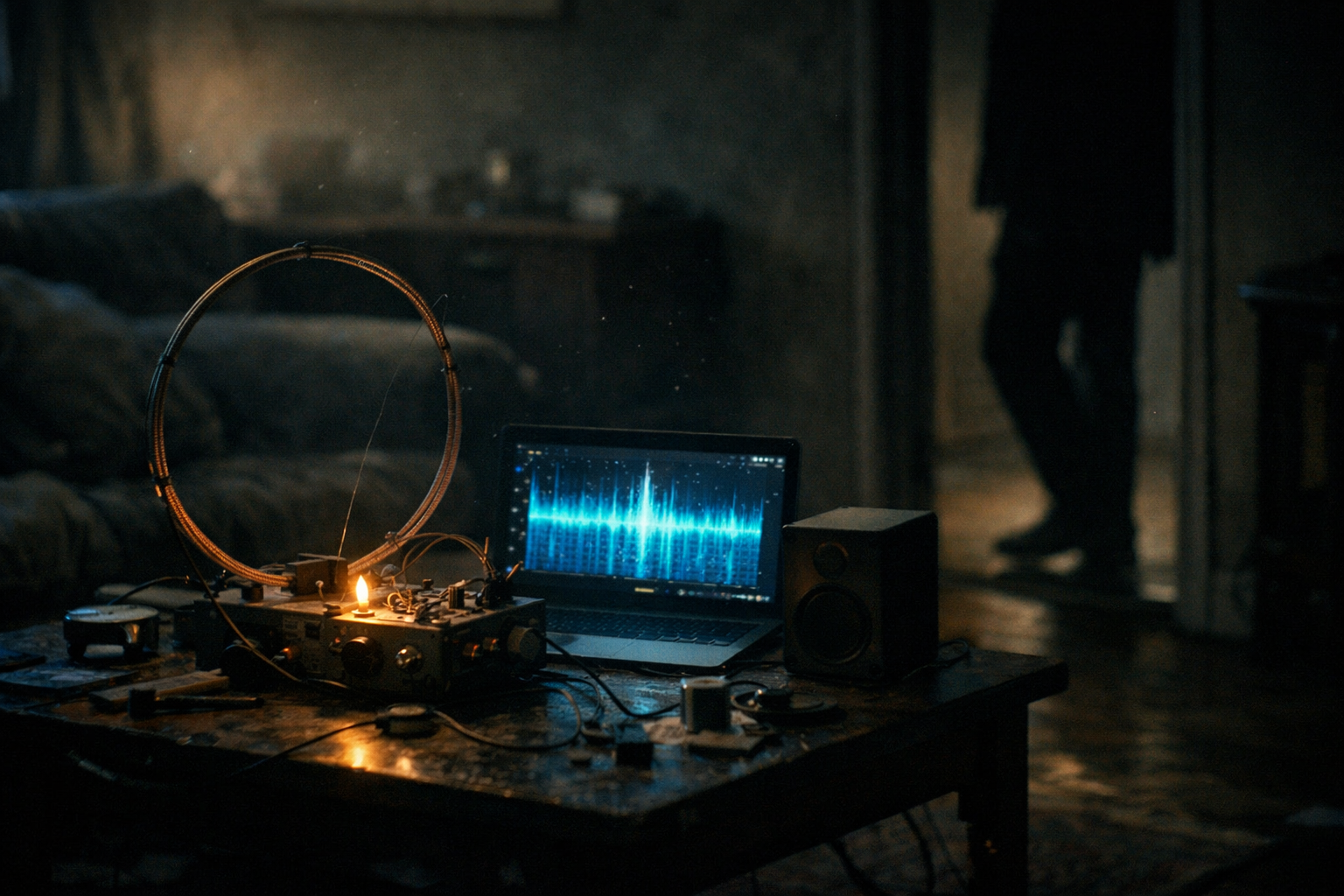
I had the folding table set up by the window because that was the only spot in my apartment where the radiator’s tick didn’t drown everything else. It was the kind of kitchen table that dips in the middle, the varnish gone to gray rings from old cups. On it, I had a battered laptop, a tiny SDR dongle with a chipped blue case, a loop of copper wire that I’d wrapped and taped into a crude antenna, and a little active speaker that hissed even when nothing was connected. People came in and out—neighbors who knew my door stuck less than theirs, friends who lived on the same floor and wanted tea, my downstairs neighbor’s sister who borrowed sugar and never returned the jar. It wasn’t a party, just the way evenings in small buildings collect company. I tuned and watched the spectral waterfall slide, even when the best thing I caught was another AM preacher dissolving into static.
It happened first in the simplest way. I had the radio set to a quiet stretch where only the background murmur showed, a kind of cloth of sound. I was bent over the laptop with one ear angled toward the speaker, searching for a faint aviation beacon I’d been told I could hear on clear nights. The door scraped. The person on the other side shouldered it open—one of those graceless entries, a huff, the emit of cold air. At the exact moment they stepped with one foot onto the living room rug, the speaker gave a single, clean pip. It wasn’t a pop or a thump like when a wire shifts. It was crisp, like someone tapping a glass with a ring. Then silence again, the cloth of sound unchanged. We both looked at the speaker like it had bumped the table.
I thought it was a fluke, the anti-static strap brushing something, the air a little dry. But when they went back out to grab the bag they’d left in the hall and came in again, the same pip landed, precise, exactly as the weight of them crossed from the hall’s tile to my rug. We tried it three more times, me adjusting the gain, them laughing and shuffling. Pip, pip, pip, each one as distinct as the tick of a metronome, each one arriving only as the person’s body became fully inside the room, not a second before or after, never in the middle of a step, never delayed. It was so oddly polite. The radio had no motion sensors, no pressure mats, no tricks. It had only what the air gave it and what the old building hummed with.
I started paying attention after that. I tuned somewhere bland—midband, nothing obvious—and left the speaker low while I made tea, while I read on the couch with my feet under a wool blanket, while I answered texts. The door would catch on that sticky point in the jamb and then swing, and there would be the pip. Different people, all kinds. My upstairs neighbor who wears old boots and has a cough. My friend who moves quiet and slid in on socks because the hallway is slick. The pip did not care about boots or socks. Three in the afternoon, dinner time, near midnight when the building went hollow. Always the pip. Not every time a person moved anywhere in the apartment—only when they entered that single room, through that one doorway, as if the boundary itself had been given a switch.
I took it to task so I could stop thinking it was my imagination. I pulled the plug on the laptop and ran off battery. I unplugged my router so the apartment felt like a cave. I killed the breaker for the bedroom and kitchen circuits until the only light was the street glow through slats and the laptop’s blue window. I tried a different receiver I’d borrowed from a guy at work who keeps one in his desk for lunch breaks, a more expensive box with a heavier dial. I went down to the basement, where it smells like laundry soap and damp concrete, to make sure no stray wire was looped oddly beneath my floor. I held my phone far away, dropped it in the entry basket where I keep keys, and then out of habit patted my jeans anyway. The pip didn’t change. The pip remained a pip, arriving with that maddening exactness when someone stepped from hall to room, as if the line where paint changes color had a throat clearing.
On the screen, the pulses appeared as a thin line down the waterfall—no spread, not the jagged bloom of interference, not a sweep like a plane’s radar, just a narrow, momentary brightness, bright enough to be undeniable and yet small enough that if I hadn’t been looking for it, I’d have missed it between coffee sips. My friend waved an arm through the doorway without stepping in. Nothing. He leaned in but kept a foot in the hall. Nothing. Then he sighed and put his weight forward, and there it was again, a single perfectly shaped fleck of light on the screen and that bell-like ping in the room. We did this until we felt stupid. We tried bringing the cat through and got nothing—the cat blinked and made a sound that was close to a question. It was not the weight, nor the movement, nor the door. It seemed to want a person, whole, inside.
The apartment learned it, if that makes sense. People began to pause in my hallway like actors who know their cue. They would grin or roll their eyes and time their entry to hear the tiny note, and then it would be over, and we would live the rest of the evening as if nothing had happened. There were long hours when the speaker did nothing but breathe its low hiss. I did laundry and listened to the neighbor’s television through the wall. I listened to a man down on the street arguing into his phone about a package. Against all that normal, the pip was delicate. At night, when the building settled and the refrigerator’s compressor clicked off, it sounded somehow nearer to the skin than anything else.
The evening I can’t stop thinking about was after a rain, when the front steps were slick and the vents carried the smell of wet stone. I had left the radio set to a quiet spot again, this time with the gain nudged down until the cloth of sound was barely a seam in the room. A friend I hadn’t seen in months came by with a bag of groceries and hugged me in the doorway. We half-laughed about the ritual. She shifted her weight forward. The pip came, but then something I had not heard before happened: instead of one clean note, there was a second, quieter, a heartbeat later. Then another. I know this reads like exaggeration. I stood absolutely still and listened as a staggered sequence of tiny tones unfolded with a spacing that felt familiar, like the way you can almost say the name of a song just from the first bar. My friend’s fingers tightened on the grocery bag’s handles. She was looking beyond me into the room as if the room had changed shape.
For maybe ten, twelve seconds, the pulses counted in a pattern I hadn’t heard in years, not since the AM station my grandmother kept on in her kitchen—a late-night program that brought children to sleep with the host’s watery voice and a lullaby that was their closing music. It had gone off the air a long time ago, not even a dead carrier left. The sequence the radio made now was not music, not notes with pitch and timbre, but the cadence was there in the spacing of the ticks, the way the breaths would have been. My friend’s eyes went bright, then wet without falling. She said the title out loud, too soft to be a correction to the air, and I knew instantly she was right because her voice landed on that space of time the pulses were mapping. We stood together as it faded, as if someone had lifted a finger off the glass. The last tiny pip hung a fraction longer, or it felt like it did, and then there was nothing but the old apartment’s hush again, the groan of a pipe deciding itself.
We did not move for a while. The groceries sweated in their plastic. She pressed a palm to her chest like she was checking whether something inside her was in step with what we had heard. She told me, in a close voice, that she used to fall asleep on a couch too small for her in a different city while a radio in the kitchen murmured that song, and that it made her think of a pair of hands that smelled like flour and dish soap. The song had an ending where the last phrase was always a little slower, as if the host didn’t quite want to close down the night. The pattern in my room had leaned there, to that small hesitance, and that was the part that undid her. I could not think of something to say about it that didn’t sound made up as I heard myself say it.
After she left, I returned to what I call tests, even if that makes them sound legitimate. I changed antennas. I coiled the copper differently. I tried the little whip that came with the dongle and the loop a friend had wound for me, taped in neat black turns. I put the laptop on a stack of books. I took it off the stack. I pulled the table a foot back so the doorway opened a different angle on the room. I did it with all the lights on, and with only the lamp by the couch. I plugged the speaker into a different outlet. I stood in the doorway and did not step in. I phoned another friend and asked them to come over without telling them why, and they stood in the hall listening to me describe something I didn’t quite believe I was describing, and when they stepped in, the radio made its single bell of sound as if to punctuate my foolishness. It did not echo the lullaby again that night or the next or the next.
Weeks added up. Sometimes there were double pips, but never the series again, and never a shape I could wrap my head around. I started to keep a notebook because it made me feel better to collect the data—tiny squares of time and notes about who had come by, pencil marks like seeds blown to one side of the page. I ticked the boxes when the pulse happened (it always did) and left them blank for the rare nights no one visited and I could only make it sound by stepping out of my own room and entering it again, which felt strange in a way I didn’t want to examine. I have logs with rain smudges and a coffee ring and a faint pencil posture where my hand sat too long without writing. The pattern is neat only in this: you can open my door and you will hear it once, bright as a point, at the place where hallway becomes living room.
People suggested wiring issues, something about the way the building was built in the early sixties, something about ground loops, about the bus bars in the basement, and I let them talk because their voices made the line of the evening smoother. I invited them to test it for themselves, and they did, and while they stood inside there was the pip again, like a curt nod, and then nothing else to catch, no buzz sustained, no humming problem to measure. We brought in a battery-powered radio with no connection to the mains and it obliged us with the same minimal announcement. I turned everything else in the apartment off and the sound didn’t change. I dragged the old wool rug aside to see if something hidden underneath wanted attention and only found a circle of dust and the imprint of a stain that predated me.
The station with the lullaby is gone. I looked for its traces out of habit and found only a forum post where someone remembered a jingle and another person replied with a date that was not quite correct. It would have been easy to leave it alone if that one evening had not happened, if the pulses had remained as impersonal as a smoke alarm test. I have tried to decide to consign it to a trick of our ears, of our placing ourselves into things. But most nights I do not have to decide anything. I move around my small place and it is my place. The receiver lives on the table by the window. The loop of wire is neater now.
I am careful with the doorway. That is new. I catch myself breathing at the threshold as if breath itself mattered. Sometimes I stand with a grocery bag or a bag of laundry and wait until the building exhales—just a slow stretch in the pipes, the elevators resting, the hallway’s far door clicking shut. I step in, and in the place between the air of the hall and the air of my living room, something acknowledges me with that single, patient, uncomplaining sound. I don’t think I have ever known a tone so exact or so slight. Last night, late, I stood in the dark hall and listened to my own apartment the way you listen outside a sleeping child’s room. I waited until the heat stopped ticking. When I crossed over, the signal answered once and the room went on holding me like it always has, with no one and nothing to explain it.