The Figure Crawled Backward Into the Drainage Pipe
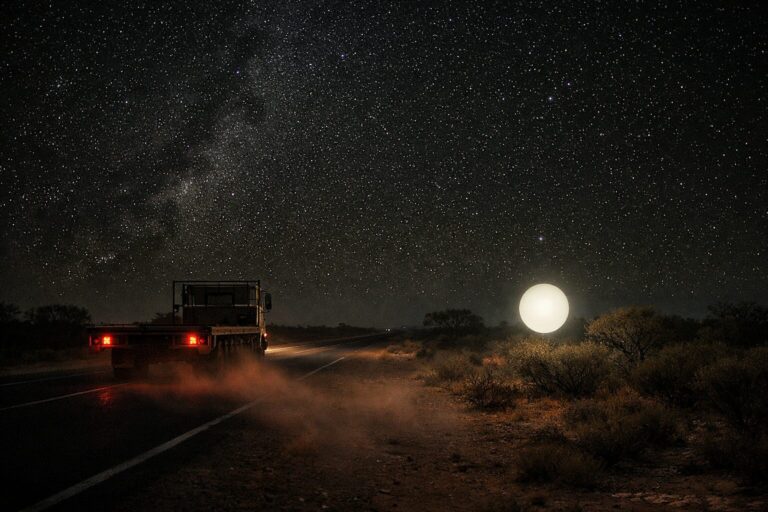
He knew the road in pieces, the way a hand knows a tool. The stretch past the silos with the wind-torn flag, the bend by the cottonwoods where the blacktop buckled each winter, the culvert at the bottom of the dip that collected beer cans and minnows after heavy rain. He took it late with the radio low, headlights finding and losing the battered reflectors on fence posts, the rectangles of mailboxes, the pale eyes of a strayed heifer that sometimes wandered the culvert pasture and didn’t spook at the sound of his engine. The glass smelled faintly of coffee from the cup by his knee. The night leaned against the truck in that soft way it did out there—crickets constant, a thrumming line of stars sliding in and out between the trees as the road cut and turned.
There was a routine to the drive. He clicked the brights on where the long fields opened and ditches ran straight as a ruler, watching the tight silver beams lift the cattails and throw a clean rim of light around the corrugated mouths of the drainage pipes. After rain the asphalt carried a thin sheen and would mirror back much of what his lights offered; tonight it was dry and faintly dusty, tire hum a steady current beneath his thoughts, his breath fogging the edge of the cab window when he exhaled too close. The AM station came and went, a tumbling of voices in the dark, the announcer laughing at something he couldn’t make out, then static, then just the white hiss of distance.
He knew he was close to the dip because the fence line on the right shrugged and flattened there, the pasture falling away into a shallow run before the road rose up again to the school-bus stop where someone had nailed a deer skull to the post. He dimmed his lights for a distant pickup that went by with a freighted rush of air, its bed rattling, then clicked the brights on again as the road opened. The rim of the pipe he always watched took shape—a dark, circular mouth tight against piled earth and thin weeds. He expected the familiar flash of some small thing moving in the ditch, rabbits or an opossum that would freeze, show its button-bright glare, then flip away into shadow.
Something was already there, low against the shoulder. At first he thought of a kid, one of the teenagers who cut across the fields this time of night, but the shape was small, too small and held wrong. It did not get up. It didn’t pivot like a person surprised by light would. It moved in a series of stilted reversals, each with the same measured backward reach, as if the elbows folded the other way, as if the joints had decided on a rule and were keeping it strictly: do not turn; do not present; retreat in pieces.
He let the truck float down in speed without tapping the brakes, afraid of spooking it, or—he realized later—afraid of declaring himself fully aware. The thing’s silhouette flickered between the seams of the bent grass. In the angle of his beams it was human-like, a little bigger than a fourth grader and yet held taut in a way that made guessing size feel slippery. A shoulder—if that was what it was—hunched, then reversed, the angles clean, insect-clean. No flash of clothing. No band of reflective tape. The curve of a head stayed turned away from the light, chin tucked, crown toward him, and it skittered but always backward, inching itself toward the corrugated lip of the pipe with the focus of something whose whole instinct was to undo distance the wrong way.
He took his foot off the gas and steered onto the gravel shoulder. The road sound bled away until the only noise was the click of the cooling engine and the fine rattle of gravel beneath his tires. The radio’s low-talk cut out when he turned the key back a notch without thinking and then he realized that he could hear the slow trickle inside the pipe, that faint water sound a ditch keeps even after a week of dry. Somewhere across the field two dogs sounded off and were answered, and under it all the pump at the far irrigation line kept its calm chopping cough.
Midway to the culvert, the figure stopped. The stop was absolute, not freezing so much as holding, like a thing that had trained itself to become a shadow. For a breath he thought it would reverse its plan, stand, step into the ditch and away, or raise a face he could catalog as a pleasant explanation. He opened his window and the night slid in clean, carrying cold and cut grass and that iron smell from the mouth of the pipe. He did not speak. His hands stayed on the wheel with the same gentle pressure he used to keep the truck from drifting. He could have rolled on. He didn’t.
Then, as if a decision was reached elsewhere, it resumed. The last feet were precise: it backed to the lip without scraping its shoulders along the rim. The corrugations there were ridged with a bloom of pale mineral from spring runoff, and dew clung to the high points in tiny beads like fish eggs. He knew the size of that pipe. He had stood in front of it with his nephew in daylight and told him you couldn’t snake through without skinning yourself raw. Three feet across if that. A child might crawl it, shoulders turned, but anyone bigger would jam. The shape moved like a person who had long practiced this one action, sidling only enough to fit, then pushing carefully, hips first, back first, tail-first, into the round mouth until its edges were at its ribs and then past.
There was no clatter, no rasp of denim or the slick whisper of an animal’s hide against metal. No plume of moths disturbed out of the weeds. It slid with a steadiness that should have been loud and was not, and the wet bright on the pipe’s lip did not break or change. For an instant the circle of corrugation cupped around its middle and seemed to shrink, like a hand closing around a wrist. The last he saw was the curve where a face would have been, low and turned, hair—if that was hair—matted with reflection. It did not look at him. It did not turn as if to make a point. It simply continued the method and was gone. The inside of the pipe held only the ring of light from his headlamps, which shuddered a little with the shake of his idling truck and made the shadows along each ripple climb and fall as if breath were passing.
He sat a while, letting his eyes find anything in that dark: a heel smudge, a handprint, a tremor in the trickle that might mean a body moving deeper where the water collected and curved under the road. It was ridiculous to think of calling out hello, ridiculous not to. He took a long breath and stepped out finally, the gravel sounding very loud under his boots. He angled the truck a little to throw more light into the pipe. Up close the smell of damp iron and algae made the back of his tongue taste like a coin. The beads of water around the rim were unbroken, a perfect tight ring of reflected stars and his headlights. He reached one finger to the corrugation and it came back wet, and there was no smear of anything on his skin.
In daylight his certainty became complicated. He slept, rose to the heat already leaning in the window, and then drove back out there because the thing had left him with the kind of quiet that asks. The fields were square and honest, the sky big and without suggestion. He parked on the shoulder, crossed to the mouth of the pipe with the sun behind him, and stood there. There were snail tracks silvered in the shade, tiny ant highways across the damp silt, the cast-off shells of June beetles under the weeds. No heel marks in the powder-fine dust. No drag. On the far side of the road, where the pipe came out into the other ditch, it was the same story: some mud that had caked and cracked, a miller moth stuck to a bit of web, a faded can with a wasp inside, turning slow.
At the diner he told it without embellishment to a man who had cut hay on those fields since before the mill went to a skeleton crew. The man’s eyes did what an old dog’s do when it hears something familiar at a distance. He said he’d heard of kids seeing things along that stretch, his nephew using that bend to scare dates with a story about a boy who never turned around. He said a woman from the far dairy put a car into the ditch there one October swearing she’d swerved to miss somebody crawling wrong, a child maybe, but it had moved like it was unspooling itself backward and then wasn’t there when the other cars stopped. The waitress, setting down coffee, said without meaning to say it that her sister wouldn’t go that way at night because something in the culverts felt like a held breath.
He went back with a flashlight later and measured the pipe in that way that’s more for mind than for math: one, two, three armspans across in volume, the ribs at his palm height, the first bend in the metal seam marked with rust the size of a thumbnail. He clicked the light on and swept it slow along the interior, the beam diluted to a soft tunnel by daylight bouncing inside. No hidden chamber, no bubble off to one side where somebody could have turned or curled up, no clever cut in the bank. Just the long, even barrel of it under the road, and at the end a circle of brightness with seedheads wavering in it like a small winter on the far side of glass.
Not long after, the county sent a crew to clear debris from several culverts along that road, including his. He happened to pass and slowed. They fed a hose into the pipe, a flat spray punching through leaves and sticks that had collected upstream. The water came out dirt-brown at first and then clean. A man with an orange vest laughed about the things people let blow down their ditches. A foam cup emerged, then a dark bottle cap that winked and spun and went to ground. Nobody working there had a story they were going to tell. They shook the hose and the pipe gave back a compliant hollow ringing and then was still.
But as summer turned into the first filaments of cold, the talk tightened. Kids put themselves to walking as close as they could to the mouth with their backs turned, then ran squealing up the shoulder when a truck approached, shamefaced and grinning when their mothers scolded them. A man swore his dog lay down flat on the leash a dozen yards from the culvert and would rather be dragged than pass it, making a low, compromised sound that wasn’t a whine and wasn’t a growl. Someone said that one night the rim of one of the other pipes down the road smoked, not with heat but with cold, as if a fog had decided on that one circle to pass through and be done. The stories didn’t land where a story usually lands. Nobody had a piece of cloth to show, or a photograph. They had the space that grew after the telling, and the way it changed the shape of the road in their heads.
He adjusted his timing to take the other route when it wasn’t too far out of his way. When he had to come that way, he slowed without needing to think about it at the dip and turned the radio down and made a private bargain with the dark mouth he was about to pass. Once in a low skein of fog with the kind of damp that puts a film on everything, his beams found the lip shining bright as a nail. There were two faint lines in the dust on the shoulder leading up to the rim, parallel, as if a pair of heels had been eased backward very carefully, or as if runnels of rain had decided to travel like legs. He stopped with his bumper square to the circle and sat with his hands mid-air on the wheel and watched the lines disappear when he breathed onto the glass. He cut the engine. The night pooled in, heavy as water, and in the quiet the trickle in the pipe seemed closer, a delicate conversation with nothing. Somewhere deep, something clicked, the forward-not-forward sound a bottle makes when you shift it on a shelf. He waited to see if the sound would repeat. He waited longer than made any sense and then a little longer still, long enough to feel the cold through his knees. When he drove away he watched in the side mirror until the mouth fell to a coin, then to the kind of darkness the eyes make for themselves.
The culvert is there now like it had always been there, corrugated edges throwing his light back in thin, honest bands, a trickle inside, weeds at its lip veined with white dust. People mention it and don’t, the way a person boxes up one bad winter and leaves it at the back of the shed. There are new dents in the guardrail beyond from something ordinary, and kids sometimes smear mud on the pipe’s mouth in handprints that rain later softens and slides away. Still, when the road opens and the brights come on and the round of that pipe arrives in the beams, a person coming home alone may feel a little clench, a breath taken in without meaning to. The circle keeps its quiet. And if on certain nights something like a small body moves within the edge of the light and then retreats, not turning, undoing distance in that wrong, careful way, it leaves the same amount behind as before: nothing to point to, only the place, and the road, and the caller in the ditch that always sounds like water.