The Airplane’s Final Call Came From the Ground
The day started easy, as most flying days do when no one expects trouble. The strip sat out past the grain elevators and the rusted water tower, a trimmed ribbon of asphalt cut through grass and milkweed, windsock idly pointing nowhere. A man in a faded baseball cap walked the length of a high-wing Cessna, dragging his fingers along the rivet lines like he was reading something in Braille. He checked the fuel sumps, wiped a dark smear off his knuckle with a rag, and stepped neatly up onto the strut. From the office window, the woman on duty watched him with the casual attention that came from a hundred similar afternoons. The air felt light; sunlight fell in wide bands; somewhere beyond the willows a dog barked without urgency.
He had told them he’d be back before dark. He was running a quick hop out to the west to photograph a few irrigation runs for a client, no passengers, just him and a lunch he didn’t eat. He called on the common traffic frequency to announce taxi, voice level and soft like always: “Crescent traffic, Skyhawk Two-One-Eight-Seven Victor taxiing from the barn for departure Runway Two-Seven, Crescent.” The office radio received him clear as a bell. She leaned back and jotted his tail number and departure time in the logbook because that is what you do, even if you know the handwriting and the hour by heart.
The engine’s note rose and smoothed as he rolled, tail momentarily light, then the whole airplane released from the runway with that deliberate, inevitable lift that never stopped feeling a little miraculous when you watched it. The line of poplars shrugged beneath him; he climbed past a circling hawk and steadied out, right turn on course. He called once more: “Crescent traffic, Eight-Seven Victor departing to the west, last call.” It wasn’t unusual—some of the pilots made that little valediction and she’d come to like it. Later she thought about those words more than she wanted to.
The radio got quiet after that. It was one of those blue-slate afternoons where sound thinned out in a way that made the fridge hum inside the office seem louder than the field outside. The woman filled out a fuel receipt for a crop duster that had left earlier, stacked a handful of envelopes for the mailbox, and killed a mosquito with the corner of a clipboard. Across the way, a mechanic with oil on his forearms stripped the cowling off a Cherokee and set the screws in a coffee tin. Nothing else pressed itself forward to be remembered.
When the call came, it arrived like a spoon tapped lightly against a glass. No sense of the horizon bending or any difference in the light, just a clean carrier rise, then the voice, the one they all knew. He sounded as he’d sounded an hour before, or the week before, or last October—calm to the edge of absent, unhurried. “Skyhawk Two-One-Eight-Seven Victor, standing by.” Then a beat of dead air, as if the pause itself were part of the message, and the exact same phrase again. “Skyhawk Two-One-Eight-Seven Victor, standing by.”
She grabbed the mic without thinking. “Eight-Seven Victor, Crescent. Say position.” She waited through the hiss. The reply that came was not a reply to a question. It was the same string of words. If there had been a different tone or a crackle or even the sloppy rush of a keyed mic without speech, she could have put it down to a thumb slip or a nervous habit. It was too clean for that. He did not give a position, or altitude, or any acknowledgement at all that anyone else was there.
Later, they would go back over what everyone knew. He had asked for flight following and been given a squawk by the center three counties over, and he’d checked in level at two thousand five hundred. His transponder dot had walked steady on the scope for a good while, heading home the way you or I might take the same county road by instinct. The tracking drops off someday for everyone; that’s just how ground-based radar works. But when center lost his return, they did not expect to hear him at that exact moment in her little office with a signal so strong it lit the VU meter like a flare. They compared clocks later. The timing didn’t like to line up.
“Eight-Seven Victor, Crescent, radio check. Say again your last.” Her voice had a fray to it now. The mechanic looked up from his bench and walked over without wiping his hands, one deep crease of oil running over a knuckle like a black river. They listened together with their shoulders nearly touching as the voice obliged them by repeating itself without regard to being asked. “Skyhawk Two-One-Eight-Seven Victor, standing by.” Exactly the same cadence. No breath. No bleed of engine in the background. No faint trace of wind.
She copied the time in the margin of the log with a sideways star next to it. The mechanic took the mic and tried a different angle, tone pitched more to tease something human out. “Eight-Seven Victor, this is Joe at Crescent. If you can hear me, ident.” But this wasn’t a transponder, wasn’t a code they could pull up as a flash on a screen. The radio didn’t care about intention. The phrases came twice more and then he was gone, the silence abrupt as if some switch had been set with a fingertip. She didn’t like the way the word standing felt in her mouth after that.
By then the sun had gotten low enough to lay long boards of shade across the runway. A bourbon-colored banding grew around the field as crickets woke and started their metallic racket. She tried his cell and let it ring until it gave up; she tried the number of the woman he lived with and dared to say nothing specific about how her hands were shaking. The sheriff’s truck came in on the gravel, lights off, then the volunteer fire chief a few minutes later. Within an hour, the radio bench in the office had been nudged to one side to make room for a gray case with a stubby Yagi antenna, a handheld with a signal-strength meter that looked like a thermometer climbing in heat. No one said accident. They said overdue. They said missing. They respected the gravity of other words by not picking them up yet.
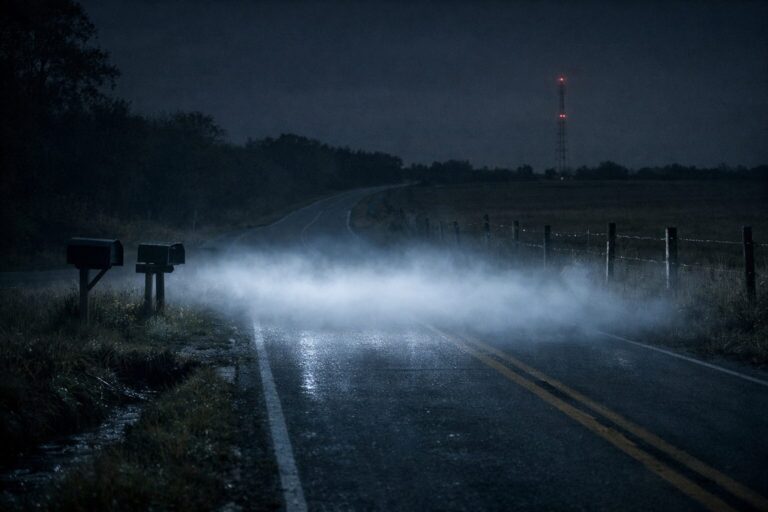
The county had a man who knew his way around directional finding. He set the antenna on a tripod out back and swung it slowly, watching the needle quiver up and down as he pointed toward the silos, then the treeline, then the distant blinking of the broadcast tower with its red beads of light. The woman stood with her arms wrapped around herself under the halo of a bug lamp, swat of bugs like raindrops against her neck. When the voice came again it startled every bird in the hedgerow. Throat-clear. “Skyhawk Two-One-Eight-Seven Victor, standing by.” The man with the Yagi stopped the swing and held, eyes flicking between the meter and the lay of the land. “It’s right here,” he said, confused more than triumphant. “Close as a neighbor. There’s no height on it. It’s coming off the ground.”
They sent one truck west and one north on the gravel. The sheriff took the long farm road south where dust hung behind him in a suspended curtain. The DF man rode with the mechanic east toward the low place where winter wheat had been cut and rolled and stubbled into combs. At the fenceline the signal meter pinned hard. They went as far as the right-of-way would let them, boots in the grass, barbs at their waist. The field stretched a long slow ripple under the dimming sky, no vehicle tracks, no flattened swath, no sign of a tailcone or a bent prop. The voice came steady into the truck cab, loud enough that the DF man turned his head as if the speaker weren’t there and the sound had come from his companion’s mouth.
“If it’s a relay, I can’t see what’s relaying it,” he said, mostly to the grass. He crouched and laid his palm on the top strand of wire as if it might be vibrating with whatever it was they were touching at. The wire was just wire. The radio meter bounced in a way that said proximity more than power. It felt like standing two feet from a person and being somehow unable to find where they were looking.
Back at the strip, the office radio had gone quiet. The woman walked to the open hangar door and stood in the weak fan of a car’s headlights as another volunteer taped a paper map to the hood. In the glow of a dome light she could see the scrawl of times and bearings accumulating in the margins of her log like some other handwriting layered under her own. The mechanic keyed his handheld and was a voice in her pocket. “We think we’re on top of it,” he said. “On top of what?” “I don’t know. That’s the thing.”
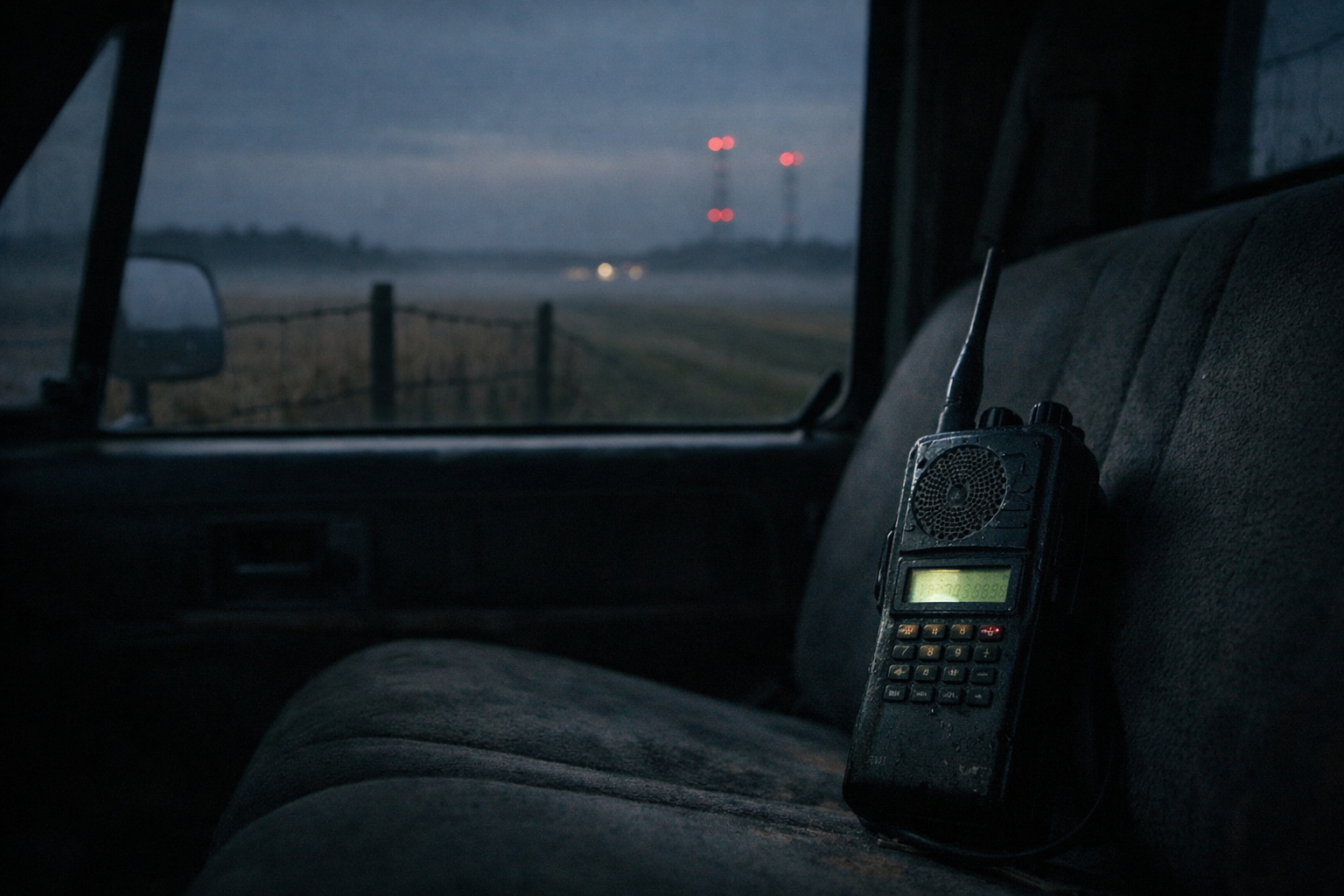
Later, long after the last of the pink had sunk out of the sky and the field had gone to that full-bodied dark where distance ceases to mean much, they stood in that stubble and listened to their own breathing. The sheriff’s SUV idled on the shoulder; the driver’s door was open, dome light dead because no one wanted to kill their night eyes. On the passenger seat lay a battered handheld radio, an older model they’d retired when the new ones came in. Its battery pack was missing; she remembers this detail because the sheriff had mentioned it earlier in the office, tossing the thing in the car as a maybe-useful relic, saying, “Needs a charger, or a miracle.”
They all heard it. The sound didn’t care that there was no current. The handheld’s speaker made the smallest pre-voice pop, the soft tack of a cone waking after sleep. Then the phrase, in that same practiced, indifferent tempo, exactly as it had been by the office window and in the truck and in the DF headphones—the same timing between words, as if taped, as if measured. “Skyhawk Two-One-Eight-Seven Victor, standing by.” It printed the air like a stamp. No carrier whine came with it. No glow bled into the face of the dead radio. It said itself again, and then the cone on the old handheld eased back into stillness with a little inward sigh, and the whole field pressurized with the sound of insects going at it as if someone had cracked a seal you didn’t know was there.
The DF man cursed softly without emphasis, then put his hands on his knees and laughed once by mistake, a bark like a cough. The sheriff picked up the dead radio and turned it over in his hands, thumb on the spot where the battery should have clicked. The mechanic, who had known the pilot’s voice for years, put the heel of his palm against his own sternum as if he’d swallowed something wrong. No one talked for a few long beats, because nothing they could say would make a shape in that dark that wasn’t false.
They went back into the field as far as they could without trespassing more than they already had. The DF man did little half-circles, then figure eights, trying to find a null in the signal to tell him where this thing had actually been. The needle stayed pinned whenever he faced the patch of open stubble about twenty paces in. There was no transmitter. There was no junk on the ground to hide anything delicate under. They are all certain about this part, even the ones who traffic in maybes for a living.
By midnight the first airplanes out on the search—guard pilots and two locals who knew all the ravines by smell—had swung back through for fuel and stale sandwiches. The woman in the office poured coffee that had been sitting away too long. She made a space on the desk between coils of coax and the DF case and opened the logbook where the line of her writing had grown less steady. She wrote down the times again without knowing why. There is comfort in the telling of numbers, sometimes. There is a way a numerable world cuts cleanly when it doesn’t want to be now.
Morning didn’t give them an airplane. The light came up over the fields in flat bands, and corn tassels flashed and horses in a far paddock cuffed flies with their tails. The helicopters widened their sweeps until their rotors were only a rumor, then a memory. The woman drove out to where they’d stood the night before and watched last night’s boot prints taken back by the bending grass. A few buzzards turned slow circles over a different part of the county and then lost interest in even that.
For the paperwork people later, there were things you could measure. The statewide incident log pulled down a recording off a receiver they keep near the ridge for situations where you want a copy of who said what and when. The time stamps said that the call sign “Skyhawk Two-One-Eight-Seven Victor” was logged at 7:19 p.m. as a near-field transmission, signal pegging in a way that usually means the source is too close to be useful. The county’s DF notes, written in someone’s careful block print with a pencil that kept needing to be resharpened, put the strongest reading not in the air but ground-level at the northwest fence line of Parcel 42, a field that the tax map said was owned by a man with a last name half the county shared.
At 2:14 a.m., long after the last truck had quit circling and the coffee in the office had gone into the sink, the unattended recorder at the shack by the fuel farm woke and took down a second near-field transmission on the same frequency. The office door was locked; the radios were off; her keys were on a ring by her bed. Nothing else went out on the tape before or after. The file name carries that hour for anyone who wants to check: the same tail number, the same words, rising briefly as if from the sod itself, saying only what it had said before and nothing more, and then gone back into whatever silence that field has always had for anyone who is not standing by.