The Bermuda Triangle: Separating Legend from Statistics
At dusk the Atlantic looks like a single sheet of metal, unbroken to every horizon. Pilots have described radios that hiss, compasses that seem to breathe in and out, and skies that darken without warning. In this sweep of water between Miami, Bermuda, and Puerto Rico, a name took hold that still prickles the imagination: the Bermuda Triangle.
Decades after its first newspaper mentions, the Triangle remains a cartographic ghost—no official borders, no legal status, yet an outline instantly recognized. Friends still swap stories about ships swallowed without a call for help, planes vanishing from clear radar, and investigators who can never quite button the case shut. The central claim is simple and provocative: this region exacts a stranger toll than statistics can explain.
That enduring tension—between evocative narrative and sober number—invites a careful walk through the record. What, if anything, marks this watery wedge as unique? And why has it become the world’s most famous maritime enigma?
Into the Quiet Water of the Bermuda Triangle

The legend’s geography is fluid, but most maps sketch a triangle with points near Miami, Bermuda, and Puerto Rico, covering heavily trafficked shipping lanes and busy air corridors. The sea here is beautiful and treacherous in equal measure: warm currents, sudden squalls, and a hurricane alley that has humbled the best planning. It is a place where a routine day can bend to emergency in minutes—conditions ripe for both genuine disaster and enduring myth.
From the start, the idea of a defined zone of danger supplied a powerful organizing principle. It turned scattered tragedies into a named phenomenon, easy to point to on a globe, easy to dramatize on television, and hard to shake once a story reached a mass audience.
Origins of the Bermuda Triangle Legend

Modern interest coalesced in mid-century magazine features, where writers gathered accounts of losses that felt hard to square with ordinary mishap. In 1964, a popular article lifted the phrase into the mainstream, and a decade later a bestseller cemented the Bermuda Triangle as a household term. Television specials of the 1970s and 1980s added ominous narration, sonar pings, and stylized maps. The effect was cumulative: what had been a handful of tragedies, spread over time and space, now wore a single mask.
As the profile grew, so did the library shelves: compilations of Maritime Mysteries and Aviation Mysteries, reprints of archival incident summaries, and, soon enough, skeptical rebuttals that asked whether clustering was real or a trick of selective storytelling.
What the Bermuda Triangle Is Said to Do

The claims come in tiers. The most conservative version asserts a statistical oddity: more ships and planes disappear here than elsewhere, out of proportion to traffic. A more dramatic telling adds instruments acting erratically—compass needles wandering, altimeters disagreeing, radios emptying of voices. The furthest reaches go paranormal: time slips, portals, and echoes of ancient civilizations pulsing beneath the Sargasso Sea.
Between those poles sit hybrid theories. Some appeal to Magnetic Anomaly Theories, noting that lines of equal magnetic variation cross the Atlantic and might, in rare conditions, confuse navigation. Others invoke science at the edge of consensus—methane hydrate releases, microbursts, rogue waves—natural forces potent enough to overwhelm a vessel without leaving much in the way of floating evidence.
The Researchers Behind the Bermuda Triangle File

Early boosters of the mystery collected scattered reports and stitched them into a through-line: a missing training flight here, a silent freighter there. Later chroniclers brought a novelist’s touch, amplifying the atmosphere and presenting the Bermuda Triangle as a puzzle box of the modern age. In counterpoint, a meticulous librarian famously challenged the case inventory in the 1970s, arguing that many cited incidents were misreported, occurred outside the supposed boundaries, or had been explained in primary documents overlooked by anthologists.
Officialdom has been steady in tone. The U.S. Coast Guard’s public materials note the region’s traffic, weather, and the sea’s indifference, but do not mark it as uniquely perilous. Marine insurers, including large underwriters, have long assessed risk here as comparable to other crowded waters. Flight and accident boards investigated case by case; there is no single “Triangle desk” in maritime or aviation oversight.
Evidence and Alleged Evidence in the Bermuda Triangle

Any fair reckoning starts with the best-known episodes. In December 1945, a group of Navy torpedo bombers on a training mission—popularly known as Flight 19—became disoriented after a series of radio exchanges suggested compass trouble and lost position. The planes ran out of fuel over water; a search aircraft dispatched to find them also vanished. The loss of multiple crews in a single window of time gave the legend its strongest anchor.
Earlier, in 1918, a large U.S. Navy collier departed the Caribbean with ore and never reached port. With no distress call and a wartime context muddying the waters, the disappearance captured the imagination. Midcentury, an airliner bound for Florida failed to arrive, its last routine communications preserved in transcripts with nothing to foreshadow catastrophe. On the maritime side, a handful of cargo vessels and pleasure craft were later found adrift and abandoned, or simply failed to arrive, feeding the file of Lost Expeditions that would be recited and reinterpreted for years.
Supporters of a special cause point to patterns they see across these cases: instrument disagreement, sudden weather shifts, the speed with which the Gulf Stream could move wreckage out of search boxes, and, in a few instances, an absence of recovered debris that feels outsized given the scale of the loss. It is a mosaic assembled from logbooks, radio transcripts, weather synopses, and, increasingly, archival photographs and charts.
Statistics, Skeptics, and the Busy Sea Lanes

To skeptics, the numbers tell a cooler story. This is one of the planet’s busiest corridors for both shipping and aviation. Normal accident rates, multiplied by enormous traffic, produce a raw count of losses that will look large even when expressed per voyage. Storm seasons punish the unprepared; navigational error magnifies over open ocean; engine failures that are survivable near shore can turn fatal without time or options.
They also stress that the Bermuda Triangle’s boundaries are elastic: stretch a polygon across several hundred thousand square miles for long enough, and unfortunate events will occur within it. Many famous ships and planes cited in anthologies, when checked against original reports, either lie outside the most commonly drawn triangle or carry plausible prosaic causes—human error, severe weather, mechanical failure. Claims of dramatic compass malfunctions shrink further when placed against the known behavior of the agonic line—the region where compasses align with true north—which wandered through the western Atlantic historically but does so in many parts of the world without spawning a comparable legend.
Institutional positions reflect this calculus. The Coast Guard and major insurers simply do not price or brief the region as abnormally hazardous relative to traffic. Scholars argue that selective framing—especially in popular books and TV scripts—exaggerated normal maritime risk into a grand pattern.
Why the Bermuda Triangle Endures
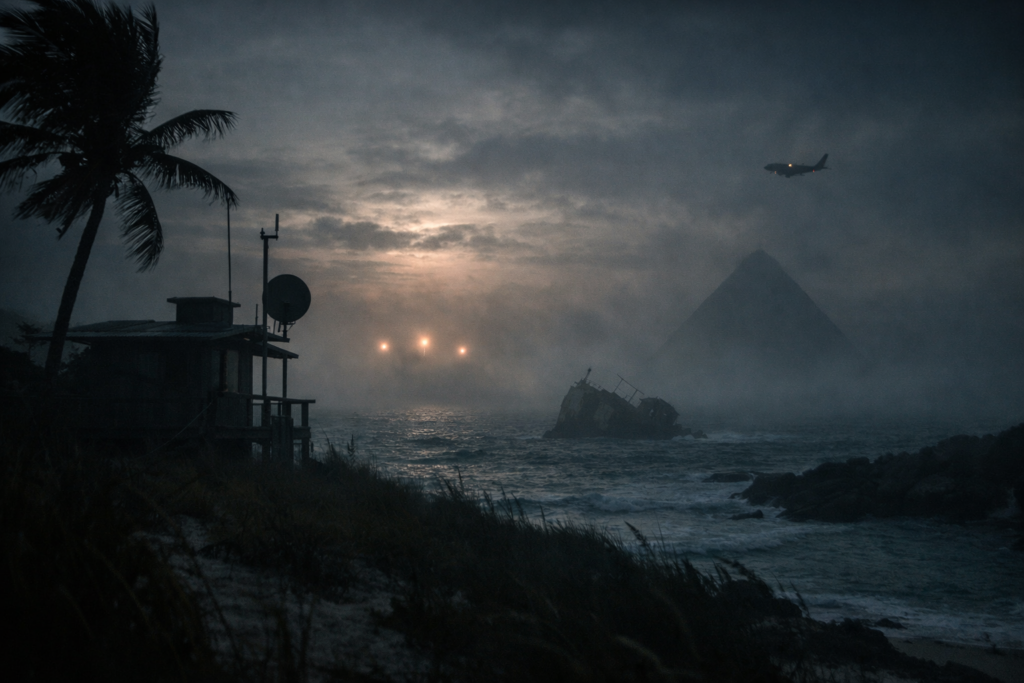
If the ledger book cools the blood, the legend still warms it. Stories thrive when they compress dread and beauty into a single image, and the Bermuda Triangle offers postcard water, sudden weather, and a minimalist stage on which radio voices can fade mid-sentence. A modern map overlaying loss feels like myth made visible.
Pop culture did the rest. The 1970s presented the Triangle beside Atlantis speculation in anthologies of Ancient Mysteries; later decades paired it with UFO lore during waves of UAP fascination. It crosses disciplines—Maritime Mysteries and Aviation Mysteries in a single frame—and lends itself to reenactment, archival montages, and blurred sonar screens. Once etched into the collective imagination, each new disappearance anywhere near the coordinates refreshes the story, even if cause is later found.
Daily Paranormal Analysis
Why it became popular: a clean geometry on the map, real tragedies to recount, and a ready-made cinematic grammar—radar sweeps, unanswered calls, and the world’s bluest water turning hostile in a heartbeat. Believers find it compelling because some cases feature elements that, even under scrutiny, resist tidy closure: Flight 19’s cascading uncertainties, aircraft vanishing without floating debris, or ships located with no definitive cause of abandonment. Theories invoking magnetic quirks, rogue waves, or even time distortions let the mind keep both science and enigma in play.
Why skeptics doubt: baseline statistics, traffic density, and archival corrections blunt the claim of a unique hotspot. The lack of consistent, instrumented anomalies across modern fleets argues against a geographically fixed, repeatable effect. Investigators point to initial media embellishments—incorrect weather reports, misplaced coordinates, unacknowledged distress calls—that evaporate a pattern when corrected.
Connections to similar cases: the “Devil’s Sea” or Dragon’s Triangle near Japan, the so-called Alaska Triangle, and other mapped zones of anxiety show the same cultural mechanics—aggregated incidents, a suggestive shape, and a narrative that exceeds the sum of the files. Together they hint that the human impulse to draw borders around uncertainty is as old as navigation itself.
Where we land: the Bermuda Triangle legend blends fact and frame. The facts are sober—ships and aircraft do vanish, weather changes rapidly, and the sea does not volunteer answers. The frame—the named triangle, the stitched narrative—is what makes the file feel otherworldly. After combing the record, we find no statistical necessity to posit a unique danger zone, yet we acknowledge that a handful of cases remain stubbornly incomplete. The mystery, in this sense, is unresolved not because the region is magical, but because the ocean is vast, records are imperfect, and chance is capricious.
Conclusion: Between Legend and Ledger in the Bermuda Triangle

The sea keeps its own counsel. Place a triangle on a map and the ocean will not notice, but we will; and when ships falter or radios fall silent, a preexisting story rushes in to arrange the pieces. The Bermuda Triangle endures because it sits exactly where wonder and risk intersect, transforming routine tragedy into an emblem of the unknown.
Sorting legend from statistics does not empty the myth of power. It refines it. What remains is a cautionary tale about navigation, forecasting, and humility—and an invitation to keep asking better questions. The Atlantic between Miami, Bermuda, and Puerto Rico needs no supernatural gloss to command respect. But in the long wake of Flight 19 and the other lost names in the logbooks, it may always carry a penumbra of strangeness, a reminder that even in an age of satellites, there are still places where the map feels thinner than we would like.