
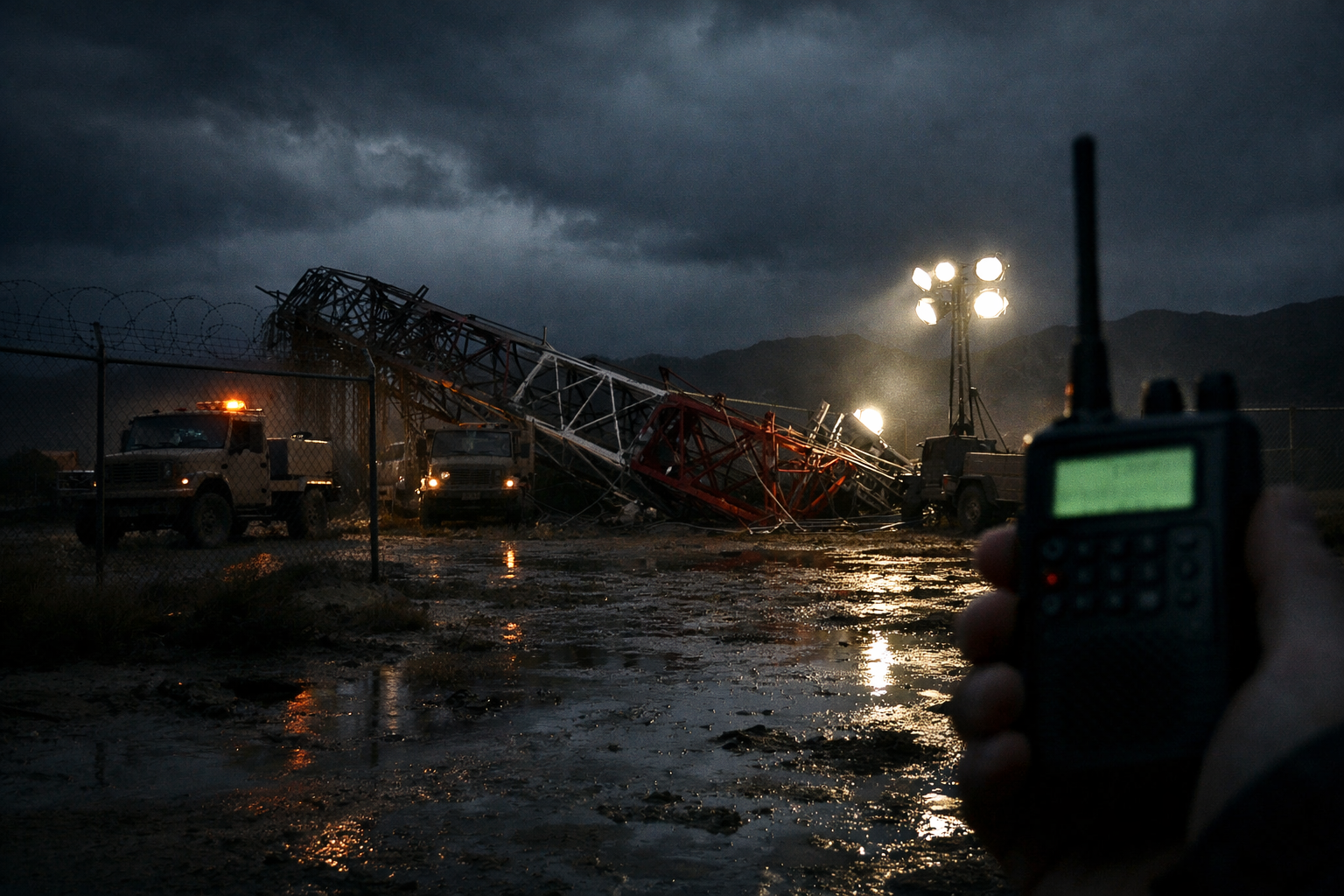
The Radio Tower Kept Transmitting After It Fell
The morning after the storm, the desert smelled like wet dirt and creosote. The kind of smell that sits low in the washes and makes the mesquite shine dark in the bends of the road. The power lines along County 12 were down in two places, one pole splintered and laid out clean along the shoulder like it had been set there with care. People in our town don’t wait for the county if they can help it. Pickup trucks were already idling at the intersection by the old range fence, orange straps looped through their headache racks and chains dragging arcs through the wet sand. We stood in little pockets, swapping tools and short sentences, eyeing the damage to roofs and fence posts and the tops of blue agave ripped and splayed like pumpkins after a freeze.
On the far side of the dry lakebed, the old military tower lay crumpled like a folding ladder someone had lost patience with. Red and white paint had flaked into the mud under it in drifts of confetti. It wasn’t the tallest thing on the range anymore, but it was the oldest. I remember my dad pointing it out on drives home from the base grocery, telling me how it used to throw line-of-sight signals across everything for tests I wasn’t supposed to ask about. In the years since, it rattled in the wind, it baked, it stood. Then, in one night, it didn’t.
A few of us walked up along the fence line until the warning signs started repeating every twenty feet. The chain-link had been flattened under one of the guy wires, the porcelain insulators cracked like eggs. Ray, who runs a scanner the way other men carry rosaries, clucked and shook his head. Somebody had already slapped a lockout tag on the big disconnect by the concrete pad, a bright red tongue with a time scrawled in grease pencil. The storm had torn the feeder lines free and laid them back like wet shoelaces. The tower’s top section was folded under, its ladder buried. No lights blinked on what used to be the beacon.
That’s when I noticed the tone, a thin, sharp sound that seemed to be happening inside my teeth. It laddered up and then down, precise as a watch. Ray had his scanner out, of course. He twisted the knob and glanced toward the tangle of metal. “I’ve got a carrier,” he said, almost to himself. He walked the fence line a few steps and the little S-meter pegged. I could hear the tone on his handset, clear now, not just inside me. It rang three times and then a woman’s voice came in, clipped and light, the kind people use when they’re reading to a room full of people who refuse to be wrong.
“Time mark. Zero seven hundred. Group follows.” She gave numbers, clean and even. Then: “Stand by.” Another set of tones walked by like someone hitting glasses with a spoon. It wasn’t a voice you hear on county fire or weather. It had military patience. It didn’t care if we were listening. It didn’t care that the tower in front of us was snapped like a chicken leg and the power was off and every panel that might have contained something bright was flayed open to the air.
Ray swore once and handed me the scanner. It was louder when I held it level with the mesh of the fence, like I could dip it into the sound the way you dip your hand into cool water. We all looked, then, at the red tag hanging off the disconnect. A base electrician had signed it at 0610. It was 0723. No incoming from the line. No lights on the control box by the ladder base. The cable trays dangled empty as a rib cage. Still, the voice.
By ten, the county emergency guy had ambled up in his white Tahoe and chewed his bottom lip while he tried to look like he didn’t know us. Ray walked him along the fence and passed him the scanner, and the man’s eyes did that small, surprised thing even careful men do. He got on his radio, and an hour later the first of the base trucks came, beige with mud all up the sides, strobing amber. Men in reflective vests stepped around puddles and pushed at the fence where it had gone slack against the tangle. A guy with a printout on a clipboard tugged at the lockout tag and made a show of confirming it. The woman on the transmission calmly marked off eight hundred hours, as if she were looking out a plate glass window at a day that had gone the way it was supposed to.
They took out a tripod with a flat gray dish and pointed it down at the wreck like someone checking a fire pit for coals. Another man peeled the cover off a little case and unfolded a mess of antennas that looked like coat hangers, and he walked them slowly left and right while the meter on his screen jumped in eager bursts when it faced the heap of lattice and crumpled conduit. He cupped his hand around his mouth and yelled a question to the man at the disconnect. The answer came back with both palms up: nothing. After a while the technician had them set a thermal camera on the tripod. We crowded without trying to look like we were crowding. The monitor was a watercolor of blues and purples. The wreck was as dead-cold as the rest of the map.
Still, the voice. The woman’s vowels were soft and flat like they might have been trained that way. A call sign rolled through, one I’d half-heard years ago at the firehouse when the base did a drill and we’d all stood around admiring their gear. There was a number string that matched the freight train milepost near the depot that got washed out last spring, the one we all had to detour around for weeks. I only recognized it because I’d written it on a pickup bed in dust while we were figuring the best way to get hay around the closure.
About noon the signal shifted. It didn’t fade or pop; it slid, like it had simply picked up a different page. I had walked back to the trucks by then because Marla was handing out coffee from a thermos and paper cups that softened at the lip if you didn’t drink quick. I was telling her about the little piece of roofing tin that had come off my shed, how it had sailed into the ocotillos and rung like a bell while it did it. She was laughing that pinched laugh you do when you haven’t slept and your house has let water in. Then, from Ray’s scanner two feet away, the woman’s voice said, “Rang like a bell.” The exact same words in the same rhythm. Marla stopped, her cup up in midair and her hand starting a small, unthinking cross over her chest.
I told myself we were all primed for coincidence. A phrase repeats and you hear it where you want to. But then the woman’s voice said, “Don’t tell the county about the generator,” and in my head I was back in Eric’s shop two nights prior, looking at the used Honda unit he’d picked up from a guy who swaps out gear after single storms. He had asked me if I thought the county would notice if he ran it out back while waiting for repairs, and I had said, “Don’t tell the county about the generator.” I hadn’t told anyone else that. It sat in the air between us, perfectly even, like something typed.
Other people started going quiet. The voice fell into the rhythm of our little town as if it had been listening to us long enough to hum it. “Frank, your tetanus is out of date.” We had said that to Frank when he stepped on a roofing nail Tuesday. “Soup’s gone by noon if the truck’s late.” That was Dot at the café every payday. “Hold short of the cattle guard.” One of the range security guys had just said that on his own radio ten minutes before. “You can’t see the stars when the base lights are on.” That was something I’d said to my wife once, and then repeated like a joke until she made me stop. Hearing it in that flat voice didn’t sound like a joke anymore. It sounded like a ledger being read off, with things classified not by importance but by the fact they’d been said at all.
The technicians got sharper with their movements after that. They walked new coils of coax along the fence and strapped a little Yagi to a fiberglass pole and aimed it into the knot of fallen steel. The meter on their handheld pegged hard enough to smack the stop. The guy with the coat-hanger antenna made a circle and said something I didn’t catch, and three more base trucks came, two with tailgates already down and canvas cases lined up like they’d been waiting all morning to be opened. Someone set up portable light towers on silent-running diesel. One of the range police cars nose-parked sideways and a man got out with his hat pulled low, and after that they strung more tape and pushed the line back. It wasn’t a hostile push. It was the kind of thing that lets you know the line is going to end up where they want it no matter how polite they are.
By midafternoon they’d cut a corridor along the fence and walked in with a square, wheeled case that made two of the men grunt when they lifted it. The woman on the radio said, “Stand by,” and then, with the same empty calm: “Marla, you don’t have to forgive him.” Marla dropped her empty cup then, and the paper puckered under her heel as she went white with anger, and I reached for her arm because that had been said in the back room at Dot’s a week ago. We both heard it. We both chose not to hear it again until just then. The man with the hat looked at us in a way that slid right off.
I asked Ray if it could be some kind of open microphone folded into the mess, something feeding back our own chatter just delayed. He showed me his multimeter’s red mouth clamped over the fence grounding strap: nothing. He tapped the blank face of the breaker box where a battery might have blinked if anyone had left one in the last decade. “If there’s juice, it’s hiding better than the rest of us,” he said. A tech with a base pass on a lanyard overheard and added, “We’ve got zero at mains. Zero at the panel. Zero at the strap. She’s a dead dog.” He said it like he wanted to put a period on it, but the voice just kept stepping over his punctuation and talking to itself.
When the sun fell away behind the low ridge to the west, those portable lights made the wreck glow like it had its own winter. Moths circled and tapped themselves to death on the plexiglass. The voice moved into what I’d swear was a checklist, except halfway through it dropped my mailbox number, then “the blue house with the cinderblock steps,” and then the exact date my neighbor’s boy shipped off for basic, which he’d told me over the fence while we pulled tumbleweed off the windward side of our yards in February. I watched the range police roll back a hundred yards on either side and block the service road that ran along the fence. They didn’t tell us to leave; they just gave us nowhere else to be except outside the light.
The county guy came and stood with me a few minutes. He made a show of cupping his hands at his belt buckle and told me, in the voice used for curious dogs, that the area was going to be closed for environmental assessment. “RF exposure concerns,” he said, like he had to get the words past a sore in his mouth. I nodded. The voice on Ray’s scanner said, very softly, “Keep your mouth shut,” and I felt the hair along my forearms turn like grass in a shift of wind. The county man swallowed and walked away without saying goodbye.
I went home when the sand started to make dry whispers under my tires. In my kitchen the light was too yellow, and my hands smelled like wet fence. I turned the radio on the windowsill to FM out of habit and caught the tone, snagged between two country stations like a thread, three laddered pings and then a wordless breath of carrier. I turned the knob and it slid away, but the pings found me again on the weather band. I shut it off, and the kitchen sounded wrong without it, like a refrigerator that’s stopped overnight.
The next morning, there were fresh signs on the fence. The kind with many lines of text and a lot of capital letters. Men in clean green shirts stood with their thumbs hooked in their vests. No one said, “she’s still talking,” and no one had to. You could see it in the way they looked at the screen on the tripod and didn’t blink as much as they should. You could hear it in the way people stepping up for a better look forgot to finish their own sentences. Ray’s scanner never left his hand, but he didn’t write anything down in the little notebook he usually fills with date, time, frequency, and small questions. He just stood, and every so often the woman’s voice said something close enough to him that he had to put his thumb and forefinger on the bridge of his nose like he could squeeze a headache back in.
By the end of the week, a new cage of fence had been bolted up inside the old one, with fresh, hard-edged signs and a barricade gate someone had trailered in overnight. A release ran in the local paper about infrastructure damage, unauthorized access, potential harm from stray emissions. It did not mention the woman with the voice like an empty room. People in town got asked simple questions by men who didn’t say who sent them, and then they asked fewer questions of each other. When I drove past in the evenings, I kept the radio off, and still felt, every time, the barest pressure at my molars just as I came abreast of the ruins where the top of the tower had accordioned into itself. Sometimes, if I cracked the window, I could make out the shape of the beeps without really hearing them, like you can see your breath only when you exhale at a certain angle on certain days.
They hauled the biggest pieces of the tower out in the dark, when the moths had tired themselves to dust on the work lights and most of the town had given up going out there to stand and not say much. A lowboy bled oil on the county road all the way back to blacktop. It left a stain you could kneel and touch until the sun took it for good. The day after they’d made one clean pass through it all, the voice was still there, not constant but present in the way wind is, colorless and unconcerned. The meter on Ray’s scanner would wink and then sit up straight, and she would say, “Time mark,” like she was starting a meeting we weren’t invited to anymore.
I think about the first time I looked up at that tower as a kid and tried to feel what it was doing. I imagined messages as hot threads of light, pulling across the sky and tying off somewhere beyond the ridge where the lights were forbidden after certain hours. I realize now that not all messages move. Some settle. They sleep in fence posts and the backs of road signs, and in the tin roofs that rattle on bad nights. You stand near enough, they remind you they never left.
There is a new gate on the service road with a keypad welded to a steel post. It has no numbers on its face that I can see from the county side, just a hard little square of black. When I drove by yesterday noon, sun high and flat, my radio wouldn’t hold a station from one end of the dial to the other until I cleared the low wash where the tower’s shadow used to run every afternoon. Then everything was normal again. I don’t keep the scanner in my truck the way Ray does. I don’t need to hear it to know that she is probably still out there, reciting times, reading the small lines we throw between each other, waiting for someone to step inside the tape and say out loud what it already knows.


