The Visitor Who Came After 3 AM
The clock in my bedroom has a way of finding the worst moments. It doesn’t tick; it glows, a small square of green that floats in the dark like a glassy eye. The first night, when I came up out of sleep with the sound of rain blown sideways against the siding, it said 3:07 AM. I listened to the storm roll the gutters and thrash the maple in the yard. I could taste the metal of it in the air, the kind of weather that sits on your tongue. I didn’t think much of the time. Storms wake everybody.
The next night, the storm returned like it had circled once and decided to come back for the rest of itself. I woke the same way, as if someone had tilted the room suddenly. The clock watched me: 3:07. Wind made a whistle out of the bathroom vent and rattled something loose in the living room—picture frame or plant stake, I couldn’t tell. I rolled over and found my cat watching the hall, ears pinned flat. Then he tucked his head under my hand, and I told myself it was nothing, because it was easier to tell myself that at 3:07 than at any other time.
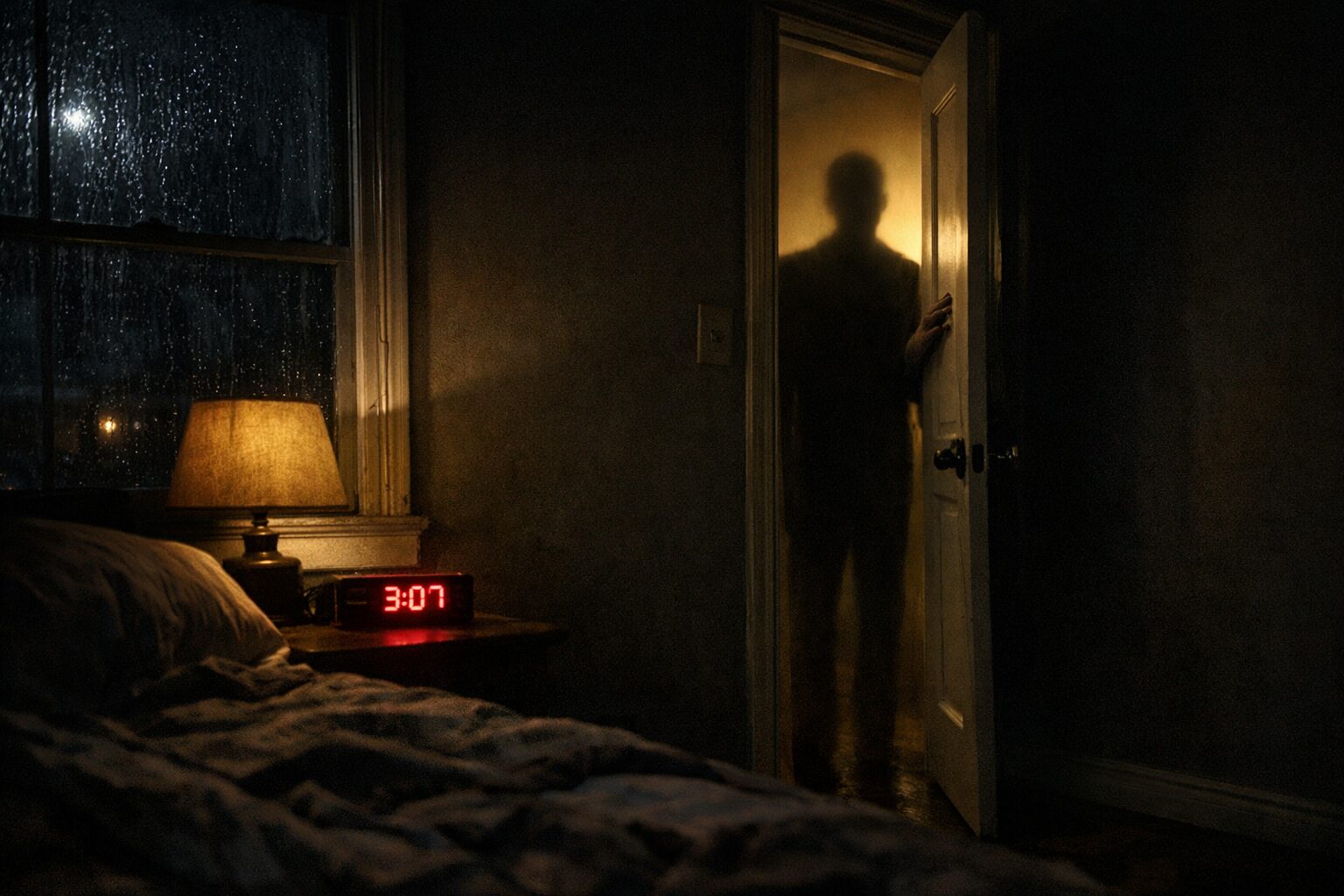
By the third night, it wasn’t a neat coincidence anymore. It was the shape of a new routine. I woke with my heart already up around my throat, the rain harder now, the kind that drags pieces of leaf and grit down the street like a breathing thing. The clock: 3:07 again. It took me a second to understand what was wrong with the room before the wrongness sharpened and I saw it. The bedroom door wasn’t where it was supposed to be. I had gone to sleep with it closed—as I always do, habit snagged from childhood, the latch pressed down until it makes that small, satisfying click—but now it was open by an inch or two. A sliver of darker dark lay in the frame, the hallway beyond the line of the door a depth I couldn’t look into without feeling the base of my skull go cold.
I lay there and made weather excuses in the quiet voice I keep for when my brain starts to run. The house is old. Humidity swells the wood. The latch sticks; sometimes it doesn’t catch. The window in the hall has been known to lift itself open a quarter-inch when the wind is from the east. The pressure shifts. Doors move. All of that is true in this house, too true, and I have never not believed the way a building can live a little on its own. I got up, reached out, and closed the bedroom door softly with my fingertips, as if it would startle if I handled it too hard. The latch yawned over the strike plate and settled into place with the small click again. I stayed there with my hand on the knob for a while, feeling nothing but the hum of the storm in the wood, and then went back to bed and stared at the ceiling until morning suggested itself.
The fourth night was quieter early. The rain had a steadier voice, less hysterical, just a constant sweep and patter beyond the windows. I checked the latch three times before turning out the lamp. I tested it, pulling gently, then more firmly, and it held. I tried not to think about it. I watched something without sound on my phone until the shapes on the screen stopped meaning anything and my hand went slack and sleep folded me up. When I woke, the first thing I did was find the clock for proof of what I already knew; it opened its green eye: 3:07. The second thing I did was look at the door. It was open. More than before—three inches, maybe four. The gap was wide enough I could see the strip of the hall runner, the corner of the framed print that leans a little because the nail is loose in the plaster. I didn’t see anyone. I didn’t hear anything, except the low bellows of the wind and the occasional creak of the rafters arguing with it.
I lay very still. A friend once told me that you can hear some things better if you make your bones quiet. I had no reason to remember that at the time, but I did. I breathed shallow and listened. That was when I heard the first taps. Not loud, not even insistent. The kind of delicate sound you might make on a door if you don’t want to wake a sleeping child—one knuckle, twice, with a pause in between. It came not from the front of the apartment, not from the outside world beating itself to pieces on my porch, but from somewhere close. Somewhere near the bedroom door. The tapping stopped as I reached for my phone on the nightstand. My hand shook hard enough that the glass chimed against the edge of the wood.
I told myself pipes. I told myself the baseboards shifting, the house exhaling. I turned on the lamp, got up, and closed the door again. I set my laundry hamper—canvas over a wire frame—against it, just to feel I’d done something. From the other side of the door I thought I could hear the hallway window flex with a low, complaining sound. I went back to bed and sat upright with my back against the headboard, legs under the blanket, lamp on, until the kind of drowsiness came that feels like a trick.
On the fifth night the storm made an occasion of itself. Lightning flirted with the blackout curtain all night, white squares of sudden day blinking on my walls. I’d left the bed lamp on low and the hall light too, telling myself it would keep whatever was in my head from making worse shapes of the dark. When I woke, the clock face said 3:07 as if it had been waiting to say it. The door was open a hand’s breadth now. The hamper had slid a little on the hardwood, only the wire frame bent the smallest amount where the door’s edge had pressed it. With both lights burning, I could see well into the first few feet of the hall. The runner, the baseboard heater, the coat hooks, the unevenness where the plaster bulges over an old patch. It should have been enough light to make everything ordinary.
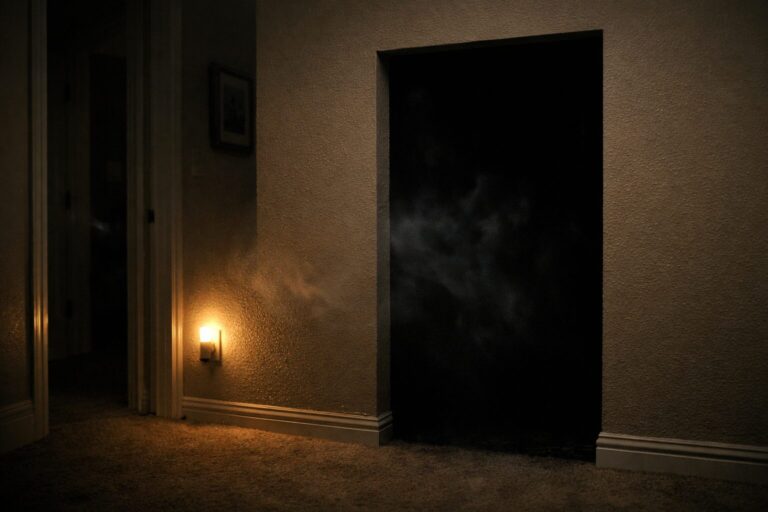
At first I thought that the darker place in the hall was only the tall shadow of my coat. It hangs there like a person because it is a person, a version of me on rainy days, with the hood up and the sleeves empty. But my coat hasn’t got the patience to wait, and the shape beyond the place where the light pooled had a feeling of choosing. It stood just beyond where the hall light failed, so that only its edge showed, a quiet depth where the air should have been a simple emptiness.
There were no footsteps. There was only a sense in my skin, the absolute animal sense that someone had pulled to a stop just outside the threshold and had been standing there for some time, aware of me in a way that tightened my throat. My lamp hummed. Somewhere in the walls something dripped steadily. If you have ever felt a room orient itself toward someone who has just entered it, you know the weight that settles on the air. It was like that, except no one had entered. The boundary between my room and the hall felt like a drawn line.
The lightning threw the hall into flat relief, and in that white thin frame of a second I saw an arm lift, an outline against the plaster. Not a floating hand, not clawed or otherworldly, nothing I could blame on a closet of too much television. It looked like a sleeve and a forearm, the low slope of a shoulder behind it, the suggestion of a palm. The hand came up and found the edge of the doorframe. The fingers—four shapes, no more detail than that—settled lightly against the wood, right at the place where the frame had chipped down to raw pine. Not pushing. Not scratching. Just there, ready to lean, as if this was a house call and politeness required announcing oneself before an entry that wasn’t quite permitted.
I did not call out. There is a kind of quiet that eats words. I sat with one hand on the blanket and the other on my phone without unlocking it, because it felt wrong to bring anything else new into the room. I watched that place where the hall refused to resolve itself into anything but a wait. I don’t know how long I watched. The series of small, patient taps came again, as neat as the second hand on a clock: tap tap. A pause, long enough to fill with the sounds of rain and the friction of my breath. Tap. The sound was so close it felt like I should see it.
“Please,” I said, finally. I don’t know what I was asking for. The comfort I’ve always pretended to need least. The mercy of the ordinary. Nothing changed when I spoke, but something in the air felt like a tilt, like a shared breath releasing. The hand didn’t move. It held there at the frame, an attitude of consideration, as if waiting for me to finish thinking. The sense of it being a person—not a man, not a woman, not anything I could name—got stronger, because something that isn’t a person doesn’t bother to wait.
Dawn made more of the room than I trusted. The lamp went off with my thumb. The hall light stayed on because I couldn’t make myself cross the distance to the switch. When I finally slept, it was the kind of sleep that lets you fall only into the thinnest water where you can still feel the ground. I woke late, heavy, and went about my day with the feeling of having behaved badly around someone I didn’t want to offend. When I left for work, the bedroom door was closed. When I came home, it was closed. I told myself so many sensible things that evening the apartment felt crowded with them, and none of them were good company.
Before bed I checked the latch again. I pulled and it held. I held the knob and pressed the door and felt the give and the catch and told myself: See? See. I replaced the bulb in the hallway sconce so primary light would chase off the hall’s bad habit of harboring corners. On the bedside table I left my phone, a glass of water, and the cat, who arranged himself into an unapologetic ball and pretended this had nothing to do with him. I left the bedroom lamp on and the hall light, too, and told myself there are worse things than a bigger electricity bill for a month. I slept as a refusal—I put my head down and I did not attend to the noise, to the weather, to the movement the house made. I thought of nothing on purpose.
Somewhere in the small hours, when the rain had taken a breath and the wind had dropped enough to make the silence feel like a waiting room, I opened my eyes and knew what it would say before I rolled my head to look. The clock watched: 3:07. My mouth tasted like metal again. The lamp burned. The hall light burned. The apartment was a lit aquarium of familiar things and yet I had the feeling of being looked at from a place I could not see. The bedroom door was open wider than it had ever been, a clean wedge of absence. The hamper had travelled farther, a little crooked, as if someone had cared enough to nudge it gently out of the way instead of shouldering through. The reach of the hall light came farther into the bedroom now. It laid a wash across the end of the bed, the top of the dresser, the soft dim circle of the rug.
I lay propped up on my elbows and felt the hair rise along my arms because there is a point where light doesn’t save you from anything. I could see the hall clearly to the far wall, to the bathroom door and the cracked mirror whose cheap frame I keep meaning to replace. There was no one in that light. But where the light fell short, right at the corner where the wall jogs a few inches to make room for what I’ve been told is an old, entombed chimney, the dark had weight again. It wasn’t shaped like a person as I would draw one. It wasn’t shaped like anything else either, not quite. It was the outline of interruption. Then, slow as if courtesy demanded that I be given a chance to look away, a hand rose into the light and settled against the frame, exactly where it had the night before. The fingers arranged themselves on the painted wood with a familiarity I recognized from my own touch on that door, the way you know the substance of a thing after you’ve leaned on it too many times to count.
I could smell wet wood and something cool that might have been the ghost of the storm. The cat had moved from the bed and now sat on the floor near the dresser, turned not toward the door but slightly away from it, as if listening to a conversation that was not mine. I swallowed and listened for my own voice, finding none that sounded like me. Carefully, as if I were moving in a room where a child slept, I reached a hand out and took hold of the lamp’s shaft, anchoring myself to it as if it could help. I did not close the door. I did not call anyone. I have never woken any neighbor for anything. I propped myself there and watched the space just outside the threshold that had started to feel more like a person than some people I have known. I waited to be spoken to in the way I had been last night. The quiet gathered. The air thinned and then thickened again, a tide that had nothing to do with the weather.
I don’t know how long I held that. All I know is that, with the lamp on and the hall light on and the bright rectangle of my clock sneering 3:07 into my perfectly ordinary storm-streaked bedroom, the small, careful sound that had been visiting me found me again, and the door that I had closed was open, and I was not any braver than the last time. I shut my eyes for a second like a child bargaining with sleep, but all that did was make the other sounds louder. When I opened them again, the hall looked the same, and that meant nothing at all.
The hand stayed on the frame as if it had all the time in the world. The lights hummed. The room breathed. The first soft tap came from the wood just to the left of the latch. Then the second, a little lower, as if someone were adjusting their stance. I knew when the pause would fall, and where in my chest it would land. I had left the lights on and fallen asleep like a coward. I had hoped that light would leave no room for anything else. But at the same hour, in the same room, with the storm finally gentling to a smear of rain against the glass, the door stood open again, and the knocking starts again.