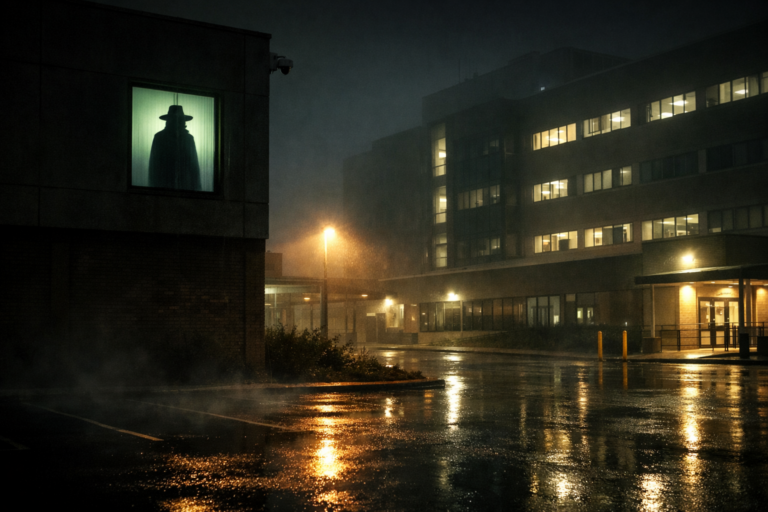
The Doorway Opened Where No Door Had Been
It was the hour when the house feels lighter, like the heat thins and the sounds travel farther. I didn’t turn on every light because I know the place by heart. The plug-in nightlight near the baseboard cast its soft amber puddle on the hall tile, and the glow from the thermostat made a green square on the wall—68 blinking once every few seconds. The refrigerator shivered somewhere on the far side of the house. Outside, nothing moved. The cul-de-sac was quiet as a held breath. I padded barefoot, one palm grazing the familiar cool paint of the hall as I headed for the kitchen for a glass of water and the small ritual of checking the sink and stove before sleeping again.
Even in that drowsy hour, my eyes pick up everything I expect: the framed photos arranged by habit—my father’s bent smile in a black-and-white print, the water stain shaped like a map of some unknown country close to the ceiling, the scuff near knee height where I once carried a box without watching the corners. That hall has always been a single uninterrupted run of wall on the left, three doorways on the right: the bathroom, the guest room, the last one to the master. It’s the simplest geometry I know. When the house settles, that hall clicks and ticks like a sleeping animal in the winter, and in the summer the air moves just enough to stir the hair on my arms. I didn’t need light to know where I was.
Halfway down, something new pulled at the edge of my attention. It’s funny how the eyes tell you before your mind listens. I had passed there thousands of times from sink to bed, bed to sink, my body making the same arc around the hall runner. Tonight, a dark vertical cut in the left wall stopped me short. There was a doorway where there has never been a doorway—no frame, just a clean, open rectangle sinking into a darkness that didn’t seem to belong to the house. The nightlight should have reached it; the little amber pool should have slipped across the tiled hallway and caught at least a suggestion of a far wall inside. It didn’t. The space inside that rectangle ate the light. It was the wrong kind of dark, like a thick cloth draped not over something, but over a shape you couldn’t hold in your head.
I stood with my shoulder almost brushing the family photos, my heartbeat picking up a hurried count the way it does when a dream keeps walking after you wake. I waited for my eyes to adjust, because that’s what they always tell you your eyes will do. Nothing resolved. The hall smelled faintly of detergent and the lemon oil I used on the frames earlier that week, and underneath that rose a thin, colder smell that didn’t live in our house—old cardboard, maybe, or a basement that never saw daylight. We don’t have a basement. I took one step forward and then another, putting myself a careful arm’s length from the opening, trying to convince my brain to make it a shadow, a trick. The edges of the doorway were straight and sure, not the smooth oval of a stain. The wall’s eggshell paint broke into a crisp line with the dark as though a blade had run there an hour before. My fingers grazed where the right jamb would have been if it had a jamb. The paint was cool, and the cooling deepened to the left, a gradient of temperature that made me think of opening a freezer door on a summer day.
The layout rose in my mind with unwelcome clarity. On the far side of that left-hand wall is the laundry closet, squeezed into a shallow bump-out we built with a contractor the first spring we lived here. Behind it, the insulated garage wall with the electric panel and a pegboard hung with tools. There is no room behind that portion of the hall for a doorway to open into—not without cutting through appliance, insulation, and half the things that keep mortgages respectable. I stepped backward, trying to find an angle that would make the dark glitch and admit to itself. The hall stayed the same length. The plug of shadow stayed the same shape.
It felt important to prove the wall again from another side, as if sensible facts could be planted like tent stakes to keep the tent from lifting into the air. I went into the guest room, turned on the bedside lamp, and stood at the shared wall, counting studs under my knuckles. Eight inches in from the outlet, knock: muffled and firm. Two hands’ span over, knock: solid again. I moved into the laundry closet and pulled the folding doors back with the soft rubbery slap they make on their track. The washer door was ajar. I leaned past the inverted detergent bottle, pressing my palm flat to the drywall where the rectangle in the hall would have met it if rectangles could meet. It felt like every wall I’ve ever touched. The clock radio on the dryer read 2:13 in blue numerals. Past that, the elevated hum of the house was unchanged.
I went back into the hall and the doorway was still there, exactly the width of my wingspan if I raised my arms, and a little taller than the other doorways on the right, as if whatever ordered things in the house had been asked to guess and guessed slightly wrong. The dark didn’t waver when the thermostat blinked green. I lifted my phone and lit it. The beam from the flashlight shoved against the darkness like a hand pressed to underwater glass. Dust motes swirled in front of me. They didn’t pass the threshold. The air inside, if that’s a word for it, took the light and said nothing back.
I told myself I was tired, that my head was inventing shapes out of habit, that the mind at that hour can make a wall out of a shadow and a shadow out of a wall. But I could feel the temperature drop across the line where real house ended and the wrong space began. It licked along my shins and gathered in the hollow of my throat. I could feel it more surely than I could see it. I stepped sideways so that I could see the kitchen beyond. Light from under the range hood threw a diagonal across the floor. It dimmed right at the edge of the opening, not a lot, the way a cloud might pass across the sun in miniature. I thought of reaching an arm over the threshold and had a sudden, simple picture of my wrist vanishing at the cuff, the heat of my blood running out into some weather that didn’t concern itself with me. I didn’t extend my arm.
In the laundry closet again, with the light on, I pressed my ear to the shared wall. I heard the sealed sound of my own head; the distant thin rush of the highway a mile away at that hour; an occasional click that could have been the expanding metal of the water heater. I put my palm back and held it there until my hand warmed the drywall. Underneath, or behind, or through—there was a sense of injured quiet, like a pause pressed a little too long. I realized my breathing had slowed itself to match that pause. I took my hand away and it felt a degree colder than the air.
Back in the hall, I stopped where I had marked the baseboard nick with a paint chip last fall, and in that posture—bare feet slightly splayed on cool tile, one hand on the wall, one hand crooked to keep my phone steady—it happened: something moved inside the doorway. It wasn’t a shape I could point to after and say, there, this tall, this wide. It was a rearrangement of the dark itself, a dip and recovery, as if a person standing just back from the threshold shifted their weight from one heel to the other. A faint dry sound came with it, like paper sliding against paper. The air that had been sleeping in the hallway stirred and turned cold with intention, a layered cold, as if the summer night had been peeled down to find winter underneath. The nightlight dimmed, just slightly, and then returned to itself. There was no furnace on to blame. The thermostat gave one green blink and went back to its number.
Every part of me made a smaller shape without my asking it to. I didn’t run. I didn’t call out, either, because the house felt so poor of sound just then that putting my voice into it seemed like putting a lit match into a room full of dust. For a count of four or five I let my body decide whether to step backward or forward, and it didn’t choose. The thing beyond the opening—or the change that had just occurred in that space—made no further sound. I could hear the creak of a tree outside rubbing itself against itself in the dark, and each time I had that familiar thought—the oak needs trimming—something under the oak of this other quiet pushed the thought away again.
At the far end of the hall I flipped the bathroom light on, flooding the mirrors with the unkind brightness they give. The doorway held. Light went up to it the way water goes to a levee and stopped. I left the bathroom light on and went to the kitchen. I let the range hood shine and opened the cabinet for a glass, and then I didn’t drink. The mouth of the glass felt wrong in my hand, as if I’d accidentally taken someone else’s drink at a party. I set it down without water in it and stood where I could see the opening from the corner of my eye. I didn’t put my back fully to it. Time did that strange nighttime thing where it both stalled and arrived. I checked the deadbolt on the back door, the one that sticks a little if you push it too fast, and came back to the mouth of the hall, and still there it was, like the hole an absent picture leaves on a wall even after you’ve hung something else in its place.
For a while, and I don’t know how long to call that while, I thought I heard a low noise like something breathing on the other side of a mattress—not the movement itself, but the way a mattress speaks when weight changes it. I put my palm flat on the hall wall again and the cool threaded into it. When I closed my eyes, the absolute black of the rectangle stayed where it was behind them, the way a flashbulb makes a ghost of itself after it’s gone off, except this one wasn’t light. It took an effort to step into the master bedroom and put the door most of the way closed, leaving it open just enough to show me that band of hallway tile and, at the very edge, the line where the darkness began. I lay on top of the sheet and didn’t turn on the lamp. At some point, the air under the door cooled, and the scent of laundry powder and lemon oil stepped back to let a hint of damp paper and unfinished wood have the room. I waited for footsteps. None came. The red of the digital clock crossed its bars with the patient efficiency of machines that aren’t concerned with what they count.
Dawn loosened the dark slowly enough that I saw the change before I could be certain it was there. The opening didn’t close; it was simply absent, the same way a noise you had been tolerating becomes impossible to remember as soon as it stops. The left wall was the left wall again: eggshell paint unbroken, the light scuff near the baseboard, the hairline crack I’ve been meaning to caulk where the ceiling meets the corner. I stood in bare feet on tile gone pleasant under the first labor of the day’s heat and walked to the place where my breath had shortened the night before. I put my palm to the paint. It was house-temperature again, not the chill I’d met like wind. For a long minute I only stood there, my hand flat, my ear not quite touching. There was no sound but the ordinary bored hum of the air return. I tapped the place lightly with my knuckle. It should have answered with that dull, quick knock I knew from every time I’d tapped for studs. It didn’t.
It returned a hollow. Not an echo—just that darker note in wood and space, the small empty that sits behind a plaster laugh in a cheap wall. I moved my hand down, the knuckle making little sounds of their own, and the hollow held its pitch across a span that was exactly the width of the vanished doorway and just as high. Farther left, the note went back to the dead, reassuring thunk of insulation and stud. Right in the middle where the doorway had been, it sounded like a speaker box missing its speaker. If I leaned my ear to it, the paint exhaled a gentle dust smell and nothing else. The nightlight was off, indifferent again in daylight. The family photos looked level and untroubled. It could have been a dream—I know that—but the skin on my forearm tightened all the same, and my mouth went dry not because of thirst, but because it’s a strange experience to be wrong about a wall.
Later I told myself I should mark the spot, the way you tack something to a map you’re not convinced you’ll need. I didn’t. For hours, the memory sat at the edge of my vision as I went about uninteresting things. There were emails to tap and dishes to wash. The day wore itself to ordinary threads. When it got dark again, I found other routes through the house without admitting I was taking them. I reached for the bathroom light with my shoulder turned away from the left wall, like someone who knows not to look directly at an eclipse. I didn’t stop walking through the hall. I kept moving and let the quiet this house has every right to own have me. When I finally reached out two fingertips and pressed them to the remembered line, it gave me only the plain cool of paint. The difference was in the sound it made when I knocked once, twice, exactly where the doorway had been. The tone came up empty and stayed there, as though a part of the house could no longer pretend to be solid under my hand, and whatever had stood behind that dark rectangle was listening for the knock to come back.