He Canceled the Trip After Seeing the Empty Chair
We were never especially good at leaving on time. There’s a picture on my phone from that morning that proves it: the blue suitcase half-zipped on the kitchen chair, a line of toothbrushes laid out to dry on a paper towel because someone remembered at the last minute, scarves shrugging off hooks, a coffee mug with a ring around the inside where the milk never quite mixed. We were giddy in the way people get when a long-delayed trip finally stops being an idea and becomes something you have to hold in your hands. There were the little arguments about chargers (“Whose is this tangle?”) and whether the black jacket needed to go or could stay. The pantry door swung open and shut like a lazy metronome, each swing another snack tossed into a bag. My brother stood in the doorway and waggled his eyebrows at me over the mountain of folded shirts like we were still kids playing a game we knew the rules to.
It felt domestic and ordinary and kind, the way leaving often does when you still believe you’ll make it through the front door in one piece. Our mother padded from room to room counting in a soft voice we were meant to ignore. “Passports, two. Wallet, keys. Plug adapters. Snacks. Motion sickness pills.” Out on the porch, the air had that thin morning chill that smells like laundry left out overnight. The rideshare app said twelve minutes. We kept losing and finding the same pen.
By the time the driver texted that he was two streets away, my brother was quiet. He set his phone face down on the counter. I thought he was running through the itinerary in his head—who would sit where, whether we’d make the connection if our first flight pushed a little, where to get coffee at the layover airport—but he looked at the mugs and then at the chair by the door and didn’t seem to see either.
“I had one of those things,” he said. “A picture. Not even a thought. Just there.”
The driver text chimed again. Our mother was wrapping a scarf around her neck like she was putting on courage. “You dreamed something?” she asked, distracted, the way people ask how a story ends when they’ve already started putting their shoes on.
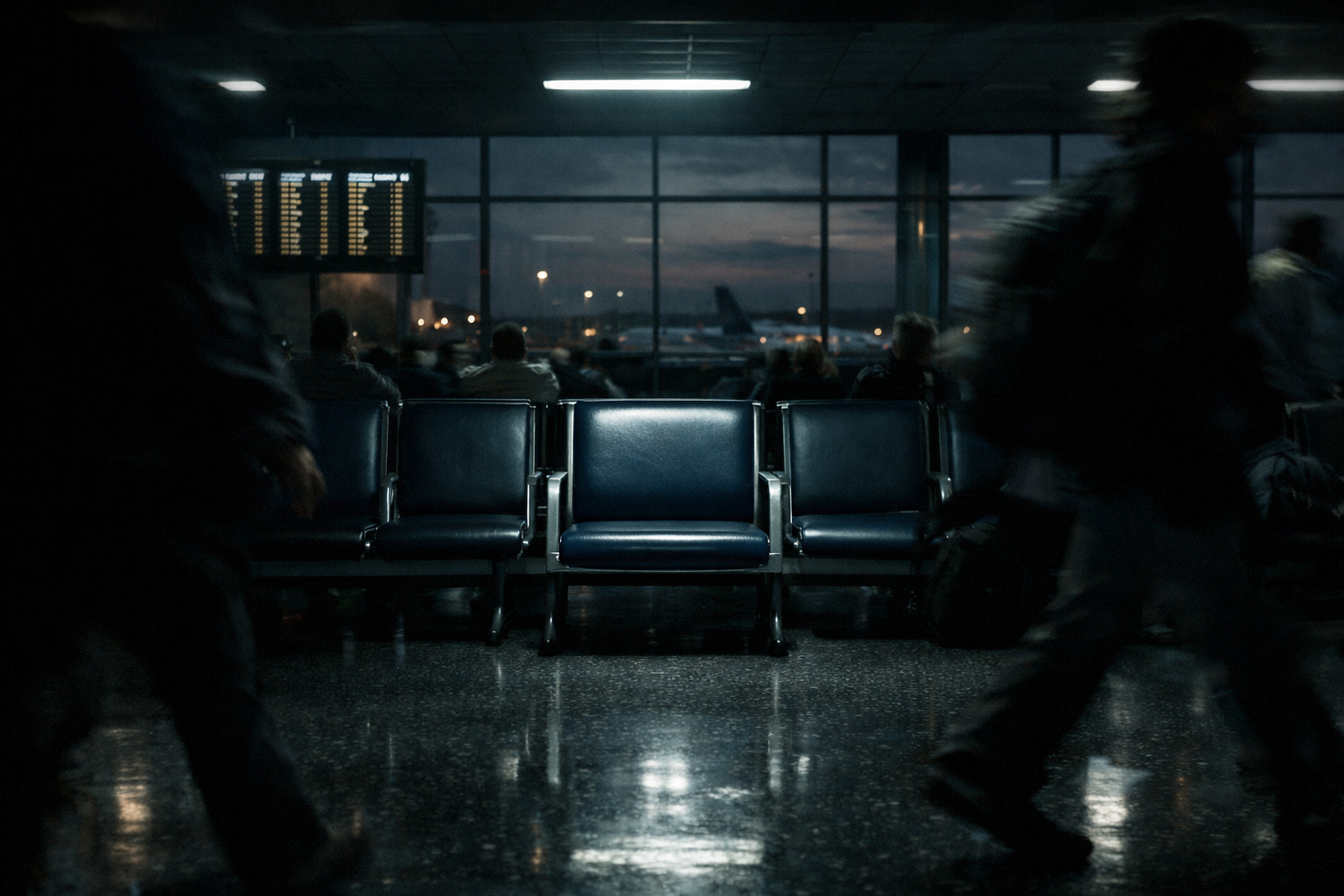
“No.” He put a hand flat on the counter and the laminate made a little tacky sound as he lifted it away. “It wasn’t a dream. I was brushing my teeth and it wasn’t the mirror and it wasn’t here. It was a departure area. Not here,” he said again when I started to ask which airport, which terminal. “Rows of those bolt-on seats—blue vinyl or plastic, with the little silver arms between them so you can’t lie down. You know how loud those places are? It wasn’t loud. It was like the room put a lid on itself. People moving everywhere with their coffees and their huge shoes and rolling bags, and one chair empty. Only that one.” He swallowed. “I could smell the place, even. That jet-fuel sourness that’s there even if the doors are closed.”
“Okay,” I said, thinking: we’re due to go, we have time to make. “An empty chair. In an airport. Not exactly rare.” I tried to tease him, light enough to float. “It means it’s our chair because we’re late.”
He didn’t smile. He was blinking the way people do when they’ve put a thread through a needle and they’re worried about it slipping out. “It felt like it was waiting,” he said. “Like it had been empty a long time and everyone had arranged themselves around it without even meaning to. It was wrong. It was—” He made a small, helpless motion, a tiny flinch of fingers. “It’s not mine, I thought. I don’t want it to be mine.”
The driver sent a third text, then a little horn sounded out in the street. We all moved like something invisible had prodded us. I lifted the blue suitcase down; the zipper’s teeth caught and then let go. My brother didn’t move. He stared not at the door but through it. The kind of stare that folds you up inside yourself.
“I’m not going,” he said. “I know how that sounds, but I’m not going.”
There was that baffled stillness that happens right before you get angry. The space between knowing and not knowing. Our mother held her scarf with both hands and looked smaller suddenly. “Don’t do this,” she said, very gently, like he was a skittish animal. “We’ve been putting this off for two years.”
“I can’t make you trust me,” he said. “But I’m asking you to.”
We scrambled then: the half-jokes that are actually pleas, the bribes only siblings can make. I picked up my coat and put it down again. I said the words you say—“we’ll sit by the window, we’ll order the good coffee, we’ll be together, it’s going to be fine”—because that’s the ritual, as if assurance could build a bridge we could walk over. He shook his head once. The next ten minutes were a phone call to customer service, his voice level and steady while his thumb pressed into the edge of the counter hard enough to turn the skin white. The agent was surprisingly kind. There was a fee. There is always a fee for changing the past.
We didn’t leave. The driver drove away, a little three-note trill of the app saying goodbye. The house got quiet like the lid had gone back on. We sat with our shoes on and our bags like pets by our ankles. I could hear our neighbor’s wind chimes and the faint animal thrum of morning radio next door. It took until 10 a.m. for anger to warm to the surface and show itself: not shouting, exactly, but an edge to everything. Our mother moved through the rooms the way you move through a story you loved before and now aren’t sure about. She would start to say something and stop. My brother cleaned the already-clean counter in small, fast circles, then put the sponge down like it had offended him.
Things began to happen in the small way things do when you’ve already decided what they mean. The airline app showed our original flight moving from “On Time” to “Delayed.” It didn’t matter why. We watched the red letters as if we had sent them. The cousin we were meant to meet on the other end didn’t pick up twice, then texted with a photo of her cat yawning—“flight gods hate me, call later”—but in the background of her kitchen table photo there was a chair pulled out just enough, the seat bare and shining in the light like a pale coin. I scrolled past it and then scrolled back. It was nothing. Of course it was nothing.
At noon my brother’s phone showed a missed call from a number that wasn’t a number, all zeros like a placeholder. He tapped it and nothing happened. He held the phone to his ear anyway and we listened to the muffled sound of our own house. It was a trick of the network, a ghost in the wires. We both laughed even as we didn’t. The laugh sat between us like a folded napkin, unused.
We made grilled cheese. We watched a show none of us cared about. The family group chat chirped with advice we hadn’t asked for and the kind of affection that feels like poking—“or just drive!”—from people who weren’t responsible for our choices. The sun moved to the other side of the house and the light on the kitchen floor changed from white to a bruised yellow and then into nothing at all. Around three, a text came in from a friend who travels for work more than anyone should and had, by chance, booked the same route a few hours later. “Weird scene at your gate,” he wrote, without preamble. “Long delay. Paramedics earlier. Everyone looks like they’ve seen a ghost.” He sent a photo before I could ask, the way people do now to prove things to themselves as much as to others.
It was just a picture of a row of those bolt-down chairs in that shade of institutional blue that makes your brain feel tired. People stood beyond them, shouldered into a hushed pattern near an illuminated sign with our flight number still on it even though time had bled far past. Some coats had been draped over the chair arms as if embarrassed. In the middle of the row, a single seat was vacant, square and neat, a perfect geometry of empty. The vinyl reflected a hard white rectangle of overhead light. On the floor nearby was a torn paper packet, the bright corner of a medical glove wrapper. The photo wasn’t framed to feature the chair. That was the worst part. It was just there, natural as a hole. He hadn’t even seen what he’d sent.
When I called the friend, he kept his voice low, as if noise could erase whatever had happened. “Guy went down,” he said. “Not violent, just… sat wrong and then he wasn’t sitting anymore. It was quiet before anyone stood up. Do you know what I mean? And then a ton of movement all at once. It was—” He exhaled and the phone hissed for a second. “They worked a long time. They moved people back. The seat where he’d been was empty after, even when everyone else sat again. It looked wrong to sit there. No one did. They finally changed the gate.”
I put the phone down slowly, like you put down something that is not yours to hold. We stood in the kitchen because it was as good a room as any to learn this in. My brother had not moved to sit in hours, I realized. He stood with his hands on the back of our own kitchen chair and stared at nothing I could see. When I told him, he nodded like the weather had turned out exactly as forecasted, like a storm you’d been listening to come in on the radio finally found your street. He didn’t look pleased, or frightened, or vindicated. He looked like someone who had set something down and was feeling the weight of his palms without it.
News trickled in the way it does now, sideways through people and then, later, in the thin language of official notices: a “medical emergency,” delays rippling through departures, a statement about the remarkable work of first responders. There were no grand words for the ordinary terror of a person not being a person anymore in a place meant for going elsewhere. The airline sent an email to our mother, a rectangle of corporate voice that may as well have been spoken by the terminal itself. Our original gate number—C12—looked like a piece of a puzzle I’d swallowed.
For a while, gratitude sat uncomfortably on the couch with us and shifted from time to time like a person who can’t get warm. We didn’t take the trip. We rescheduled in smaller pieces. My brother refused to pick a new date like picking a date was pointing a finger at the future and daring it to blink. Within the week, we drove to the mountains instead, the car full of the same jackets and the same jokes bent into a different shape. He didn’t talk about the chair and I didn’t ask, and our mother watched the trees zip past like she was reading subtitles too fast to take in.
After that, I started noticing chairs. You would, too, I think, if you had a reason. In coffee shops where two friends leave the third seat angled out just a little. At the doctor’s office, one bare patch in a waiting room of coats and knees. At a crowded gate months later when I flew alone for work, there was an empty seat two over from me that nobody seemed to own even when people were sitting cross-legged on the floor by the windows. I moved to take it and then didn’t and couldn’t say why. A woman put her bag there and patted it like it was a pet.
We didn’t tell the story widely. It doesn’t translate. People want a lesson with an edge on it, a reason to tuck into their pocket like a pocketknife. It isn’t that. It lives in the house with us now like a smell you only pick up when the air goes still. It makes you grateful for ridiculous things: the way plastic buckles sound when they click, the way a zipper grinds and then glides, the dent a mug makes on a wooden table if you don’t use a coaster. And it makes you uneasy in the places meant to smooth you out—concourses with their long bright floors, their moving sidewalks, their assurance.
Sometimes my brother will look up from whatever he’s doing and be gone for a second, like a signal passing through. He’ll come back and joke about something small—the way our mother still mutters “passports, two” even when we are only going to the grocery store—and we will let the joke sit because it means something else is not sitting there. When people ask why we canceled, I tell the gap version. We were tired, or the fees were too much, or we’ll go later when there’s a sale, as if money and fatigue can measure what chooses us.
I don’t know what that empty chair was. I don’t know if it belonged to my brother for a minute and then belonged to a stranger because one of them had to own it, or if it was always a shape in the day that someone was going to fit. I only know the picture in his words was more solid than some days I’ve lived through. If you ever find yourself certain of an absence—certain the world is arranging itself around a space it will not fill—set your bag down and listen. There are fees for changing the past. The future charges more. Sometimes all you can do is leave a space open and not argue with what insists on being missing.