She Dreamed the Crash Before It Happened
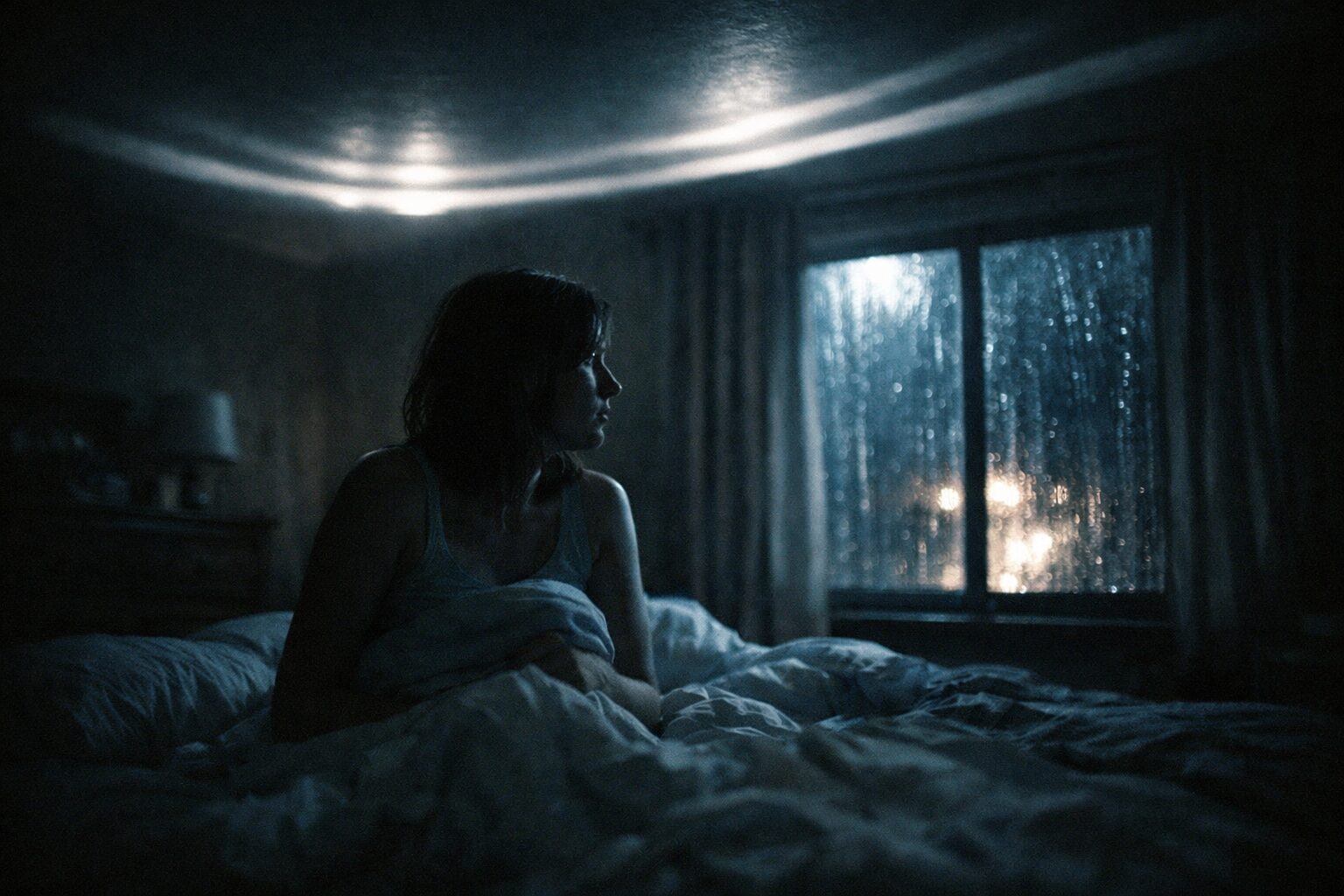
She woke up with the noise already there, not the thunder outside but something finer, a dry chime that seemed to flutter through her chest. It was the same sound that had followed her up out of the dream: a bright, brittle cascade, the way ice snaps when the freezer door sticks and lets a sheet fall and shatter at your feet. Breaking glass, but delicate. She was upright before the alarm could pretend to be useful, sheets tangled at her hips, rain belling steadily against the window and the old sash throwing in the taste of damp paint and wet leaves. On the ceiling, the headlights of a car bending around the corner grayed and slid like fish under ice. Her phone said 3:17. She sat there and listened to the house take the wind, the gutter gurgle somewhere deep in its throat, and tried to hold onto the edges before the dream softened and ran.
It had not been the sort of tilt-a-board nightmare that collapses as soon as you sit up. This one had come with edges and weight. She could recall the particular viscosity of rain on glass, the slowness of the wipers, the grip of her fingers on a wheel that in waking did not belong to her: the ridges under her thumbs were in the wrong place, and the plastic felt older, polished by other hands. The road was known to her—she could feel that—but not in a way she could ever quite name. There was a cross street and a traffic light that in the dream only blinked amber, a short stretch where guards kept the ditch, a mailbox with a lid that hung open like a tongue. Headlights came toward her at a shallow angle, floating and then swelling, one a touch higher than the other as if the car were listing. She had time to notice something absurd and small: a blue cup on the floor, rolling delicately, born forward from nowhere to nick at the side of her shoe. Then there was the bright brittle rain of glass, falling in a kind of polite curtain, and she woke with it crinkling on her skin, though when she brushed her arms, there was nothing.
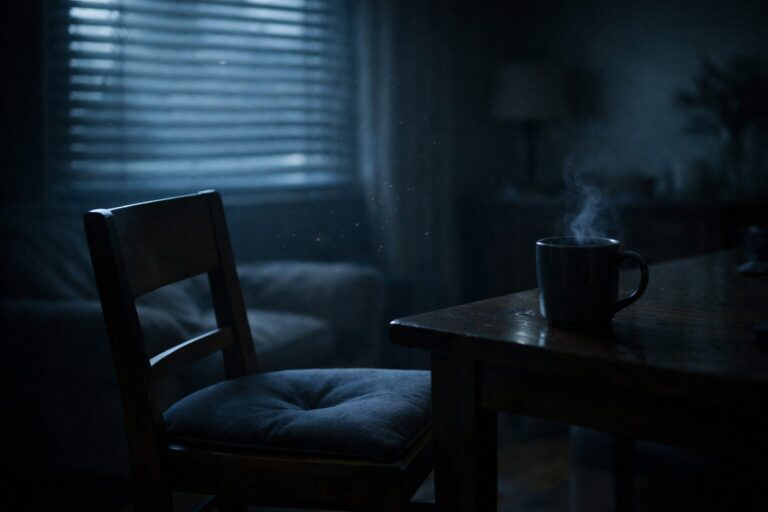
She went to the kitchen because it was what she did when she needed to make something settle. The floorboards were cold and took her weight noisily. A line of streetlight on the counter cut her coffee mug in half. She stood with her hands around the dry cup waiting for her breath to even. Through the thin wall the neighbor’s dog huffed and resettled; the storm seemed stalled, the rain neither slackening nor thickening, a long gray thread drawn through the night. The specifics came and went: the blink of amber light, a wet newspaper skidding into a puddle near a curb, a sensation of slick rubber. She told herself she would write it down, and then did not, and then lay back down with her phone face down on the table and did not sleep so much as let her eyes close while the house breathed around her.
By the time she dressed, late, the sky had softened from black to the color of dishwater. The rain kept, touching everything clean and mean. She set her travel mug in the holder, wipers at their least irritating speed, and took the same way to work she always did because changing it would make being late worse. When she passed the veterinary clinic with the wall painted in faded blue paw prints, the morning radio, which she left on mostly for company, was somewhere in the middle of a song she hadn’t heard in years. The singer’s voice had that underwater warble she’d forgotten she remembered. She reached for the knob to turn it down, but just then the line she hadn’t known she knew lifted and laid itself across the windshield: we could be heavy weather. The words fit the morning with an ugly neatness that felt arranged.
She let the radio go from habit. The rain made a fine noise up on the roof, and she could hear the tires of other people’s cars fanning water. The song ended and a traffic update started, syllables shaved off by static. In the left lane a work van edged ahead with a ladder pushed too far forward, the rungs ticking now and then against loose tie. The morning was full of clanks and minor drips. At the corner near the thrift store, an orange barricade leaned in on a cone and a battered sign read LANE CLOUSRE, a narrow misspelling that made her look twice because she had seen it before. She knew with an unhelpful certainty it had been there in the dream, only then the letters had seemed bigger because her face had been closer to the glass. She told herself she’d driven past it last week and only now really read it. She told herself there was nothing to this but her mind being cruel to itself in a very ordinary way.
She took the turn that put her on Delmont Road, and the trees closed in. On either side, locusts and the hard-bent pear by the ranch with the cracked white siding made a low tunnel of their own. The sky above was a lid resting on them all. Ahead, she could see the faint color-washed glow where Harrow crossed—no real light, only the suggestion of a space where there would be one, the kind of crossing where people ask themselves if a stop is really a stop in the rain. In the dream, that light had not been a light; it had been an amber flicker that did not change. Now, as she rolled forward, the actual signal was out. It hung there blinking politely, and in the slick of morning it meant exactly what the dream had meant it to mean.
She slowed without needing a thought. The wipers went shtunk-shtunk with that sleepy insistence she recognized viscerally, more body than mind. On the right, the mailbox with its door yawning was yawning again, for real this time; she half-smiled without meaning to and then felt her stomach go in on itself at the wrongness of being pleased to meet a thing you had already met in sleep. A silver pickup tucked close past her, the loose ends of a green strap slapping the tailgate. She watched its taillights go damp and far and knew—knew in a way she did not care for—that just beyond where those lights were folding themselves down the road, a pair of headlights would rise and float, wrong by an inch, one wearing a film or a fog that would make it seem sulkier than the other.
They did. It was a dark sedan easing up Harrow toward the same unregulated crossing, twin discs haunted into circles by the beats of rain, one a smear and the other more knife-bright. It should have been neutral—the world is full of cars and wrong bulbs and it had been raining since before dawn—but it folded something over, paper meeting as if cut to mirror. The inside of her car felt smaller. The radio hummed under her, not yet words, and there was a taste like pennies at the back of her tongue. The picture in her head wavered back to where the dream had unrolled itself and her hands had not been her hands on a wheel that had not been hers. She could feel the weight of the cup that had rolled between her feet as if she had a child’s cup there now, as if her own sensible shoes could nudge it and make it cluck against a pedal. She blinked very deliberately and set her blinker.
Just before the mouth of the intersection, where the paint on the road thickened itself again for a crosswalk no one ever used, she turned off early. Sable Lane was narrow and pocked and delivered you grudgingly through a row of bungalows with swing sets softening into their yards. Her wheels hissed, and she let them carry her into the empty lot beside the preschool with the cartoon whale on its sign. She put the car in park and left the wipers on, then off, then on again, because somehow the sound of them was better than the sound without them. One heartbeat then another came and went big and obvious in her throat. She picked up her phone and wrote the simplest possible note to her manager: Running five late, flooded spots by Delmont. Be there soon. The text sent itself away, and she sat there counting beats as if she could wait down what she could not name. The amber blink at the end of the road kept blinking where she could not see it. Somewhere past the row of houses a siren rose and fell and then stuttered into stray pulses like a dream forgetting itself.
By the time she slotted into the back lot at work, she had done that thing people do where they talk themselves back into their own lives. Meetings. A list. The ordinary relief of someone asking where the tape went, whether she’d brought her lunch, if she’d seen the email about Friday. At ten she laughed at something in the break room and felt the residual weirdness dilute, and for a moment the rain past the high windows was only something the building had to marshal its gutters to handle.
She heard about the crash at noon, not from the radio but from Erin two desks over, who said “Delmont and Harrow is shut down” without knowing she was saying anything personal at all. Erin held her phone screen so they both could see. The photo was the kind people take from behind a line of hoods, police tape strung shallowly sagging between two signposts, a cruiser askew with its lightbar washing the rain the color of syrup. A dark car with its front pushed in had come to rest in a slant that made no immediate mechanical sense. On the blacktop, picked out in a way the wet did not mind, was a slim lace of something that at first looked like salt and then was obviously the smalls of glass across a lane.
She kept looking because she couldn’t not. At the lower right of the photo—almost an accident of framing; you could have cropped it and lost it—sat a plastic thing that the eye could ignore until it didn’t: a blue cup with two little handles, the kind you give to something not yet steady with liquids. A streak of cartoon orange on its side made a fox’s tail. It was tilted, one handle up like a hand expecting to be taken. The caption had nothing kind to say about the cup. It did not say cup. It said: two vehicles involved, minor injuries reported, intersection closed for cleanup. Later, in the comments where people’s patience went to bite each other, a person with a last name she recognized as a daycare owner said, No children, that cup fell out of my bag when I stopped to help and everything got knocked around, I’m fine, please stop writing rumors.
She sat with that. A cup shaped exactly like the one she had watched roll to touch her shoe in a weather that had not yet happened. In the dream it had said nothing about children, only about the light grip of plastic, the way hard rain purls sound and the way your mind catches on small ridges when big ones would drown it. She had not told anyone about the cup because even telling someone about the dream would have felt like inviting a superstition into the room and seating it at her table. She had told no one about the mailbox or the song or the swollen look of the headlights or the exact polite amber that does not change. The cup had been hers privately until the phone put it on a screen in her hand and handed it back to her with its cartoon tail shining wet.
She made it to the restroom and ran her fingers under the dryer without turning it on, watching them shine, imagining the tiny glints of glass that had not in fact been there even when she had brushed them from her arms in the dark. Back at her desk, the page of notes she had left under her keyboard seemed to have a new date written on it in her own hand that she did not remember choosing, which was only the small betrayal of a brain busy with something else. The ordinary human comfort of method eluded her for a while and then returned, because it always does. The picture with the cup went down her screen when emails and calendar alerts stacked on it, and then the day folded forward as it has to for people who have to be somewhere at four.
That night, the rain deposed itself to a mist. The storm moved on in that slow way where it remembers one more thing it wants to say and throws it back onto the street again as the evening settles. She lay in the bed where she had left sheets in a heap and thought about calling her sister and saying something casually silly about superstition, but if she said it, she would have to name it, and naming would make her as foolish as she felt. The house breathed, the gutter coughed, the neighbor’s dog gave up a soft complaint and then slept. A car bent around the corner, and its headlights lifted and slid their same silver ladders up the wall, up across the ceiling, until for one unreasonable heartbeat she thought they would stop and wait at the angle where the plaster cracked in a gentle branch. They did not. They kept going on, as the rain did, and when she finally slept, she did not know if she was leaving the dream or going back to it. Somewhere out there, long after the sirens had laced back into quiet, a crossing kept its one good eye on the road and blinked, and blinked, and blinked.