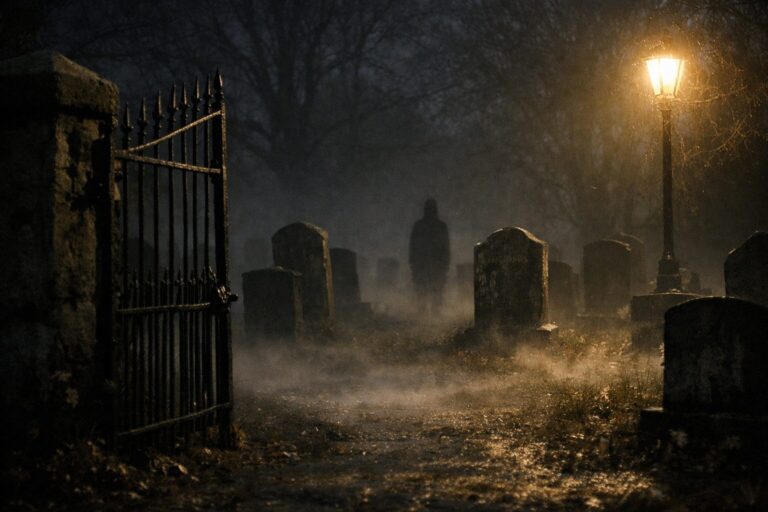
The Map That Led to an Empty Grave
She found the map beneath a ragged quilt, folded into itself like a leaf. The trunk was one of those grim, low steamer chests with a domed lid and dulled brass corners, the kind families drag across decades and never quite open. It had sat in the back room of her late aunt’s house for as long as anyone remembered, nested behind suitcases of clothes gone soft with age and a wire laundry basket that had rusted to the floorboards. She had never thought the trunk would hold anything except old menus and brittle postcards, but she lifted the lid and the hinges breathed, and that was when she saw the map.
It was thick paper, onion-skin with a skin of grit, folded into sixths, its corners blunt and furred where fingers had worried them long ago. Someone had drawn it with a soft pencil that had faded to the color of river silt. There were short, familiar notations—fence line, the lane, stone wall—written in a neat, looping hand, and a small cross marked in graphite near a sketched huddle of trees. In one corner, a date was written and then half erased. The smell of the trunk—cedar, old cloth, the stale sweet of mothballs—clung to it. She turned it once, then again, and a name in the margin emerged after her eyes adjusted: the cemetery.
She lived only a few miles from that cemetery, though she had never gone in. It lay on a hill beyond the edge of town, fenced in with lean black iron, its rods grown together with vines. She knew it from the road, from the way the light made a sharp noon glare off the tipped stones in winter and fell away from them in summer, all heat going thin. On her phone, she pulled up the satellite image, pinched and dragged the landscape, and then laid the map out flat over the table to try to match it. The roads were right. The creek was suggested by a gentle slash of pencil. But there was a short path sketched on the map—an arrowing lane arcing along the fence line, dead-ending into a corner of trees—where her map app showed nothing at all.
She placed her finger on the drawn cross. It sat just outside the plotted graves, if the scale was to be believed, a little beyond a low stone wall the pencil had shaded with care. The phone offered no equivalent. On the screen there was only a tilled field and then the hedgework of a new subdivision on the far side. No small stand of trees like the ones, clearly, that had been important to whoever drew this. No lane was labeled there. The wrongness of it made the air in the room feel louder, as if the refrigerator were grinding in the wall, as if time had been overlaid awkwardly and not everything agreed.
She did not tell anyone she was going. There was no thought of theft or discovery, nothing rowdy in her mind. That morning had been gray, a skinned sky pressed low enough to taste. She put the map in a gallon bag to keep the weather off it and slid it into her shoulder bag. There was a narrow spade, the kind meant for window box herbs, in the trunk of her car. She did not imagine much use for it, but it felt like part of the ritual to bring it along. On the drive she passed bare trees scaffolding the road, a field of last year’s corn flicked flat, and then the iron fence shouldered up into view and she slowed, tires rolling in the gravel of the narrow pull-off by the gate.
No one was there at first. The church that kept the cemetery was brick and blind-looking, dark with an older shade of red as if it had been left long in a kiln. A sign beside the gate read, please respect the grounds. Leave stones, not flowers. The iron bars came to points where snow sometimes gathered. Now there was only the stale damp of a late afternoon, a damp that pressed and left a film on her skin. She slipped through the gate, and her steps went small and quiet on the path.
It was not a large cemetery. There were family names repeated, a Gothic itch to the first letters, crosses of stone and simple set blocks. She passed the older sections where the graves sank and settled as though tired. A robin flicked across her path, vanished into the shrub. She stopped once to breathe, to match the drawn landmarks to the real ones. The map’s stone wall was there—lower now and absently kept, its baseball-sized stones warmthless under her palm. The three trees were there too, though one ended in a rotted stump nursing polypore shelves. Past those things, the map asked her to step off the path.
Her shoes scraped at tufts of brittle grass between the headstones. She kept close to the fence line, where the iron swallowed vines and the ground changed its texture. There in the corner the land held a hush, not silence exactly, but a thinning, as if even the cars humming on County Route 6 had lost heart. The trees the map had indicated made a crooked crown, their roots pushing up through ground that had once been tilled and cared for but now had taken on the roughness of a place felt to be outside of work. It was only then that she saw, just to the left of a slate marker without a clear name, the stretch of soil that looked unaccountably dark. As if someone had laid their palm there and stirred.
From above it would have appeared as nothing against the winter brown, but up close she saw the shallow impression. She knelt and pressed her fingers to the ground. It was looser than the turf around it, breaking easy under her touch. She noticed the feathered edge of a shovel bite, the way a blade leaves a brief wall and then crumbles it, how the grass lifts and then falls wrong. There was a cigarette butt a foot away, yellow filter puckered. Heel marks were caught in the softened moss that had been damp and then dried. She looked around for anyone—someone from the church, a groundskeeper—but there was only the sound of a crows’ chain across the field, a complaint from beyond the far trees.
It was not marked with any kind of stone. No date, no name. Set beside it, a slate that had lost its face to weather slumped into the soil, and the corner of it had been knocked against when someone worked the ground; a careless bruise that must have been recent. She told herself not to be foolish. Graves settled, ground heaved. Animals burrowed. Still, the map—her map—had asked for this corner as if a finger had pressed it there on a table somewhere decades ago, sure of itself. The small spade felt light in her palm. She pressed its edge to the loosened earth and pushed.
The soil gave without resistance for the first few inches and then less easily, as if knots of roots had been threaded through it and then friendly hands undid those knots from beneath. The air in the narrow scoop just under the turf was old and cool, emptier than it should have been. She dug again, and the cut into the ground showed her the boundary of an older dig: a vertical face of compacted clay running straight, too straight for some small animal, the imprint of boards long ago pulled up or never laid. She widened it with her hand, the dirt mudding her nails, and brushed away what she had half hoped and half feared would be wood gone to string. There was only a clean negative shape, the dimensions familiar because bodies are familiar, a rectangle the length of a life, and it went down and down into perfect, human absence.
Her mind offered history to explain it—old burials without coffins, disinterments sent elsewhere, the moving of graves for roads. But the map’s small cross had been sharp, and the soil here had been lately touched, and when she angled her ear to the cut and the cold slid up her sleeve, there was only the fact of the empty. She thought of calling the number on the church sign. She thought of closing the small wound she had made and leaving. In the end she did both, pressing the first slice of turf back into place with the flat of her palm and then punching the digits into her phone with that same dirt still under her nail. When a man answered, his voice came big with the echo of a shed.
He told her they had not opened anything out there in years. There were no new graves in that corner, he said. No recent digging. He knew the ground the way other people know kitchens. He had not seen anything when he locked up the gate last Sunday. She did not say his certainty felt like a rope pulled through her. She did not tell him about the map. She only thanked him, said she must have been mistaken, and ended the call while the crow in the next tree made a sound like a door tapping in wind.
She brushed her palms on her jeans and felt the awkward itch of having done a thing wrong, in the wrong place, at the wrong time. She smoothed the disturbed soil again, set the loose clods back where they would seem less out of place, and walked back along the stone wall. On the way out she paused beside a marble angel whose face had slid away. The gate made a prim noise when she closed it. The gravel under her tires sang when she pulled out, and then the sound was absorbed by the road and the breathing of the heater in the car.
She had pushed the map into the inside pocket of her bag without thinking, the slick of the plastic making an unlovely rub against her coat as she climbed into the car. She drove home by the long way, through the new subdivision and past the field that had not been anything for as long as she had known it, an old emptiness repurposed as a view glimpsed between garages. The sky had spent the day forgetting what light was supposed to look like. In the half gloom, porches glowed like aquariums. She told herself not to bring the map into the house, that it could stay in the trunk and be nothing, but her hands moved without consulting her, taking up small tasks, her keys dropped in their bowl, the lights touched on, the kettle filled. She left her bag by the door, unopened.
She heard the kettle complain its way toward a boil and went to the sink to rinse the cold from her fingers. When she turned back, the table was not empty. The bag still leaned against the wall by the door, slack, the zipper’s little tongue nested against the fabric as she had left it. But on the kitchen table the map lay smoothed open, the weight of its corners finding purchase in a way the paper did not remember how to do on its own. It was wet in one corner as if it had been pressed against something damp. A blade of grass clung to it. The house was closed up to the draft, and yet there was that wet.
She stood and looked and did not move. The lines on the map had darkened. They held a sheen she had not seen in the attic. The pencil marks were newer, that was what her eyes told her, laid down with a hand still warm enough to leave its heat in the graphite. The cross by the cemetery was gone. Not erased exactly. The place where it had been was smudged by a soft thumb. Beneath it a faint shadow of the old mark still hovered, like a place where something had once been pressed and then lifted. Where the cross had been, the paper kept the memory but not the point. Instead, farther along the fence line line on the map, there was another new cross—neater, surer. It sat across the road, aligned with the gentle shape of a creek she knew too well. It was not at the cemetery anymore. It was on the other side of town. If she were to draw a straight line down her street, it would intersect exactly there.
She traced the route with her finger, following pencil lane to pencil creek, counting intersections as the map had asked her to do before. The table’s laminate, scratched with the ghost of plates, came up cool through the paper. She turned and looked out her window as if the world would have corresponded to the small world under her hand. Her backyard leaned into dark. The fence made a gray seam. Beyond it, the ground ducked a little before it rose to the line of the neighbor’s yard, a small dip she had never thought to name. In that dip, in the real ground, her hydrangea sticks made their winter angles. She stared until her eyes watered and nothing shifted, nothing admitted anything about itself. In the quiet of her kitchen, the kettle had begun to build again toward a sound.
When she took one breath and then another and looked back at the map, there was dirt under the lower edge of it, a thin crumb line the exact color of the soil she had pushed with her thumb beside the fence in the cemetery, green-black and fine, broken by a pale grit of old clay. And the new cross, made darker than the old one, had been set so precisely where her street crossed the creek that she could have measured it with a ruler. Her name was not on the map. No street names were. But scales are scales, and the small worlds that we carry sometimes know more about us than they should. She slid one hand beneath the paper and felt the cold of it and then folded the map in on itself and did not know where to put it. Outside, behind the fence, a single dry leaf moved in a circle for a while and then lay down again.