The Boat Returned Without Its Crew
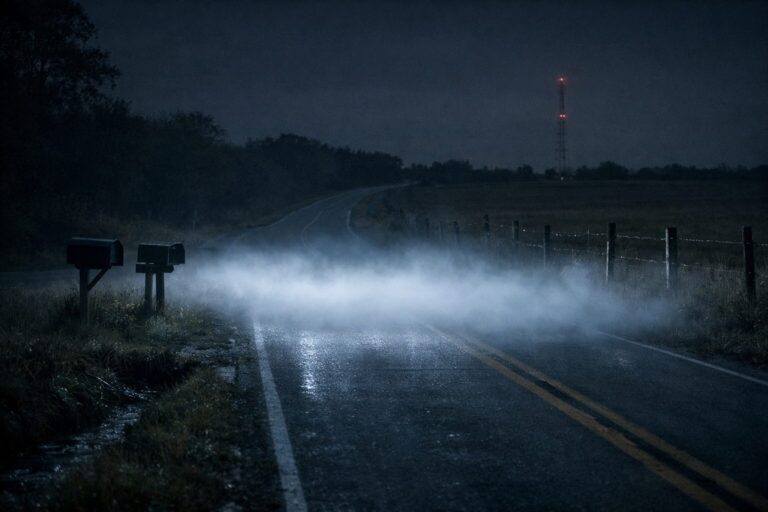
The fog came in thin as milk that morning, not a thick blanket but a loose veil stretched across the far end of the lake. The asphalt of Lake Road shone with dew, and the pines above it carried beads like glass on their tips. Out past the last dock, a outline emerged, lazy and certain, a dark shape eased along by the faintest breeze and the soft push of current. The old men on milk crates outside the bait shop were the first to see it and stand, palms to brows, as if the brim of their caps wasn’t enough. It was a familiar blue hull with a white cabin roof—The Minnow’s Wish—coming in with no engine and no noise but a muted bumping of its fenders against the low swell.
A county pickup rolled to a stop along Lake Road. A man in a yellow vest climbed out and stood next to the bait shop, and a woman washing out a coffee pot brought the dripping pot to the doorway to see. The boat moved in slow diagonals, catching on nothing, turning toward the public dock with an aim that felt like intent, like a blind animal smelling home. By the time it nosed into the slip, two teenagers from across the street had jogged down the planks to throw a line, glancing back for someone older to tell them where to tie.
It was routine, at first glance. The Minnow’s Wish belonged to two men who lived up the hill from Lake Road in a small house painted the same weather-beaten blue as the hull. People saw that boat most mornings before sunup, purring out while the loons were still calling. It was not odd for it to be back by mid-morning, except for the silence of it now, the way it seemed to have come of its own accord, and the lack of any wave or shout from the cabin. The teenagers tossed the line and caught the cleat and cinched it down, and only then did they look uncertain, because no one was visible in the doorway, and there was no laughter from the deck, no boots on fiberglass, no scrape of bucket.
They peered over the rail. The first wrongness was simple and clean: the deck was empty. There were no boots by the ladder, no jackets slung over the gunwale, no tackle scattered where a man might have dropped it to light a cigarette. The cabin door was slid halfway open, and inside the shadow, a coffee mug sat at the edge of the counter, turned upside down as if drained and washed. A light breeze flapped the pennant the brothers liked to fly, a faded bit of checkered cloth that always rode the antenna. The pennant hung limp. Empty felt like a sound on that boat, not just a sight.
Word went around Lake Road quickly, carried across the parking lot between the bait shop and the marina office. A deputy came in a few minutes later, and the bait shop woman, still in her apron, stood at the dock with her coffee pot cooling in her hands. Across the water the fog sat, not advancing, not retreating, a pearl wall that seemed for the moment to be measuring distance. The deputy climbed aboard first, calling out the two names anyone would have called, and when no one answered, he moved slowly from stern to bow, ducking into the small cabin, looking under the bench seat where spare life jackets were kept.
There were no signs of struggle or panic. No torn cushions, no chipped paint, no fresh gouge on the gunwale. Heavy things lay where they should. The first-aid kit was latched. Even the bungee cord that sometimes worked loose from the cooler was in its place. The whole of it was arranged in a way that suggested completion, not interruption. The deputy stood a long while with his hand braced on the doorway of the cabin, as if feeling for some heat there. He looked at the glass of the porthole, at the wiped arc where a sleeve or a hand sometimes cleared mist. It was clean.
The deputy tried the radio mounted above the wheel and found the switch in the down position. He flipped it up; there was no crackle, just steady quiet, as if the air over the lake had chosen silence. He checked the battery switch; it was off, neatly so, with its red handle lined perfectly with the stencil on the panel. He put it back the way he found it. On the starboard side, rods were in their tubes, lures clipped to guides, hooks put away and the line tensioned so the spinners wouldn’t rattle. The tackle boxes were latched and stowed beneath the bench. The throw cushion was slid into its sleeve. It was all so finished that more than one person on the dock commented under breath that no one had prepped that boat so carefully, not those two, not on any morning anyone could remember.
When the hood of the engine was lifted, its metal was beaded with dew. The engine block was cold enough to take the heat out of a palm. No condensation of heat lingered under the cowl, no scent of fresh exhaust hung in the fiberglass or in the air. The fuel bulb was firm and unpumped. There were no tracks of damp on the floor from dripping oilskins, no rings from a set-down bottle. There was no fish smell at all. The fish box had been scrubbed and propped open, its aluminum shining under the small skylight as if it had been polished last night and left to dry in a clean shop, not out on a lake under weather.
By mid-morning, a few more vehicles had pulled off Lake Road and lined the shoulder. People kept their distance. One of the men who usually helped trailer boats on weekend afternoons came down with a coil of yellow rope and draped it along the dock, not certain whether he would need it. A gull landed on the piling and watched with its head cocked. The deputy asked for phone numbers and called them and went quiet when the second call did not pick up. A game warden arrived and fished a hook with a magnet along the bottom of the lake near the slip, because it was something he could do. The bait shop woman made another pot and set paper cups on the counter, empty for hands that did not come back to take them.
It became a kind of vigil, set to the sound of dock lines creaking and the soft ticking of hull against piling. The deck of the Minnow’s Wish, so white it reflected the underside of the sky, showed no footprints but a smear here where a bucket might have slid and been wiped. The warden took pictures. The deputy took pictures. They stepped carefully, careful to put their feet only where the fiberglass already showed other prints, and then, when they agreed they had looked at all there was to look at, they stepped off entirely, backing away along the dock one by one until they stood in a loose line, their bodies forming a space no one seemed eager to cross again.
Whatever they had expected to unfold next did not. The fog out over the lake held its shape. The loons had gone quiet. A ripple moved toward shore and touched the pilings and went away again. It should have eased things, that quiet, that sun lifting weakly through high haze until the tops of the pines along Lake Road lit in a thin gold. It didn’t. It was exactly then, with everyone off and the boat riding against taut lines, that the bait shop woman said softly, There. No one asked where. Everyone saw.
On the bare fiberglass just aft of the cabin door, where they had all been staring and finding nothing, a wet mark rose up as if conjured from beneath the surface. It started as a darker oval that gathered itself from the dry white around it. Another darker crescent budded beside it. The shape bloomed into the unmistakable ball and heel of a foot and, forward of that, the splay of five toes, the middle one set a little in front of the rest, as if the foot had rolled forward on it. Water gleamed in the groove where the arch should have been. A bead fattened at the tip of the first toe and let go and slid toward the scupper. There were no other prints. The print was not a boot and not the tread of a rubber sole. It was skin or the hint of it, without a hair, without a scar, utterly ordinary and therefore impossible.
All the steps onto and off the boat had been counted without being counted. They were, by nature, counting people: how many rods, how many beers, how many more minutes until the fog would lift. They knew no one stood there in the last minute before they stepped back. They knew where their own prints should be and where they were. The deputy moved forward a half step and did not set foot on the deck. He crouched and looked, and when he finally reached out, it was not to touch but to hover his hand over the glistening mark. He drew his hand back as if the cold coming off the engine had leapt to the air here too.
Someone whispered that the brothers liked to go barefoot on hot days, that grease can smear and make a mark look like anything. Someone else said the opposite. They said the younger one hated a bare deck because of hooks. The discussion unfolded at a whisper so as not to stir the air across the print, as if it could be smudged by a voice. A photograph was taken. Another and another. Between the first and the third, a second bead of water slipped from the ridge the big toe had left and traced a new path, thinner than the first. None of them saw a second print appear. None of them heard a door. The radio remained dead in its mount, the switch as it had been, polite and off.
By late afternoon the crowd thinned. The game warden took the deputy’s number and left in his truck, the orange light on the roof turning but unlit against the day. The bait shop closed early for once, the woman flipping the sign with a hand that left a wet coffee ring on the underside of the glass—the only ring anyone saw all day. The deputy tied the Minnow’s Wish with two lines fore and aft and then ran a third spring line, humming and not aware of it, testing the knots as if the right pressure in the fibers could keep a thing from wanting to move. He took small care with every loop and tuck. He checked the battery switch again and left it off. He slid the cabin door closed, heard the latch catch, and pulled it twice more.
Evening brought the white-throated call of a bird from the far treeline. The fog, as if tired of being watched, let its edge unravel into strands. Bugs came out and danced in a field of sun that had managed, briefly, to find a seam in the cloud. Lake Road darkened and went back to the few cars that belonged to people who lived here. The deputy turned once before he got into his cruiser. The boat sat level and obedient in its slip, its bow pointed toward the dock as it always did, rope like drawn lines on a map. He wrote the time down without knowing why it mattered that he do it.
The night was clear enough to show the first smear of a star over the hill. The breeze came up from the open water, a slow, persistent breath that leaned into the pines and made their branches lift and fall. The dock creaked at its joints. Somewhere mid-lake a ripple started and never reached shore. Lake Road emptied. The bait shop’s motion light blinked once at a moth and went still. The shape of the Minnow’s Wish sat in the dark like a thing thinking.
By morning the fog was gone and the sky had bleached to a color that promised heat later. The dew on the road steamed in pale threads. The bait shop woman came out early, a key on a lanyard knocking softly against her chest. She saw it first and did not call out. The deputy, pulling in with his cup and his notebook, saw it second. The men on the crates saw it third and made a sound like a chair scraping over tile.
The lines were tight just as he had left them. The cleats were the same, his careful hitches unpicked by nothing and tied to nothing new. The cabin door was latched as he had latched it. But the Minnow’s Wish had turned in its slip without slack, without the geometry of the knots breaking. It was facing the open water, its bow toward the blank, bright lake and its stern toward the dock, the ropes crossing themselves in a way that suggested a body that had rolled over in sleep without unwrapping the sheets. The water around the hull made a sound like shushing. A set of tiny insects printed Morse on the surface where the shadow of the boat fell. The deck where the print had been was bright and dry. If there had been a smudge left by salt or skin oil, the night had lifted it.
It stayed like that through the morning and then through another day, until the state came with a flatbed and men in shirts with loud patches, and they took it away up Lake Road in a procession of red flash that woke the neighborhood dogs. People did not look much at the lake that week. The ones who drove past the empty slip at dusk found themselves checking their rearview without knowing why. The sound of a radio not hissing filled the marina office like a new furniture. Some swore that if they leaned on the rail at the right hour, with the cranes quiet and the laughter gone, they could hear a single wet step on a clean surface they could not see. Others said nothing at all and drove slower by the water, as if a thing properly tied could still turn itself toward whatever had called it.