
The Gas Station Clock Lost Us an Entire Hour
We pulled off the highway a little after one in the morning, the kind of late where the air sits heavy and the white noise of the interstate lingers even after you close the car door. The station was one of those always-on places at the edge of a subdivision, the light from its canopy a harsh island against a wide asphalt lot. Inside, everything was clean in that artificial way: rows of gleaming bottled drinks, chips stacked so the logos faced the same way, a rotating hot dog roller that looked like it hadn’t served a soul since dinner. I shook off the drive and filled a paper cup with coffee, watched the thin stream darken until I pressed the little red ‘stop’ with my knuckle. Nate came up behind me with a plastic-wrapped cinnamon roll and a bottle of water, eyebrows up like, you sure you want that sludge? I shrugged and took two of those tiny shelf-stable creamers anyway. We paid a clerk who had a radio clipped to his belt and a distracted look, mom-van headlights floating by on the road beyond as someone else passed without stopping.
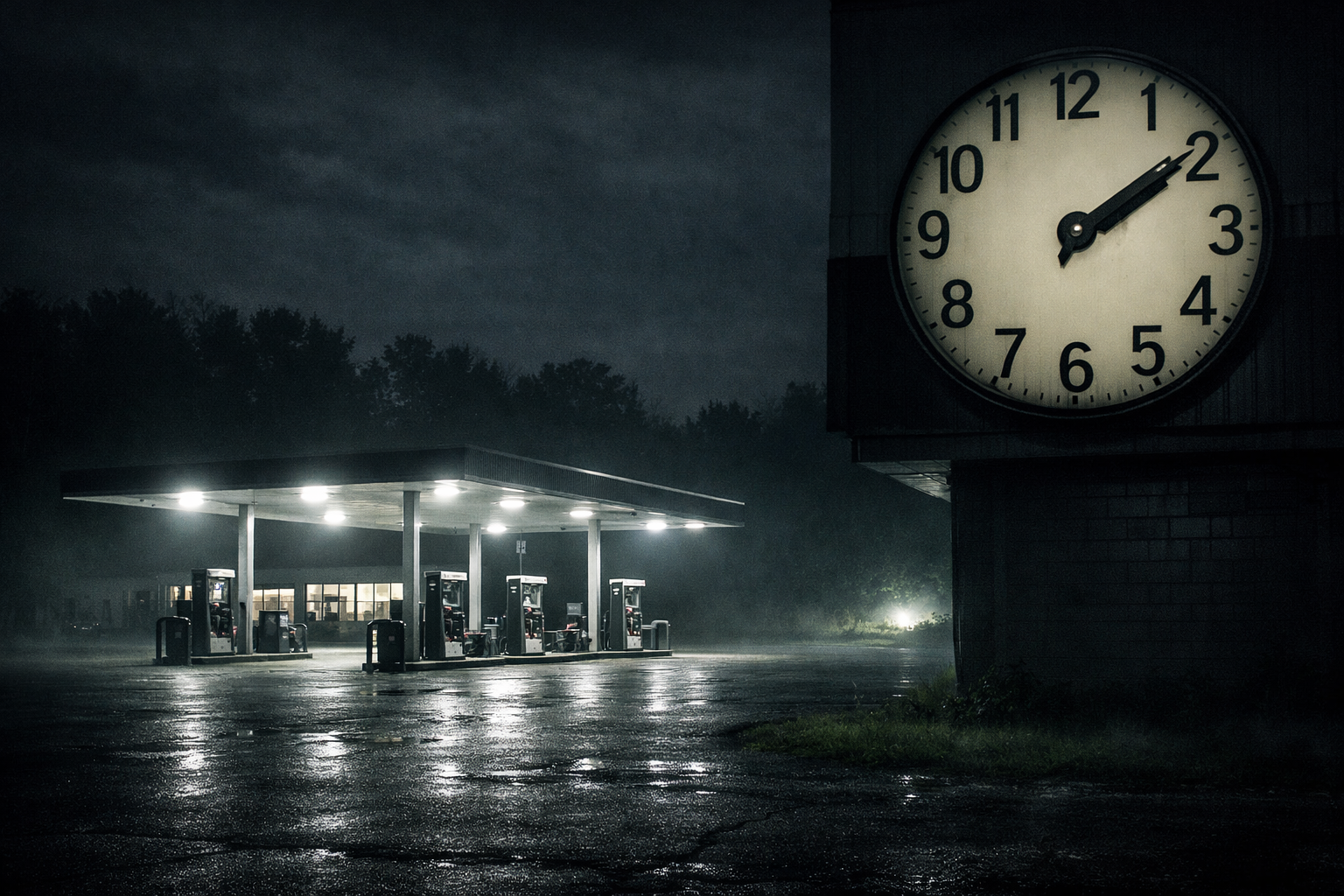
On the way back out, I did the usual glance at the big analog clock they had bolted to a bracket under the canopy, a strange decoration for a place that also had three digital signs going at once. The hands said 12:08. It made a blunt kind of sense—there had been a time change last week, and places like this never keep up. I remember pointing with the cup and saying to Nate, their clock’s off. He made a face around a mouthful of cinnamon roll and said, Before or after? The parking lot was quiet, pumps idle, the air buzzing with that fluorescent hum and a whiff of hot rubber. Off to the side, past a low stone wall and a strip of neatly planted shrubs, the dark thickened into a line of trees. Beyond those trees, you could just make out a retention pond, flat as glass under the sodium streetlights from the subdivision. Somewhere in the distance a late sprinkler clicked and turned and clicked and turned, water beading on a for-sale sign no one could read at that hour.
We walked, because after two hours in the car your legs need to remember what to do. There was a curb that ran along the side of the building, an empty propane cage, a stack of windshield-washer fluid glowing an unhealthy blue. We cut across toward the tree line, not into it, just enough to feel like we were away from the cameras and the too-bright lights. The night had that hollow feel—like sound didn’t travel right. We talked about nothing—work, a friend who’d moved, a movie Nate had watched on the plane. I kept both hands wrapped around the cup to keep the heat in. Ten minutes, maybe less. The wind agitates leaves in different ways at that hour, and I was listening to that instead of Nate, the way a thousand small noises can turn into one steady feeling.
We turned back toward the car. I still had more than half my coffee, the cardboard ring softening where my fingers had warmed it. I looked up across the wide black, the lonely pumps, the shine of our car. The big clock had moved. Not by minutes. The hands now pointed to 2:19. My stomach did something I don’t have a polite word for. I stopped so hard the coffee slopped, and Nate almost walked into me.
How long did we just stand there? I asked, trying for a laugh and not getting anywhere near it. He squinted at the clock, then dug in his pocket as if a phone would tell a better story. His lock screen lit our faces weirdly pale. 2:19 AM. He put his phone flat against mine, a childish way of proving we hadn’t both misread it, and there it was again. 2:19. I could feel the heat gone from the cup like I’d set it down and forgotten it for an hour. In the reflect of the glass on the station’s front, the lobby inside looked the same as we’d left it—only now it was later. I pulled the receipt from my pocket because I needed something with ink on it to be wrong. The paper was fresh and slick, the heat-printed letters sharp. Time: 02:07:33. We had only just walked out, hadn’t we? I hadn’t even torn open the creamer I tucked into my hoodie pocket. I showed it to Nate, then looked up at the clock as if we were in some game where glancing up would reset the board.
We went back in. The temperature change made my skin prickle. The clerk was restocking cigarettes, a cardboard tray against his hip. I asked him if the clock was right, hating how my voice rose on the last word. He looked at the wall clock behind him—the cheap one with a battery—and said, It’s two-fifteen. He sounded bored, then looked at our faces and straightened. You just came in, right? He waved his scanner vaguely toward the counter. I held my receipt up. He leaned forward, squinted. 02:07:33, he read out. The second hand on the wall clock ticked, loud and plastic. He said, Hold up, and thumbed something on his point-of-sale, calling up a list of transactions—the one before mine, one after—and they were all in the two-oh-something range. I told him the big clock out there was wrong by an hour earlier. He frowned and tugged the cord that led into a back room. Come with me, he said, like we were stepping off the map.
The back office was barely a room, more like the station had remembered to have one at the last minute. A metal desk with a stain that might have been coffee, a swivel chair with one arm duct-taped, and a DVR setup with a small monitor that flickered where it shouldn’t. He pushed buttons with the kind of familiarity that says he does this a lot—fast forward, back, search by time. We watched ourselves on camera One walking in, my hoodie, Nate’s cap, me tipping a creamer into the coffee like it wasn’t a crime. In the grainy footage, the timestamp in the corner clicked up: 02:06:58, 02:07:01, 02:07:05. He scrubbed back to when the pumps had been empty. The bottom bar with the little green motion blips had a blank strip—no blue, no green—just nothing between 01:09 and 02:09. He tapped the screen as if touch would help. That’s weird, he said without any drama. If there’d been a power outage, the registers throw a code. He glanced at the side little UPS unit under the desk. The battery light was steady, quiet, nothing flashing. I could hear my own breath too loudly in that small room, and the soft electronic clicks of the DVR felt rude. The clerk looked at us with a different expression now, not yet believing, but remembering this in some future story as we were living it.
Back outside the air felt thicker. There was a hum I hadn’t heard before, not the sharp insect buzz you ignore, not the electricity under the canopy. This was low, like something big and dumb and patient sat idling somewhere it couldn’t. It came through my chest before my ears put a word on it. Nate stilled, head turned toward the trees. That’s new, he said softly, and I nodded because words were too heavy now. It was a suburban strip of trees, mind you, nothing wild—maples planted in a line, a worn path, the glow of the subdivision drifting through the gaps. And there, flattened against the dark like a pale off-switch left just above the grass, something hovered. That’s as close as I can get; a shape you only know because it wasn’t the shapes around it. Not lit, not shining, just paler than the night, with a sort of wrongness at its edges, like the idea of an outline if outlines were tired. It felt low, as if I could have thrown a stone and hit it, and yet there wasn’t the confidence of a thing you can hit. The hum leaned toward us. We took steps we didn’t talk about. Gravel shifted under my shoe, loud in the way you remember sounds after you hear them. The trees didn’t move. I felt that metallic mouth-taste you get when lightning is thinking about you. We got within ten, twelve paces of the low stone border and the hum cut so clean it pulled a tug out of us, like a door unlatched by someone on the other side. The pale left too, not a moving-away, just a gone. The crickets were suddenly embarrassed at their own volume and tried to make up for it all at once. For a second even our breathing felt borrowed.
We didn’t speak on the way back to the door. In the glass of the store I saw us, two tired men standing in their own light, and behind us the parking lot went on being a parking lot. The clerk had already called his manager by the time we walked in again. He was shaking his head with the phone to his ear, saying something about the feeds dropping an hour, about two guys talking about the clock. The manager arrived like managers do—keys jangling, apology for the hour half-sincere and half a habit, looking everywhere and nowhere and then at the monitor. She walked through the same steps the clerk had, with the same result: a smooth stupid gap where an hour should live. She asked if we’d mind if she called it in, and then a cruiser idled into a blue wedge outside and an officer did the calm voice he had worked hard to have, took our names, our statements, did the thing with the pen you see on TV. He felt the coffee cup I still carried and made a face, said, Cold, huh, with the word stretched to hold a question that didn’t fit in this world. They checked breakers, checked the little paper-tape logs the registers spit out when they hiccup. There was no record of a failure, just a consensus that we all owned the same hour now and none of us knew what to do with it.
We left because there was nothing left to do. The canopy’s clock had settled at 2:46, the second hand making its innocent trips. Our car chimed at the seat belt exactly the way it always does, the dash clock agreeing with my phone now like they had organized a meeting without me. The road back into the neighborhood unfurled in the quiet way late roads do, house after house tucked behind trees that were more careful not to be seen than they are in daylight. I kept one hand at twelve on the wheel and one at four because anything else felt like trying too hard. Nate said something about finishing the movie tomorrow, and I realized he’d dropped and then picked the thread of a sentence in precisely the same place we’d left it outside, as if that hour were a commercial break we didn’t agree to. The sprinklers were off at the park even though the sign said they ran until three. A school marquee flashed two words out of some longer message—WELCOME BACK—and then stared at us blankly. My cup sat in the holder cooling the same as it had cooled when time made sense. We didn’t talk about the hum or the pale shape because saying it would push it farther away or make it reach back in, one or the other.
The next morning I found the receipt where I’d tucked it into the car manual like evidence. The heat print hadn’t faded. 02:07:33. The creamer I’d pocketed, unopened, had a seam dent from my thumb that wasn’t there until I made it that night standing under the clock. I thought about driving back, checking the clock in the light, asking the clerk if the cameras had remembered the missing part while we slept. I didn’t. Instead I stood at my kitchen window and watched a line of school buses thread through a beam of sun and wondered if I’d ever kept time the way I thought I did. Every so often since then, around the edge of the day when you can’t tell if it’s late or early, I’ll hear a hum underneath something else—an AC kicking on, a plane miles away, my own blood—and I’ll watch whatever I’m doing feel like it’s been picked up and put down again a little to the left. All I have for it is a clock on a canopy I can see perfectly in my head, and the way Nate and I stepped toward the trees because it felt wrong not to. None of this has a clean edge to cut on. It sits where the lot meets the grass, in the neat seam where the night had to choose and never quite did.


