The Hill Where People Still Leave Offerings
Where I was staying that month, people had a way of changing the subject when the hill came up. It was just west of town, a low rise above the pines and the creek, with a narrow path worn in by deer and old boots. They would only say that someone still went up there and left small things. There were always new things, someone said in a tone that tried and failed to be casual. Buttons, coins, bits of ribbon tied into careful bows. When I asked who or why, the answers thinned out like smoke. The clerk at the hardware store ran my card and stared at the counter. The woman at the bakery reached for a loaf that wasn’t there. No one said there was a law about it. It was more like a bruise you didn’t press.
It was almost June, and the forest held the kind of light that seems to have a place it’s going. I took the path one evening when the heat had lifted out of the road and the mosquitoes just started to whine. The trail showed itself behind a cut in the field, between a cemetery fence and a weathered sign that once pointed walkers toward a lookout. The letters were gone. The posts were gray with lichen. I stepped into the shade and the field’s noise fell to a softer, deeper kind of quiet, as if the woods had closed around my ankles.
I’d been told there was nothing special at the top. It was a hill, not a mountain—just a swell in the trees with a view of rusted roofs and the river with its braids of pewter water. Still, there was a feeling in the path, the sense that it remembered feet. A beer can wedged in the crook of a maple had gone soft with years. Strips of cloth—blue, red, a fraying plaid—fluttered from low branches as if the season had left its own rags behind. The ground was pillowy with needles and last year’s leaves, damp under the top crust and smelling like old coffee grounds and iron. A squirrel burst out of cover so close to my shoe I flinched.
I climbed without hurry, making myself look at ordinary things. The white x of a birch scar. A blown-out stump filled with chipmunk droppings. Bits of quartz glittering in the dirt like lost teeth. Something—wind, I told myself—tapped lightly in the high branches and then went still. On the slope, the trail crossed a shallow game path marked by two small hoof prints, neat as punctuation in the mud. The sky color thinned toward amber through the trunks as I topped the last rise.
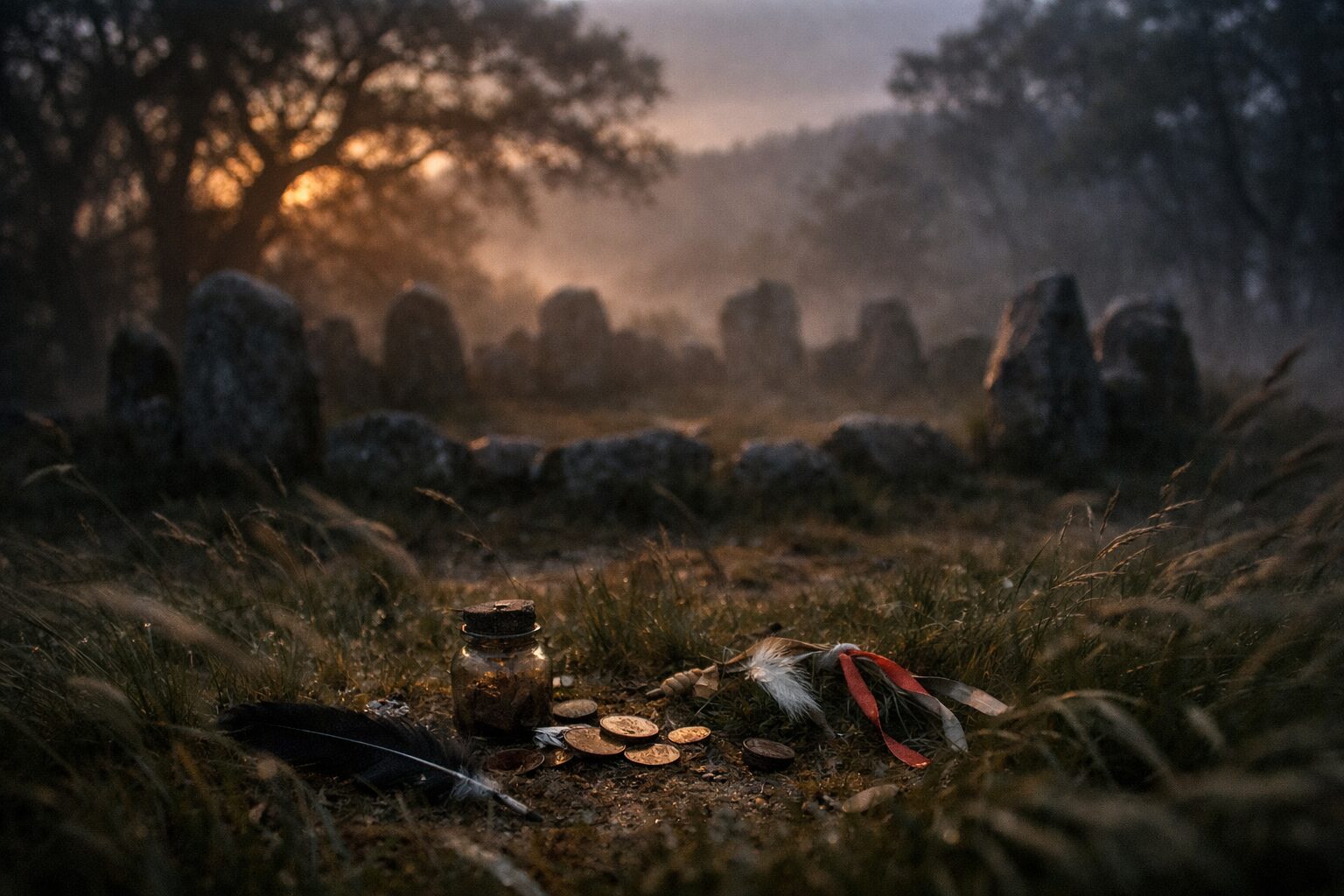
The crest was a gentle corona of grass and low rock, slung between three old oaks. The stones were not a wall anymore—not even a line, really. Just a scatter of heavy shapes with their corners worn into the earth in a way that made you think of hands and time. Lichen mapped them with pale archipelagos. Between them, in the shallow cups where the stones had sunk, lay things that had not been there long. The first wrongness was their newness. They were clean. A loop of copper wire polished bare in one curve. A sprig of dried lavender still purple at the tips. Three pennies, heads up in a crisp little fan. A coil of yarn bracelet the size of a child’s wrist. They were arranged with intention around the old stones. And though the ground was damp enough to hold the print of my boot like a photograph, I saw no other marks. No shoe treads, no deer scuffs, nothing but my own steps coming up behind me and darkening as the dew rose.
I stood still a long minute, shoulders picking up a coolness that wasn’t quite wind. It had rained just after lunch; even the thin blades of grass at my ankles still wore a freckling of beads. I crouched and touched my finger to the damp dirt a hand’s breadth from a bright dime—wet, pliant, ready to remember—and then I looked for where the someone had gone. The path in was a thread, easy to read. I turned my head slowly. If there had been a person, a dog, a child, the grass would have told the story. It told nothing. It looked back at me with a blank green face.
I held still long enough for the birds to scold and then calm. Then I stood and walked a lazy half-circle around the stones, careful not to brush anything with my sleeve. I didn’t go too close. I told myself I wasn’t superstitious. The copper loop looked like a bracelet, and when I first saw it the break in the loop pointed toward the west, its open end cupping the last light. By the time I’d taken six steps around to the other side, it had its open mouth turned toward me, a neat offset that I would have blamed on my own shifting view if not for the little shiver that went through me as if a key had been turned at the base of my skull. I stopped and frowned. The penny fan had been a fan. Now the arc was tighter, almost a bow.
I tried to find the trick—rocking my head, blinking, standing on a different tuft of ground. Sometimes what you see is only your eyes. The lavender filled the warm air with something sweet and tired. A moth with a notch in one wing touched down on the yarn bracelet and lifted again, undecided. I took another few steps. The tiny jawbone of some long-dry animal—the size of a matchstick, delicate with teeth—had lain like a hyphen. Now it was a small arrow, pale and exact, pointing at my knees.
The light dropped a degree. Somewhere in the grass, a tick crawled the length of a blade toward no clear appointment. I thought of the way people in town had looked past me when I brought this place up, the way one man had scratched his cheek until it blushed and said you can go look if you want but don’t touch anything, and then he’d looked away hard enough to bend the air between us. I rubbed my own palms dry on my jeans and told myself that if anything was moving, it was beetles. A beetle easing out from under a coin. A thread stirring loose from the yarn.
I came around so that the three oaks were now between me and the slope down. There was a little glass jar, thumb-high, with something dark at the bottom that could have been coffee grounds until the breeze—no, I told myself again, not a breeze—lifted a faint smell that was more like honey gone over or old tea. The jar’s lip had been to the left. It was to the right now. My mouth went dry in the same way it does on the dentist’s chair, the body knowing something before I agree to know it.
Then the grass spoke. It was low enough at first that I could pretend it was two stalks worrying against each other, gray and dry even in the green season. It was below my left knee, then under my right heel: a long whisper like a road heard from far away, syllables braided but not making words, soft enough that I had to lean slightly to be sure I heard it at all. I froze mid-step, my backpack sliding an inch down my shoulder. In that held moment, I understood I was in the center of something’s attention in a way I have not felt before or since. I looked down because it felt like I had been called by something too polite to be loud.
Every small thing around the old stones had turned. You could say that of course each appeared to face me because I was seeing it from where I stood, but that would be a cheap way not to name what I saw. The pennies’ heads were a row of profiles aimed like listening faces toward my chest. The lavender, bedraggled but stubborn, had its scarred ends pointed like blunt fingers. The copper loop, the jawbone, the thread of yarn—each had their break or their pointer drawn toward the space I occupied. A feather I swear I had not noticed before lay in the grass with its shaft lined up like a sight. Nothing touched me. The air was not even especially cold. But I felt as if my name—my real name, the one the body keeps—had been spoken into the pores at the back of my neck by someone pressed close to the ground.
“I didn’t take anything,” I said aloud before I knew I was going to. The shape of my voice broke the sameness in the oaks and came back smaller. Somewhere downhill a dog barked twice and stopped. I crouched without thinking to make myself occupy less air. The whisper slid again along the surface of the hill, never lifting to become a voice and never quite going away, like a shallow stream under ice. It had the patience of a habit. I picked my backpack up without letting the strap scrape across the grass and straightened slowly. I could feel it consider that new length of me: calf, thigh, ribs, throat.
I walked backward first, the way I have eased away from a fearful animal, letting it see each foot before the weight went down. Then I turned because I had to, because we are built to go down incline forward. I moved past the oaks and then the trees closed ranks and the stones were not in sight even though I had gone only a few yards. The whisper was behind me and then nowhere. In the still places between birdcalls I heard only the old quiet again, deeper for what had been in it. I kept to the trail as if it were a narrow bridge over water.
The descent turned the world back into ordinary again by degrees—the smell of damp metal from the creek, a distant tractor, a wavering column of gnats gold in the last light, the reassuring ugliness of a crushed plastic bottle at the path’s edge. By the time I stepped out into the field, the town had lit its windows. Somewhere a grill popped and lofted fat smoke into the cooling air. My heart, which had been a fist in my throat, loosened until I could swallow without noticing it. A pair of teenagers cut across the street and laughed in the way you laugh when you’re full of an evening you almost deserve.
I did not go into the bakery the next morning. I did not mention where I’d been. In my room that night, I laid my jacket on the back of the chair and a long time later I reached into its pocket for my keys and came up with something else. It was a small stone, not much bigger than a matchbox, with that same pale lichen in thumbprint ovals and a flatness I recognized from the way the hill held its rocks. There was a notch taken clean out of one edge as if by a set of careful teeth. The stone was cool to my hand though it had been in a warm room for hours.
I had not picked up a thing.
I set it on the dresser, thinking I would take it back in the morning and lay it down where the grass could see me leave it. I turned the lamp off and for a second the room kept the blue of late June past dark, like the last of the sky held in a cup. The chair creaked as the jacket settled. I stood still a few breaths so I wouldn’t hear anything I could not name. Then I went to bed and slept lightly and did not dream. In the morning when I reached for my keys, the jacket had its weight again, familiar and slightly off, as if someone had made a careful addition I had not asked for.