The Person at the Window Had No Face
It was one of those nights when a house gets loud by being quiet. The refrigerator droned; the old thermostat ticked in uneven intervals; the neighbor’s wind chimes rang once, then stopped as if they had second thoughts. I was in the front room with a lamp on low, folding a few towels I hadn’t bothered with after the dryer cycle. The street outside was dark except for a wedge of sodium light slanting in from the cul-de-sac. A drizzle had come through earlier and left everything with a soft sheen, and I could smell damp soil through the gap in the window where the sash never seals quite right.
We live in a split-level on a small, uncomplicated street. The front window spans almost the entire wall. Most nights I keep the blinds slatted but half-open, because it makes me feel a little less boxed in. Every once in a while a passing car throws moving lattices of light across the ceiling, but on weeknights after ten it’s mostly still. It was close to eleven-thirty when I noticed movement in that window—just a soften-then-sharpen in the glass, a shift in the reflection like something had passed by outside. I paused mid-fold with a towel stretched between my hands and listened, as if listening would confirm it.
It didn’t come with footsteps on the walk, or a car door, or a muted voice carrying from the street. Not even the neighbor’s dog objected. But I had the simple and certain feeling of a presence, the way you feel a draft before you feel the cold. My eyes tracked to the dark slice between the edge of the curtain and the frame. A vague vertical moved there, as though someone stood very near the glass and shifted their weight, only barely.
I set the towel down and stood without scraping the chair across the floor. I thought: a package late, a confused Uber, a kid from down the block who forgot a key and tried the wrong house. All of those required the next action to be obvious: a knock, a ring, a voice calling through. None of that came. The figure resolved by degrees as my eyes adjusted to the dark: a person, definitely, a human height and human stillness, body aligned square to the window with a patience most people don’t have when they realize they’re at the wrong door.
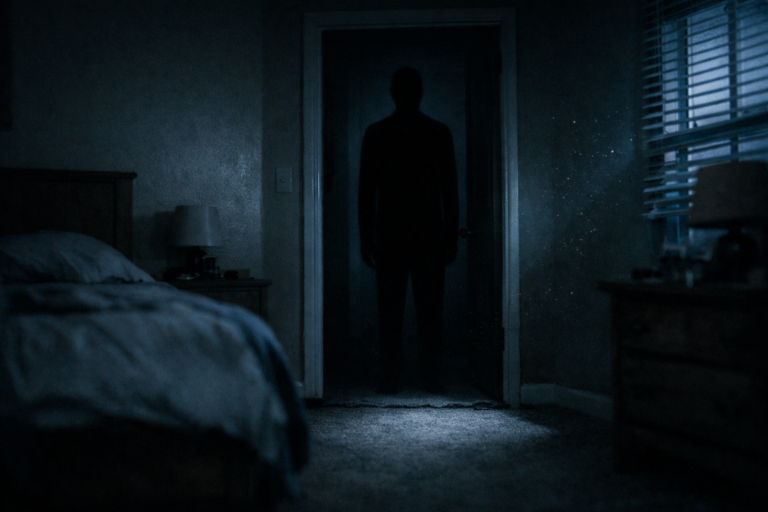
They were close enough that the glass caught a darker mass where a head should be. No hat I could make out, no hood. Just the outline of someone standing there as if looking in. The blinds cut them into pale and dark bands; the porch is narrow, so you have to be within a foot or two of the window to even stand there. The ordinary etiquette of it—that impulse to wave or call through the glass and ask if everything’s okay—died in me when they didn’t move at all. They had found a place and entered it and did not adjust. I tried to see the logic in it. My skin had already decided there wasn’t any.
There’s a switch for the porch light by the door. You can’t reach it without passing in clear silhouette across the front room. I waited a beat too long and then did it anyway, crossing that short distance and feeling the delicate, childish fear that the very act of turning on the light would announce me as if I hadn’t already been visible in that warm square this whole time. My fingertip found the plastic nub and pushed up. The bulb out there has a second of lag before it warms. In that breath, the front of the house felt suspended. Then the porch lit up, butter-yellow, falling in a clean sheet over the figure at the window.
At first I thought the light had blown out my ability to focus. The face—the place where the face belonged—took the porch light and held it. Every other part of the figure made sense enough in the quick glance you give a person at your door: shoulders under a dark jacket, a knit of fabric at the hems, hands at their sides in that awkward way strangers hold themselves. But the head was wrong. The light did not reveal eyes. It did not reveal a mouth or the plane where a nose interrupts the shape of a cheek. It wasn’t that the face was covered; it wasn’t hidden by fabric, or a mask, or shadows that refused to yield. The porch light made everything else certain and left that oval soft and featureless, like a thumb has pressed imperfectly into clay and smoothed everything you rely on to make a person into who they are.
I told myself it was a trick of the glass—a reflection somehow turning into a white blur, the inside of the window catching the lamp behind me. I stepped to the side to angle my view, and the blankness tracked with them. It had dimension without detail, the pale of skin but not skin. Dumbly, I thought of a cutout, a paper with a face shape removed and nothing behind it. The lights made a faint line along a jaw that didn’t quite resolve; the porch light traced their shoulders and the gentle angle where the head met them, and still the center stayed empty of features.
I reached for the lock because I felt silly standing there. The motion of my hand at the door must have drawn the first response I got. The figure lifted one hand—slowly, without a jerk or the hesitation of someone deciding to do something—and brought the palm level with the glass. Then it pressed the hand to the window. No sound. The glass did not quiver or squeal the way it does when my niece sticks her face to it to make a joke. For a second the light wobbled in the skin of that hand because there are veins and tendons to catch and throw it, because the world made sense in that small way. The hand was as ordinary as any I’ve seen: long fingers, a knuckle that seemed a little reddened by the cold, a faint crescent of a nail catching the light. It lay against the pane with a pressure I could feel through the air, through my own skin.
I spoke before I meant to. “Can I help you?” It came out thinner than I had imagined it would. If the act of speaking was supposed to unlock any sane response, it didn’t. The hand stayed. The head—if that word is even right for it—remained tipped as though those non-existent eyes had chosen an exact point to examine somewhere behind me. The old clock in the kitchen bloomed with its single chime for the half hour. That clock is cheap and the tone of it is slightly wrong, a sour bell. The sound ran through the room and died and had no effect on anything.
I took a step back. The hand left the glass without dragging along it, a lift that gave me the unaccountable impression of someone lifting a sticker, patient with it. For a moment, an oval of the outside air seemed to cling where the palm had been. The porch light picked out the faintest fog around it, as if the night air had been squeezed and then released. There should not have been fog; the air had a wetness to it, yes, but it wasn’t cold enough to breathe out and make clouds. I knew I was inventing the fog in my own head even as I saw it hover and go.
I stepped away from the door and reached the small table by the couch where my phone was face-down. My fingers were clumsy. I called the easiest number first, my neighbor across the street because we have an unspoken agreement for each other’s odd hours. She answered on the second ring in a voice rubbed raw with sleep. While I whispered that someone was at my window, I kept my eyes on the silhouette outside. It didn’t shift. It didn’t even lean to try to see me better. I felt the thinness of the glass between us in a way I had never paid attention to before, the smallness of every barrier you think will do.
“Don’t open the door,” she said immediately. “I’ll look from my window.”
I waited while she crossed her dark house to her own front room. In that quick wait, a tapping conversation I could not hear seemed to happen among the chimes next door and the leaves of the maple. I saw the blinds across the street open a little and a face pale with backlight peer out. “I don’t see anyone,” she said after a second, and then, more slowly, “at your porch. Your light’s on, but…it’s empty.”
There was no drama in the way it happened from my side. No sudden movement, no retreat, no trick of light. One moment the figure occupied that space and the next there was only the simple porch, the two leaves plastered by the earlier drizzle near the mat, the dark knot in the wood rail I’ve always meant to sand out. I didn’t witness an exit. It was simply not there anymore in a way that made me feel as if I had been concentrating on a word too long and it had unraveled into shapes instead of meaning.
My neighbor kept asking me questions. I told her I would call the police, the small ones, the non-emergency line, because I had that tone in my voice you get when you’re trying not to be the person who needs the big red switch pulled. I stayed on my side of the door while I did it, gave my address, described what I felt comfortable describing. I tried to say it had been someone in a coat and found that I couldn’t make myself add any more about the face. The dispatcher asked me to stay on the line and not go outside. I said that I wouldn’t.
But I needed to see. I hung up. I moved the chain across, turned the deadbolt, and opened the door only as far as my knee and my shoulder could hold it. The night air smelled like wet concrete and cold dirt from the flowerbed. The porch light made a clean rectangle that spilled past the railing and onto the walk. Everything had a thin gloss to it from the earlier rain. When I slipped one foot out onto the concrete in my sock, the wetness took the heat from my skin immediately. I shut the door again, then opened it the rest of the way with a sense that if I did it quickly enough, if I acted like the house had the right to do this, it would.
From the edge of the threshold, I could see my small front walk, the two steps down to the drive, the darker damp patches on the asphalt where water had pooled. There is a place on the left where the neighbor’s gutter sometimes leaks a thin ribbon across our sidewalk when it rains, and it had done that earlier; water had run and dried in streaks and then been dampened again. In that kind of damp, everything records a little. My own bare foot had already printed a blurred crescent of skin on the concrete. A moth battered itself once against the light and found nothing to hold.
If someone had stood with their weight placed just so at my window, if they had leaned far enough to set their hand against the glass, if they had stepped to the right or to the left to leave—they would have left something. The concrete was darkened where anything touched it. You could make out the ghost-shapes of my shoes from when I’d hauled groceries in earlier that evening; you could see a faint arc of grit where I’d dragged the trash bin back from the curb. The place where a person would have stood was just clean wet concrete, a gloss with nothing broken in it. No wedge of a heel, no edge of a sole, no scuffed dirt. The mat was dark with moisture, the kind that takes impressions easily, and it lay smooth as if it had not felt weight in days.
Behind me, the refrigerator coughed on and held that sound, steady and simple. From across the street, my neighbor thought to flick her porch light on and call my name in a hush. I stood alone in the rectangle of my own light with the phone warm in my hand and the taste of wet air in my mouth. When I finally went back inside and closed the door, the glass of the window reflected me and the room and the yellow smudge of the porch bulb so perfectly it was almost another room. I reached toward the place where the hand had been and then let my fingers fall. By the time another light rolled slow down the street and a cruiser came to a stop near the curb, there was still nothing printed on the wet ground where a person would have been.