The Phoenix Lights: What Thousands of Witnesses Saw
On a soft March evening in the Sonoran spring, the first reports sounded almost gentle: a loose wedge of lights gliding over Arizona neighborhoods, silent and improbable, tracing a path that would be remembered for decades. People stepped out of restaurants and onto porches to watch. Some pointed straight upward, stunned. Others would follow the formation by car as long as the highways allowed. The Phoenix Lights were on the move, and the story that followed would become one of modern ufology’s defining chapters.
Years later, the phrase Phoenix Lights still triggers a particular shiver among Arizona UFO enthusiasts and skeptics alike. It’s the scale that lingers: thousands of witnesses, an entire metropolitan area looking skyward at once. At the core sits a debate that refuses to die—did residents watch a single, immense V-shaped craft cross the state, or were they seeing a sequence of mundane lights, misinterpreted amid desert darkness? Into that dispute came official explanations, political reversals, and a handful of videos that have been pored over more times than any security camera feed in a courtroom drama.
The Phoenix Lights occupy a rare space in the annals of anomalous sightings. The central claim—an enormous, triangular arrangement of lights moving in coordinated silence—demands attention. With the story stretching from the northern part of the state into the Phoenix basin, it remains a touchstone in discussions of Black Triangles, mass sightings, and how official statements shape public memory. To understand how this case endures, we retrace the night, the evidence, and the explanations.
Origins of the Phoenix Lights

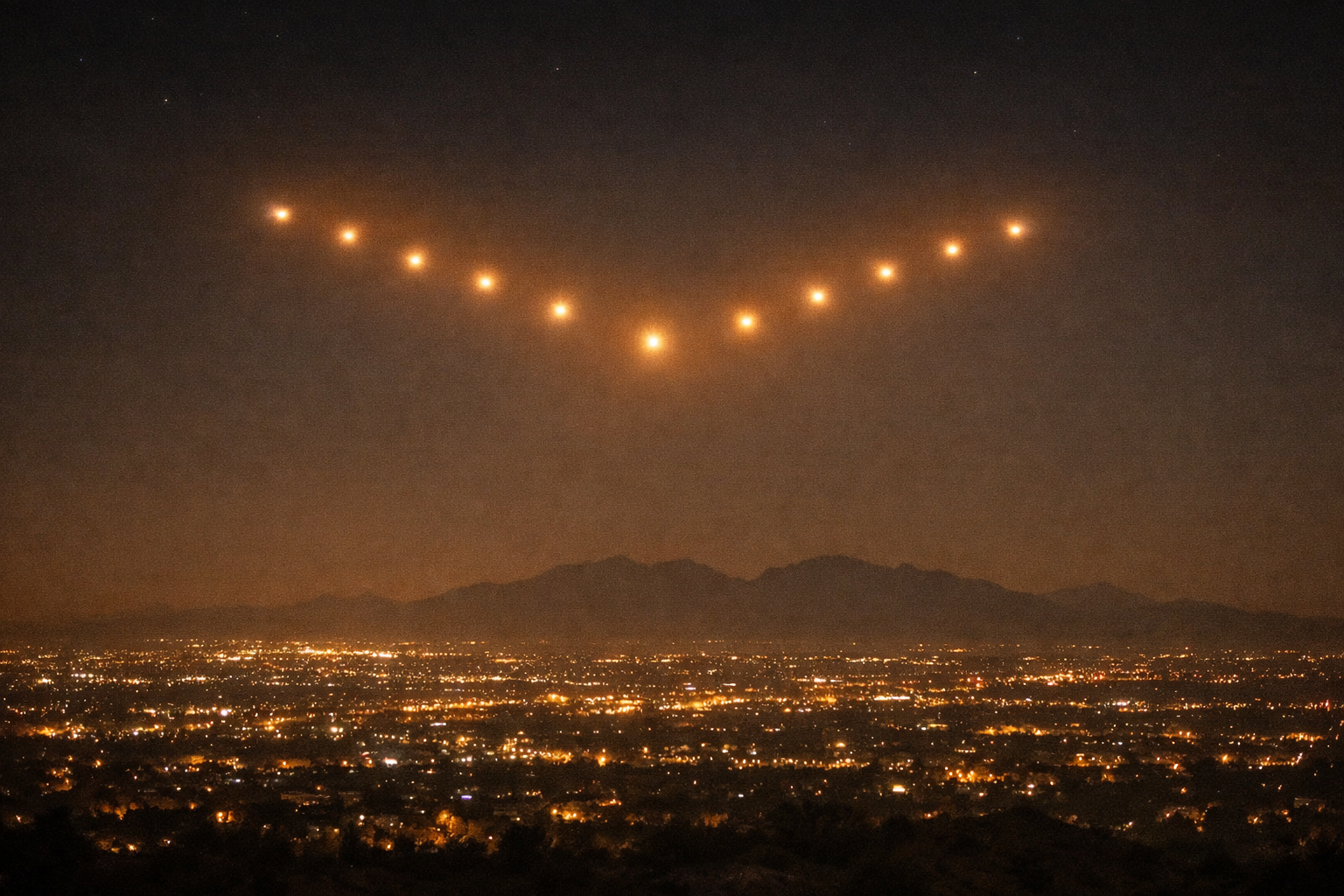
March 13, 1997, began like any other cool desert evening, but the first calls to authorities in Arizona soon marked the Phoenix Lights as different. Witnesses from the north reported a V-shaped or triangular formation, a set of dull, amber or whitish points that appeared to be connected by something darker than the sky—or simply connected by the eye’s need to draw lines between the lights. The formation seemed vast. It moved slowly. And, crucially, it made no audible engine noise to most who watched from the ground.
As the hours rolled on, Phoenix-area residents described the formation moving through the metro corridor. Later that night, a second tableau appeared: a cluster of lights seemingly stationary or descending behind the Estrella Mountains to the southwest. According to the U.S. military, those later lights were consistent with illumination flares dropped during training over the Barry M. Goldwater Range, a routine exercise whose timing—by sheer coincidence or not—landed squarely in the timeline of the Phoenix Lights.
What the Phoenix Lights Witnesses Described
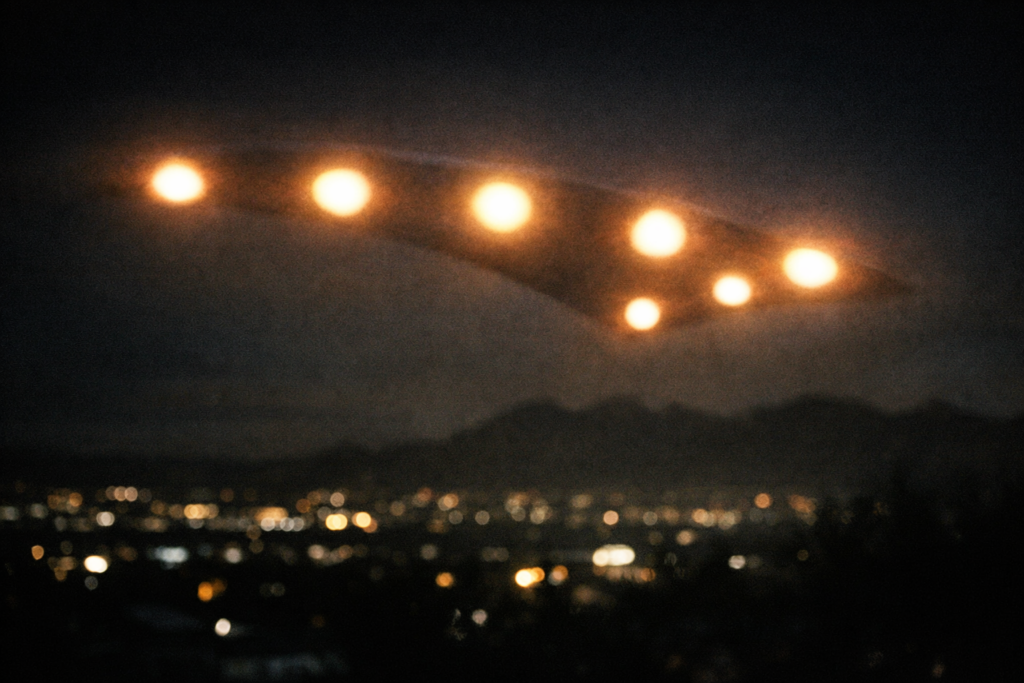
Accounts fell broadly into two camps. The first concerned a large V-shaped or triangular array traveling north to south, sometimes described as a single craft “blotting out the stars,” other times as a tight formation of independent lights. The second camp centered on the stationary lights lingering over the mountains, which appeared to hang, fade, and reappear, as if winking through layers of desert haze.
Those who saw the moving formation emphasized its scale and quietude, claiming the lights glided as if linked by an invisible structure. Others, standing miles apart, reported that the alignment and spacing of the points remained remarkably consistent, adding to the impression of a single, monolithic object. In a classic pattern seen in mass sightings, recollections diversified over time: the longer the story lived in memory and media, the more details took on sharper, sometimes divergent edges.
Key Figures in the Phoenix Lights Story
Few figures loom larger than Fife Symington, the Arizona governor in 1997. Initially, he treated the affair with a light public touch—most famously featuring a tongue-in-cheek press appearance that cast the incident as something to smile about. Years later, however, Symington stated he, too, had witnessed a formation in the sky that he could not explain, a reversal that poured fresh fuel onto the Phoenix Lights debate.
Alongside political voices were statements from military and aviation authorities. Air traffic control tapes and pilot reports from the period have been reviewed and debated. Civilian investigators and national UFO organizations compiled timelines, mapped sightlines, and collected camcorder footage from backyards and hilltops. The Phoenix Lights thus quickly migrated from local curiosity to a benchmark in American UFO history, referenced alongside other Mass Sightings and Military Cases such as Rendlesham Forest in England for the way official accounts and eyewitness testimony clashed—and, at points, intersected.
Evidence and Alleged Evidence in the Phoenix Lights
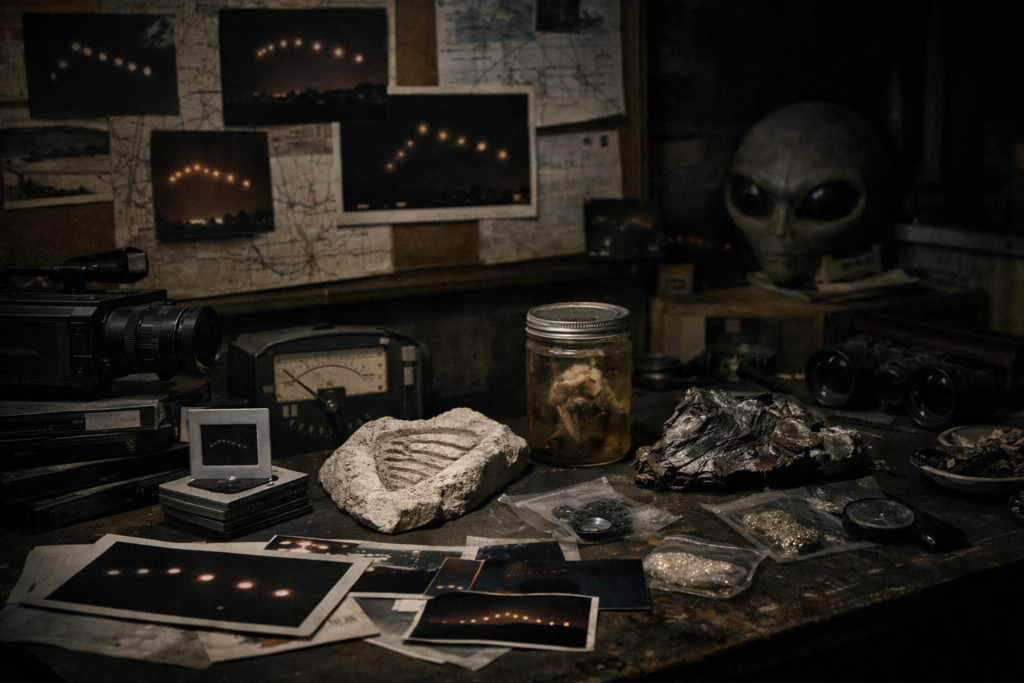
Footage from that night constitutes the primary record—consumer-grade video shot across the city and its outskirts. Analysts have studied the way the stationary lights fade in sequence, which some argue aligns with flares descending behind a mountain ridgeline. In other footage, the moving formation appears as a tight string of points crossing the sky, too dim and diffuse to resolve any structure between them.
The variability in vantage points is crucial. In any urban area, lines of sight shift with elevation, light pollution, and the masking effect of ridges and buildings. A set of lights that looks “connected” from one block could appear as independent points from another. Compression artifacts, long zooms, and jittery camcorders in low light produce a visual soup that complicates retrospective analysis. Still, taken as a whole, the Phoenix Lights videos are striking for their consistency in layout and tone—and for how little extraneous noise or strobing is evident when compared to conventional aircraft footage shot in similar conditions.
Skeptical Explanations for the Phoenix Lights
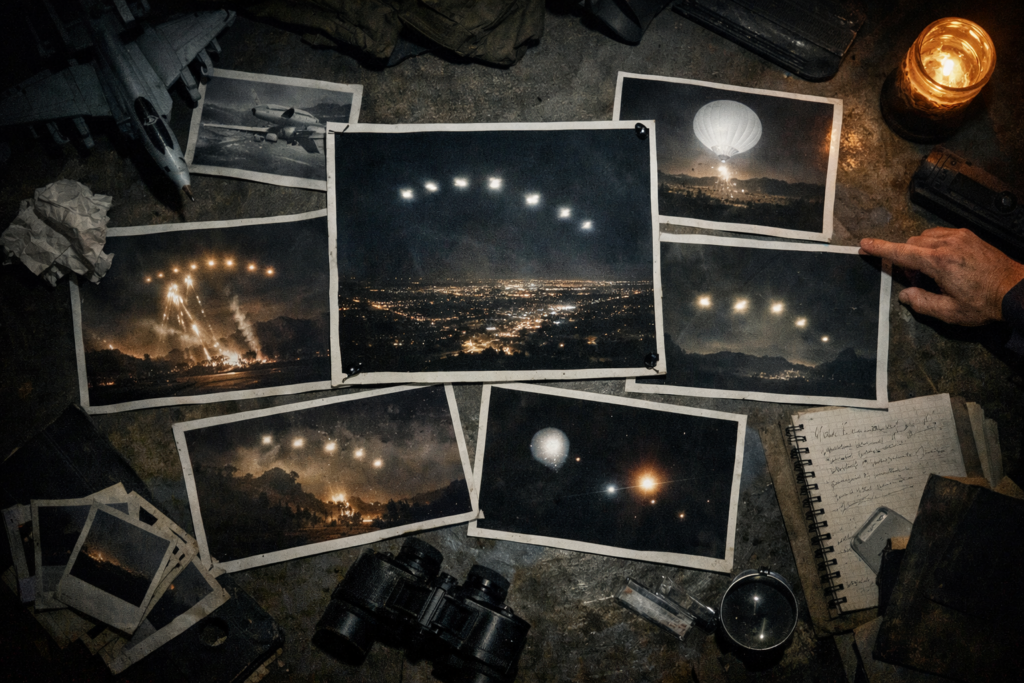
For skeptics, the Phoenix Lights divide cleanly: the later stationary sequence near the Estrella Mountains aligns with illumination flares dropped during a training mission. Flares burn bright, can appear to hover, and will wink out as they drift behind terrain or as their chemical charge expires. Atmospheric conditions can make them seem to dim and brighten in place.
The moving V-shaped formation, skeptics argue, may have been a flight of aircraft—possibly small planes or military jets—travelling in formation, with lights configured or perceived in an unusual way. Human visual perception at night tends to connect points into geometric shapes, especially against a dark sky with few reference cues. The impression of silence could stem from altitude, wind direction, and the masking effects of urban noise. Lastly, with thousands of people watching and talking, time compression and memory drift can blend separate events into a single narrative arc.
Why the Phoenix Lights Story Persists
Part of the draw is scale: mass sightings possess their own gravitational pull. When many people report similar features—silent passage, triangular geometry, lights that refuse to twinkle like stars—the impression of reality solidifies. The Phoenix Lights also intersect with a broader tapestry of Black Triangle reports from the 1990s and early 2000s, where enormous, quiet shapes are said to move with improbable steadiness over suburbs and highways.
Another factor is official opacity and then reversal. The military’s explanation for the later lights may be solid for that specific sequence, but it does not address all accounts of the earlier moving formation. Symington’s shift from levity to later acknowledgment that he saw something unknown elevated public curiosity. The case became a cultural hollow where multiple truths could live: routine training exercises on one hand, unaccounted-for aerial behavior on the other.
Daily Paranormal Analysis
The Phoenix Lights rose to prominence for classic reasons: a critical mass of witnesses, multiple vantage points, and media that arrived quickly to amplify the narrative. Believers see in the formation’s calm, deliberate passage the contours of a single, giant craft—something that defies ordinary propulsion and flight behavior. They connect it to international Mass Sightings and Military Cases where official accounts addressed parts of a timeline but left a core phenomenon unresolved, as with the contested documents and testimonies in the Rendlesham Forest affair.
Skeptics, meanwhile, are heartened by the flare footage analysis near the Estrella Mountains and by the psychological and perceptual literature on nighttime observation. A known phenomenon can masquerade as something extraordinary when conditions are just right: differing vantage points, sparse starlight, and the human brain’s penchant for pattern-making. Formation flying, unusual light configurations, and the absence of engine noise at certain altitudes could plausibly produce a Phoenix Lights–like experience for ground observers.
Why does the story endure? Because it straddles the line between explainable and inexplicable. The flare explanation is a sturdy pillar for the later display, but it is not a totalizing theory for the entire evening. The earlier moving lights remain debated, and the lack of definitive high-resolution footage—paired with the sheer number of testimonies—keeps the case alive. In that vacuum, the Phoenix Lights operate much like other enduring UFO touchstones: they resist closure and invite careful, iterative reexamination.
Connections to similar cases are both thematic and procedural. Black Triangle reports share the same blend of silence, vast size, and slow pace; Arizona has logged multiple such sightings over the decades, making the region a recurring locus in UFO discussions. The Phoenix Lights also underscore the importance of synchronized data collection—radar records, pilot logs, and triangulated video—an evidentiary trifecta that, had it been more robustly archived that night, might have given this case a clearer resolution.
Where the Phoenix Lights Stand Today

More than a quarter-century later, the Phoenix Lights remain a keystone in American UFO memory. They are the case people bring up at conferences and kitchen tables when the topic turns to mass sightings: large numbers of ordinary observers claiming to see something extraordinary, moving as if it had a mind and purpose of its own. The U.S. military’s statements about training flares convincingly explain some of what the public witnessed. Yet the sustained claims of a vast, traveling V-shaped formation persist in parallel, buoyed by testimony and the cumulative weight of recollection.
In the end, the Phoenix Lights embody the core paradox at the heart of UFO study. We have too much witness data to dismiss and too little definitive, instrumented evidence to close the file. Between those poles lies a landscape of possibility—the place where careful investigators work, where skeptics argue from knowns, and where believers point to the unknowns that remain.
Whether read as a cautionary tale about perception or as a compelling hint that we do not yet understand all that crosses our skies, the Phoenix Lights continue to command attention. And as the broader UAP discussion evolves—with new military reporting channels and declassified summaries—the case’s central question still hovers over the desert: did thousands watch aircraft and flares, or was there, for a few minutes in 1997, something else moving over Arizona that we have yet to name?