
It Used My Mother’s Voice From the Basement
It was a Thursday night so ordinary that my memory tries to file it with all the other unremarkable ones. The street out front had settled after the after-dinner dog walkers, the neighbor’s motion light kept catching moths, and a storm that never arrived had left the air feeling heavy. I had the dishwasher going just to hear it. I was cleaning the glass stovetop with a rag and listening to the slow, sticky squeak each pass made. The house had that cool, slightly stale air you notice in summer when the vents go quiet for a few minutes. That’s when I heard my mother call my name from downstairs.
She said it the way she always does when she needs something simple. No urgency, just a soft upward shape at the end, like a hand held out. Then: “Can you come down a minute?” The words lifted through the vents and baseboards the way voices do in our house, gathering a thin echo from the basement. I didn’t even think. I said, without looking up, “Yeah, hold on.” I wiped the rag in a circle and realized, with a little cold space opening in my chest, that my mother wasn’t home.
She had called after dinner to say she was staying with her sister two towns over, helping sort through some boxes. She’d sent a photo of the highway exit in that nothing light that looks like orange tea. Her car wasn’t in the driveway. I had seen the empty spot when I came in. The only set of footsteps on the rug by the door were mine. I stood under the kitchen vent and listened, and through it, a little clearer this time and a little lower, her voice came up again: “Can you come down a minute?”
It wasn’t just that it sounded like her. It wore her. It borrowed the tiny tremor that comes when she’s tired, the exact breath she sets between can and you, the same polite urgency that made it feel wrong not to go. But it did not sound like a live voice. It didn’t shift with the house. It didn’t fight the air. It had that set quality of a phrase played back again in a quiet room. I stood at the hallway and looked down toward the basement door. The hall nightlight made a pale oval on the hardwood, and the door was a darker rectangle beyond it, shut the way we keep it to keep the cool from dropping away.
I told myself she might have come back and I hadn’t heard her car, that maybe she’d parked on the street or brought something heavy in and taken it straight downstairs. That’s a shape your brain finds because it is easier than the blank. I padded to the door, my socks catching a splinter I knew was there and had been meaning to sand down. I put my knuckles on the door and listened. Down in the cool of the concrete and boxes, in the place where the smell of damp cardboard gathers, her voice said, with friendly patience, “Can you come down a minute?”
I opened the door. The switch is on the left, and the light over the landing is one of those soft filament bulbs my mother likes that takes a second to wake up. It glowed itself awake and pushed a little wedge of gold over the first six steps, then surrendered to gray. The rest of the stairwell stayed dark, the kind that licks at light and leaves the edges fuzzy. I leaned over the rail and called, “Mom?” The absence of footsteps was the first thing. There are creaks, always, when people shift their weight on those old steps, and none happened. There was only the sound of the dehumidifier from the far corner, a continuous small engine hum like someone breathing shallow and steady who doesn’t want you to hear them.
“Can you come down a minute?” Same tone, same breath, same gentle mother weight on minute, as if I had pushed a button. It came from deeper into the dark now, past the area where the dryer duct turns down, where if you look long enough your mind insists it sees shapes moving in the open shelves. I felt the way you do when you forget a step and your heel hits nothing. I put a foot down and the third stair creaked a familiar complaining croak. I think I wanted to prove to myself the sound would change if I changed something—my position, my voice, the way I called back. “What do you need?” I said, a little louder.
“Can you come down a minute?” It did not advance or retreat with me. It placed itself further in as I moved, the way someone would if they were trying to keep you at a certain distance without appearing to back away. It wasn’t an answer, and it wasn’t not an answer. I took another step, my fingers on the cold banister. The bulb above me clicked and gave a pulse, like a tired eye trying to stay open. The landing light barely held its circle. I could see the bottom of a box labeled HOLIDAY LINENS and the lip of the old chest freezer in the peripheral dark. “Mom,” I said, because hearing yourself say a name is sometimes proof of a thing being in the world.
“Can you come down a minute?” It passed under the sentence like a recording might, the same tiny catch on can, the same patience sliced exactly the same amount from each word. It didn’t overlap itself or step on me when I tried to talk. It waited until I had finished, then said the whole piece again as if I hadn’t spoken. The longer I stood there, the more the wrongness accumulated: there was no sound of hands on the laundry sink or a drawer. No shift of weight on concrete. The hum of the dehumidifier didn’t waver to suggest someone had passed it. The house kept itself. My mouth went dry in that metallic way you get before you stand up to speak. I lifted my phone because I had to do something that pulled the world back into place.
It vibrated in my hand as if on cue. The screen lit with my mother’s name. I stared at it for a second like it was a joke I didn’t understand, then swiped to answer. There was a hollow road sound around her words, that long-tire-on-pavement whoosh that I can hear in my sleep. “Hey honey,” she said, “I’m about to get off the highway. You okay?” The basement spoke under her, perfectly on time: “Can you come down a minute?” The words braided and didn’t know each other. For a second I had both of them in my ear—the flat basement shape and the road-wrapped living one—and I had to clamp my teeth on the side of my tongue to see if the hurt was in the same place as usual.
“Where are you?” I asked her. It came out too hard, and she laughed once, uncertain, the way people do when your tone tells them they missed something. “Five miles from Marcy’s, crossing the bridge,” she said. “Why?” The basement made its request again, mild as ever, a little patient, like this was the third time and I really ought to have come by now. “Do you hear that?” I asked, and I turned the phone to speaker and held it toward the dark. The voice obliged. “Can you come down a minute?” For the first time I heard something like effort around her breath, as if she were pushing it through cloth. On the phone, tire noise lifted then settled. “Who is that?” my mother asked. She sounded smaller. “Are you with someone?”
I did not want to say no. I did not want to put the word into the air and make space for it. “Just—” I said, useless, and then I said, quieter, “I’m at the top of the basement.” The light above me clicked again and steadied. The dark under the string-pull seemed to tilt, like a mouth tilting up to listen. “Come upstairs,” my mother said. It wasn’t a command, just the steady pressure of someone’s hand on your back when your feet won’t move. The voice below me said, for the fourth time I can swear to, “Can you come down a minute?”—and there was a sweetness to it then, almost satisfaction, because the words came out without any artifact of distance. Like it was where my eyes couldn’t see but exactly where my voice would have gone if I had finished a step. I went backward instead. The banister’s varnish felt gummy under my palm. I shut the door without taking my eyes off the opening until the wood met wood and I felt the latch seat.
I stood in the hallway with the phone to my ear, breathing into it so she would hear me alive. The door, with its cheap hollow center and painted-over grain, managed to look thinner than it usually does. I laid my hand flat against it and felt nothing from the other side, not even the steady cool you expect off concrete. The hum of the dehumidifier was a duller throb now, soaked by the wood. It seemed wrong to turn my back, but the feeling of being seen from a height lower than my knees was worse. I went to the living room without turning any lights off and sat on the arm of the couch like a kid who doesn’t want to wrinkle the throw. On the phone, my mother said she was almost there, that she could come by if I wanted, her voice trying not to bend itself around whatever shapes it was making in her mind.
I wanted to ask her to keep talking. I asked her what color the sky was where she was, and she said a flat marigold that doesn’t show up in pictures. I asked her what exit she was passing and she said 31B, the one where the old billboard for the pizza place has the ghost letters of a different ad fading underneath. The house began to collect itself around those details, as if the HVAC listened too. The dishwasher cycled to a softer sound. Somewhere a drip made itself known, the one under the bathroom sink that only speaks when the humidity is up. The basement did not make its request again. I sat there until the phone went quiet and the voice on the GPS said the destination was on the right, until I had no good reason to be afraid except the kind that stays like smoke after a match has been blown out.
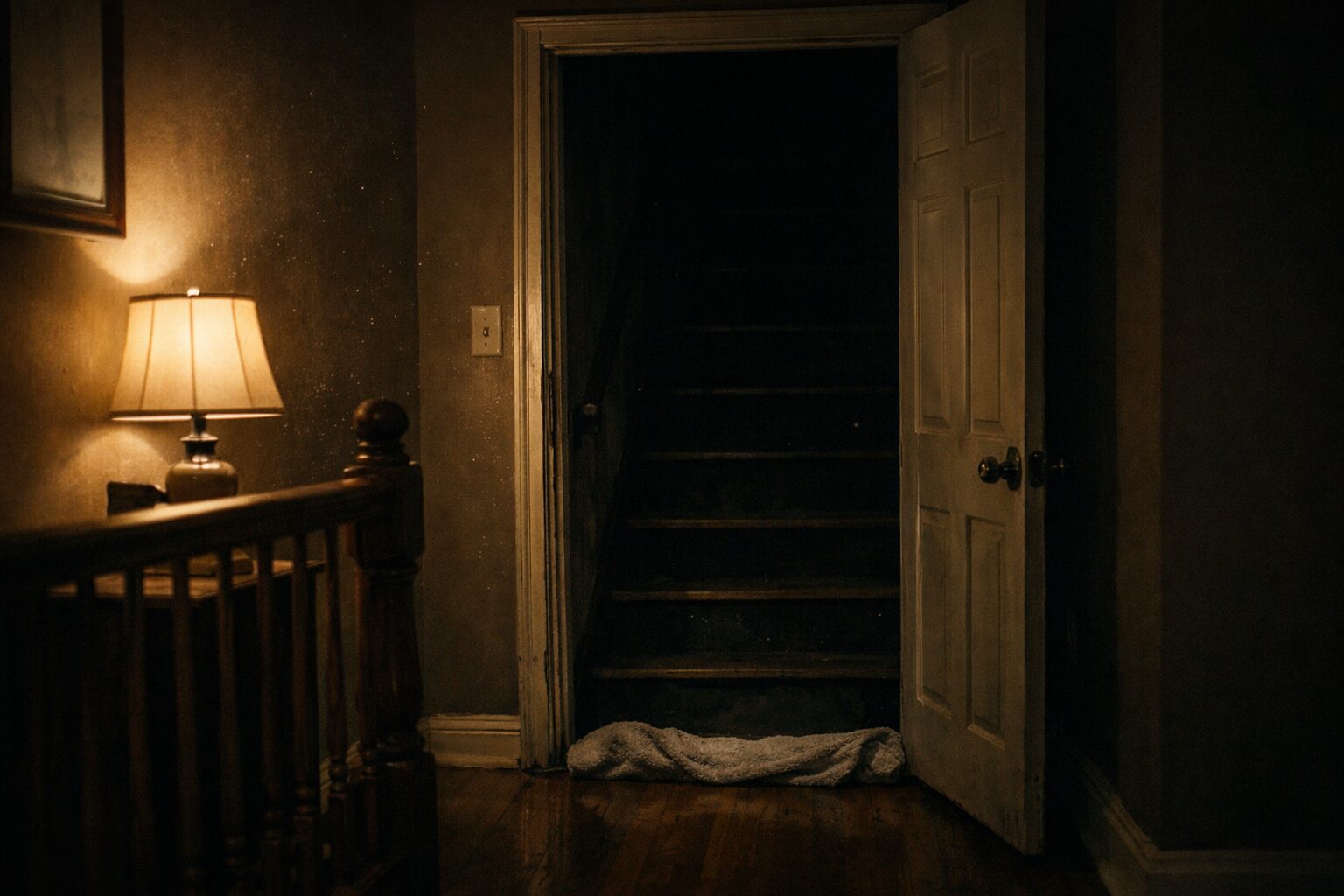
Nothing happened after that in a way that a person might find impressive if they were expecting a big end. The rest of the night was the sound of canned laughter with the TV too low to understand the joke, the hiss of a neighbor’s sprinkler starting up, the ice maker in the freezer dropping its small brittle harvest. I did not open the basement again before bed. I set a folded towel along the gap where the door meets the floor, not because I thought it would do anything but because that’s what you do for a draft.
In the morning, the kitchen smelled like coffee grounds and the towel looked foolish on the floor, but I left it. Over the next days I did the long, slow restocking of ordinary courage. I went in for my mail and carried it to the kitchen counter. I left the light over the hallway on at night. I forgot, and then remembered, and then forgot again. My mother came home with a backseat full of gift bags and an old framed cross-stitch she insisted was charming. We ate on the porch where the neighbor’s wren was busy teaching its children and the air felt like paper just before you tear it. I didn’t tell her, not in the first telling way that makes something a permanent part of your house. The basement was just a place that waited for laundry. We let it wait.
It was days later, late enough that I could lie to myself and say I’d laid it down. We were both home. I was standing in the hallway because the hall closet is nearest the front door, and in summer we keep the mop and the broom there to catch what the front rug misses. The front rooms glowed with TV light that flashed at its own rhythm. The air was the kind of comfortable that makes people say perfect even if they don’t mean it. The basement door was shut the way it had been all week, the towel folded like an apology along the bottom. I reached for the closet knob and paused because I thought I’d heard the softest thread of someone moving behind me, the way fabric sounds when a person shifts and doesn’t want to make it a noise. I turned slowly, and the dark seam of the stairwell looked back at me.
The whisper came not from the concrete, not from underfoot, but from the height of my shoulder, just inside the line of the door where the wood meets the jamb. It had my mother’s warmth laid over it like a thin blanket, and the breath felt close enough to bend the tacky summer air. It spoke as the house listened, and it did not need to be loud. It did not need to be anything but exact.
“Can you come down a minute?”


