The Bridge Lights Came On for Someone Who Never Crossed
They had other ways home. Gravel lanes that paralleled the creek, a farm-to-market road that added ten minutes but kept tires on high ground, the state highway with its wide shoulders and chattering rumble strips. People who worked the night shifts or took late diners at the gas-station café knew to loop around rather than face the old county bridge after dark. They said it wasn’t the tight turn onto the span or the railings, flaked with white paint and lean as ribs, that made them uneasy. It was the way the bridge came alive for nobody.
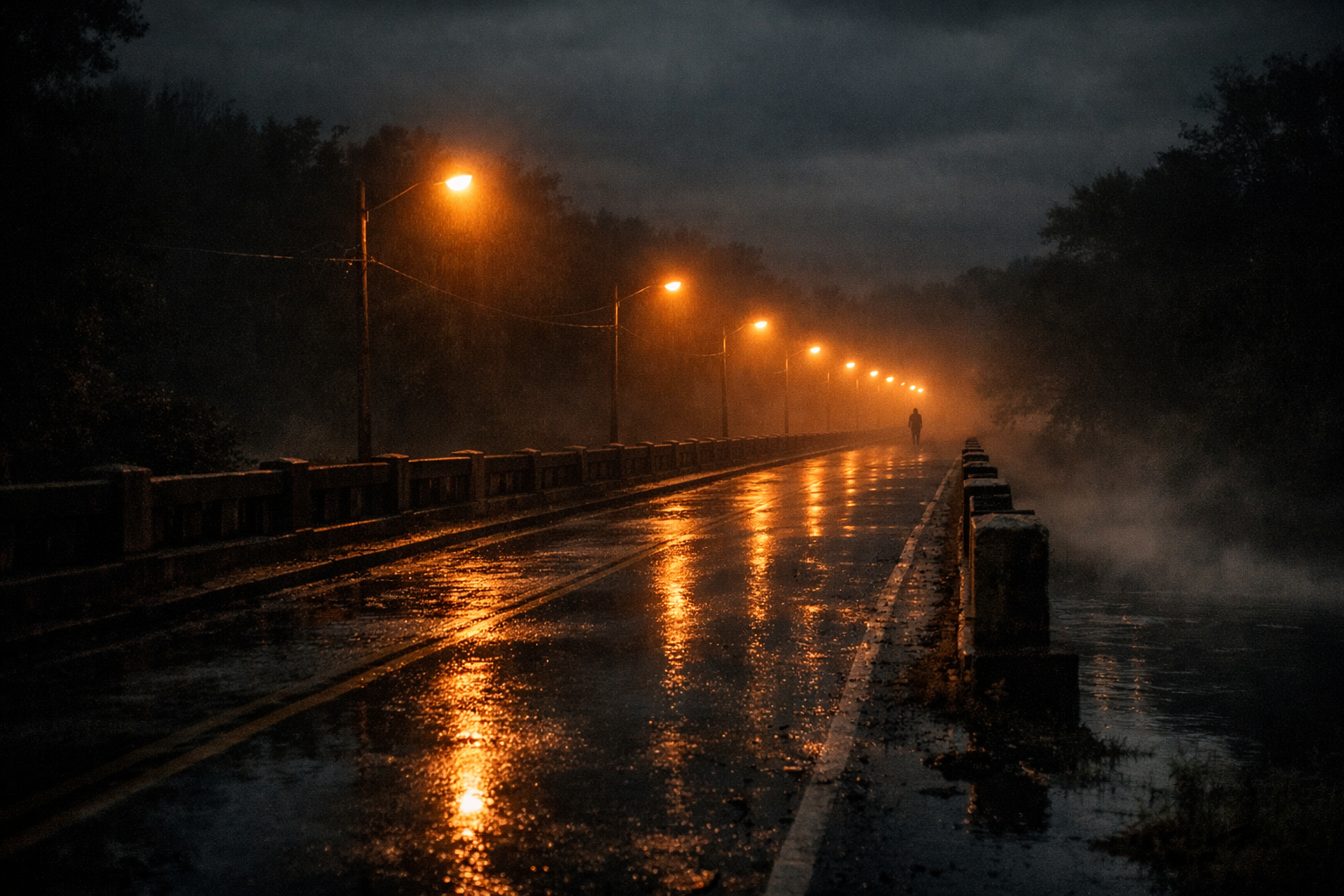
In daylight, the place looked tired rather than mean. The creek lay low most months, shined like a strip of roofing tin, snagging driftwood on stumps. The bridge itself was a humped concrete thing with a little lift at midspan and a ribbon of rust along the apron where winter salt had chewed. A row of waist-high posts carried small lamps the county had added twelve years back after a boy on a four-wheeler went over the side. Those lamps were not much bigger than coffee cans, amber and polite, meant to warn a pedestrian if there ever was one. But by the time the cattails went black and water picked up the moon, folks said the lamps had their own schedule and their own walker.
They told it as a practical matter, not as a dare. At the feed store, at the lunch counter, while clearing tables or filling tanks, they spoke of the same wrong little detail that made them swing wide around the township: the lights did not come on all at once like they were supposed to. They came on in order, a single file of soft yellow blooms, as if stepping stones were being tested by a careful foot. First the lamp by the western guardrail clicked and hummed and brightened, throwing a coin of light on the damp. Then the next toward the belly of the bridge. Then the one after that. There was a pause between each, long enough to be noticed, short enough to set a rhythm. And always, just before the last two posts on the far side, the procession stopped.
If someone had been there, if some late angler or kid had cut across the span and hopped the rail, there would have been a shadow to blame it on or at least laughter later. But the asphalt showed no scuffs, the creek only burbled, and the lamps made enough light to make the emptiness plain. No one they could see ever crossed with the glow.
It was left alone like that for years—something to mention while stirring sugar into coffee—until a woman who drove night runs for the bakery decided to sit and see what she’d been avoiding. She had flour in the grooves of her hands, a soft white map that never fully washed away. She was not a daring person. She was practical, the way people get when the road and work and the small hours bind their days. She had time between drops, a cigarette she allowed herself on long drives, and the particular stubbornness that comes with the hum of tires for company.
She pulled into the crushed-stone turnout by the western abutment where a field road met the creek. The gravel there was bare where a stock trailer had dug ruts, the weeds shin-higher than her bumper. She turned off the headlights and left the engine running long enough to let the heater push out the damp, then killed it too. The night felt like a shed the river had built around her: the bitter-green smell of algae, the cool, the far-off tick of a pump from a field. The bridge sat five car-lengths away, pale in the dark, its white rail catching starlight.
She lit the cigarette, the ember bright enough to be seen for a minute and then tucked it low. Time spread flat. When she put the butt out, the first lamp clicked. It was a small sound, a thin tap like a spoon against glass. The can-shaped fixture gave a breath of hum and then an amber circle opened on the concrete, picking out the grain of the broom finish and a gum wrapper that held a little light like a coin. She counted in her head to settle her nerves—one-Mississippi, two-Mississippi—until the same tap, the same breath, and the next lamp came alive closer to the center line.
She told herself at first it was a slow-warming circuit or the cold. But each post woke with the same measured delay and each pool of light overlapped the last by just the width of a stride. The creek shone where the arcs met, bright where you would place your foot if you were walking, dim in between where you might hesitate. She watched her own breath fog the glass and made a smaller space with her hands to see better.
On the far end, where summer families sometimes parked to throw sticks for their dogs, there was an extra dark under the last of the unlit posts. It was not shaped much like anything at first, only a slightly thicker stripe where the night gathered. It had the posture, though, of a person who had chosen a spot and was unwilling to be moved from it—a vertical patience. She squinted and then unclenched, sitting back as if to let the windshield round what she saw. The dark didn’t move. She blinked until her eyelids made the clouds render and unrender, and when she opened them wide the far dark seemed thinner, so thin she thought she’d made it up entirely.
The lamps kept their pace. Tap, hum, bloom. The third and fourth lights turned the bridge into a kind of hallway with no ceiling. The woman could have opened her door and stepped into that hallway, the way one might step behind a neighbor’s porch to cut through a yard, and found the path lit all the way to the place where the glow always gave up. She didn’t. She sat and listened. She could hear the electricity in the wires a little, a sizzle that sounded damp, and the river said its own soft things against its stones.
When the pool of light reached the hump of the span, the amber reached the level of her eyes. There her reflection made a faint ghost of her face in the glass and behind that face the blank of the concrete and railing. It would have been simple to say no more lamps would come on—that the rumor would prove itself and be done. But with the same patient count, the next lamp woke and then the next, until the bright edge of it came to align with the nose of her car.
She felt it then without anything touching her. The car shifted on its shocks very slightly as the night cooled the chassis. Something like the breeze that comes when a big bird goes by without calling passed the open slide of the window: not air so much as the idea of air. The sixth lamp should have flared if the pattern continued at the same pace. Instead it held at the fifth, the bright rim at the exact place where her passenger door would open onto the rail and the wet weeds. Between the last lit circle and the next dark post, there was a gap that a person might occupy if they chose to plant themselves exactly beside her and stop.
She did not look all the way to her right. She looked at the metallic grain of the steering wheel and at the thin spidered crack in the windshield that she’d been meaning to fix. She heard the small creak of fresh paint shrinking on the bridge rail, a mild winter noise months ahead of schedule. She smelled the sourness that comes up from river mud when it is stirred. The seatbelt tongue tapped once against the plastic column beside her hip, a touch caused by nothing she could see. Her hands tingled, then cooled, as if she had set them near a shop fan that blew without moving the air around it.
She reached across and thumbed the lock down on the passenger door because the motion itself was something to do. The lock’s click felt loud and cartoonish. Nothing followed it. The dark beyond the circle of light remained only that: dark. She shifted in the seat and the upholstery made a sound like a shoe twisting in old snow. The woman shaped a small, steady breath and let it out; in that pause between in and out, she thought she heard another breath answer, not inside the car, not in the bridge’s broad air either, but held right at the edge where her breath set down.
Down the length of the bridge, the earlier lamps stayed lit as if to hold a line back to where they’d started. The unlit posts beyond the one beside her stood like teeth that hadn’t erupted yet. She decided to go in the way people decide to start the mower or pick up a dropped tool in the rain—by moving first and thinking second. The key turned. The engine trembled and coughed and caught. The headlights threw their own blunt and permissive light across the circle of amber by her fender, making that piece of glow look frail, like a candle in morning sun.
She put the car in gear and eased up on the brake. The tires crackled lightly on the grit. As she rolled forward, she expected the next lamp in the sequence to take its turn and flare as she came even with it, making a walkway ahead no one could claim. Instead, nothing woke in front of her; the unlit stayed unlit, respectful or stubborn. But in the mirror—the rectangular room of it where the world becomes small—the light she’d been parked beside held even with her bumper, not fading as it should have with distance. It kept to its place at the back quarter, like a car pacing behind her without shining its beams.
She didn’t speed, not at first. There was a superstition that said if you hustled away from a thing like this, you left it a reason to continue. She drifted at five, then eight miles per hour, and the bright coin behind her matched that slow. When she reached the mouth of the span, with the cedar right where the guardrail ended, the amber body in the mirror seemed to draw closer, not because she was slowing but because it chose to. The creek turned black in her side windows and then fell away, the brush took its place, and still the same unit of light hung in the glass, neither larger nor smaller, as if the mirror had become an eye that only knew one distant thing to watch.
By the time her tires found the waviness of the older county asphalt past the bridge, her heart had taught her ribs a quick, teachable beat. She went to twenty-five, then to thirty-five, the car humming into a kind of relieved hurry. The circle in the mirror finally began to shrink, which should have settled her, should have put the thing back on the bridge where it belonged. But she watched it grow small and then go fixed: a single disk on the humped back of the span, bright as a knuckle in sun. In the center of that disk, just where the post would have thrown its shadow if there had been more moon, she thought there was again that stitch of vertical darkness, narrow as a board, too straight to be the absence of anything but a body.
At the curve before the hill, the road lost sight of the creek for a stretch. She told herself to look at the line where the pavement and the gravel met, to drive inside a life that had this car and this heater and not very much room for any other story. Curiosity turned the mirror once more into a window. The far lamp on the bridge burned alone in the bottom corner of the glass. As the hedgerow closed in, as the grade began to lift her out of the floodplain, she watched that single light make what looked like one slow step toward her on a road it could not use. It held there under nothing, under the whole of the night, precise and patient. When she finally crested and lost it, there was a last flicker the mirror caught, and in that narrow bite of reflection a figure stood exactly where the glow stopped—thin, distant, and turned the way a watcher turns when the person they chose to follow at last drives on.