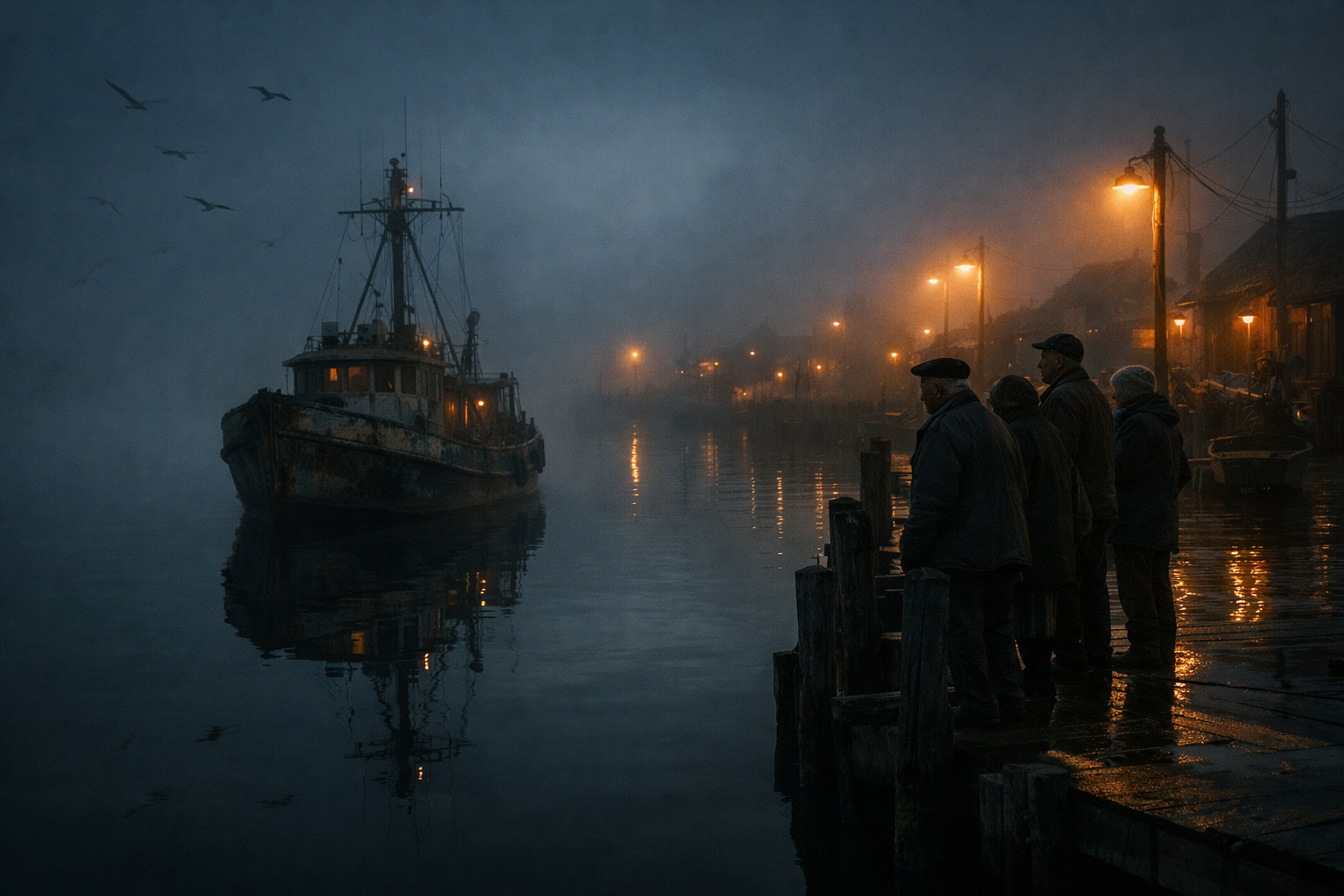
The Fishing Boat Returned With No Wake Behind It
The village worked by the dark. It always had. On winter mornings, the first light came late, mottled and slow over the breakwater, but the houses were up long before that. Kettles went to whisper on stovetops, porches flashed lanterns through the mist, and the harbor received the usual procession of bodies, boots, and hoisted bags. There were certain sounds a person could trust: the tap of halyards against masts, the muttered riddles of gulls, the cough of a diesel trying to warm its will. When the boats left, they left in order—three together at the little channel, another two after sorting out a fouled rope, the last one holding until an older woman on the stones raised a hand and nodded that the swell at the mouth had eased. Everyone had their pattern, and that had kept the village fed and unafraid long enough to call it tradition.
Their eyes grew used to the way lanterns bobbed along the quay and away, small constellations drifting seaward. You could mark the time by how far they had flicked into the gulf. A boy on a bicycle leaned into the rail, counting the flare of deck lights as if they were beads. A baker stood in the doorway of her shop with her apron untied, flour like soft frost in her hair, waiting to see the last transom slip by. Out in the harbor, the green and red navigation lights turned in their measured dance. The old harbormaster, a man with hands as notched as driftwood, noted the tide against the pilings, and made a line on a notepad where he kept better track than the official charts did.
By that measure, nothing should have taken them by surprise. Dawn, thin as skin, had only just begun to show itself when the first suggestion of a returning engine announced itself, a low hum threaded through wind that smelled of salt and cold iron. Someone on the pier said, “They’re early,” and someone else agreed because the sound was that recognizable, that dear and specific. From the channel’s mouth the shape resolved, a boat they all knew by its battered wheelhouse and patched net draped like an old blanket across the stern. It moved in with a steady throttle, blue exhaust tugging from the stack in faint puffs, the bow easing into the flat like a wetted finger on glass.
There should have been the lacework behind it. There always was. Even in dead calm, propellers roughed the water into a hissing V, hulls combed the surface into a line strangers could follow from the cliff. The boy on the bicycle leaned harder and frowned. The harbormaster stopped his pencil midway through a figure. A woman who had been looking at the sky lowered her head to watch the boat and, after a long moment, said, “Where is it?” There was no wake. The sea behind the boat lay untroubled, unpursed, as tidy and blank as the water in a polished basin. The boat parted it, and the water closed at the exact same instant, without quiver or seam.
The engine was not idling. Everyone heard the tone that meant the throttle was deciding between work and reserve, the way it did when a skipper wanted to be sure his gear wasn’t dragging. That engine hummed and thrummed and rattled its old bolts loud enough to make a gull bank wide, but the harbor made no answer in ripples or the slap-slap anyone could have expected along the hull. It came past the marker, past the scoured rock where a boy had once lost a shoe, and the boat was in among their piers with the flat black water lying as it lay, unmarked as slate. The men on the dock could no more decide where to look—at the boat’s easy motion or the water’s refusal—than choose a good thing over a bad one when they suddenly looked the same.
They caught her lines because hands know what to do long before the head finishes thinking. Coils of rope flew and were made fast, though the lines made quiet sounds against the posts, the muffled speech of cloth to cloth. When the first man stepped to the rail there was a little cheer from the shore, not because they were back but because the way back had been wrong. He did not return the cheer. His face held the drift of someone who has woken mid-walk. He blinked as if the air stung him. Another hand appeared at the wheelhouse door and clutched the frame, fingers white. A third man stood in the stern and watched a knot he wasn’t tying. They were not hurt. They were whole, unbloodied, without even the stupid gashes a hook sometimes finds. But their quiet was not the quiet of sleep or stubbornness. It was absence.
One spoke when the harbormaster asked him where they had fished. His lips cracked and he gave a short line of syllables that should have belonged to somebody in the next county or a century ago or not at all. He said it softly and not again, something like, “Se rian-null,” and when they asked what he meant he looked startled that they had made a noise, and lowered his eyes to where the deck wore scuffs from boots that did not look precisely like theirs. A woman climbed on and put a blanket around the youngest of them and asked if they were cold. He nodded at the question and again at the blanket without seeming to know why he did either. The wheelhouse smelled of diesel and brine and a faint iron like cut nails. A clock above the radio read a minute that had already happened. The GPS chirped at a steady interval, requesting a fix it already had, insisting in small electronic patience that it was not lost in the least. The depth sounder, a grudging thing in the best of times, drew a clean horizon across its glass, as if the harbor had no bottom at all.
On the small table where an oilskin logbook usually lay with the pencil stuck square in the crease, there were careful lines, each time of a set and haul the way the skipper always kept them, but half the entries were dimpled with round wet marks as if something had set down cups there. Under the damp, some numbers had swelled and uncurled, the way paper does when it has to swallow two stories at once. A radio check sent out a question and the speaker returned with their own small echo, a copy trying to catch up with the mouth it came from. The fuel gauge needle lay lodged between three notches, otherwise steady but trembling as if the glass had a tiny heart behind it.
People tried to ease their own nerves by doing something stupid and then pretending it was wise. A net was run out from another boat and walked across the space between hulls, a clumsy way to see how the harbor might behave. The mesh went from hand to hand, the lead-line kissed the water, and every few yards the floats twitched like something below had passed a finger along them. Twice the mesh came up snarled tight with nothing in it, knotted in bunches as if it had wrapped itself around a body that gave no weight. A compass laid on the rail faced due east and refused to waver even when a man turned himself north and then south holding it close, as if north had moved and taken himself to some other edge. Another compass, the cheap kind from the bait shop, would not point at all but walked its needle like a dog in circles.
The sea told its own mind in the small language the village had learned it in. A rock at the mouth was skirted by a strip of current that usually TIGed and bubbled without cause, only now it did not. A bottle thrown to show the set went along straight as a name written on a sealed letter. Even the gulls spoke with fewer words, giving up their commentary for longer and longer breaths and choosing the air over the water when they could. When a man tested the surface with the butt of an oar, the dip barely took a ring. He drew it back and tried again, harder, like a person who puts his hand in a fire twice to be sure of the burn. Behind the boat, where the propeller’s old habit should have written its foamy cursive in a flourish at the corner of the transom, there was only the hull and then the water, joined as if no blade had cut between them.
No one was shouting any longer. The harbor moved with the sound of shirts against their own wearers and the delicate fuss of rope across dogs. The crew, all but one, let themselves be led up to the pier and into blankets and the baked heat of a shop where someone poured tea for people who were used to coffee. They nodded, and tried to nod again to appease the woman’s worry, and set their cups down without drinking. One of them put his hand to his throat as if to clear a fog there, but nothing came. The youngest blinked a kind of salt water out of the corners of his eyes that left no track on his cheek. The one who had said the strange thing stood a little apart, watching the line of the horizon past the harbor mouth as if it had been drawn closer while he was not looking.
People could not keep their houses from saying what they had seen, and so the village knew by noon. There were accounts for what might have done it. A film on the water, someone said, from a spill miles out—except there was no smell and the gulls’ feet were clean. A trick tide, another said, the backwash of the point cancelling the prop’s work—except those had not moved like this, and the tide had been wrong for it. The harbormaster, whose job had made a skeptic out of him in matters of men while teaching him a very old faith in the sea, tried on the words and took them off. He walked to where the rope from the strange boat lay coiled and then coiled it again because his hands like order when his head does not.
Near dark, the wind changed and showed its teeth up the gully. Doors shut and lamps turned their faces inward. The crew went to their homes with their families, set into their bedrooms as if rooms were harbors boats could lie in, and the boat stayed tied where the harbormaster had told it to stay. Someone saw one of the men later, the youngest, at the end of the quay, standing in the shadow of the light, coat open, bare hands on wood. He was not a fool; he had worked these planks since the day his father lied about his years and set him on a deck with a coil of rope as if it were a toy. He went down the steps to the floating dock and then along it to where the water kept itself too still. There were two sets of bootprints on the hoar that had gathered on the boards—coming and coming, and then stopping where the cleat was. In the morning there was his coat there, folded on the iron, damp without smelling of salt. No one would say his name at first, as if names, like wakes, ought not be wasted when the surface took nothing.
After, they talked of the small wrongs as if they were the whole. The net shed’s door left latched in the morning would be open at noon and closed by evening with no hands to do it. A chalk line drawn on a piling at high water breathed to the tide like a throat and then disappeared between one man’s blink and the next, though the water had not touched it. The fishmonger, an old man with the patience of scales and knives, laid his brass pocket compass on his block and watched it point at the door for two hours, ignoring the easting as if a new pole had gone up where the harbor’s ladder ended. One of the crew spoke no word anyone could hear for a week, and then when he did, he said, very mildly, that he had not been at sea at all, not anywhere that had a name people shared, and smiled once as if to be kind to his own sense.
They made plans because plans treat fear like a job. The harbormaster walked with the skipper to the wheelhouse to check what could be checked. He noted the fuel against the log, the log against the hours, the hours against the grit under their fingernails. The boat’s chartplotter, a stubborn little brain, showed a line that went out the channel and then lay along the west shelf and then, abruptly, doubled on itself not with a tidy corner but like a thread had been laid down and then pulled back through its own holes. When he pressed the button to bring up the past track, the screen displayed it and then, with a small polite blink, it did not. The youngest’s bunk was dry and tucked with the same indifferent square a hand gives its own blanket when it will be getting up again soon. In the scuppers, a gathered dewdrop trembled but did not fall with the boat’s movement. The harbormaster put his palm to the rail to feel if a thing that ran could be asked to steady itself. The rail was colder than the air by more than ought to be allowed.
On the second night the tide went low and stayed a strange low for the hour. The boat, tied in its slip, eased against her lines and then eased again as if the water had opened a small hand there. The starboard cleat creaked its old complaint. The sea behind her should have shown her inching, but it mirrored the dark and refused to say whether anything had passed. The man who kept the night watch at the fuel dock saw the hull slide a hand’s breadth sideways while both stern lines lay slack as if tossed down. He would have said he was tired, except he was not. He did not go nearer. His dog did not either, and had to be pulled by the collar to walk past the boat at dawn, and even then put its head down and tried to walk on the land.
Some went to church and some lit the stove and some walked out to the cliff to make themselves feel large with height. The talk settled into grooves that did not help. Fog would come, they said, and this would be smudged by it and folded into that drawer of things that had been not quite right until they had been right enough to live with. The old men, the ones with the cataracted eyes and the interest in nothing but chips games and weather, said there had been names once for a flat that would not take a mark and a sea that wore a smooth like a held breath. The woman who had first said they were early made bread with a peculiar care and forgot the salt. In the afternoon, the harbormaster met the skipper in the lane and asked nothing, because there were questions that had already gnawed themselves to rags on the bone of it. The skipper touched his cap and did not meet his eye. His boots were dry. His face had learned a new stillness.
By the end of the week, they had the courtesy not to ask the crew to go again. Nets hung from the shed rafters vanished one by one, not stolen, not misplaced, simply not present when a hand reached without looking where it always found them. The logbook, left to air on the wheelhouse table, turned a page in the night; in the morning the new page was blank and their last entry had lost a number, then later a word, then the small flick of a comma they’d once thought mattering. Someone said they had seen, from the breakwater just as the light was thinking whether to exist, the outline of a hull move along the edge of the channel. There was no wake behind it. There was not even the kindness of a shadow where the water should have been interrupted. It was there and then not, like a name under a wave. The ones who had been on her when she returned kept their heads down when they passed the place, as if they were walking in front of a sleeping thing and had learned, all at once and without speech, how to be quiet.