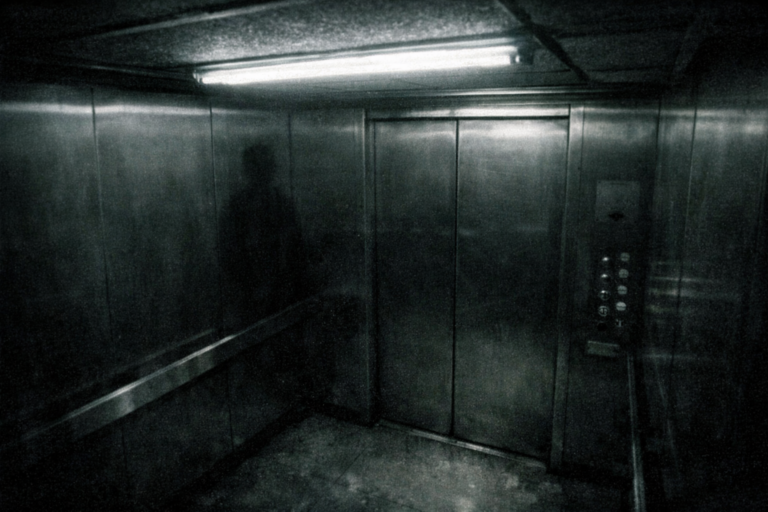
The Janitor Found Desks Arranged in a Circle
He liked the building best when it no longer pretended to be awake. Past eleven, the last bus rumble and gossip hung-up, it shrank down to its real size: hallways that breathed in the vents, the hum of vending lights, and a clock that ticked a second slower than his watch. He moved with his rolling cart as if tracing grooves he’d already worn into the tile, dust mop whispering ahead of him. The keys hung heavy at his belt and struck his thigh with a small, steady rhythm—there was comfort in the weight of them. He knew which ones you had to jiggle twice and which doors would drink a key like it was owed.
He checked the trophy case with its frozen smiles, the posters curling off one corner—Respect, Kindness, Try Again—and the construction paper turkeys still taped from a holiday that had long passed. In the gym, he stood a minute to listen to the echo of his own breath, then snapped off the lights and let it fold back into dark. He passed the front office, glanced at the row of security monitors: grainy gray-blue images of empty hall and doors, a flicker of static like snowfall. He always watched for anyone who had forgotten something, a teacher doubled back for a laptop. He rarely saw anyone at this hour, and if he did, they looked out of place, faces washed in the camera’s sheen.
He had already done Room 204—Flores, sixth grade—while there was still a bit of light west through the blinds. The usual: wipe down whiteboard, spray the desks, empty the pencil shavings, sweep glitter that clung in the corners like it had grown there. Ms. Flores liked her desks in four neat rows of five, and he set them square to the taped line on her floor, because she said it mattered to the kids if they started the day like a grid, not a scatter. He signed her laminated checklist on the hook by the door—he always signed—and turned the key until he felt the bolt bite. The camera in the hall outside 204 covered that doorway and the pair across from it; he’d glanced at its little lens in its smoked bubble and thought nothing of it.
By the time he turned back down that wing for his second pass, the building seemed to lean into his shoulders, a kind of pressure he got when he was the only one there—like a vacuum that you carry with you. He rounded the corner and stopped. Room 204’s door was shut. The handle was as he’d left it: straight, proud, the slim metal cover over the latch flush to the jamb. He pressed it. It held. Locked. Through the narrow wired glass, the room was dark; the strip of exit sign light made a thin blood-red wedge on the floor.
He took out the key and fit it, then paused, thinking of the camera overhead. He did not want to unlock it if he didn’t need to. He cupped both hands around the glass to kill the hallway glare and leaned in. Even in the dim, he could make out shapes, the shine of metal legs. He blinked. Every desk—not just a few, all of them—sat in a ring, circled out wide from the center like a wreath. The chairs were tucked, their backs facing in, the desktops canted slightly to the middle as if paying attention to something that wasn’t there. Where he knew there should have been rows—he could still feel the rhythm of moving them into line earlier—there were no straight lines at all, only that curve. There were thin scuffs in an arc on the wax where the legs had redrawn the floor.
He unlocked, flicked the lights, and stood in the door a long second. He had done it himself, then? No. He remembered the click of the lock, the paper towel he’d wadded by the sink, the way a pencil had rolled off one desk while he sprayed it and he had put it back in the cup shaped like a tin can. He checked, anyway, because habit was one of the only things that made the building behave. He reset each desk to the taped lines, two inches between chairs. He checked the laminated seating chart clipped to the whiteboard: names in Ms. Flores’s tidy print. He lined them to that. When he left, he locked the door and tugged twice, harder than he needed to. The bolt caught tight.
In the office, he sat in the rolling chair before the monitors and scrolled back the feed for the Hall B camera. The corridor lay empty for ten minutes at a time, then his shadow, then the tail of his cart. He watched himself push past 204. He watched the clean space breathe in and out of grain. He waited for anyone. Nothing. No teacher with a tote, no kid who had ducked a detention, no custodial ghost of himself returning. He scrubbed forward and saw only the still shot where he knew he had peered through glass and seen a circle. He pressed his fingers into his eyes until his skull ached, then stood back up and told himself he had misremembered, or Ms. Flores had come and already left while he’d been in the gym. He clipped the radio to his shirt and went back to work.
The building had a pattern, and he tried to return to it. East wing trash, mop up the spill outside the nurse’s, take the lost-and-found hoodie he’d found under the stairs and fold it on top of the pile in the office. He paused to listen to the long, low sound the air system made cycling down for the night. He heard the roof creak and the grease in the cafeteria vents tick as it cooled. He told himself what he always told himself: buildings talk if you bother to hear it. He wished sometimes that this one would shut up.
At five minutes to midnight, he went past 204 again. He could tell from halfway down the hall that the light under the door was wrong—he felt it more than saw. He knew where a clean door made a darker seam line on a glossy floor. This seam had a scatter against it, as if something had touched down near it and then lifted again. He stopped before the glass and stared in without opening. The desks were in a ring again. If anything, the circle was tighter, the legs describing a finer curve. The chairs were all tucked, the tennis ball halves some teachers added to legs—Ms. Flores didn’t use them—absent, but if they had been there he thought he might have seen the felt nap caught against the wax. A circle is just a line that knows where it’s going, he thought, and then wondered why the thought had come at all.
He keyed in, set his cart in the door without entering, and sheafed them back to rows with a little more force than he liked. The chairs clacked. The sound of metal on tile was louder than it should have been. He lifted each desk to avoid dragging, now conscious of marks. He set the last one, stepped back to the hall, and put his hand flat on the cool door for a count of five before turning the lock. The skin of his palm tingled from the cold of the metal. He held the handle and pushed his ear to the gap. Nothing. The whole hall waited with him. He locked it and walked five doors down to the water fountain, took a sip he didn’t need, then stood and listened to the wet drip of the fountain settle back into pipe.
Some part of him, the part that sorted recycling without looking, was done being patient. He went back to 204 and leaned against the wall opposite, cart parked beside him. He didn’t look in again. He watched the door. He counted to sixty and then to another sixty, then lost count and only felt the building’s slow hiss fill in where numbers had been. He shifted the keys at his belt so they wouldn’t chime. He had the thought—clear as a voice—that if he didn’t move, the room might forget he was there.
The first scrape came thin as a pencil line. A small shift, chair leg to tile, so quiet at first he thought it was farther away. Then it dragged a little more, a sound like a table drawn by a careful, stubborn child, and the sound belonged to inside that room and nowhere else. He straightened without meaning to, took two steps toward the door, and stopped himself with his hand half to the handle. Another scrape, longer, stuttering once over an old bubble in the wax—he knew every bubble on this floor. Something paused in there, then another chair came, a second sound on a slightly different pitch. He could hear the difference between leg caps and raw metal. It was raw metal. He imagined the feet making new arcs, new rings over the polish he had laid down three days before with the buffering machine that made his shoulder ache. He looked up at the camera bubble above the door as if it might look back, as if there might be another man on another screen who could tell him what his own hallway sounded like.
He fit the key into the lock and turned, and as soon as the bolt released, the room on the other side went quiet so completely it felt like a vacuum had been sealed. He held the door and breathed once, then pulled it open.
Ms. Flores’s room glowed in its overhead bars of light like a stage. Every desk in the class sat in a circle so exact that he could see each leg’s foot placed on a point that, if you’d laid a compass to the tile’s grid, you wouldn’t have bettered. At dead center of that ring was a single desk with its chair tucked. All the others faced it, as if for the performance of a single piece of furniture. He took two steps in and the hair on his forearms rose under his sleeves. Chalk dust hung in the air like a veil; the board’s eraser scent stung his nose. The goldfish tank in the corner filter-purred. On the whiteboard, the seating chart’s names were a small square of neatness. He looked from the chart to the desk nearest him, then to the next. The ring had taken no account of the chart. The center desk wasn’t anyone’s seat from that grid.
He came up on the center desk, steps soft without trying. The desktop held a scattering of pencil scratches that students made without meaning: a small sun, a square, math problems rubbed half away. Near the corner, darkened with time, a name had been carved deep, not with a pen but with something sharper: LINA DORSEY. He ran his thumb across it and felt the way years sand smooth what once stood up. He had emptied this room’s trash all fall, and he did not know a Lina. He looked to the chart again, reading each first name like he could conjure a last to match. No Lina. He glanced at the attendance list tacked to the corkboard with a cartoon pushpin—two copies of the same lineup, no Lina there either. He tried to remember last year’s. He could sometimes recall the way kids said hello when he propped the door with his foot. He had nothing.
The other desks all stared in. He took a step back and felt a sliver of wax lift under his heel where something had turned a small circle to place itself just so. Beyond the door, the hallway kept being empty in the way hallways are when they are supposed to be. He turned his head to listen for anything—breath, a fan he’d missed, the rodent traps he checked every Wednesday night—and heard only the fish filter, the faint rattle of a loose blind slat when the air caught it. He held the name in his head and felt, for the first time all night, the sense that he was not so much alone in the building as tied to it, thread pulled through one bead and ready to go through the next.
He didn’t rearrange the desks this time. He backed to the door and let the light switch go down with his knuckle. In the hall, he turned the key, watched the latch catch, and kept his hand on the metal an extra breath. At the monitor bank, he scrubbed the feed back to the moment he had stood just there and listened to those drags and scrapes. On the screen, the hallway lay still. His own figure leaned, one shoulder to the wall, and the seconds ticked in the corner: 12:03, 12:04. No one came. The door did not move a fraction. He watched himself vanish when he stepped into the room and then appear again when he came out. No other shape crossed that threshold.
At the end of the shift, the building had taken back what little warmth it would give and was a dark mass against the glass of the exit when he left. He walked the length of B Hall without looking through any more panes of wired glass. As he turned the corner, a low shift of something wooden on tile reached him, traveling the kind of distance that sound does in an empty place. He stopped long enough to look back once at the closed door and see nothing. On the other side, in the quiet center of the ring, a single desk waited, chair tucked, a name cut into its top that no student at the school had now.