
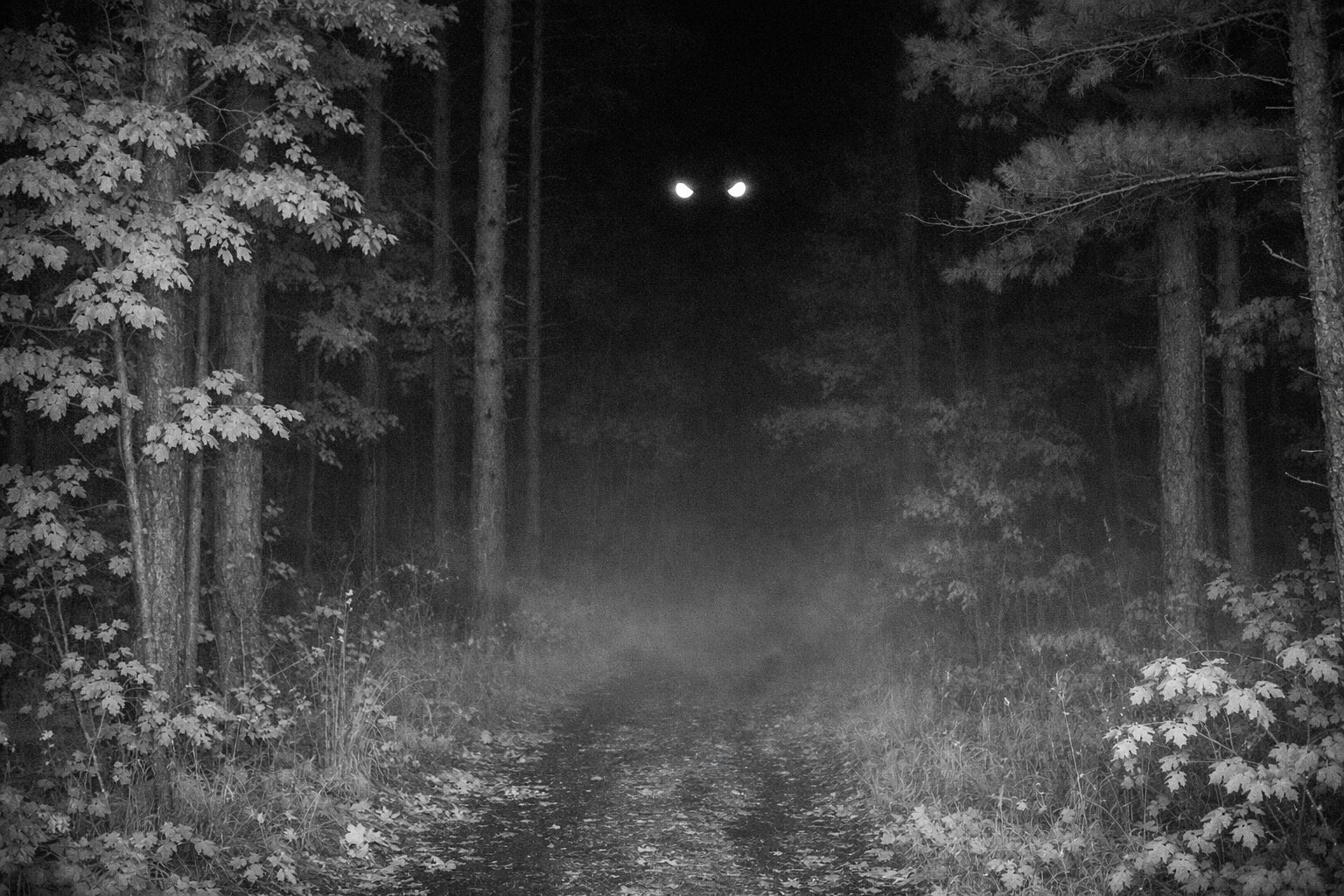
The Camera Caught Eyes Too High for Any Animal
For a week straight, I’d been hearing a sound I couldn’t place coming from the far line of our property, where the logging road pinches into a deer run and then disappears into pines. It wasn’t the yipping of coyotes or the too-clean scream of a fox, both of which I’m used to. It came as a hollow tapping, like knuckles against a dry trunk, three careful raps and then silence long enough to make you wonder if you imagined it. I don’t sleep in August with the windows open for the cool. I sleep with them open for the sound of our place—the night insects, the creek, far trucks passing on the blacktop beyond the trees—and those knocks began showing up in the space where a person holds their breath.
I had a trail camera halfway down the old ridge path. I’d strapped it to a young maple where the deer step down to the wet spot, pointed toward a narrow corridor between a blown-down hickory and a mess of briers. All spring it had thrown me the usual: foxes slipping past glare-eyed, two sets of fawns on the same night in June, the neighbor’s lab with his tongue out. I’d set it to take three shots in a burst, spaced a second apart, so I could see approach and retreat. Every Sunday I’d pull the card, sit at the kitchen table with my boots still muddy, and page through, mostly out of habit. The Sunday I’m thinking of, I went out sooner than usual because around two the night before the hollow taps had drifted in closer, toward the maple and the camera.
The camera was where I’d left it, webbed over in front by a sheet of morning silk I waved away with a stick. The strap was tight. The little LED winked when I pulled the card. You get to know the things you own. Nothing felt off except the quiet. The run usually smells like bruised fern and the creek, a damp green smell. That morning it smelled like the inside of a toolbox, metallic and stale. Maybe that doesn’t mean anything. I told myself it didn’t and walked the card back to the house.
At the computer, I clicked through a month of ordinary. Hot deer with ribs showing in moonlight. A raccoon stumping across with something white in its hands like a pastry. Thirty empty frames where wind must have moved the grass wrong. The timestamps reassured me—01:03, 01:04, 01:06—like a clock you didn’t know you missed until it’s there. Then I got to a black frame with two points near the top edge, dead center, and everything stopped turning.
They weren’t bright the way a flash blinds. They were the kind of dull shine you get when you find a lost screw in the carpet with a flashlight, soft and deadflat. Two circles, level with each other, separated by about as far as the span of a grown hand. The moon-phase stamp on the bottom said 13%. The temperature read 586F. The time was 01:12:33. You could see the ghosty pale of the nearest sapling and the ripple of the trail behind it, and then those two reflections at a height that didn’t belong to anything I knew moved through that corridor. There was no head around them, no smear of shoulder, no neck. No body at all. Just the eyes, and beneath them only the faint grain of the night.
I backed up a frame and went forward. There was nothing before, nothing after. The interval stamps that usually show up—01:12:32, 34, 35—never appeared. I checked the file numbers. There was one frame, 382, then 383 skipped to a coyote nose from a week before. I squinted at the eyes until my own felt like they were drying out. I told myself owl, and then my own counterargument stepped out in front of me: the patch of air where those circles hung was clean, empty of branches. You can only perch on what’s there.
I took a pencil and the tape measure and a stepladder back down before noon. There’s a trick to these things: you sight from where the camera is, pick a landmark in-frame—the scar on the hickory, the knot on the maple—and work back from that. I walked to where the eyes had hung and put my back to the briers. The ground dips just there, so I checked that, too, set the ladder in the same little bowl the deer make with their hooves and stood up on the third rung. I held the tape against the maple where the strap cut a little line in the bark and sighted with my thumb in the air until the spot in space where the circles had been and my pencil mark lined up. The number made the hair move on my arms even with the heat. Eight feet, nine inches, give or take the tilt of the ladder and my own shaking. The nearest branch sturdy enough to hold anything bigger than a jay was higher and off to the left. There were no scrabbling tracks in the black leaf mold, no dig marks on the trunk. Leaves hung undisturbed but for the brush of my sleeve. To have eyes at that height you would need a thing beneath them.
I went home with sap on my hands and the shape of that air where something might have been under my skin like splinter glass. I turned the camera settings to overkill before dinner. Burst to three. Video on with a ten-second clip set to trigger on motion. I shifted the strap up two inches and angled the lens the smallest touch upward to emulate the eye-level it had found. It felt like I was setting a snare made of pixels, and I don’t trap anything. That night I lay in bed with the windows open, and the night noises felt like someone tiptoeing on broken bottles. The hollow tapping didn’t come. Silence did, and in place of relief it brought a kind of pressure.
I pulled the card again just after sunrise, still in pajama pants tucked into rubber boots. Dew had soaked my shins and the cuffs. I told myself I wouldn’t even go back to the computer, that I’d stick it in the drawer and check later with coffee and a clear head. I went straight to the kitchen and slid it into the slot. There were five raccoons playing like they were in a kindergarten at 22:47. A fox at 00:32, tail big as a feather boa. At 02:19:08 there was one frame, again singular no matter what settings I had begged for, like the camera had decided to ignore me. The eyes were there again. This time they were lower in the frame and much closer to the lens than before, so close there was a faint, granular halo to the light around them. The bark texture on the maple was crisp. A spider thread lit across the bottom corner like a whisper line. No smear committed itself to the eyes, though. They were perfectly round and perfectly still. The pupils, if that’s what they were, were deep blacks that never flared with the IR. There was nothing for the camera to take but that, and yet that was all it had decided to take. No approach, no leaving. No ten-second video. The temperature read 566F. The stamp at the edge of the frame where the brand likes to put its name blurred in a way it never had.
Up until that point, I’d been scared like you get when a coyote comes in close on a walk, that jump-scan in your chest. With that second picture the fear was of a different shape, layered and slow, like finding a window open you know you closed. I looked up at the window over the sink and tried to imagine those eyes nearly level with the camera, two or three inches higher even. You start plugging the heights you know into the math you don’t. The six-foot fence post. The nine-foot reach to change the porch light. The way the house looks from the run when you are bent picking blackberries in August, feeling watched, and you tell yourself it’s only the house looking back.
I went down again after breakfast with steadier hands to check the camera body itself. I don’t know what I expected to find—mud prints on the plastic, a smear of hair—but I expected some sign. What I found was neater and worse. The strap was still ratcheted hard. The bark showed an unfamiliar scuff as if a palm, broad and flat, had been pressed smooth against it and then removed without slide. The camera was not pointed where I had left it. Sometime between the last picture and when I set my boots in the dew, it had been turned a hair more than a half circle. It was facing uphill, not down-trail toward the briers and the hickory scar, but back up at the opening between the pines where the crook of our driveway shows and, beyond it, just slices of white siding through the trees. The little LED blinked like it always does, patient and indifferent. I felt that toolbox smell again somehow, and the sense I used to have as a kid when we were quiet in church and someone at the back stood up and stretched and blocked you from the door without making a sound.
I didn’t take it down. I slid out the card and put a fresh one in, then walked home a different way, along the creek and through the pasture, even though it was longer. I left the boots at the door. I washed my hands twice. I made coffee so hot I couldn’t drink it and sat where I always sit to look at what the place catches of itself when I’m not looking.
The last photo on the card should’ve been the eyes, but it wasn’t. There was another after, time-stamped 02:36:44, like the camera had obeyed whatever turned it and done what it was built to do. The frame was darker, almost a charcoal wash where the trees made a pattern like ribs. Upper right was a soft rectangle I knew before I let my brain tell me—the second-floor window above the porch. I could see the faint square of the curtain we keep pulled to keep morning from burning the room too fast. The porch light was off. A reflector on the mailbox winked like a star that had given up halfway. I leaned in to the picture until my forehead nearly touched the glass of the monitor. It took a second for them to show themselves because I wasn’t looking for them where they were.
They sat ahead of the house in the picture, not in it, just above and past the flat dark slice of the roofline where the soffit hides the nests the wrens like to build—two circles, set at that same steady spacing, high where no head could be and no branch could have offered purchase, as if held at the exact mark my pencil had made on the maple. They had the same deadglow as before, like coins at the bottom of a shallow stream, nothing lively in them. For a long time I didn’t move. It felt like if I breathed too loudly I would fog the glass on their side. When finally I did move, it was only to step back from the table and look toward the staircase without knowing why, the way you check a door you know you locked because you suddenly can’t remember ever learning the sound it makes when it latches.


