
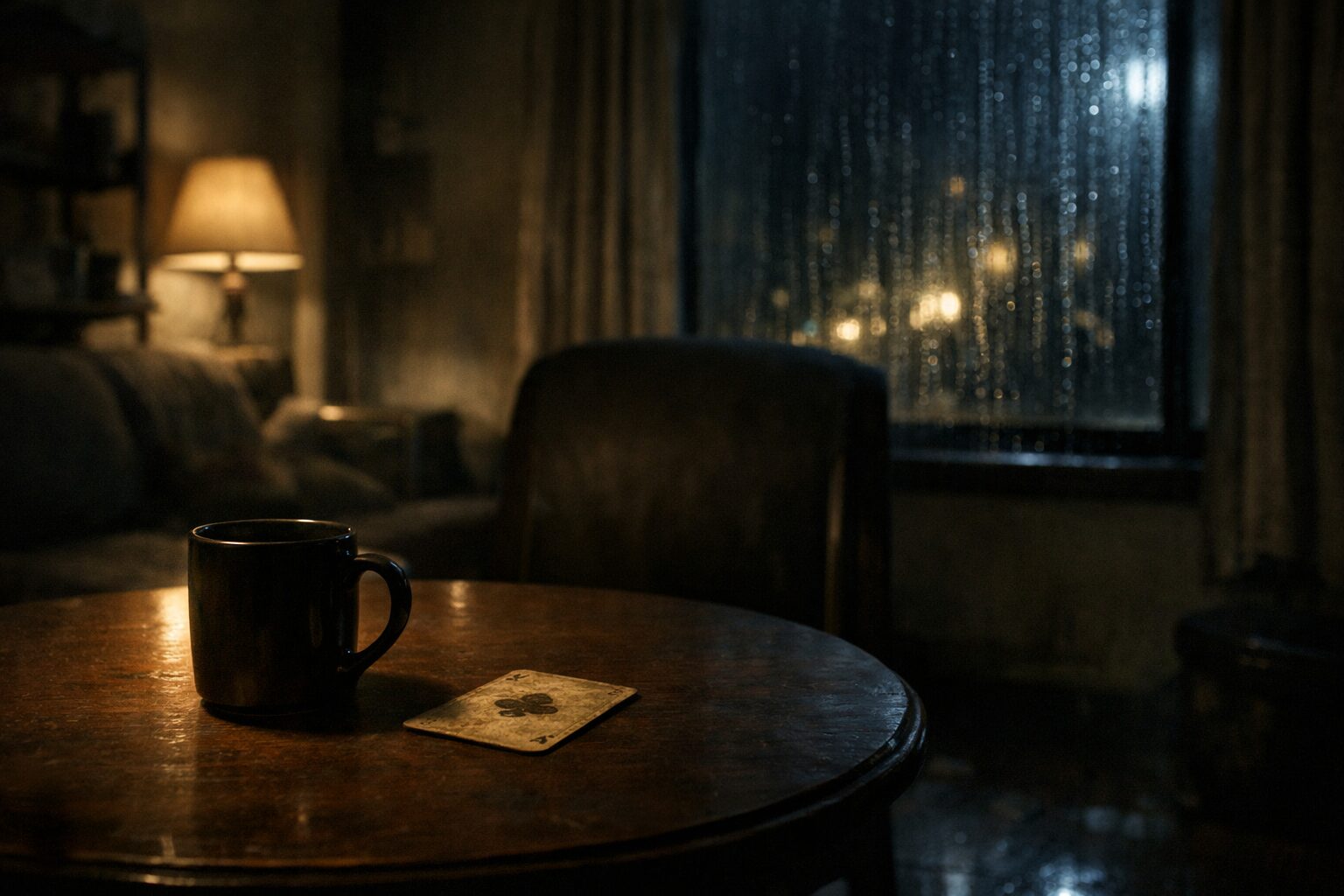
The Medium Repeated the Last Words No One Told Her
I didn’t go to be convinced. My mother didn’t want to go alone, and my uncle had to work late, so I told myself I’d keep her company and keep count in my head. I pictured gauzy scarves and too much perfume. The address turned out to be a third-floor walk-up in a narrow building, the kind that glows pale in late afternoon and smells like old varnish. The buzzer stuck on the first press and let out a tired wheeze. Inside, the stairwell held a dry heat, a trace of dust, curry from someone’s dinner. The apartment was quiet in the way places are when a person lives alone—you hear the building instead of voices. A small lamp threw a warm circle over a low round table. The radiator clicked twice and gave up. The window was half open to the slant of the street: a muted city sound, tires on wet asphalt, then nothing but the hum of a refrigerator somewhere off to the left.
The woman who answered the door could have been someone’s librarian. Gray hair tied back, a knit cardigan with one elbow gone shiny, small glasses that she kept pushing up with the side of a knuckle. There was no incense. A kettle breathed on the stove, and she poured us tea without asking if we wanted any. She took our coats and draped them across a chair as if that was the right thing to do for people she’d only just met. I was relieved at the lack of theatrics; it gave me room to be skeptical without feeling mean.
We were the only ones there. Three chairs and her chair. She asked us to put our phones away, not because of interference but because they broke people’s attention. Her voice had the paint-roller cadence of someone who has said these sentences before: she could not guarantee contact with a specific person, she could not make promises, she preferred if we said “yes,” “no,” or “I don’t know,” rather than volunteering too much. She folded her hands around her tea as if to warm them and closed her eyes.
I waited for the show. For the stream of names thrown like confetti, for the vague grief that fits anyone. She started soft. A man with a chest issue. A sense of being outdoors, of soil under nails, of a hat worn more from habit than sun. Words that were a field and a sky and maybe a shovel, if you wanted. My mother tensed. She said “yes” once, and “I don’t know” twice. I marked a line in the air near my knee with a forefinger without meaning to, my private tally of hits and misses.
She offered a name with the wrong initial. My mother shook her head. She said, “There’s an L, or a soft sound, maybe at the start?” We were not difficult about it. It was strange and not strange, like watching a person feel around in a dark drawer for their keys. She touched the table with the flat of her fingers and fell quiet. I watched the way her eyes moved under their lids, the little drift to the right and left. Somewhere in the building a pipe knocked, then settled back into itself. It was not a dramatic pause. It was the kind of quiet that borrows from other rooms.
Then she said a sentence so ordinary it felt wrong in the room. She said it like someone repeating a grocery item to themselves: “Don’t let the ivy win.” She opened her eyes as if to check whether the words had landed. No one moved. She frowned slightly and repeated it, each word its own pearl: “Don’t. Let. The. Ivy. Win.”
It wasn’t a name, not a grandchildren’s cluster, not a date or a town or the smell of tobacco some people cling to. It was a phrase with dirt in it, and a strip of brick wall, and both my hands in garden gloves tugging at something that didn’t give. I looked at my mother and she was looking at me as if I had made some cue to the woman that I had not. I felt my own face as if I could pry it into something neutral. The room had become a kind of bell; the words seemed to hang there after she said them, thin and bright.
At the hospital, it had been barely words at all. He—it takes me a second even now to decide whether to write his name—my grandfather had a way of saying ordinary sentences like they were to be put in a pocket and kept. He’d taught me to run my palms along the brick, feel for the places where ivy fingers found purchase, and pry them one by one, patient. That last night, I’d gone after work, too late probably. The corridor lights were the color of dishwater and hummed. His eyes were more awake than his body. I told him the story about the neighbor who let her ivy take the gutter down. He breathed in a rattling way and lifted a shoulder in the kind of shrug that used to end an argument. When I stood to go, he tugged at my sleeve with a thumbnail. “Don’t let the ivy win,” he’d said, with the gentlest laugh trapped at the end of it, as if he knew it was a silly thing to carry into the dark. I nodded like it was a serious directive. I drove home and told no one. When the call came at five in the morning, it didn’t include what he had said to me. It didn’t need to. No one asked. No one would write that sentence in a message or say it in a eulogy. It sat where it sat, small and strange and mine.
The woman across from me watched my face for a script that would let her continue. I said nothing. It felt, irrationally, like a test I would fail if I nodded too fast. My mother cleared her throat, about to ask a question that would move us past it. The woman’s eyes went soft again, unfocused, as if she were trying to hear through a wall. She lifted her chin slightly, her mouth parted, and for a second I saw the face a person makes when they’re listening to a voice on a bad phone line—leaning into it, amused at themselves for leaning. When she spoke, it wasn’t louder, but it slid against the room in a way that made the hair along my arms notice. “Don’t let the ivy win,” she said again, but not in her voice. The rhythm was the same as in that hospital room: the first three words in a row and then the soft weight on “win,” followed by that breath that is almost a laugh and almost a cough.
Something in me recoiled from how exact it was. If she’d said “Keep the ivy down,” I could have filed it. If she’d said “He says to mind the garden,” I could have tucked it into the ordinary drawer where you keep coincidences with the paperclips. It had to be a trick of the ear, I thought, as if she’d somehow matched the shape of a sentence I carried and I was completing it, like a song on the radio when the signal drops and your mouth keeps going. Only the room kept sounding like the inside of a seashell. The refrigerator kicked off at the edge of the sentence and the silence that replaced it had the weight of a person stepping into a hallway.
“Do you know what that means?” she asked after a long moment, and her voice then was hers, flat and slightly tentative. My mother said, “He had ivy all over that back wall,” and then, looking at me, “but—” the protest falling apart before it could make a shape. I said “Yes,” and felt as if I’d handed something over without meaning to. The woman nodded as if that was the right answer to a question I hadn’t realized she’d asked, and she went on to other things—more fields and soft consonants, a sweater she described as itchy, the way the corners of a mouth turned when someone thought they weren’t being watched. I heard much less of it. I watched the lip of my tea trembling on the meniscus as if the apartment had a heartbeat.
By the time we put cash in the small blue dish on her entryway table and stepped back into the stairwell heat, the sun had dropped behind the opposite building and made the landing windows into dull mirrors. The white paint along the handrail had peeled in long fingernails and curled away. Outside, the air had cooled in the way it does when a storm passes you by and goes to bother someone else. My mother asked me once, on the second step down, “What did you hear?” and I said “Not much,” immediately and automatically, and then, because it sounded curt in the echo of the stairwell, I added, “She’s good at details,” which would do for both of us. My mouth felt dry with the tea tannins. I held the handrail all the way down even though I didn’t need to.
In my apartment that night, the same quiet was waiting. Buildings settle differently at night. The streetlight drew a band of gold across the floor that caught in the ridges of the rug and seemed to move if you stared too long. I turned on the kitchen light, and the bulb hummed in a way I hadn’t noticed before. I wasn’t looking for anything, or at least that’s what I told myself while my hands went to the top cupboard and then to the drawer with the batteries and the rubber bands, then to the hall closet where a cardboard box sat with a life’s worth of paper in it: envelopes with the glue torn, programs from other people’s milestones, photographs sliding out of their sleeves as if they, too, were tired of not being looked at. I had not opened that box since before he died. I don’t know what decided it for me. The hinge squeaked when I lifted the lid, a small animal sound that made me pause.
It was there two thirds of the way down, under a tax letter and the postcard from a beach no one had named on the back. A birthday card he’d sent the year I moved into this apartment, the first week of heat that had made sleep a slender animal I couldn’t catch. The front was a watercolor of a watering can. Inside, the familiar small handwriting that leaned to the right, the loops of the g drawing a tail that never quite touched the line below. There was a sentence underlined as if to make a joke of itself. “Don’t let the ivy win,” it read, the ink trailing off a little where the pen had scratched dry and picked up again. I could see his hand in the pressure. I could hear him say that thing about the mortar flaking if you let the tendrils get behind it. The room pressed in and then out, and a pressure built behind my nose as if I was about to sneeze and didn’t.
I stood very still. The apartment seemed to be listening with me, as if the walls were waiting for their cue. Through the thin wall to my right, my neighbor’s television turned down another notch. A car door thumped two stories below. Somewhere a dog shook its tags and the sound traveled like ice in a glass. I put the card on the table and smoothed it the way you do with a tablecloth that now has a visible center. In the lamplight, the underlined words struck me as something I could have missed forever if I had not gone looking. I didn’t know whether this made it more ordinary or less. I was aware of my own breath, the hitch at the top of it, the way my chest made a soft cloth sound. The apartment had the same weight the medium’s room had taken on, as if the hum had gone out of it and something else had moved in to take that place.
When I heard it again, I didn’t move. There wasn’t a tremor in the cutlery or a change in the light to explain it away. It was just behind me and slightly to the left, close enough that if I had turned my head quickly, I would have expected to see the shape of a mouth making the words. The rhythm was exact, the tiny laugh embedded in the breath after, a syllable folded into silence. My name wasn’t in it and didn’t need to be. The refrigerator motor hesitated, as if waiting its turn. My fingers pressed flat against the card until the paper took the print of them.
“Don’t let the ivy win.”


